Starch, Glycogen & Cellulose (AQA A-Level Biology): Revision Notes
📚Revision Notes
Starch, Glycogen & Cellulose
These three polysaccharides are formed when many monosaccharide units join together through condensation reactions. Each serves different biological functions, and their structures reflect these specific roles. Understanding how the arrangement of glucose monomers creates distinct properties is essential for appreciating their biological importance.
Starch
Starch serves as the primary energy storage molecule in plants. This polysaccharide appears as small granules throughout plant tissues, particularly in seeds and storage organs like potato tubers. Plants use starch to store glucose in a compact, accessible form.
Structure and composition
Starch molecules consist of α-glucose monomers connected by glycosidic bonds formed during condensation reactions. The polymer can exist in two forms:
- Unbranched chains that coil into helical structures
- Branched chains with multiple connection points
Note
Individual starch molecules typically contain between 200-5000 α-glucose units, making them substantial macromolecules. The helical arrangement results from the specific orientation of α-glucose units and the hydrogen bonding between hydroxyl groups.
Properties suited to energy storage
Starch's molecular structure provides several advantages for energy storage:
- Insoluble nature prevents the molecule from affecting water potential, avoiding unwanted water movement into cells through osmosis
- Large molecular size prevents diffusion out of cells, keeping the energy store where needed
- Compact structure allows efficient storage of large amounts of glucose in small spaces
- Rapid hydrolysis releases α-glucose quickly when energy is required for respiration
- Branched regions provide multiple sites for enzyme action, enabling simultaneous glucose release from many points
Important
Starch never occurs naturally in animal cells, where a similar molecule called glycogen fulfils the same function.
Glycogen
Glycogen functions as the primary carbohydrate energy store in animals and bacteria. Often called 'animal starch', this polysaccharide shares many structural features with starch but displays important differences that suit animal metabolism.
Structure and location
Like starch, glycogen consists of α-glucose monomers linked by glycosidic bonds. However, glycogen exhibits more extensive branching than starch, creating shorter chain segments between branch points. Animals store glycogen mainly as granules in muscle tissue and the liver.
Note
The amount of carbohydrate storage in animals remains relatively small because fat serves as the primary long-term energy store. This explains why glycogen deposits are limited compared to fat reserves.
Advantages for animal metabolism
Glycogen's highly branched structure provides specific benefits for active organisms:
- Insoluble properties prevent osmotic water movement, similar to starch
- Compact storage maximises energy density in limited space
- Extensive branching creates numerous enzyme binding sites for rapid breakdown
- Quick glucose release supports the higher metabolic rate of active animals compared to plants
The increased branching allows enzymes to work simultaneously at many sites, releasing glucose monomers much faster than from starch. This rapid mobilisation suits animals' need for quick energy during activity.
Cellulose
Cellulose differs fundamentally from both starch and glycogen in structure, function, and biological role. Rather than storing energy, cellulose provides structural support as a major component of plant cell walls.
Structural differences
The key difference lies in the monomer composition - cellulose consists of β-glucose units rather than α-glucose. This seemingly small change produces dramatic structural consequences:
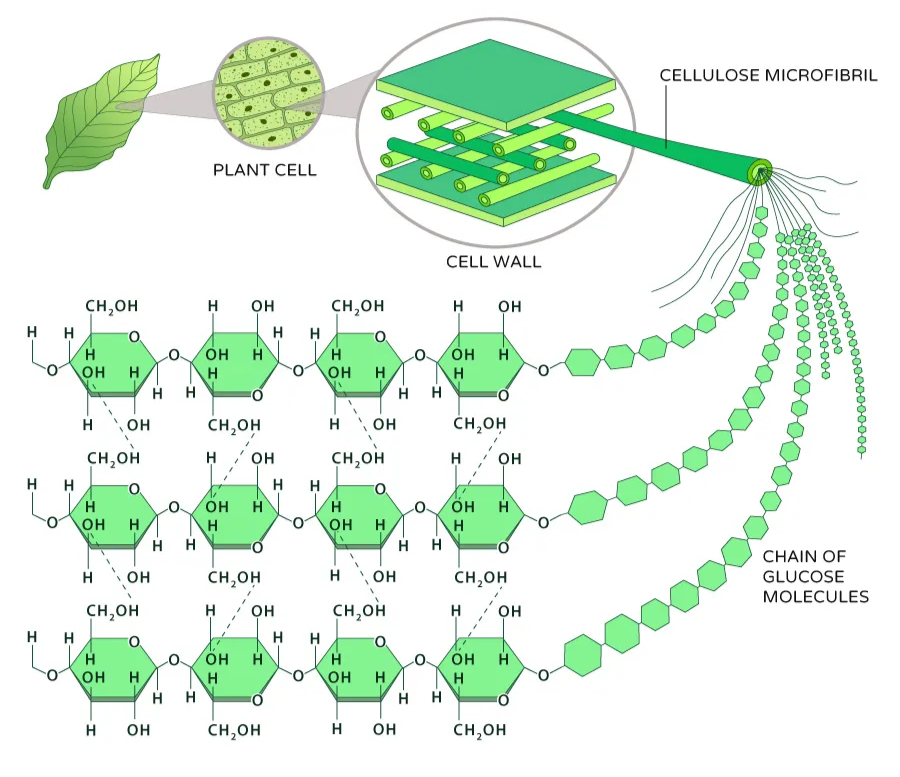
- Straight, unbranched chains replace the helical coiling seen in starch
- Parallel chain arrangement allows adjacent molecules to lie alongside each other
- Hydrogen bond formation occurs between hydroxyl groups on neighbouring chains
- Cross-linkages develop between parallel chains, creating stability
Important
The difference between α-glucose and β-glucose may seem minor, but it completely changes the molecule's properties and function. While α-glucose creates energy storage molecules, β-glucose creates structural materials.
Molecular organisation
Cellulose molecules organise into increasingly complex structures:
- Individual β-glucose chains form the basic cellulose molecules
- Hydrogen bonds link adjacent chains together
- Groups of chains combine to form microfibrils
- Microfibrils arrange in parallel bundles called fibres
Note
This hierarchical organisation creates a material with exceptional tensile strength, making cellulose an ideal structural component.
Function in plant cell walls
Cellulose provides essential structural support for plant cells and tissues:
- Cell wall rigidity prevents cells from bursting when water enters by osmosis
- Turgor pressure develops as cells become turgid, pushing against neighbouring cells
- Tissue support maintains stem and leaf structure for optimal photosynthesis
- Shape maintenance keeps non-woody plant parts upright and functional
The inward pressure from turgor creates semi-rigid structures throughout the plant, particularly important for maintaining the surface area needed for efficient photosynthesis.
Key structural comparisons
| Feature | Starch | Glycogen | Cellulose |
|---|---|---|---|
| Monomer | α-glucose | α-glucose | β-glucose |
| Chain structure | Branched/unbranched | Highly branched | Straight, unbranched |
| Organisation | Helical coils | Compact granules | Parallel chains |
| Bonding | Glycosidic only | Glycosidic only | Glycosidic + hydrogen bonds |
| Function | Energy storage (plants) | Energy storage (animals) | Structural support |
| Solubility | Insoluble | Insoluble | Insoluble |
Summary
Key Points to Remember:
- Starch and glycogen both store energy using α-glucose monomers, but glycogen's increased branching allows faster glucose release for active animal metabolism
- Cellulose uses β-glucose monomers, creating straight chains that form strong structural materials through hydrogen bond cross-linking
- All three polysaccharides are insoluble, preventing osmotic problems while serving their specific biological functions
- Structure determines function - the different arrangements of glucose monomers directly relate to each molecule's biological role
- Location matters - starch in plants, glycogen in animals, and cellulose in plant cell walls reflect their different functional requirements