Energy & ATP (AQA A-Level Biology): Revision Notes
📚Revision Notes
Energy & ATP
Why organisms need energy
All living organisms require energy to maintain life processes and remain alive. This energy originates from the Sun, where plants capture solar energy and use it to combine water and carbon dioxide into complex organic molecules through photosynthesis. Both plants and animals then break down these organic molecules through oxidation to produce adenosine triphosphate (ATP), which serves as the primary energy currency for cellular processes.
Structure of ATP
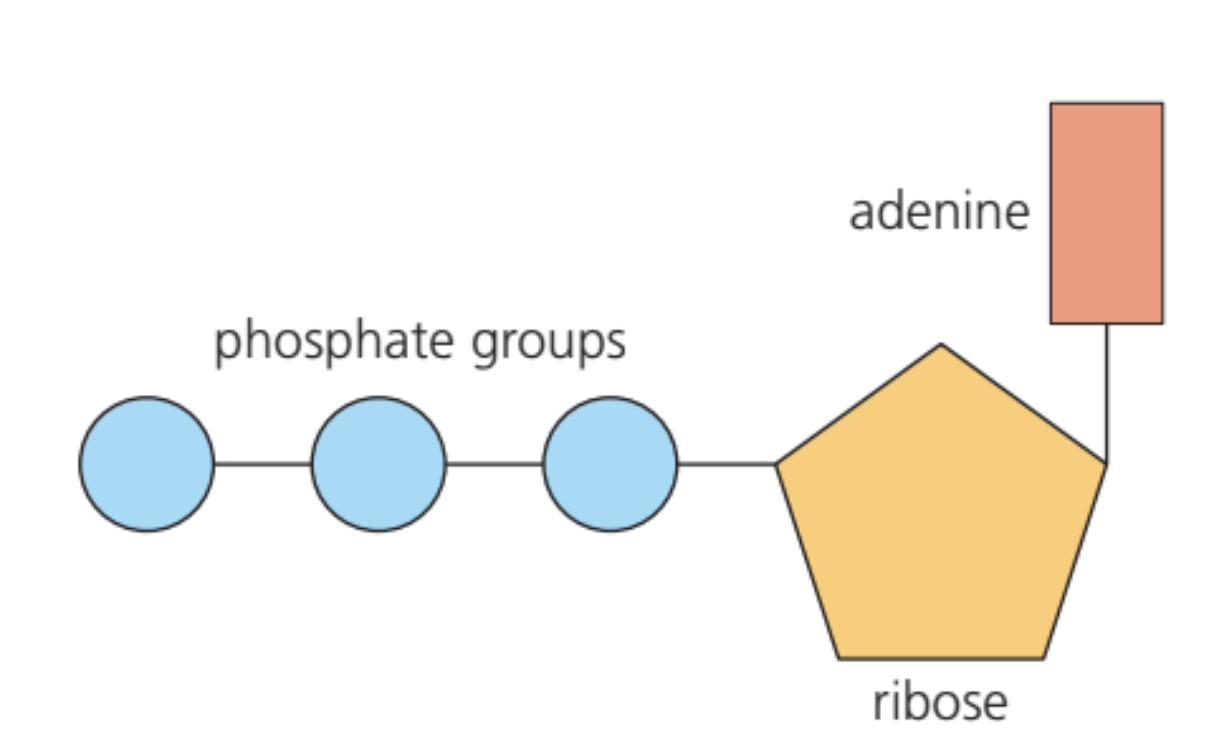
ATP (adenosine triphosphate) is a phosphorylated macromolecule consisting of three distinct components:
- Adenine - a nitrogen-containing organic base that forms part of the nucleotide structure
- Ribose - a five-carbon sugar molecule that provides the structural backbone where other components attach
- Phosphates - a chain of three phosphate groups linked together in sequence
This structure makes ATP a nucleotide, specifically one that has been modified with additional phosphate groups to store energy.
Note
The combination of adenine, ribose, and phosphate groups classifies ATP as a nucleotide - the same basic building blocks used in DNA and RNA, but modified for energy storage rather than genetic information.
How ATP stores energy
The energy storage mechanism of ATP relies on the chemical bonds between its phosphate groups. These phosphate bonds are unstable and possess low activation energy, meaning they break easily when required. When these bonds break, they release substantial amounts of energy that cells can immediately use for various biological processes.
In most cellular reactions, only the terminal phosphate group (the outermost one) is removed from ATP. This process follows a specific chemical equation that shows the conversion of ATP to ADP (adenosine diphosphate):
Where:
- ATP = adenosine triphosphate
- H₂O = water
- ADP = adenosine diphosphate
- Pᵢ = inorganic phosphate
- Energy = released for cellular use
ATP hydrolysis reaction
The breakdown of ATP occurs through a hydrolysis reaction, where water molecules are used to break the bonds between phosphate groups. This reaction is catalysed by the enzyme ATP hydrolase (also called ATPase), which speeds up the process of energy release.
During hydrolysis, water splits the bond between the second and third phosphate groups, converting ATP into ADP and releasing both an inorganic phosphate and usable energy for the cell.
Note
The enzyme ATP hydrolase (ATPase) is crucial for controlling the rate of energy release in cells. Without this enzyme, the energy release would be too slow to meet cellular demands.
Synthesis of ATP
ATP formation from ADP represents a reversible reaction, allowing cells to continuously regenerate their energy supply. The process requires energy input to add an inorganic phosphate molecule back onto ADP, reforming ATP. This reaction is catalysed by the enzyme ATP synthase and involves removing water molecules, making it a condensation reaction.
The ATP-ADP cycle operates continuously in living cells, with ATP being broken down when energy is needed and reformed when energy is available from other cellular processes.
Three pathways for ATP synthesis
ATP can be synthesised through three different cellular mechanisms, each occurring in different locations and conditions within cells:
Photophosphorylation occurs in chlorophyll-containing plant cells during photosynthesis, where light energy drives the addition of phosphate groups to ADP.
Oxidative phosphorylation takes place in both plant and animal cells during respiration, where energy from breaking down glucose and other molecules powers ATP synthesis.
Substrate-level phosphorylation happens in plant and animal cells when phosphate groups are directly transferred from donor molecules to ADP, typically during glycolysis and the Krebs cycle.
Key principle of energy transformation
Important
Energy cannot be created or destroyed - it can only be transformed from one type to another or transferred between different locations. This fundamental principle explains why organisms must continuously obtain energy from their environment and convert it into forms their cells can use.
Summary
Key Points to Remember:
- ATP is the universal energy currency of cells, consisting of adenine, ribose, and three phosphate groups
- Energy is stored in the unstable bonds between phosphate groups, which have low activation energy for easy breaking
- ATP hydrolysis releases energy by converting ATP to ADP using water and ATP hydrolase enzyme
- ATP synthesis reforms ATP from ADP through condensation reactions catalysed by ATP synthase
- Three pathways produce ATP: photophosphorylation, oxidative phosphorylation, and substrate-level phosphorylation