Inorganic Ions (AQA A-Level Biology): Revision Notes
📚Revision Notes
Inorganic Ions
What are inorganic ions?
Inorganic ions are small charged particles that cells contain within their cytoplasm and that dissolve in the body fluids of living organisms. These ions exist at different concentration levels - some are found in high concentrations while others are present in much lower amounts.
Note
Unlike organic molecules, inorganic ions do not contain carbon-hydrogen bonds and are typically simple charged atoms or small groups of atoms. They play essential roles in maintaining cellular functions and biological processes throughout the body.
pH and hydrogen ion concentration
The concentration of hydrogen ions in a solution determines its acidity or alkalinity, measured using the pH scale. Pure water maintains a neutral pH of exactly 7, which occurs because water molecules can split apart in small numbers.
When water molecules break down, they produce both a hydrogen ion () and a hydroxide ion (). These hydrogen ions can combine with water molecules to form hydronium ions (), though for simplicity, we usually refer to them simply as hydrogen ions.
In pure water, equal numbers of hydrogen ions and hydroxide ions exist, creating the neutral pH of 7 that serves as our reference point for comparing other solutions.
Understanding acids and bases
Acids are substances that release hydrogen ions when dissolved in water. This increases the concentration of ions in the solution, making it more acidic. Solutions with more hydrogen ions than hydroxide ions have a pH lower than 7.
Bases work in the opposite way - they remove hydrogen ions from solution by accepting them. When bases dissolve in water, they reduce the hydrogen ion concentration, leaving more hydroxide ions. This creates an alkaline solution with a pH higher than 7.
Important
Key Concept: Acids donate ions (making solutions acidic), while bases accept ions (making solutions alkaline). This fundamental difference determines whether a solution will have a pH below or above 7.
The relationship between acids, bases, and pH helps explain many biological processes, from enzyme function to blood chemistry regulation.
Important inorganic ions in biology
Several inorganic ions perform vital functions in living organisms:
- Iron ions form part of the protein haemoglobin, enabling it to bind and transport oxygen effectively throughout the circulatory system. Without adequate iron ions, oxygen transport becomes severely impaired.
- Sodium ions participate in the co-transport mechanism that moves glucose and amino acids from the gut lumen into the epithelial cells of the small intestine. This process is essential for nutrient absorption during digestion.
- Phosphate ions contribute to the structure of both DNA and RNA nucleotides, forming part of the sugar-phosphate backbone that gives these molecules their stability. Phosphate ions also appear in ATP molecules, where they store and release energy for cellular processes.
Example
Example: Iron Ion Function
- Iron ions () bind to the haem groups in haemoglobin
- Each haemoglobin molecule contains 4 iron ions
- Each iron ion can bind one oxygen molecule ()
- This allows each haemoglobin molecule to carry up to 4 oxygen molecules through the bloodstream
The pH scale characteristics
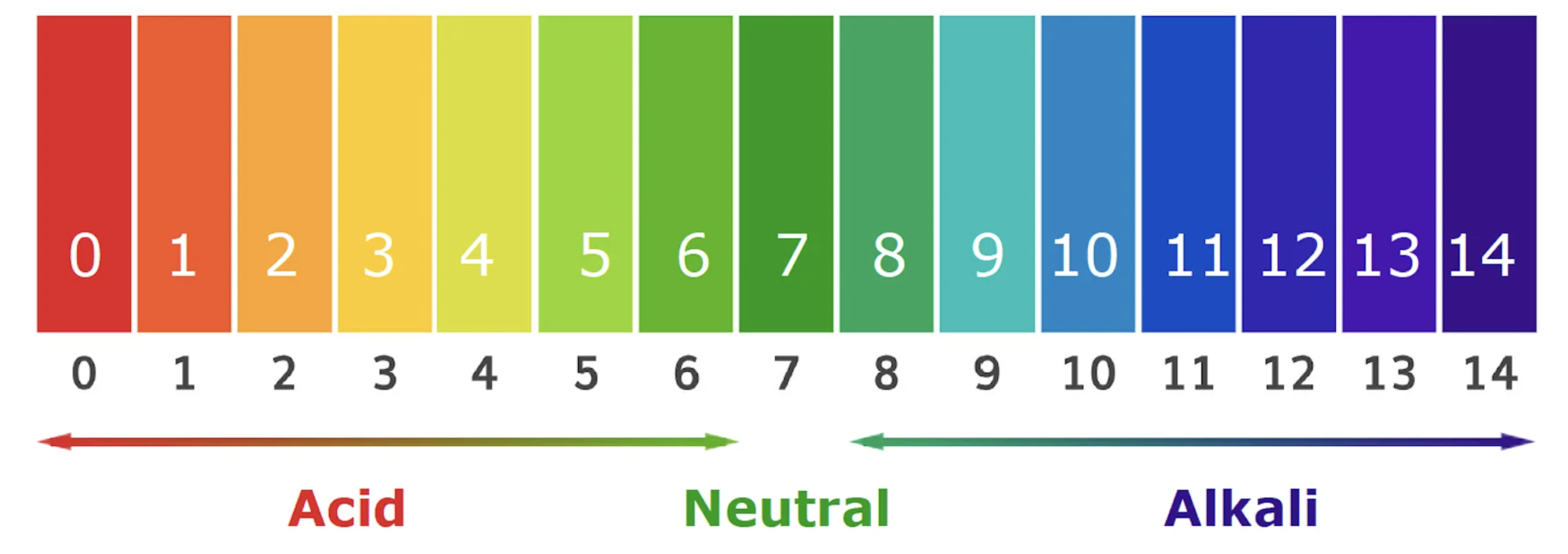
The pH scale uses a logarithmic scale ranging from 0 to 14, which makes it much easier to express the enormous range of hydrogen ion concentrations found in different solutions. Each single unit change on the pH scale represents a ten-fold change in hydrogen ion concentration.
Important
Critical Understanding: The logarithmic nature of the pH scale means that small number changes represent huge concentration differences. A solution with pH 3 contains ten times more hydrogen ions than a solution with pH 4, and one hundred times more hydrogen ions than a solution with pH 5.
For example, a solution with pH 3 contains ten times more hydrogen ions than a solution with pH 4, and one hundred times more hydrogen ions than a solution with pH 5. This logarithmic relationship allows scientists to work with manageable numbers rather than writing out extremely large or small decimal values.
Solutions with pH values below 7 are acidic, while those above 7 are alkaline. The further from 7, the stronger the acid or base becomes.
Summary
Key Points to Remember:
- Inorganic ions are charged particles found in cells and body fluids at varying concentrations
- pH measures hydrogen ion concentration - 7 is neutral, below 7 is acidic, above 7 is alkaline
- Acids donate hydrogen ions () while bases accept hydrogen ions, affecting solution pH accordingly
- Key biological ions include iron (oxygen transport), sodium (nutrient absorption), and phosphate (nucleic acid structure)
- The pH scale is logarithmic - each unit change represents a ten-fold difference in hydrogen ion concentration