Functions of Proteins (AQA A-Level Biology): Revision Notes
📚Revision Notes
Functions of Proteins
Proteins carry out diverse roles within living organisms, with their specific functions determined by their molecular shape. The relationship between protein structure and function is fundamental to understanding how these biological molecules work.
Note
The structure-function relationship in proteins is one of the most important concepts in biology - understanding this connection helps explain how proteins perform their specialised roles in living systems.
Two main categories of proteins
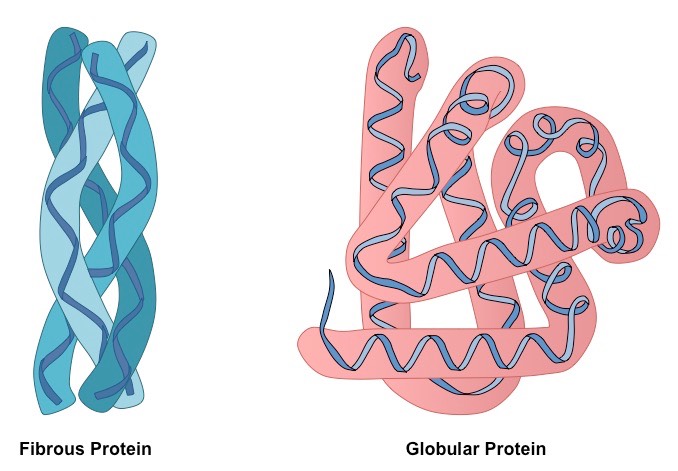
Based on their shape and role, proteins can be classified into two basic categories:
- Fibrous proteins have elongated, thread-like structures that make them ideal for structural functions. These proteins provide support, strength, and shape to cells and tissues. A key example is collagen, which forms strong fibres in connective tissues.
- Globular proteins have compact, rounded structures that enable them to perform metabolic functions. These include enzymes that catalyse biochemical reactions and transport proteins like haemoglobin that carry oxygen in the blood.
The distinct structural differences between these protein types directly enable their specialised functions.
Important
Key Distinction:
- Fibrous proteins = Structural roles (support, strength)
- Globular proteins = Metabolic roles (enzymes, transport)
Collagen as a structural protein
Structure enables function
Collagen demonstrates how protein structure determines function. This fibrous protein forms long chains that run parallel to each other, creating extremely stable molecules through several structural features:
Note
Collagen's Hierarchical Structure:
- Primary structure: Each chain consists of an unbranched polypeptide chain
- Secondary structure: The polypeptide chain forms a tightly wound helix
- Tertiary structure: Individual chains twist into a secondary helix, with glycine amino acids enabling tight packing
- Quaternary structure: Three polypeptide chains wind together like strands in a rope, forming a triple helix
The chains are held together by cross-linkages between amino acids of adjacent chains, creating exceptional strength and stability.
Function in tendons
Collagen's structural properties make it perfectly suited for its role in tendons. Tendons connect muscles to bones and must withstand considerable mechanical stress during movement.
Example
Worked Example: How Collagen Functions in Tendons
When muscles contract, tendons transmit the force to pull bones in the direction of contraction. The staggered arrangement of collagen molecules within tendon fibres, where individual molecules have different start and end points, ensures strength is distributed throughout the structure rather than concentrated at weak points.
This arrangement prevents the tendon from failing at specific locations and enables efficient force transmission from muscle to bone during movement.
Structure-function relationships
The examples of fibrous and globular proteins illustrate a key biological principle: protein function is directly related to protein shape. The molecular architecture of each protein type has evolved to optimise their specific biological roles.
Important
Fibrous proteins like collagen sacrifice flexibility for strength and stability, making them ideal structural components. Globular proteins maintain more flexible, compact shapes that allow them to bind to other molecules and undergo conformational changes necessary for metabolic processes.
Summary
Key Points to Remember:
- Protein function depends on molecular shape and structure
- Fibrous proteins (like collagen) have structural roles, providing strength and support
- Globular proteins (like enzymes and haemoglobin) perform metabolic functions
- Collagen's triple helix structure and cross-linkages create the strength needed for tendons
- The structure-function relationship is fundamental to understanding how proteins work in living organisms