Feedback Mechanisms (AQA A-Level Biology): Revision Notes
📚Revision Notes
Feedback Mechanisms
Components of homeostatic control
- Homeostatic control maintains stable internal conditions through a coordinated system involving five essential components working together in sequence.
- The optimum point represents the desired level or normal range at which the system should operate. This serves as the target value that the body aims to maintain.
- A receptor detects any deviation from the set point and recognises when conditions have moved away from the normal range. These sensors continuously monitor internal conditions.
- The coordinator processes information from various receptors and integrates these signals to determine the appropriate response needed.
- An effector carries out the corrective actions required to return the system back to its optimum point. These are typically muscles, glands, or organs that can produce a physiological response.
- The feedback mechanism ensures that information about the effector's actions is communicated back to the receptor. This creates a complete loop that allows the system to monitor whether the corrective measures have been successful.
Note
The five components work in a continuous cycle: optimum point → receptor → coordinator → effector → feedback mechanism. This sequence ensures that the body can detect changes, process the information, respond appropriately, and monitor the effectiveness of the response.
Negative feedback
Important
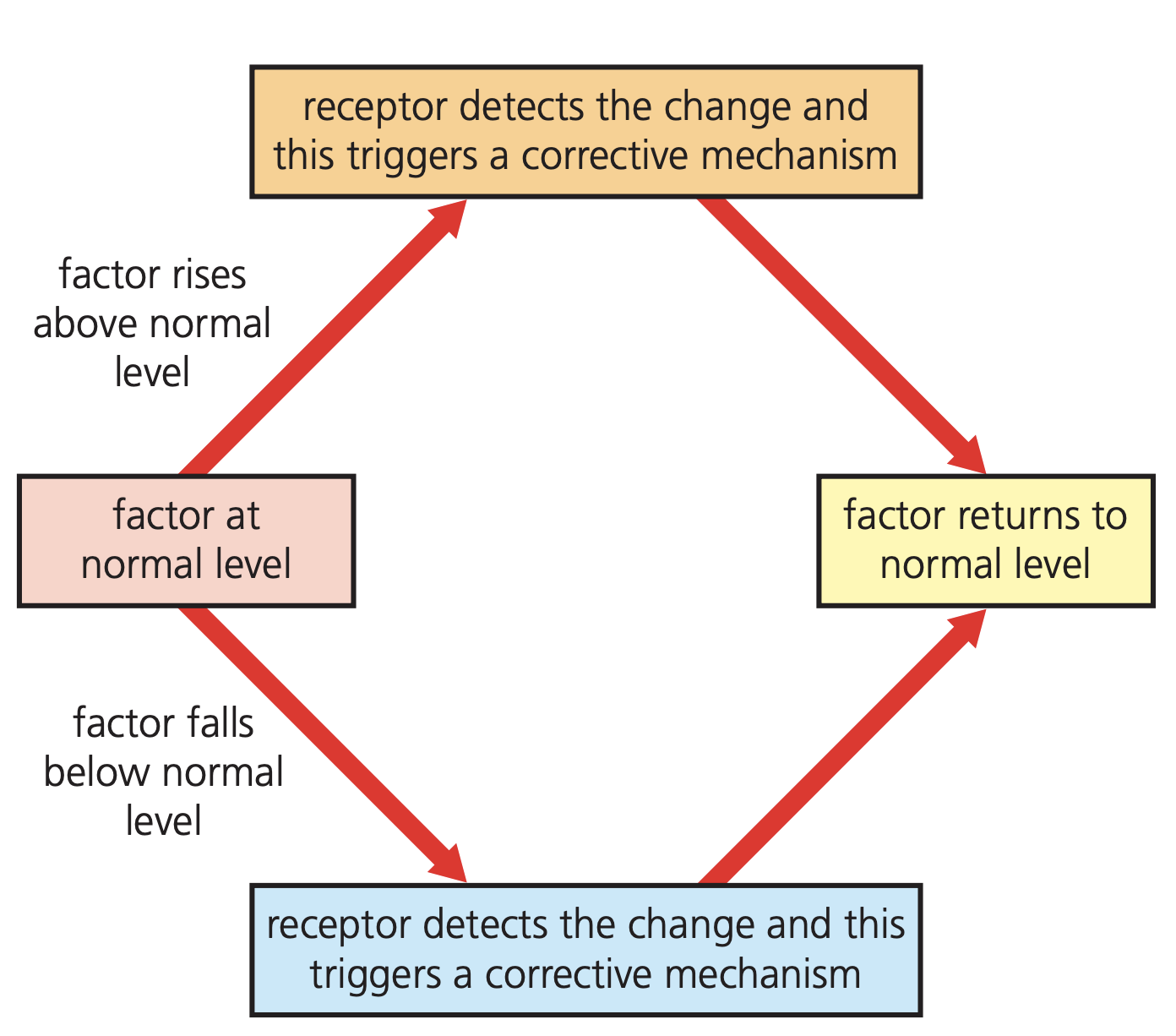
Negative feedback occurs when the stimulus triggers corrective measures that are subsequently switched off once the system returns to its optimum level. This mechanism prevents overcorrection and maintains stability by counteracting any deviation from the normal range.
The process works by having separate negative feedback pathways that can respond to deviations in either direction from the norm. This provides greater precision in homeostatic control since the body can respond appropriately whether a factor increases or decreases beyond acceptable limits.
Blood glucose control
Blood glucose regulation demonstrates negative feedback through the actions of two key hormones. When blood glucose concentration falls below normal levels, receptors on the cell surface membranes of α cells in the pancreas detect this change. These α cells act as the coordinator and respond by secreting the hormone glucagon.
Glucagon stimulates liver cells (the effectors) to convert stored glycogen into glucose, which is then released into the bloodstream. This raises blood glucose concentration back towards normal levels. As blood with elevated glucose concentration circulates back to the pancreas, it reduces stimulation of the α cells, leading to decreased glucagon secretion. This represents the negative feedback component - the hormone's action leads to a reduction in its own production.
Example
Worked Example: Blood Glucose Regulation
When glucose levels fall:
- Receptors on α cells in the pancreas detect low glucose
- α cells act as coordinators and secrete glucagon
- Glucagon stimulates liver cells (effectors) to convert glycogen to glucose
- Blood glucose rises back to normal levels
- Higher glucose reduces α cell stimulation (negative feedback)
When glucose levels rise:
- β cells detect high glucose levels
- β cells produce insulin
- Insulin promotes glucose uptake and storage
- Blood glucose falls back to normal
- Lower glucose reduces insulin production (negative feedback)
Conversely, when blood glucose levels rise above normal, β cells in the pancreas produce insulin. This hormone promotes glucose uptake by cells and its conversion to glycogen and fat for storage. The resulting fall in blood glucose concentration reduces insulin production, again demonstrating negative feedback control.
Temperature control
Body temperature regulation involves the hypothalamus in the brain, which contains thermoreceptors that detect changes in blood temperature. When body temperature increases, these receptors send nerve impulses to the heat loss centre, also located in the hypothalamus.
The heat loss centre coordinates the response by sending nerve impulses to effector organs in the skin. These responses include vasodilation (widening of blood vessels), sweating, and lowering of body hairs. These actions increase heat loss from the body surface, causing blood temperature to decrease.
Example
Worked Example: Temperature Control Response
Heat response pathway:
- Thermoreceptors in hypothalamus detect temperature rise
- Heat loss centre (coordinator) processes the information
- Nerve impulses sent to skin effectors
- Vasodilation, sweating, and hair lowering occur
- Heat loss increases, blood temperature decreases
- Cooler blood reduces thermoreceptor stimulation (negative feedback)
As the cooler blood returns to the hypothalamus through circulation, the thermoreceptors detect this temperature reduction. This reduces the stimulation of the heat loss centre, which in turn decreases the signals sent to the skin effectors. The corrective measures gradually cease as normal temperature is restored, demonstrating negative feedback.
Important
Without this feedback mechanism, the body would continue to lose heat even after normal temperature was reached, potentially leading to hypothermia and serious health consequences.
Positive feedback
Important
Positive feedback occurs when the corrective measures remain active, causing the system to deviate further from its original normal level. Unlike negative feedback, this mechanism amplifies rather than reduces changes.
This type of feedback is less common in healthy biological systems but serves important functions in specific situations. Positive feedback often occurs when control systems break down or during processes that need to reach completion rapidly.
Examples in biological systems
In neurones, a small influx of sodium ions increases membrane permeability to sodium, allowing more ions to enter. This creates a rapid build-up of electrical charge that enables quick nerve impulse transmission.
During childbirth, the hormone oxytocin causes uterine contractions. These contractions stimulate the release of more oxytocin, creating a positive feedback loop that intensifies contractions until birth is completed. This demonstrates an advantage of positive feedback - it ensures the process continues to completion rather than stopping halfway.
Example
Worked Example: Oxytocin in Childbirth
- Labour begins with initial uterine contractions
- Contractions stimulate oxytocin release from pituitary gland
- Oxytocin causes stronger uterine contractions
- Stronger contractions trigger more oxytocin release
- Positive feedback loop continues until birth is completed
- Process stops when baby is born and stimulus is removed
Positive feedback in disease
Note
Certain diseases involve positive feedback when normal control systems fail. This illustrates why positive feedback can be dangerous in biological systems.
In typhoid fever, temperature regulation breaks down, leading to rising body temperature that further disrupts the control system, causing hyperthermia. Similarly, when the body becomes too cold, temperature control systems may fail, leading to positive feedback that results in progressively lower body temperature.
These examples illustrate why positive feedback can be dangerous - without the stabilising effect of negative feedback, biological systems can spiral out of control.
Remember!
Summary
Key Points to Remember:
- Homeostatic control involves five components: optimum point, receptor, coordinator, effector, and feedback mechanism working in sequence
- Negative feedback turns off corrective measures once the optimum is reached, preventing overcorrection and maintaining stability
- Blood glucose and temperature control are classic examples of negative feedback using separate pathways for increases and decreases
- Positive feedback amplifies changes and is less common but important for processes requiring completion, such as childbirth
- Feedback mechanisms are essential for preventing dangerous overcorrection or undercorrection of physiological responses