Nervous Coordination (AQA A-Level Biology): Revision Notes
📚Revision Notes
Transmission Across a Synapse
Synaptic transmission is the process by which nerve impulses pass from one neurone to another across the small gap called the synaptic cleft. This process involves the release of chemical messengers called neurotransmitters, which allow communication between the presynaptic neurone (sending the signal) and the postsynaptic neurone (receiving the signal).
The synaptic transmission process
Important
Synaptic transmission is a precisely coordinated process that converts electrical signals into chemical signals and back into electrical signals. Understanding each stage is crucial for grasping how the nervous system communicates effectively.
Synaptic transmission occurs through a precise sequence of six main stages, using acetylcholine as the neurotransmitter in cholinergic synapses.
Stage 1: Action potential arrival and calcium channel opening
When an action potential reaches the end of the presynaptic neurone, it triggers calcium ion protein channels to open. This allows calcium ions () to enter the synaptic knob through facilitated diffusion. At rest, sodium ion protein channels in the postsynaptic membrane remain closed.
Stage 2: Vesicle fusion and neurotransmitter release
The influx of calcium ions causes synaptic vesicles containing acetylcholine to move towards and fuse with the presynaptic membrane. This fusion releases acetylcholine molecules directly into the synaptic cleft through exocytosis.
Stage 3: Neurotransmitter diffusion and binding
Acetylcholine molecules diffuse rapidly across the narrow synaptic cleft due to the short diffusion pathway. These molecules then bind to specific receptor sites on sodium ion protein channels located in the postsynaptic membrane.
Stage 4: Postsynaptic depolarisation
When acetylcholine binds to the receptor sites, it causes the sodium ion protein channels to open. Sodium ions () then diffuse rapidly into the postsynaptic neurone along their concentration gradient, generating a new action potential in the postsynaptic neurone.
Stage 5: Neurotransmitter breakdown
To prevent continuous stimulation, the enzyme acetylcholinesterase hydrolyses acetylcholine into choline and ethanoic acid (acetyl). This rapid breakdown ensures the signal is discrete and allows for precise control of nerve transmission. The breakdown products diffuse back across the synaptic cleft to the presynaptic neurone for recycling.
Stage 6: Neurotransmitter recycling
ATP released by mitochondria provides energy to recombine choline and ethanoic acid back into acetylcholine. This reformed acetylcholine is stored in synaptic vesicles ready for future use. The sodium ion protein channels close once acetylcholine is removed from the receptor sites.
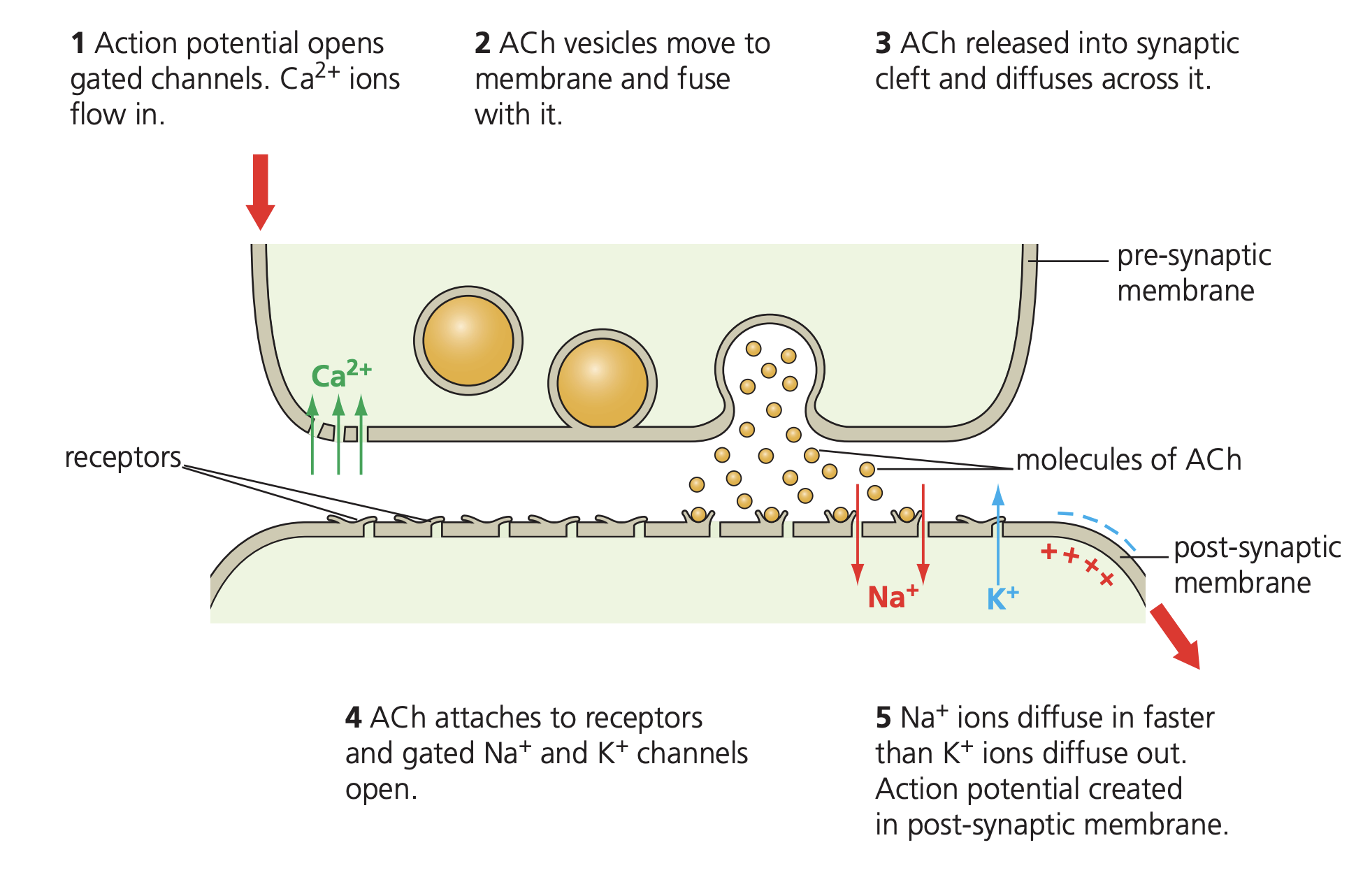
Key components and their roles
- Calcium ions (): Calcium ions act as the trigger for vesicle fusion and neurotransmitter release. Their concentration must be precisely controlled to ensure proper synaptic function.
- Acetylcholine: Acetylcholine serves as the chemical messenger, carrying information across the synaptic cleft where electrical transmission cannot occur.
- Acetylcholinesterase: Acetylcholinesterase ensures synaptic transmission is terminated quickly, preventing prolonged stimulation and allowing the synapse to respond to new signals.
- Mitochondria: Mitochondria provide the ATP necessary for neurotransmitter synthesis and recycling, highlighting the energy-demanding nature of synaptic transmission.
Links to other topics
Synaptic transmission connects to action potential propagation in neurones and is essential for reflex arcs and nervous system coordination. The process also demonstrates principles of enzyme action and membrane transport mechanisms.
Summary
Key Points to Remember:
- Synaptic transmission converts electrical signals to chemical signals and back to electrical signals
- Calcium ions trigger neurotransmitter release by causing vesicle fusion with the membrane
- Acetylcholine must be rapidly broken down by acetylcholinesterase to ensure discrete signalling
- The process requires ATP for neurotransmitter recycling, making it metabolically active
- Sodium influx into the postsynaptic neurone generates the new action potential