Neuromuscular Junctions (AQA A-Level Biology): Revision Notes
📚Revision Notes
Neuromuscular Junctions
What is a neuromuscular junction?
A neuromuscular junction is the specialised connection point where a motor neurone meets a skeletal muscle fibre. This junction serves as the communication link that allows the nervous system to control muscle contraction.
Note
The presence of multiple neuromuscular junctions across each muscle is essential for effective muscle function. If there were only one junction per muscle, the action potential would travel slowly across the muscle, resulting in uncoordinated and weak contractions. Having many junctions spread throughout the muscle ensures rapid and powerful contraction when stimulated simultaneously.
Motor units and muscle control
All muscle fibres supplied by a single motor neurone work together as a motor unit. This arrangement provides precise control over muscle force:
- For light movements, only a few motor units are activated
- For powerful movements, many motor units are stimulated simultaneously
Note
This system allows for graduated control of muscle contraction strength, enabling everything from delicate finger movements to powerful jumping actions.
Structure of the neuromuscular junction
The neuromuscular junction contains several key components that work together to transmit signals from nerve to muscle:
Presynaptic components
- Axon terminal of the motor neurone
- Synaptic vesicles containing the neurotransmitter acetylcholine
- Presynaptic membrane where vesicles fuse during signal transmission
- Mitochondria to provide energy for the transmission process
Postsynaptic components
- Postsynaptic membrane (sarcolemma of the muscle fibre)
- Acetylcholine receptors embedded in the muscle membrane
- Specialised areas of the muscle membrane with increased permeability to sodium ions
The synaptic cleft
The narrow gap between the presynaptic and postsynaptic membranes where neurotransmitter diffusion occurs.
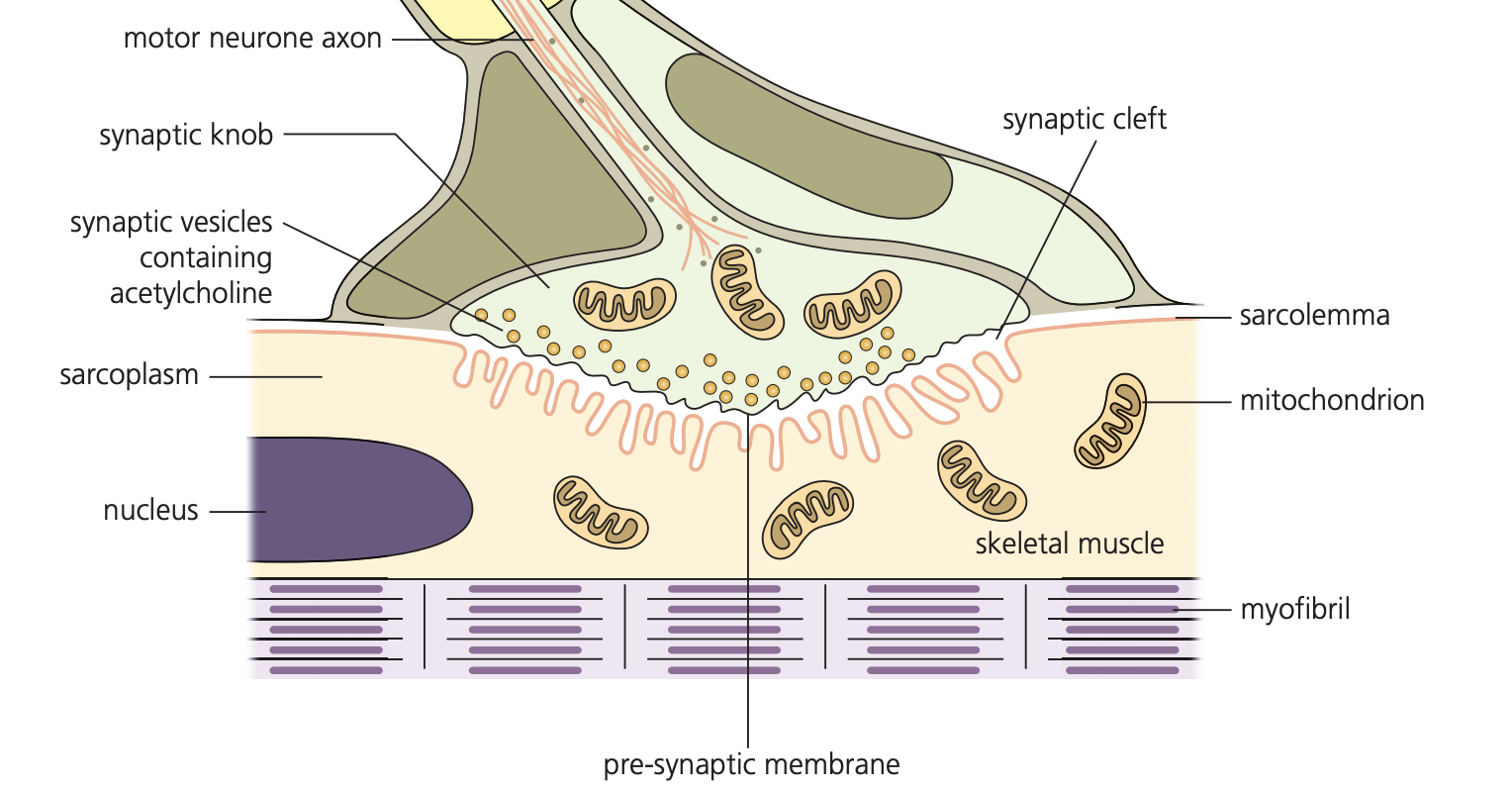
How neuromuscular transmission works
Example
Step-by-Step Process: Neuromuscular Transmission
When a nerve impulse reaches the neuromuscular junction, the following sequence occurs:
- Action potential arrival: The nerve impulse reaches the axon terminal
- Vesicle fusion: Synaptic vesicles fuse with the presynaptic membrane
- Acetylcholine release: The neurotransmitter is released into the synaptic cleft
- Receptor binding: Acetylcholine binds to receptors on the postsynaptic membrane
- Membrane permeability change: Sodium channels open, allowing Na⁺ ions to enter rapidly
- Depolarisation: The muscle membrane becomes depolarised, triggering muscle contraction
- Neurotransmitter breakdown: Acetylcholinesterase breaks down acetylcholine to prevent over-stimulation
- Recycling: The breakdown products diffuse back to the neurone for acetylcholine synthesis
Comparison with cholinergic synapses
Neuromuscular junctions share similarities with cholinergic synapses but have important differences:
Similarities
- Both use acetylcholine as the neurotransmitter
- Both transport neurotransmitters by diffusion
- Both have receptors that cause sodium ion influx when activated
- Both use a sodium-potassium pump to repolarise after transmission
- Both use enzymes to break down the neurotransmitter
Key differences
| Feature | Neuromuscular junction | Cholinergic synapse |
|---|---|---|
| Effect | Only excitatory | May be excitatory or inhibitory |
| Connections | Links neurones to muscles only | Links neurones to other neurones or effector organs |
| Neurone types | Only motor neurones involved | Motor, sensory, and intermediate neurones may be involved |
| Signal continuation | End of neural pathway | May produce new action potentials in other neurones |
| Receptor location | On muscle fibre membrane | On postsynaptic neurone membrane |
Important
Critical Distinction: Unlike synapses between neurones, neuromuscular junctions are always excitatory and represent the final step in the neural pathway before muscle contraction occurs.
Biological significance
The neuromuscular junction represents a highly specialised adaptation for rapid and reliable muscle activation. This sophisticated system demonstrates several key evolutionary advantages:
Summary
Key Advantages of Neuromuscular Junction Design:
- Muscle contraction is rapid and coordinated through multiple junction points
- Force generation can be precisely controlled via motor unit recruitment
- Energy is efficiently used through the motor unit system
- Muscle fatigue is minimised through selective activation of different motor units
Links to muscle contraction mechanisms and the sliding filament theory.
Summary
Key Points to Remember:
- Neuromuscular junctions are specialised connections between motor neurones and muscle fibres
- Motor units allow precise control of muscle force by activating different numbers of muscle fibres
- Acetylcholine is the key neurotransmitter, broken down by acetylcholinesterase to prevent over-stimulation
- The structure ensures rapid, coordinated muscle contraction through multiple junctions per muscle
- Unlike synapses, neuromuscular junctions are always excitatory and represent the end of the neural pathway