The Balance of Payments: The Fundamentals (AQA A-Level Economics): Revision Notes
📚Revision Notes
The Balance of Payments: The Fundamentals
Introduction to the balance of payments
The balance of payments is a comprehensive record showing all monetary transactions between a country's residents and the rest of the world during a specific time period. Think of it as a country's financial statement that tracks every pound flowing in and out of the economy through international dealings.
These transactions are organised into three main accounts:
- The current account
- The capital account
- The financial account
Note
Understanding the balance of payments is crucial because it reveals important information about a country's international competitiveness and whether it is living within its means. When a country consistently spends more abroad than it earns, it must finance this gap through borrowing or selling assets.
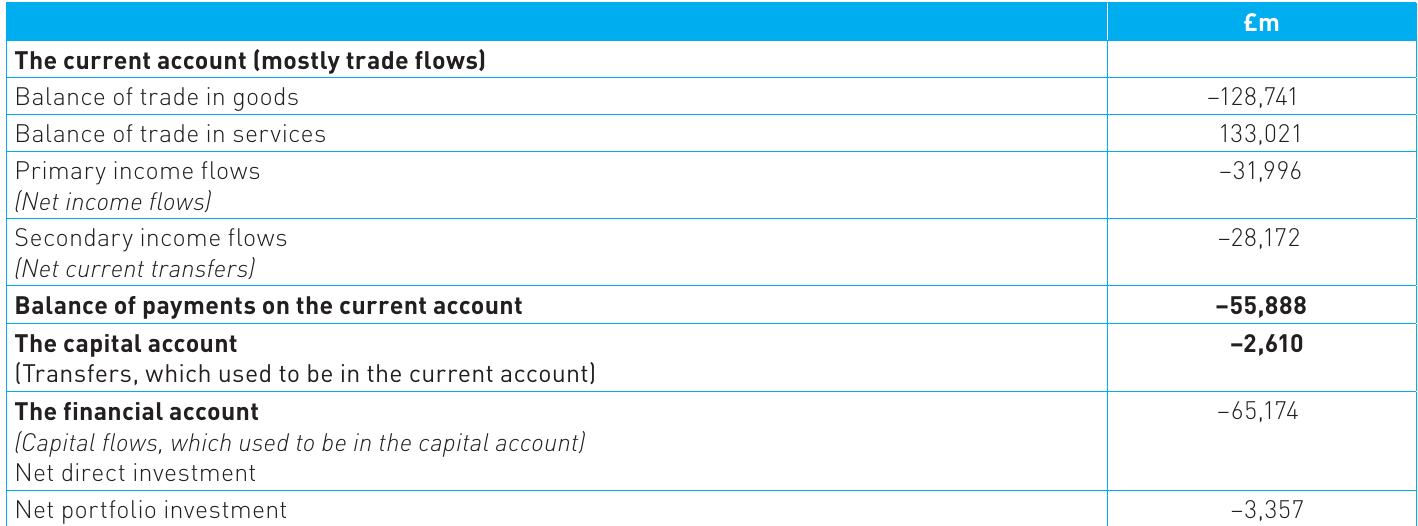
The structure of the balance of payments accounts
The current account
The current account is the most important section of the balance of payments. It measures all currency flows into and out of a country over a particular time period relating to:
- Exports and imports of goods and services
- Primary income flows (investment income)
- Secondary income flows (transfers)
Important
The current account is considered the most significant part of the balance of payments because it reflects a country's international competitiveness and indicates whether the country is living within its means.
The capital account
Several years ago, the UK changed how it presents balance of payments data. The capital account, which was once a major component, was restructured. Capital flows were moved out and listed under a new category called the financial account.
The capital account now contains various transfers of income that were previously part of the current account before this reclassification. It has become a very small and usually insignificant part of the overall balance of payments.
The financial account
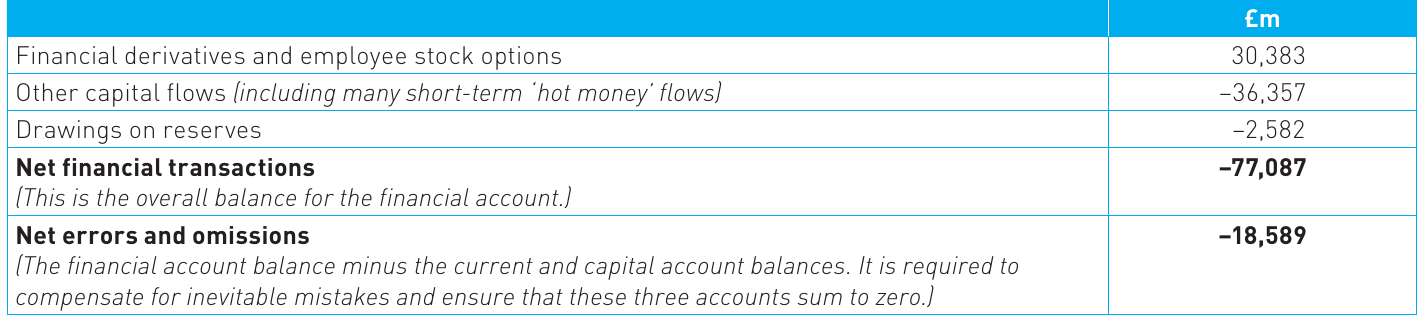
The financial account records capital flows into and out of the economy. It has five main components visible in the balance of payments tables:
- Net direct investment
- Net portfolio investment
- Financial derivatives and employee stock options
- Other capital flows (including short-term 'hot money' flows)
- Drawings on reserves
When a country runs a current account deficit, the borrowing that finances this deficit is recorded in either the capital account or the financial account.
Note
Note on net errors and omissions: You may notice a row in balance of payments tables called 'net errors and omissions'. This compensates for inevitable discrepancies and ensures the three accounts sum to zero mathematically. The financial account balance minus the current and capital account balances must equal zero.
The four components of the current account
The current account comprises four main sections, which together determine whether a country has a current account deficit or surplus.

Balance of trade in goods
The balance of trade in goods measures payments for exports and imports of physical products. It shows the difference between the total value of goods exports and goods imports. This is sometimes called the balance of visible trade because goods are tangible items you can see and touch.
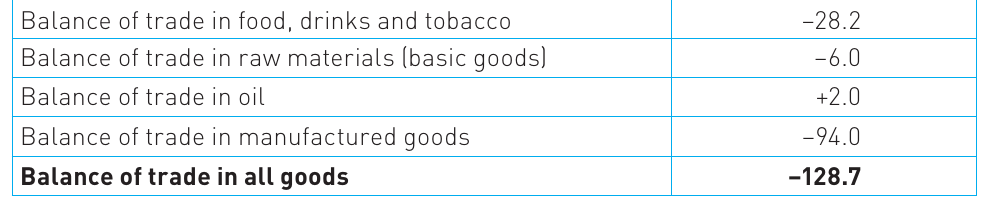
The UK's balance of trade in goods can be broken down by different commodity categories. As the table shows, the UK runs deficits across most categories:
- Food, drinks and tobacco show a deficit of £28.2 billion
- Raw materials and basic goods show a deficit of £6.0 billion
- Oil shows a small surplus of £2.0 billion
- Manufactured goods show the largest deficit at £94.0 billion
The overall balance of trade in all goods was −£128.7 billion in 2020, representing a substantial deficit.
Important
The manufactured goods deficit is particularly significant. For over 200 years following the Industrial Revolution, Britain was a net exporter of manufactured goods. However, this changed in the early 1980s. The manufactured goods deficit is now substantial, reflecting:
- Loss of competitiveness
- Deindustrialisation of the UK
- The fact that most manufactured goods are now produced in emerging-market countries, particularly China
Balance of trade in services
The balance of trade in services measures the difference between payments for service exports and service imports. This is part of the balance of invisible trade because services are intangible.
The decline of manufacturing and growth of service industries mean the UK now has a post-industrial, service-sector economy. This transformation is reflected in the balance of trade in services.
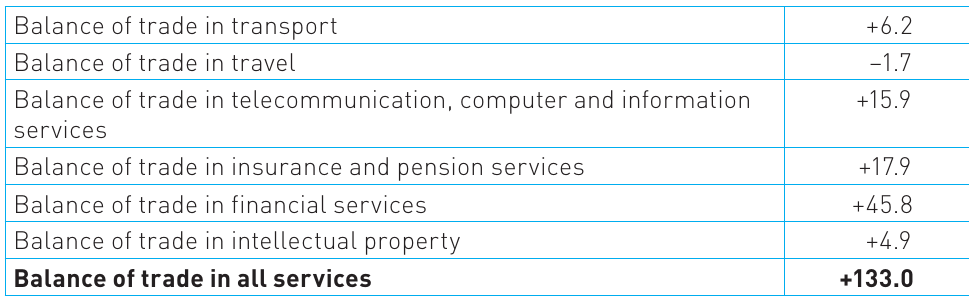
The UK shows surpluses in most service categories:
- Transport: +£6.2 billion
- Travel: −£1.7 billion (the only deficit)
- Telecommunication, computer and information services: +£15.9 billion
- Insurance and pension services: +£17.9 billion
- Financial services: +£45.8 billion (the largest individual surplus)
- Intellectual property: +£4.9 billion
The balance of trade in all services was +£133.0 billion in 2020, representing a substantial surplus.
Whereas most manufactured goods are internationally tradable, many services are produced and consumed domestically in what's called the sheltered economy. However, globalisation has changed this. Many services previously produced within the UK are now imported, as UK companies outsource or buy services from overseas suppliers in countries with cheaper labour costs. This includes:
- Call centres relocated to India
- Back-office service activities
- Financial and ICT-related services
Despite this, the UK remains a significant net exporter of financial, insurance and ICT services. The financial services sector is particularly important to the UK economy and contributes the largest individual surplus to the services balance.
Important
Exam tip: Make sure you appreciate the importance of financial services in the UK's balance of trade in services. Although the current account and overall trade balance are usually in deficit, the surplus on trade in services is largely derived from the financial services industry.
Trade balance trends
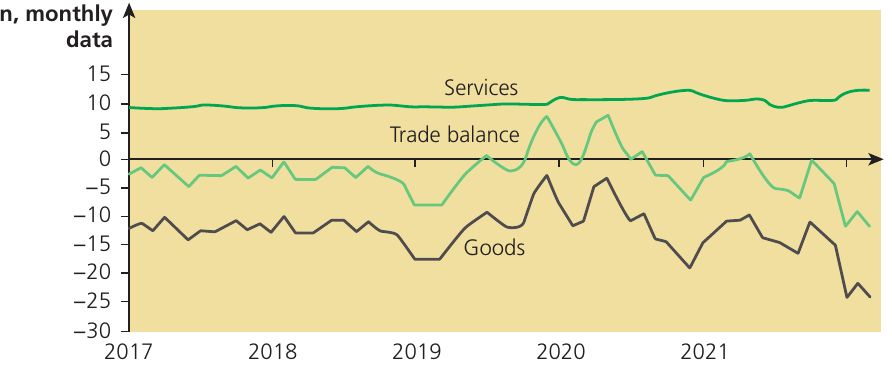
The chart above shows changes in the UK trade balance from 2017 to 2021. Key observations:
- The services balance remains consistently positive (in surplus) around +£10 billion
- The goods balance shows a persistent and growing deficit, declining from around −£10 billion to −£25 billion
- The overall trade balance fluctuates near zero, with high volatility in 2020-2021
- The services surplus partially offsets the goods deficit
Note
The balance of trade moved into surplus in 2020 (for the first time since 1997) largely due to the slowdown in trade during the Covid-19 pandemic. However, this surplus was unlikely to continue.
Primary income
Primary income flows are net income flows consisting mainly of investment income generated from profits, dividends and interest payments flowing between countries. The balance of primary income comprises:
Inward flows: Income flowing into the economy in the current year, generated by UK-owned capital assets located overseas (such as shares owned in foreign companies or land owned overseas)
Outward flows: Income flowing from the economy in the current year, generated by overseas-owned capital assets located in the UK
When UK-based multinational companies (MNCs) invest in capital assets in other countries, profits generated flow back to the parent company and its UK shareholders. The investment itself represents an outward capital flow in the financial account, but the income it generates is current income, recorded in the current account.
Conversely, profits flow out of the UK to overseas owners of assets located in the UK. For example, Japanese or US multinational companies owning subsidiary companies in the UK generate profits that flow out to their overseas shareholders.
In 2020, the UK's net primary income flows were −£32 billion, indicating that foreign asset owners were earning more from their UK investments than UK residents were earning from overseas investments.
Note
Until 2011, inward primary income flows usually exceeded outward flows, and the UK enjoyed a substantial surplus of investment income. However, the collapse of foreign investment earnings became a major factor contributing to the current account deficit widening after 2011.
Some older textbooks may refer to primary income as 'investment income' and secondary income as 'net transfers', reflecting terminology used before 2014.
Secondary income
Secondary income flows are current transfers of income arising from items such as:
- Gifts of money between residents of different countries
- Donations to charities abroad
- Overseas aid
- Transfers between the UK and the EU
The UK has traditionally run a negative secondary income balance, caused by:
- Net contributions to the EU budget
- Overseas aid programmes
- In some years, the cost of maintaining armed forces in countries such as Afghanistan
In 2020, the balance of secondary income was −£28.2 billion.

Current account deficit and surplus
A current account deficit occurs when currency outflows in the current account exceed the currency inflows. If receipts exceed payments, there is a current account surplus.
For each section of the current account, a plus sign (+) indicates a credit item (net currency flowing into the UK), while a minus sign (−) indicates a debit item (net currency flowing out of the UK).
In 2020, the UK's balance of payments on the current account showed a deficit of −£55.9 billion. This means the UK was living beyond its means and relying on what Mark Carney, the then Governor of the Bank of England, called the 'kindness of strangers' to finance the deficit. Put simply, the UK must finance its current account deficit through investment flows from abroad, which are secured against assets such as office buildings located in the UK.
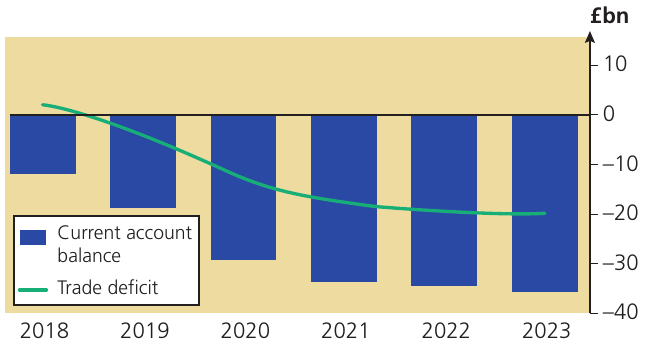
The chart shows the UK current account balance and trade deficit from 2018 to 2023. Throughout this period, the UK has run a persistent current account deficit. By 2020, the UK current account deficit had narrowed to 2.6% of GDP, similar (as a proportion of GDP) to the USA, France and Canada.
Note
The current account deficit has widened primarily because the primary income deficit has been growing. This means foreigners who own assets in the UK are earning more from their assets than UK investors receive from their investments overseas.
Important
The consensus view among economists is that while the size of the current account deficit is unlikely to cause a crisis in the near term, it is storing up problems for the future. If international investors lose confidence in UK financial assets, the country will experience a dramatic fall in living standards because it will be unable to finance its trade deficit.
Worked example: interpreting changes in the current account
Example
Worked Example: Interpreting Changes in the Current Account
Let's examine how different components of the current account can change:
| Year | Balance of trade in goods and services | Primary income balance | Secondary income balance | Current account balance |
|---|---|---|---|---|
| 2022 | −4.0 | +2.0 | −1.4 | −9.0 |
| 2023 | −3.9 | −4.6 | −1.3 | −10.2 |
Analysis: Over the two-year period, the current account deficit increased by 1.2% of GDP. The balance of trade in goods and services improved slightly by 0.1% of GDP, while the secondary income balance also improved by 0.1% of GDP. However, the primary income balance deteriorated significantly by 6.6%, from +2.0% of GDP to −4.6%. This demonstrates that the deterioration in the current account balance was mainly caused by the deterioration in the primary income balance, though we cannot be absolutely certain without knowing all components in detail.
The financial account and investment flows between countries
Understanding primary income flows in the current account requires knowledge of capital flows in the financial account. It's important to avoid confusing capital flows (which figure in the financial account) with investment income (the predominant component of primary income flows in the current account).
Outward capital flows generate inward flows of investment income in subsequent years. The capital outflow enlarges the stock of capital assets located in other countries, owned by UK residents and MNCs. Net capital flows measure the difference between inward and outward capital movements.
Note
Positive net outward capital flows (money flowing out to be invested in physical or financial assets in other countries) over a period of years mean the country acquires capital assets located abroad that are greater in value than the country's own assets bought by overseas companies.
Long-term direct capital flows
Foreign direct investment (FDI) involves investment in capital assets (such as manufacturing and service industry capacity) in a foreign country by a business with headquarters in another country. The overseas company very often establishes subsidiary companies in the countries in which it is investing.
Direct overseas investment involves acquisition of real productive assets, such as:
- Factories
- Oil refineries
- Offices
- Shopping malls
Example
Worked Example: Foreign Direct Investment
For example, a UK-based MNC may establish a new subsidiary company in the USA. Direct investment can also involve acquisition, through merger or takeover, of an overseas-based company. These are examples of outward direct investment.
Conversely, decisions in the 1980s and 1990s by Japanese vehicle manufacturers Nissan, Toyota and Honda to invest in automobile factories in the UK led to inward foreign direct investment.
Long-term direct capital flows can partly be explained by competitive advantage. The flows respond to people's decisions to invest in economic activities and industries located in countries with a competitive advantage. Since changes in competitive and comparative advantage usually occur slowly, long-term direct capital flows tend to be relatively stable and predictable.
Portfolio capital flows
Portfolio investment involves the purchase of financial assets (pieces of paper or, increasingly, electronic claims laying claim to ownership of real assets) rather than physical or directly productive assets. Typically, it occurs when fund managers employed by financial institutions, such as insurance companies and pension funds, purchase:
- Shares issued by overseas companies
- Securities issued by foreign governments
The globalisation of world security markets (capital markets) and the abolition of exchange controls between virtually all developed economies have made it easy for UK residents to purchase shares or bonds listed on overseas capital markets. This has led to a massive increase in portfolio investment. UK residents can now buy shares and corporate bonds previously only available on the capital market of the company's country of origin. Securities issued by foreign governments, such as US Treasury bonds, can also be bought.
Note
The 2007 credit crunch and subsequent financial meltdown had a significant adverse effect on portfolio investment both within and between countries. Many financial assets, particularly those bought and sold by banks, became known as 'toxic assets'. This term arose because a potential purchaser of financial assets offered for sale by a bank could not know in advance whether the assets were high risk and potentially worthless, or a sound investment. In conditions of imperfect information, trading in many types of financial asset collapsed.
Short-term speculative 'hot money' capital flows
Short-term capital movements, also called hot money flows, are largely speculative. The flows occur because the owners of funds (including companies, banks and wealthy private individuals) believe a quick speculative profit can be made by moving funds between currencies.
Hot money movements are triggered by:
- Differences in interest rates (funds flow into currencies with high interest rates and out of currencies with lower interest rates)
- International crises (such as outbreaks of war in the Middle East, causing funds to move into 'safe-haven' currencies regarded as politically stable)
- Speculation that a currency's exchange rate is about to rise (owners move money into that currency) or fall (money moves out)
Important
Hot money flows are usually very easy to move and will move quickly as returns and opportunities arise.
If the pool of hot money shifting between currencies were small, few problems would result. However, short-term capital flows have grown significantly over the last 65 years or so. Large-scale movements of funds from one currency to another create:
- An excess supply of the former currency
- An excess demand for the second currency
To eliminate excess supply and demand, the exchange rates of the two currencies respectively fall and rise. The movement of funds between currencies produces the changes in exchange rates that speculators (financial traders gambling on changes in market conditions) were expecting. This self-fulfilling process enables them to maximise returns.
More significantly, large-scale hot money flows between currencies destabilise exchange rates, current accounts of balance of payments and domestic economies. Such destabilisation occurred late in 2008 and early in 2009 when owners of hot money shifted their funds out of the pound on a massive scale. However, market sentiment later changed, and hot money flowed into the pound, at least until the middle of 2015. As of 2022, the main hot money flow is into the US dollar, forcing up its value, largely due to it being seen as a safe investment in times of uncertainty caused by the Covid-19 pandemic and Russia's invasion of Ukraine.
Note
Speculative capital flows between major currencies such as the dollar, pound and euro, which occupy central positions in international finance, can destabilise the international monetary system. Recent examples of destabilisation include the credit crunch and financial meltdown. Banks and other financial institutions, and governments, in many countries (including the UK) saw their international credit ratings downgraded. To fight recession, governments built up massive budget deficits, which they tried to finance partly by borrowing overseas.
Worked examples with balance of payments data
Example
Worked Example 1: Calculating the Balance of Trade in Goods
Consider the following balance of payments data:
| Item | £m |
|---|---|
| Balance of trade in goods | +1,000 |
| Balance of trade in services | ? |
| Balance of trade in goods and services | +600 |
| Primary income | −75 |
| Secondary income | +30 |
| Balance of payments on current account | ? |
| Net direct investment | +300 |
| Net portfolio investment | −100 |
| Other items in financial account | −550 |
| Financial account balance | ? |
Solution:
Step 1: To find the balance of trade in services:
- Balance of trade in goods and services = Balance of trade in goods + Balance of trade in services
- +600 = +1,000 + Balance of trade in services
- Balance of trade in services = −400
Step 2: To find the balance of payments on current account:
- Current account = Balance of trade in goods and services + Primary income + Secondary income
- Current account = +600 + (−75) + (+30) = +555
Step 3: To find the financial account balance:
- Financial account = Net direct investment + Net portfolio investment + Other items
- Financial account = +300 + (−100) + (−550) = −350
Example
Worked Example 2: Calculating the Balance of Payments on Current Account
Given the following data:
| Item | £m |
|---|---|
| Balance of trade in goods | −700 |
| Balance of trade in services | −200 |
| Primary income balance | +230 |
| Secondary income balance | −50 |
Solution:
Balance of payments on current account = −700 + (−200) + 230 + (−50) = −720
This represents a current account deficit of £720 million.
Key points to remember
Summary
Study Tips:
- Make sure you understand the different items in the current account relating both to trade and to primary and secondary income flows
- You may need to calculate the trade balance, which includes only trade flows (goods and services)
- Avoid confusing the balance of trade in goods with the whole current account, and the current account with the balance of payments as a whole
- The balance of payments includes the current account but also includes other parts relating to money flows
- Make sure you have some knowledge of the balances of trade in items such as manufactured goods, oil and automobiles
- Knowledge of what the UK actually produces can be useful in exam application questions
Remember!
Summary
Key Points to Remember:
- The balance of payments records all monetary flows between a country and the rest of the world in a particular time period
- It consists of three main accounts: the current account, capital account and financial account
- The current account has four components: balance of trade in goods, balance of trade in services, primary income and secondary income
- The UK typically runs a deficit on trade in goods (particularly manufactured goods) but a surplus on trade in services (particularly financial services)
- A current account deficit means a country is spending more abroad than it earns and must finance this through borrowing or asset sales
- The financial account records capital flows including foreign direct investment (FDI), portfolio investment and short-term 'hot money' flows
- Primary income consists mainly of investment income (profits, dividends and interest) flowing between countries due to ownership of overseas assets