Critical Paths (AQA A-Level Further Maths): Revision Notes
📚Revision Notes
Critical Paths
Understanding float
When planning projects, some activities have more time available than they actually need. This extra time is called float (also known as slack).
Float is the amount of spare time available for an activity. It is the difference between the time available for the activity and the time the activity actually takes.
Note
Float represents flexibility in scheduling. Activities with float can be delayed without impacting the overall project completion time, making them less critical to monitor closely.
Calculating float
The float of an activity can be calculated using the formula:
This tells us how much an activity can be delayed without affecting the overall project completion time.
Critical activities
Not all activities have float. Some activities are so important that any delay will push back the entire project.
Important
Critical activity: An activity with zero float. This means it has no spare time at all. Any delay in a critical activity will delay the entire project.
Key point: A critical activity must start at its earliest start time and finish at its latest finish time, with no room for delay.
Critical paths
When we connect critical activities together through a project network, they form a special route called the critical path.
Critical path: A sequence of critical activities from the start to the end of the project. This path determines the minimum project duration.
Why critical paths matter
- The critical path shows the longest route through the project network
- The length of the critical path equals the minimum project duration
- To reduce project time, you must shorten activities on the critical path
- A project can have more than one critical path
Note
Understanding critical paths is essential for project management. These paths determine when your project will be completed and where you need to focus your attention to meet deadlines.
Identifying critical activities and paths
To find critical activities and paths, you need to complete three steps:
Step 1: Forward pass
Work through the network from start to finish, calculating the earliest start time for each activity. The earliest start time is the earliest moment an activity can begin, considering all preceding activities.
Step 2: Backward pass
Work backwards through the network from end to start, calculating the latest finish time for each activity. The latest finish time is the latest moment an activity can finish without delaying the project.
Step 3: Calculate float
For each activity, use the formula:
Activities with zero float are critical activities. The sequence of these activities forms the critical path(s).
Reading network diagrams
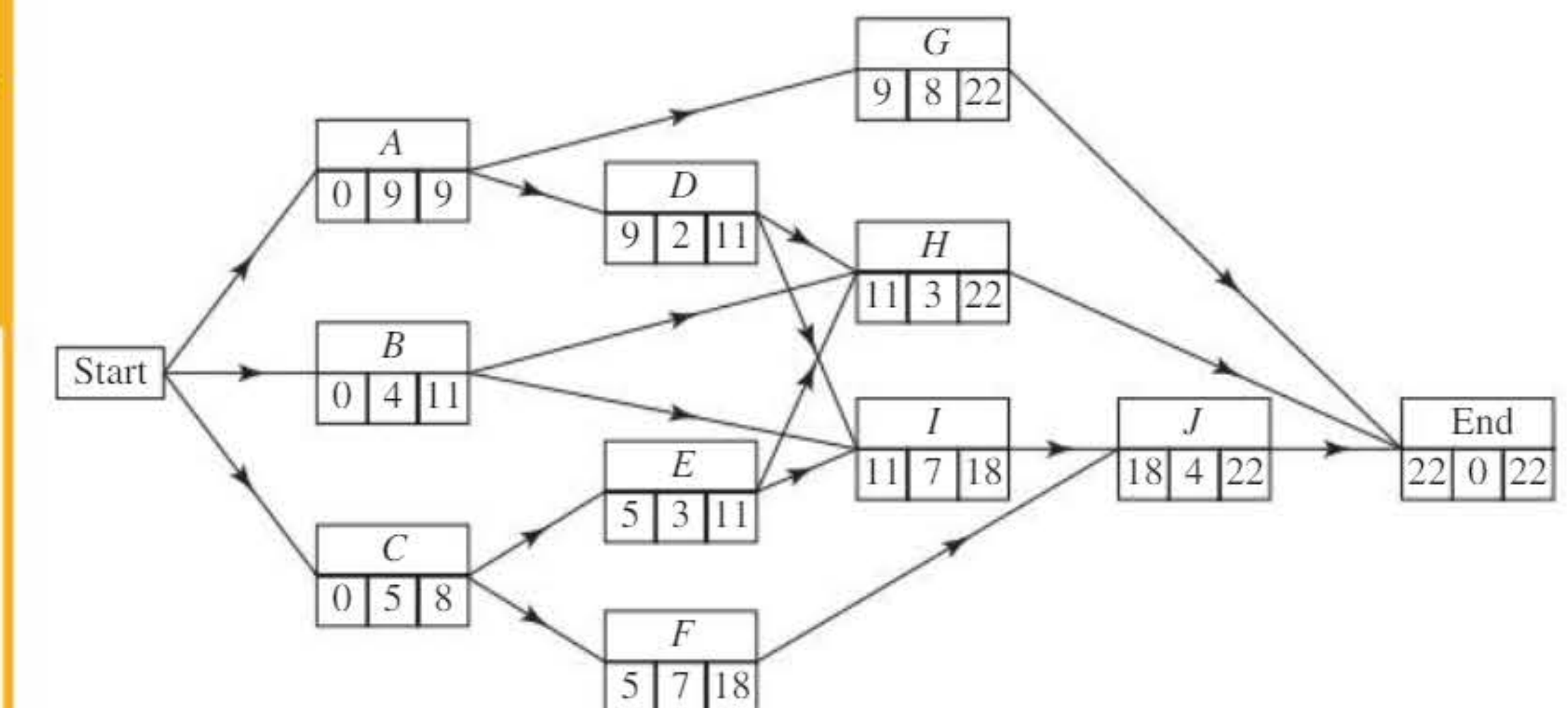
In activity network diagrams, each activity node typically shows three values:
- Top left: Earliest start time
- Top right: Latest finish time
- Bottom: Duration
The forward and backward passes fill in these values, allowing you to calculate float and identify critical activities.
Worked example 1: Single critical path
Example
Worked Example: Finding a Single Critical Path
Let's examine a project network where the forward and backward passes have been completed.
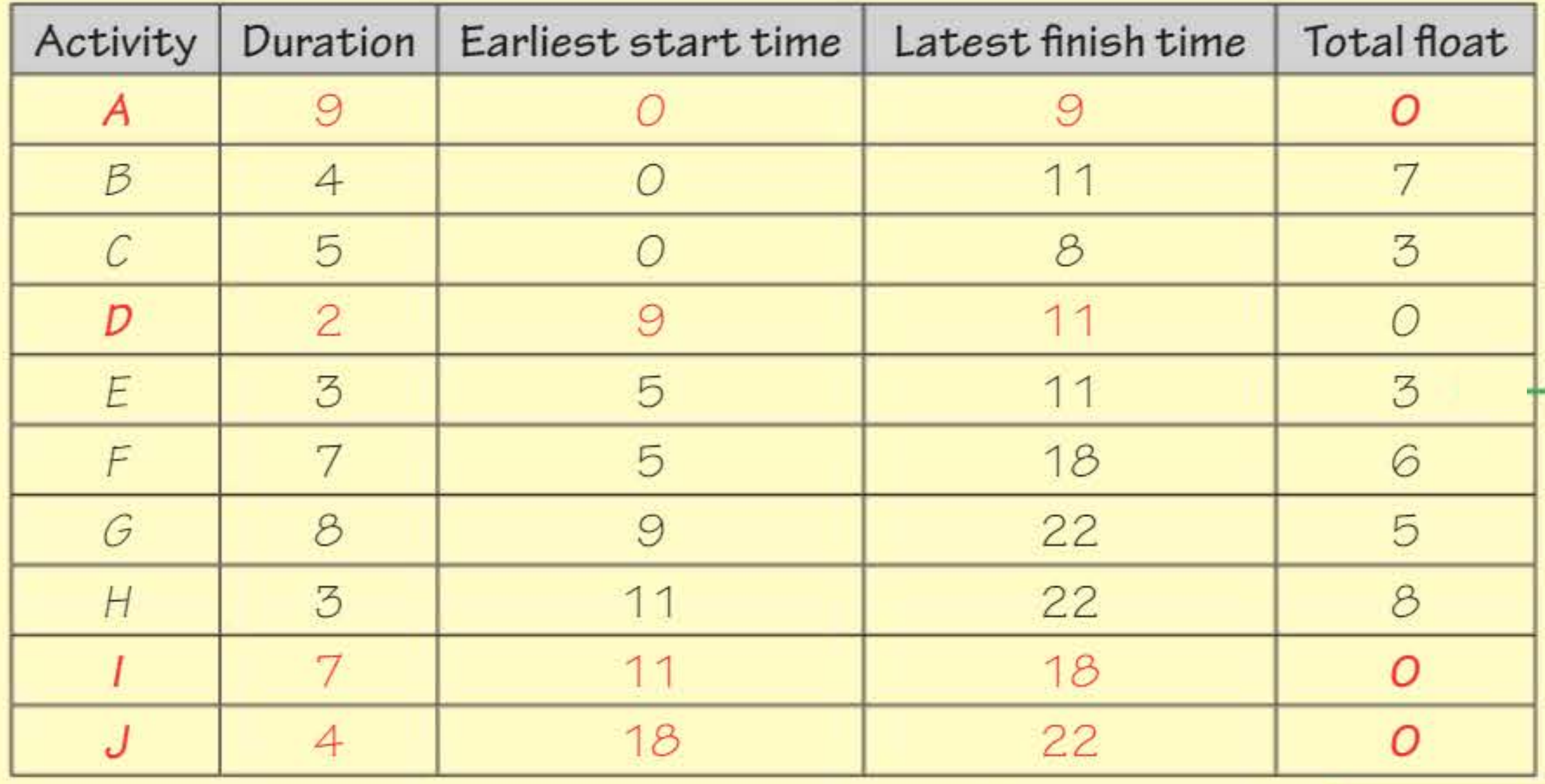
From this table, we can calculate the float for each activity:
Activity E: Float = (11 - 3) - 5 = 3 days
This means activity E has 3 days of spare time.
Finding critical activities: Look for activities with zero float in the Total Float column. In this example, activities A, D, I and J all have zero float, making them critical activities.
Finding the critical path: Connect the critical activities in sequence: A → D → I → J. This is the critical path for this project.
Interpretation: Any delay to activities A, D, I or J will delay the entire project. However, activities B, C, E, F, G and H have some float, so minor delays to these activities won't necessarily affect the project completion time.
Multiple critical paths
Some projects have more than one critical path. This happens when different sequences of activities all take the same total time.
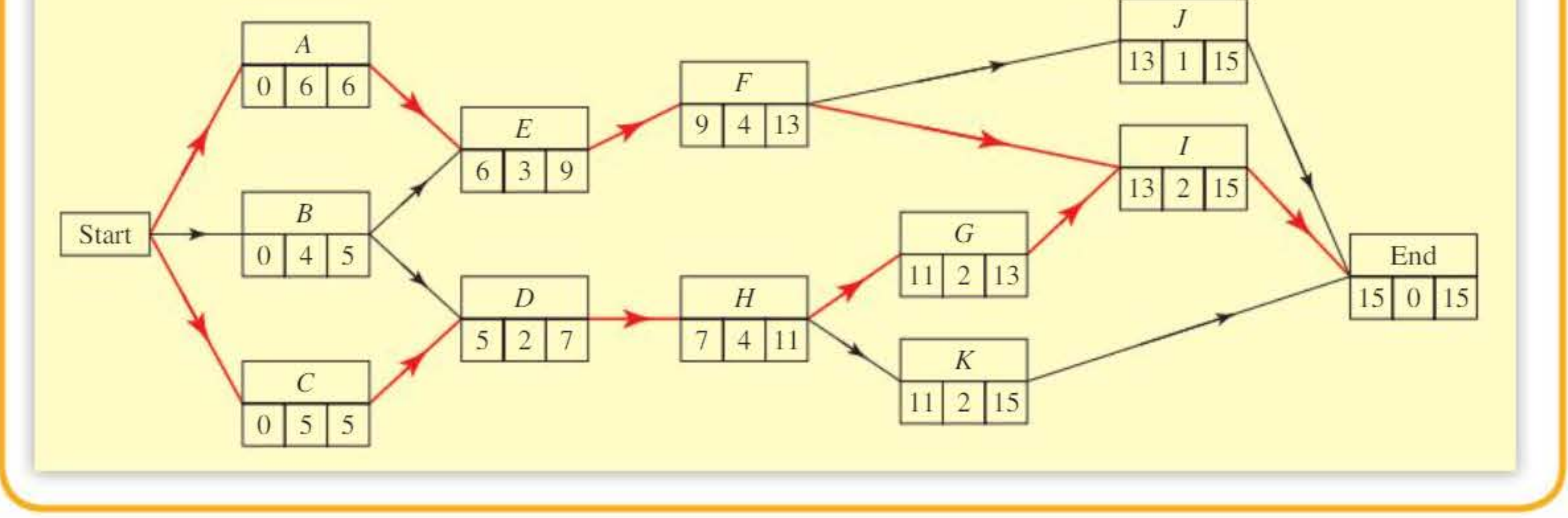
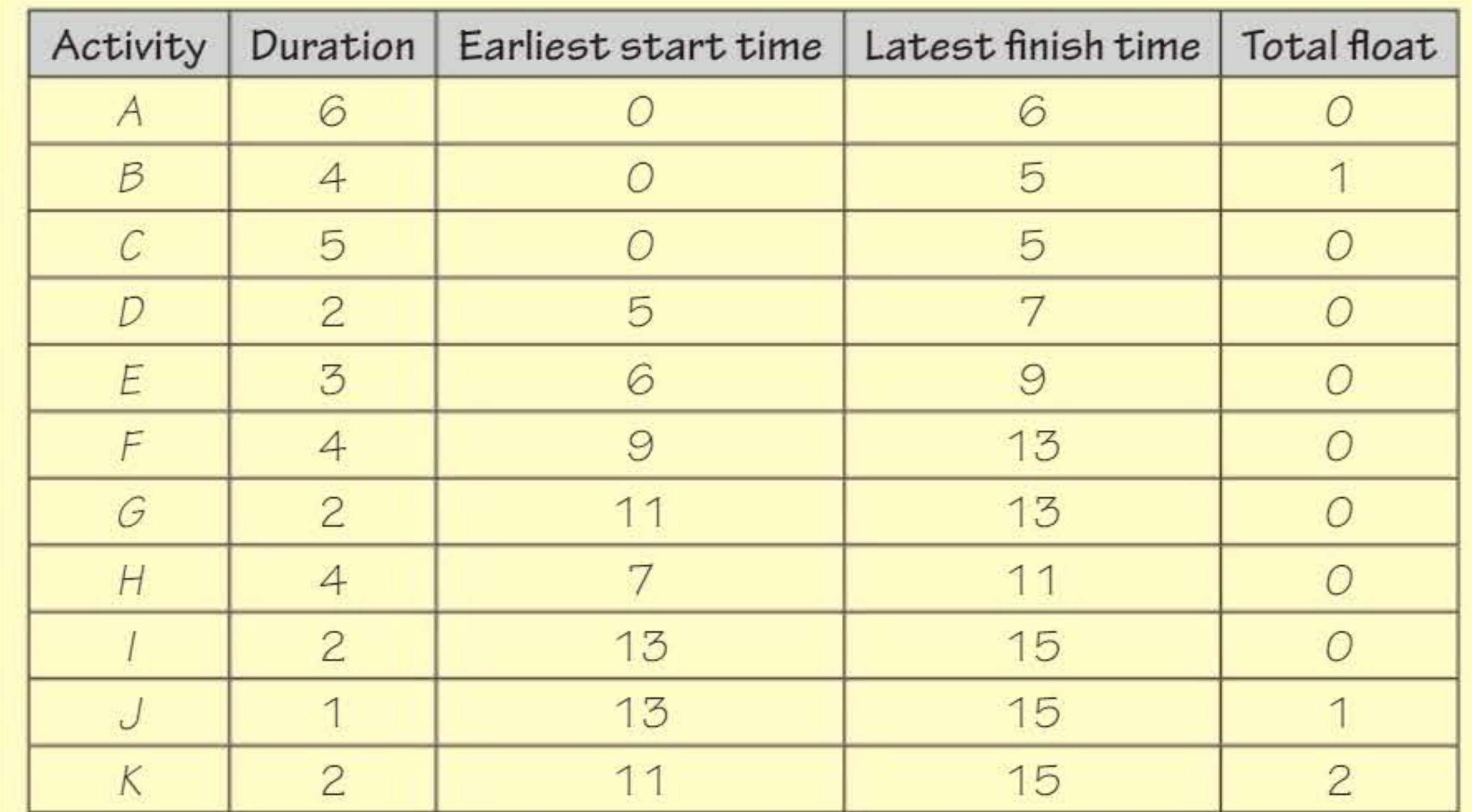
In this example, the critical activities are A, C, D, E, F, G, H and I (all have zero float).
These activities form two critical paths:
- Path 1: A → E → F → I
- Path 2: C → D → H → G → I
Both paths have the same total duration and reach the end node.
Important
Critical concept for multiple paths: When a project has multiple critical paths, you must consider all of them when making project management decisions. To reduce the overall project time, you need to shorten activities on ALL critical paths simultaneously.
Reducing time on just one critical path will not reduce the overall project duration - the other critical path(s) will still determine the completion time.
Worked example 2: Multiple critical paths in detail
Example
Worked Example: Identifying Multiple Critical Paths
Consider a network with activities A through K:
| Activity | Duration | Earliest start time | Latest finish time | Total float |
|---|---|---|---|---|
| A | 6 | 0 | 6 | 0 |
| B | 4 | 0 | 5 | 1 |
| C | 5 | 0 | 5 | 0 |
| D | 2 | 5 | 7 | 0 |
| E | 3 | 6 | 9 | 0 |
| F | 4 | 9 | 13 | 0 |
| G | 2 | 11 | 13 | 0 |
| H | 4 | 7 | 11 | 0 |
| I | 2 | 13 | 15 | 0 |
| J | 1 | 13 | 15 | 1 |
| K | 2 | 11 | 15 | 2 |
Step 1: Identify critical activities (those with zero float): A, C, D, E, F, G, H and I.
Step 2: Trace the paths through the network using only critical activities:
- A → E → F → I (with durations 6 + 3 + 4 + 2 = 15)
- C → D → H → G → I (with durations 5 + 2 + 4 + 2 + 2 = 15)
Result: Both paths take 15 time units, so both are critical paths for this project.
Worked example 3: Project cost optimisation
Example
Worked Example: Reducing Project Duration with Cost Analysis
A construction project has the following precedence table:
| Activity | Preceded by | Duration |
|---|---|---|
| A | - | 9 |
| B | - | 5 |
| C | - | 8 |
| D | - | 3 |
| E | A | 3 |
| F | D | 4 |
| G | B, E | 10 |
| H | C, F | 4 |
| I | B, H | 10 |
| J | G, I | 2 |
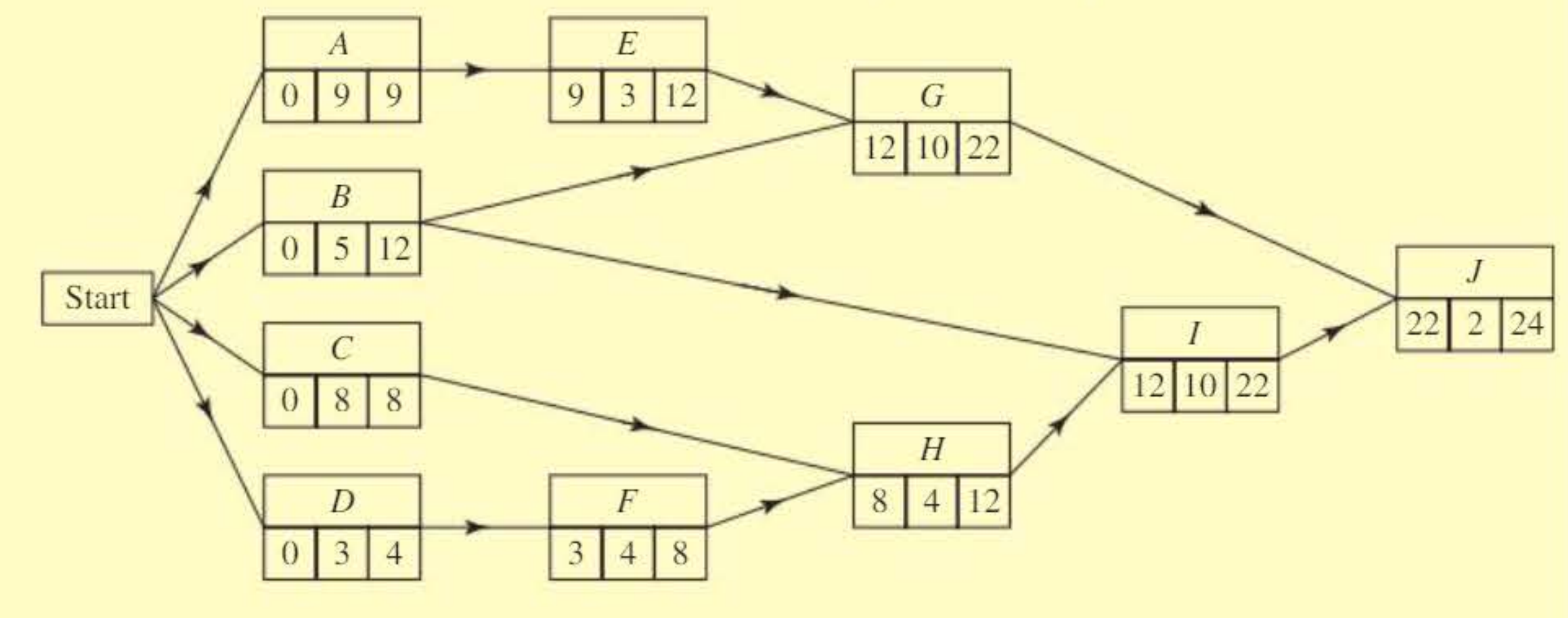
Part a: Draw the network and find the project duration.
After completing forward and backward passes, the project duration is 24 days.
Part b: Identify the critical path(s).
Calculating float for each activity:
- A: Float = 0 (Critical)
- B: Float = 7
- C: Float = 0 (Critical)
- D: Float = 1
- E: Float = 0 (Critical)
- F: Float = 1
- G: Float = 0 (Critical)
- H: Float = 0 (Critical)
- I: Float = 0 (Critical)
- J: Float = 0 (Critical)
There are two critical paths:
- A → E → G → J (duration: 9 + 3 + 10 + 2 = 24 days)
- C → H → I → J (duration: 8 + 4 + 10 + 2 = 24 days)
Part c: Each activity can be shortened by 1 day at a cost of $100. How much would it cost to reduce the project duration by 1 day?
To reduce the project by 1 day, both critical paths must be shortened by 1 day.
Looking at the paths:
- Path 1 (A-E-G-J): We could shorten A or E by 1 day
- Path 2 (C-H-I-J): We must shorten one of these activities by 1 day
Activity J appears on both paths, but shortening J by 1 day only reduces each path by 1 day total.
Solution:
- Shorten C by 1 day (affects Path 2)
- Shorten either A or E by 1 day (affects Path 1)
Total cost: 100 = $200
This ensures both critical paths are reduced by 1 day, giving an overall project duration of 23 days.
Problem-solving strategy for critical path questions
Follow this systematic approach:
Note
Systematic Problem-Solving Approach
Step 1: If necessary, draw a neat activity network. Sketch it first to plan a clear layout.
Step 2: Perform forward and backward passes to find the earliest start times and latest finish times for all activities.
Step 3: Calculate the float for each activity using:
Then identify critical activities (those with zero float).
Step 4: Answer the question, considering:
- Which activities are critical?
- What is/are the critical path(s)?
- How does the question relate to project duration?
Worked example 4: Impact of delays
Example
Worked Example: Analyzing the Impact of Activity Delays
A building project network shows activities with durations in days:
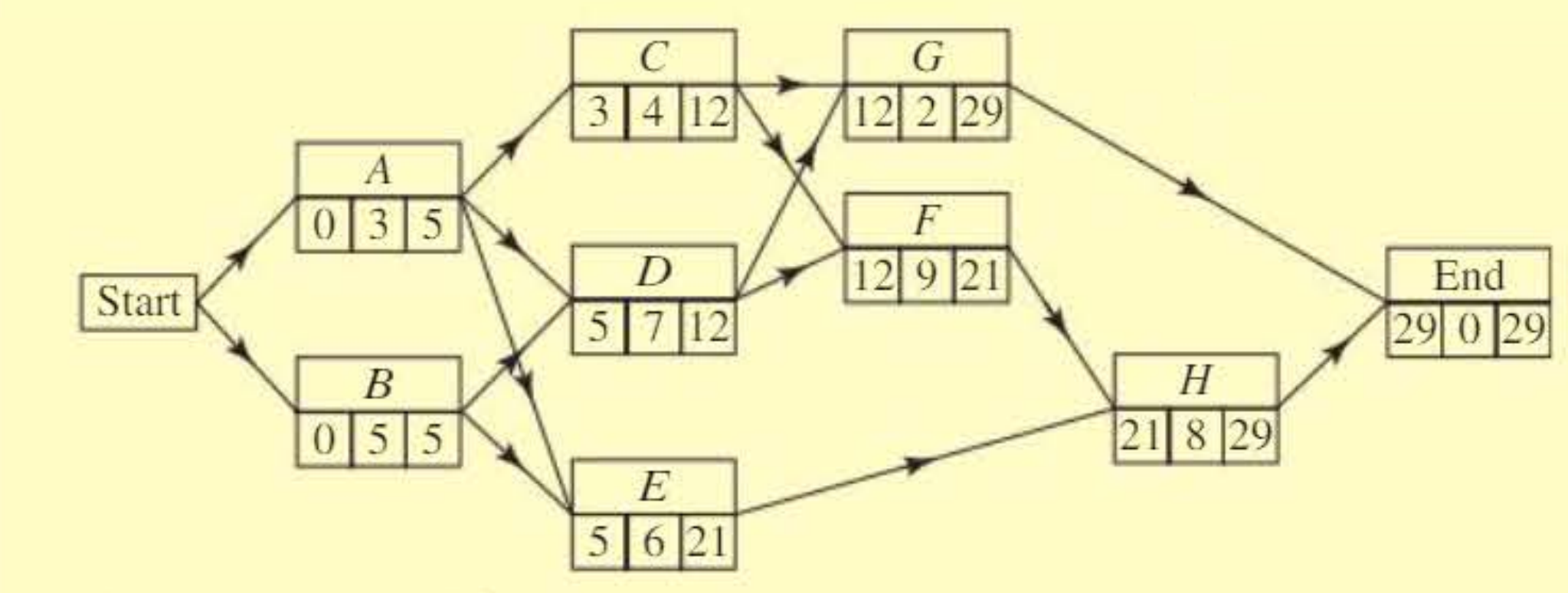
Part a: Find the project duration if all goes to plan.
After performing forward and backward passes, the duration is 29 days.
Part b: Identify the critical path.
The critical activities are B, D, F and H (all with zero float).
The critical path is: B → D → F → H (duration: 5 + 7 + 9 + 8 = 29 days)
Part c: Activity C is delayed by 7 days. What effect does this have on the project duration?
Originally, activity C has a float of 2 days. This means C can be delayed by up to 2 days without affecting the project.
However, a 7-day delay exceeds the available float by 5 days (7 - 2 = 5).
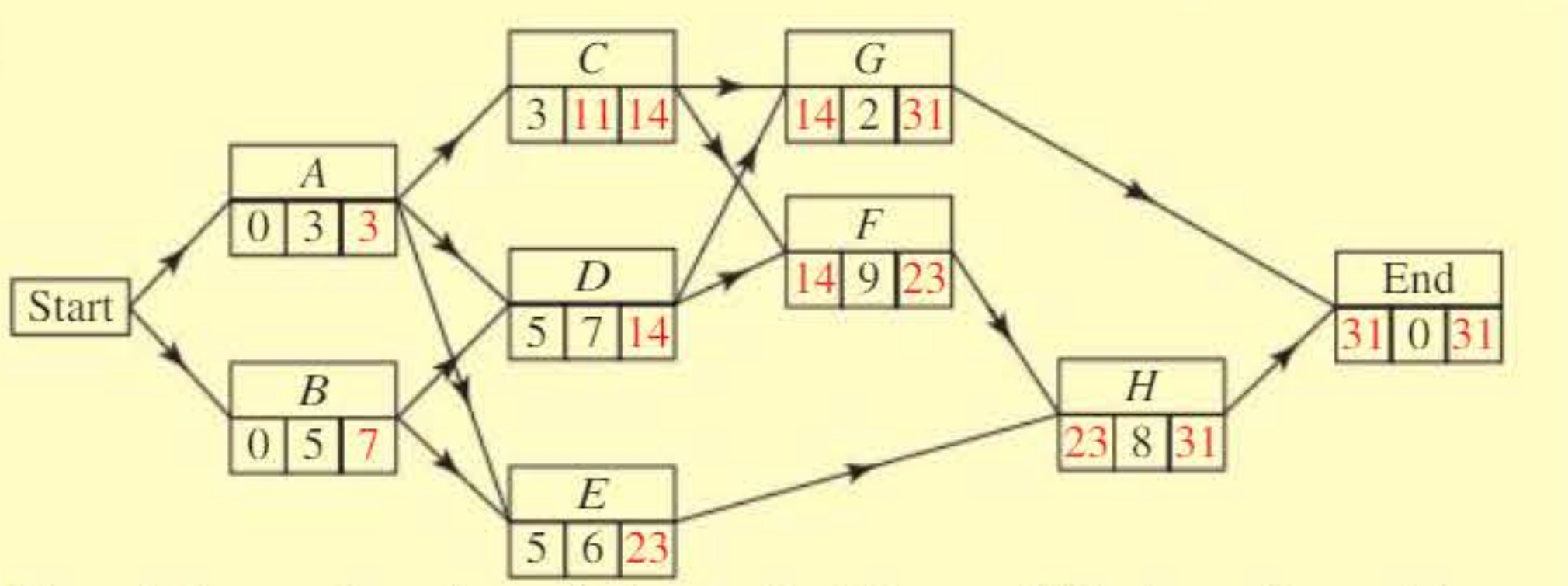
When we recalculate the network with C taking 11 days instead of 4 days:
- The new project duration becomes 31 days
- Activity A, which previously had 2 days of float, now becomes critical
- The critical path changes
Key insight: The minimum project duration increases by 2 days (from 29 to 31 days), not by the full 7-day delay, because C originally had 2 days of float that absorbed part of the delay.
Exam tips
Important
Common Pitfalls to Avoid
- Forgetting that projects can have multiple critical paths
- Only reducing one critical path when trying to shorten project duration
- Miscalculating float due to errors in forward or backward pass
- Confusing earliest start time with latest start time
Note
Key Exam Techniques
- Always complete forward pass first, then backward pass
- Check your float calculations for all activities
- If asked to reduce project time, identify ALL critical paths first
- Show your working clearly for float calculations
- Remember: critical activities have exactly zero float, not just low float
Time-saving Tips
- Start by identifying activities with no predecessors for forward pass
- Work systematically through the network
- Use a table to organise your float calculations
- Highlight or underline critical activities as you identify them
Remember!
Summary
Key Points to Remember:
- Float is spare time available for an activity: Float = (latest finish time - earliest start time) - duration
- Critical activities have zero float - any delay will delay the whole project
- A critical path is a sequence of critical activities from start to end
- Projects can have multiple critical paths - all must be considered together
- To reduce project duration, you must shorten activities on every critical path simultaneously
- Always perform forward pass (earliest times) then backward pass (latest times) before calculating float