Inequalities (AQA A-Level Further Maths): Revision Notes
📚Revision Notes
Inequalities
Introduction
Inequalities are mathematical statements that compare two expressions using symbols such as < (less than), > (greater than), ≤ (less than or equal to), or ≥ (greater than or equal to). Solving inequalities follows similar rules to solving equations, but there are two crucial differences:
-
Solutions are ranges of values - Unlike equations which typically have specific numerical solutions, inequalities have solution sets that are intervals or ranges of values.
-
Sign reversal with negative multiplication/division - When you multiply or divide both sides of an inequality by a negative number, you must reverse (flip) the direction of the inequality symbol.
These differences require extra care when working with inequalities, especially when dealing with negative numbers or more complex expressions.
Multiplying and dividing by negative numbers
When solving inequalities, you must be particularly careful to avoid incorrect assumptions when working with expressions involving negative numbers.
The sign reversal rule
Key rule: When you multiply or divide both sides of an inequality by a negative number, you must flip the inequality symbol.
For example:
- If , then (the inequality flips from > to <)
- If , then (dividing by positive 2, no flip)
- If , then (dividing by negative 2, so flip the sign)
Worked example: Negative denominator
Consider the inequality:
To solve this, multiply both sides by . Since is negative, you must reverse the inequality sign:
becomes
Rearranging:
Dividing by 7 (positive):
Therefore the solution is , which represents a range of values.
Squaring both sides of inequalities
A common mistake is assuming that if , then . This is not always true, and depends on whether the numbers are positive or negative.
Example 1: When squaring fails
Counterexamples:
-
If and , then is true. Squaring both sides: and , so ✓
-
However, if and , then is true. Squaring both sides: and , so ✗
The inequality direction reversed! This shows that squaring both sides does not always preserve the inequality relationship.
When expressions can be positive or negative, consider each case separately rather than automatically squaring both sides.
Solving rational inequalities algebraically
When solving inequalities involving fractions, you can multiply both sides by a positive expression without changing the inequality sign. If you need to multiply by an expression that could be negative, you must consider different cases.
Example 2: Quadratic inequality
Solve the inequality
Step 1: Multiply both sides by , which is always positive (so the inequality sign remains unchanged):
This simplifies to:
Step 2: Expand the brackets:
Step 3: Rearrange to standard form:
or
Step 4: Factorize and solve :
The solutions are and
Step 5: Use a sketch of the parabola to determine where the quadratic is positive:
Since the coefficient of is positive, the parabola opens upward. The quadratic is greater than or equal to zero when:
or
Note: We exclude from the solution because it makes the original denominator equal to zero, making the expression undefined.
Alternative method: If the inequality had been , you could multiply both sides by and consider the cases when is positive and negative separately.
Using sign charts
An alternative method for solving rational inequalities is to analyze the signs of the numerator and denominator separately. This method uses critical values - the values where the numerator or denominator equals zero.
For the expression :
- The numerator when
- The denominator when
These are the critical values. We now test each interval:
| Expression | |||
|---|---|---|---|
| -ve | -ve | +ve | |
| -ve | +ve | +ve | |
| +ve | -ve | +ve |
When both numerator and denominator have the same sign (both positive or both negative), the fraction is positive. When they have opposite signs, the fraction is negative.
Therefore when
Exam tip: Remember to include values where (where the graph intersects the x-axis) if the inequality is or .
Solving polynomial inequalities graphically
For polynomial inequalities, sketching the graph can help you quickly identify the solution regions.
Example 3: Cubic polynomial
Sketch the graph of and use it to solve:
i
ii
iii
Solution:
The polynomial is already factorized, so the x-intercepts (roots) are at , , and .
From the graph:
i when or or
ii when or
iii when or
Use the graph to identify where the curve is above the x-axis (positive) and below the x-axis (negative).
Solving rational function inequalities
When working with rational functions, analyze the signs of the numerator and denominator separately.
Example 4: Rational function sign analysis
For the function , find the values of x where:
i ii iii
Solution:
i when the numerator equals zero (and denominator is non-zero):
, so
ii For , the numerator and denominator must have the same sign.
-
If , the numerator is positive
-
For the denominator to also be positive,
-
Therefore: ✓
-
If , the numerator is negative
-
For the denominator to also be negative,
-
Therefore: ✓
Combining these: when or
iii For , the numerator and denominator must have opposite signs.
-
If , numerator is positive. For denominator to be negative,
-
This gives: ✓
-
If , numerator is negative. For denominator to be positive,
-
There is no value of x that satisfies both and , so no solutions here.
Therefore: when
From the graph, you can confirm these results by observing where the curve lies above and below the x-axis.
Key point: For Example 4, is the numerator's critical value (where it changes sign), and is the denominator's critical value. These are the boundary points between positive and negative regions.
Solving higher degree polynomial inequalities
For polynomials of degree 3 or higher, use factorization and sign analysis with critical values.
Example 5: Quartic polynomial
a Solve the inequality algebraically.
b Confirm your answer using a graph.
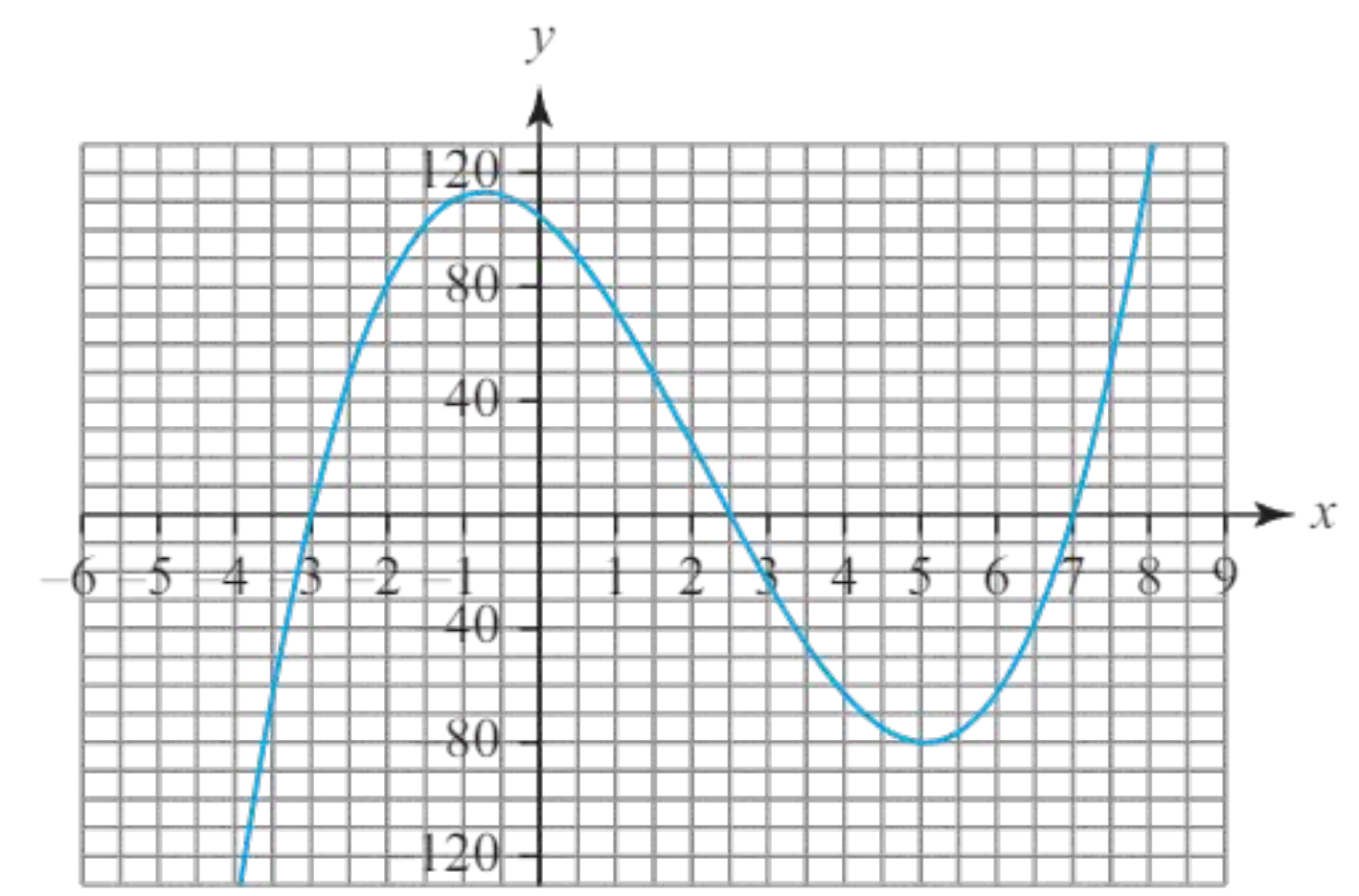
Solution:
a First, factorize the polynomial. Notice this is a quadratic in :
The critical values are where each factor equals zero:
Now analyze the signs in each interval:
- When : All four factors are negative, so is positive
- When : Three factors negative, one positive, so is negative
- When : Two factors negative, two positive, so is positive
- When : One factor negative, three positive, so is negative
- When : All four factors are positive, so is positive
Since the inequality is , we include the critical points where :
Solution: or or
b The graph confirms this result. The curve intersects or is above the x-axis for the ranges we found.
Exam tip: Reorder the brackets by size of root to make sign analysis easier:
Finding conditions for real roots
Sometimes you need to determine when a function has real roots, which involves solving inequalities with the discriminant.
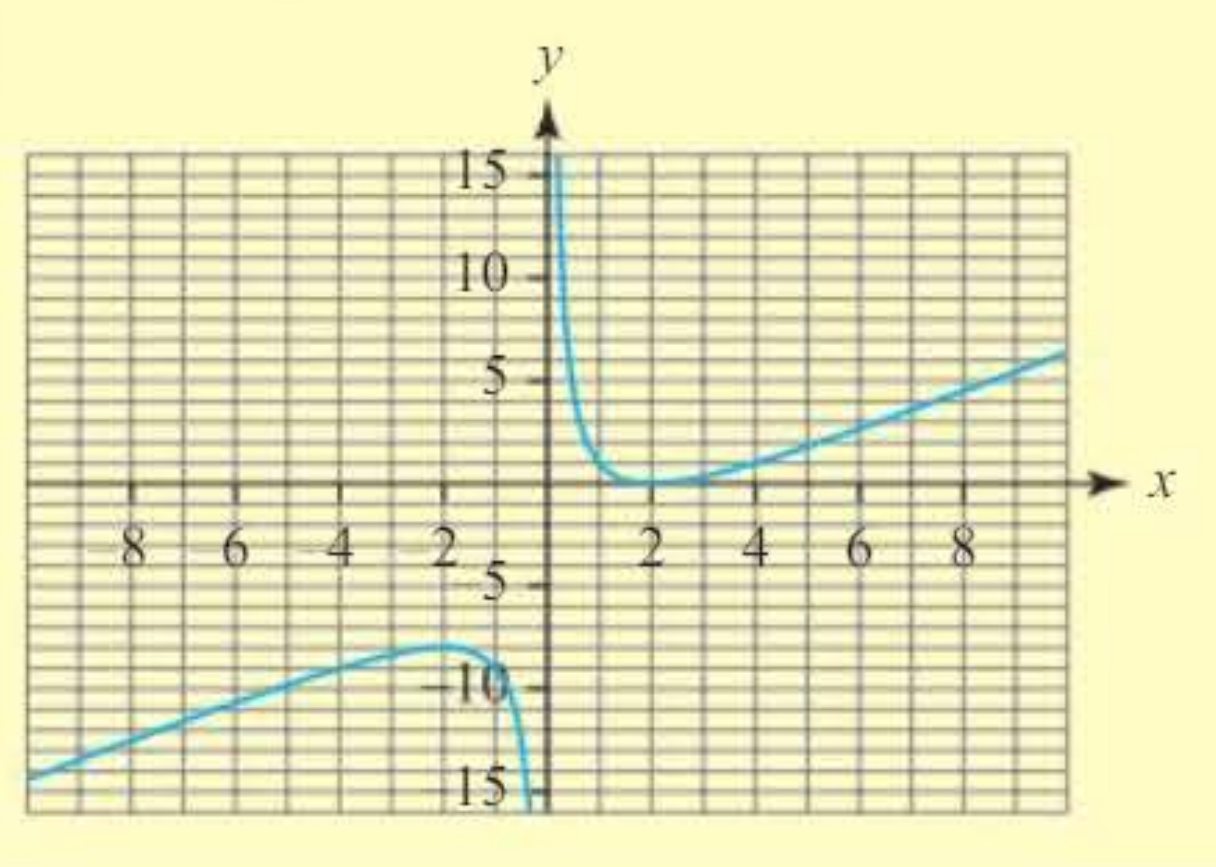
Example 6: Discriminant conditions
The function intersects the straight line
a Form a quadratic equation in x and k
b Find the values of k for which f(x) has real roots.
c Confirm your answer using a graph.
Solution:
a Setting :
Multiply both sides by x:
Rearrange:
b For real roots, the discriminant must be non-negative:
For this product to be non-negative, either both factors must be positive or both must be negative:
- Both positive: and , which gives
- Both negative: and , which gives
Therefore: has real roots if or
c From the graph of , you can see that x only has real roots when or , confirming our algebraic solution.
Solving double inequalities
A double inequality involves finding values that satisfy two inequality conditions simultaneously.
Example 7: Compound inequality
Find the values of x for which
Solution:
We need to solve two separate inequalities and then find values that satisfy both.
Part 1: Consider
The critical values are (numerator zero) and (denominator zero).
Test the sign in each interval:
- For : is negative
- For : is positive
- For : is negative
Therefore when
(Note: We don't include as the expression is undefined there)
Part 2: Consider
When , the denominator is positive, so we can multiply both sides by without reversing the inequality:
When , the denominator is negative, so we must reverse the inequality when multiplying:
But this contradicts our condition , so this gives us as the solution for this case.
Therefore when or
Combining both conditions:
We need values that satisfy both AND ( or )
The overlap is: or
But since is not in the range , we only keep the first part.
Final solution: when
Key strategy: For double inequalities, solve each part separately, then find the intersection of the solution sets.
Summary
Remember!
-
Solutions to inequalities are ranges of values, not individual numbers - always express your answer as an interval or union of intervals.
-
Flip the inequality sign when multiplying or dividing by a negative number - this is the most common error in inequality problems, so check carefully.
-
Use critical values to analyze sign changes - identify where numerators and denominators equal zero, then test the sign in each interval between critical values.
-
Sketching graphs helps visualize solutions - for polynomial and rational inequalities, a quick sketch shows you immediately where the function is positive or negative.
-
For inequalities with ≥ or ≤, include boundary points where f(x) = 0 - but exclude points where the expression is undefined (denominator = 0).