Modulus-Argument Form and Loci (AQA A-Level Further Maths): Revision Notes
📚Revision Notes
Modulus-Argument Form and Loci
Understanding modulus and argument
When working with complex numbers on an Argand diagram, we can describe their position in two important ways.
Modulus is the distance from the origin to the point representing the complex number. For a complex number , the modulus is calculated using:
Note
This formula comes from Pythagoras' theorem, treating the complex number as a vector from the origin. The real part and imaginary part form the two perpendicular sides of a right triangle, with the modulus being the hypotenuse.
Argument is the angle measured anticlockwise from the positive real axis to the line representing the complex number. We write the argument as , where the principal argument satisfies:
Important
The argument is always measured in radians, where radians equals . The principal argument must lie in the range . This means:
- Angles above the real axis are positive (between and )
- Angles below the real axis are negative (between and )
- Always check which quadrant your complex number is in to determine the correct sign
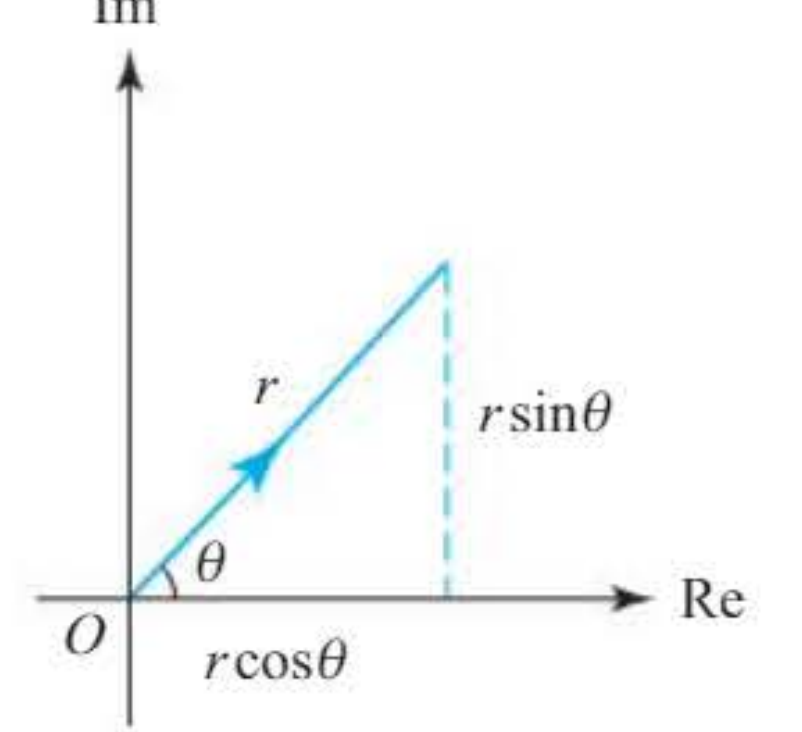
The diagram above shows how the real component equals and the imaginary component equals .
Modulus-argument form
Instead of writing complex numbers in Cartesian form , we can express them using their modulus and argument.
The modulus-argument form (also called polar form) of the complex number is given by:
where is the modulus of and is the argument.
Note
Converting between forms:
To convert from Cartesian form to modulus-argument form:
- Calculate the modulus using
- Find the argument using , ensuring the angle is measured with the positive real axis
- Check which quadrant the complex number lies in to get the correct argument
- Write in the form
To convert from modulus-argument form to Cartesian form:
- Use for the real part
- Use for the imaginary part
Example
Worked Example: Converting to modulus-argument form
Let's convert to modulus-argument form.
Step 1: Find the modulus:
Step 2: Find the argument. We calculate:
Step 3: Since the complex number is in the fourth quadrant (positive real part, negative imaginary part), the argument measured clockwise from the positive real axis is negative:
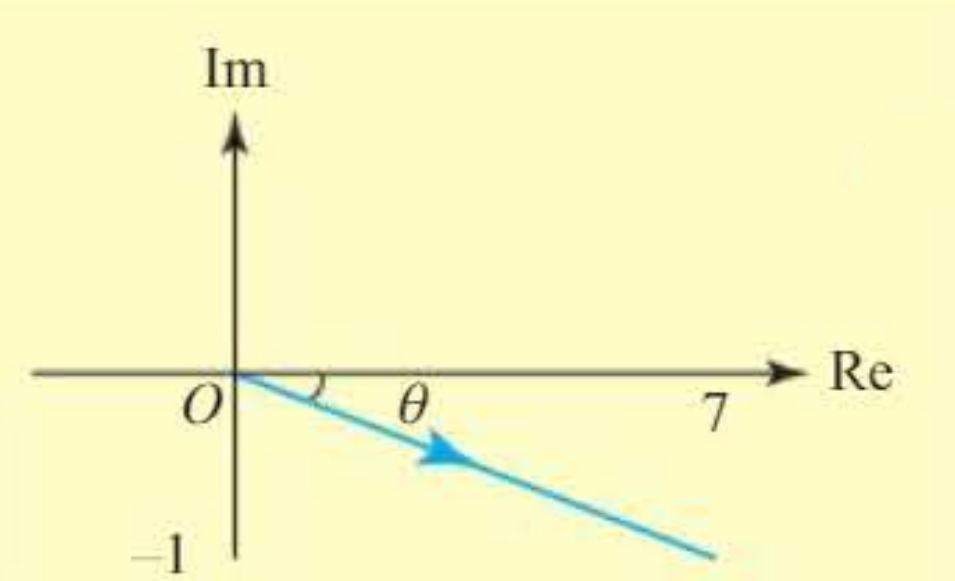
Step 4: Therefore, the modulus-argument form is:
Exam tip: Always ensure your argument is in the correct range . Draw a quick sketch to verify which quadrant your complex number is in.
Example
Worked Example: Finding argument and modulus of a product
Given that and , find the argument and modulus of .
Step 1: Find :
Step 2: Find :
Step 3: Using the property :
Step 4: For the argument, we can use a calculator to find:
Step 5: Using the property :
Properties of modulus and argument
These properties are essential for working with products and quotients of complex numbers.
For any complex numbers :
Modulus properties:
Argument properties:
Note
These properties make multiplication and division much easier in modulus-argument form compared to Cartesian form. For multiplication, you simply multiply the moduli and add the arguments. For division, you divide the moduli and subtract the arguments.
A helpful mnemonic: "Modulus Multiplies, Argument Adds" for products!
Understanding scalar multiplication
When we multiply a complex number by a real scalar, the modulus is scaled but the argument can change depending on the sign.
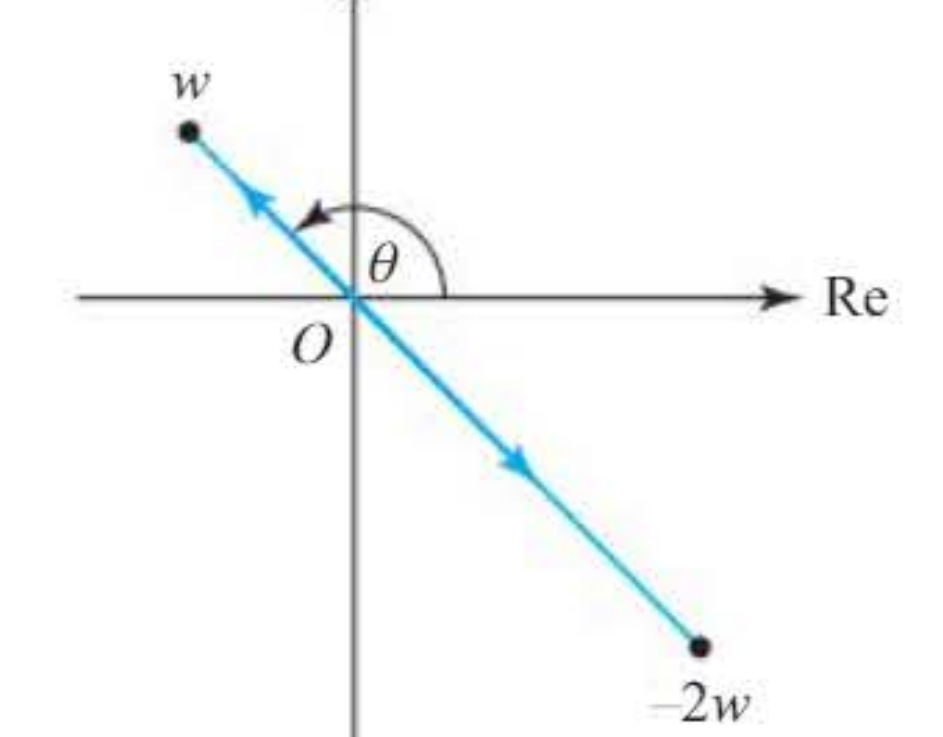
From the diagram showing and , we can see that:
- (the modulus doubles)
- (multiplying by a negative number rotates by radians)
Let and .
Then
The proof shown demonstrates these properties algebraically using modulus-argument form. The key steps involve writing both numbers in polar form, expanding brackets using the fact that , and separating real and imaginary parts.
Loci in the complex plane
A locus (plural: loci) is the set of points satisfying a given condition. We can draw several important types of loci on an Argand diagram.
Circle loci
The equation represents all points at distance 4 from the origin.
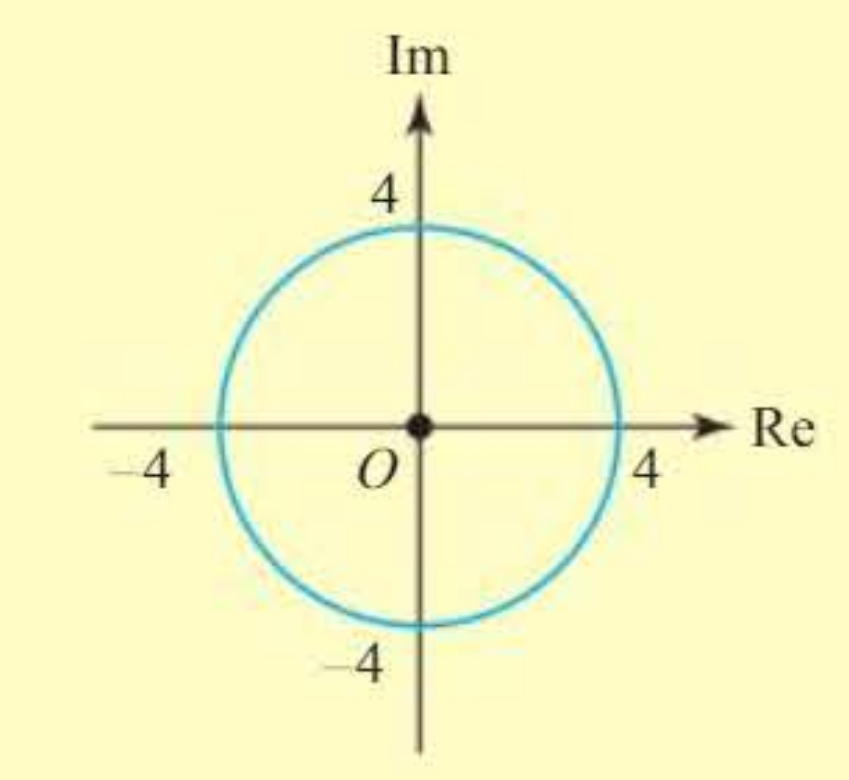
This forms a circle centered at the origin with radius 4.
More generally, the locus of points satisfying is a circle with center and radius .
Note
The expression represents the distance from point to point . When this distance is constant, we get a circle. This is exactly like the definition of a circle in geometry: all points at a fixed distance from a center.
Remember: "Circle = Constant Distance"
Example
Worked Example: Sketching a circle locus
Sketch the locus of points that satisfy .
Step 1: Rewrite in the standard form :
Step 2: This tells us the locus is a circle with:
- Center at , which is the point on the Argand diagram
- Radius
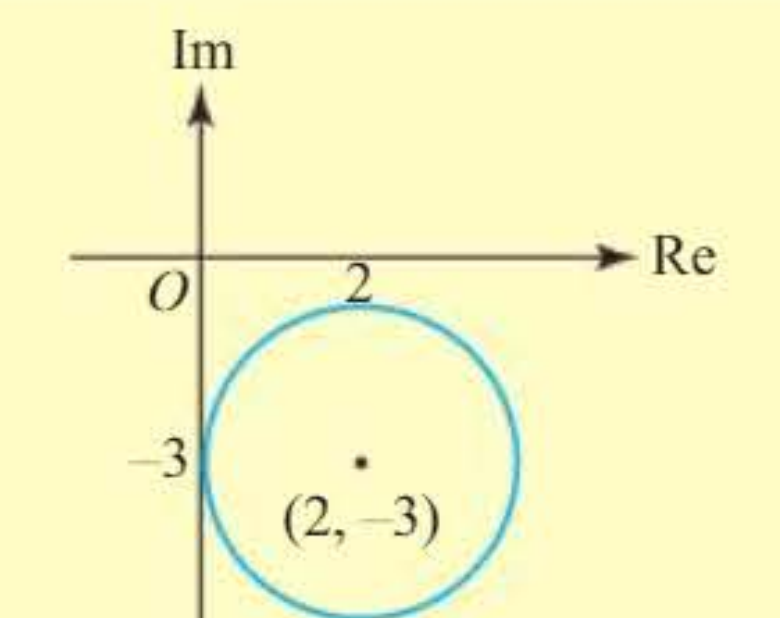
Exam tip: When you see , immediately identify it as a circle. The point inside the modulus (with opposite signs) is the center.
Half-line loci
The equation represents all points that make an angle of with the positive real axis.
This forms a half-line (or ray) from the origin at the specified angle.
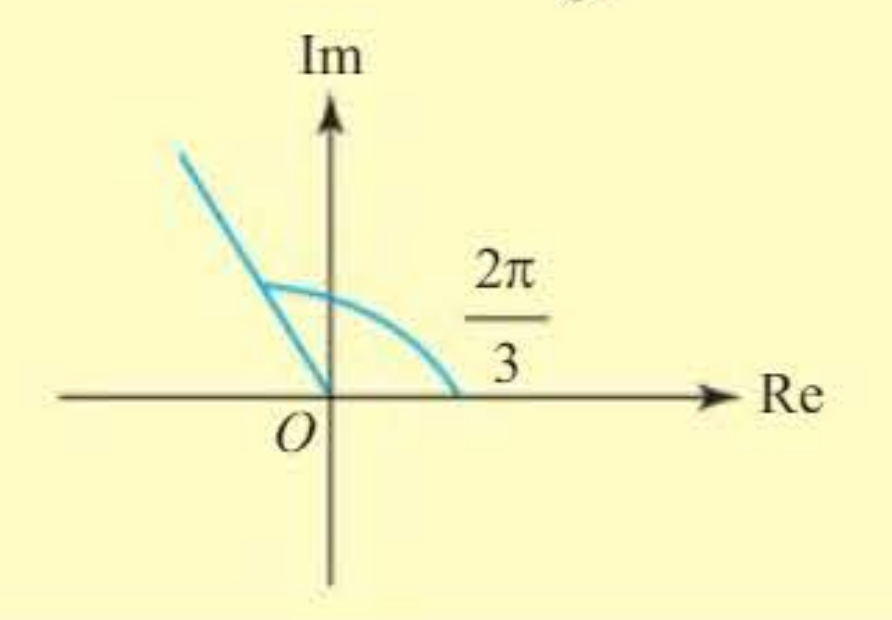
More generally, the locus of points satisfying is a half-line from the point at an angle of to the positive real axis.
Important
The half-line starts at but does not include that point itself (since the argument is undefined at the starting point). Always use an open circle to indicate this when sketching.
Remember: "Half-line = Fixed Angle"
Example
Worked Example: Sketching a half-line locus
Sketch the locus of where .
Step 1: Rewrite in the standard form :
Step 2: This tells us:
- The half-line starts at the point , which is
- The angle with the positive real axis is
Step 3: Draw a horizontal line in the positive real direction from , then rotate it anticlockwise by radians.
Exam tip: The notation means "the angle from to ". Start at and draw the ray at angle .
Perpendicular bisector loci
The locus of points satisfying consists of all points equidistant from two fixed points and .
This is the perpendicular bisector of the line segment joining and .
Note
This makes intuitive sense: if a point is the same distance from two different points, it must lie on the perpendicular bisector. Remember: "Perpendicular bisector = Equal distances"
Example
Worked Example: Sketching a perpendicular bisector
Sketch the locus of points satisfying .
Step 1: Rewrite in standard form:
Step 2: This means the locus includes all points equidistant from (the point ) and (the point ).
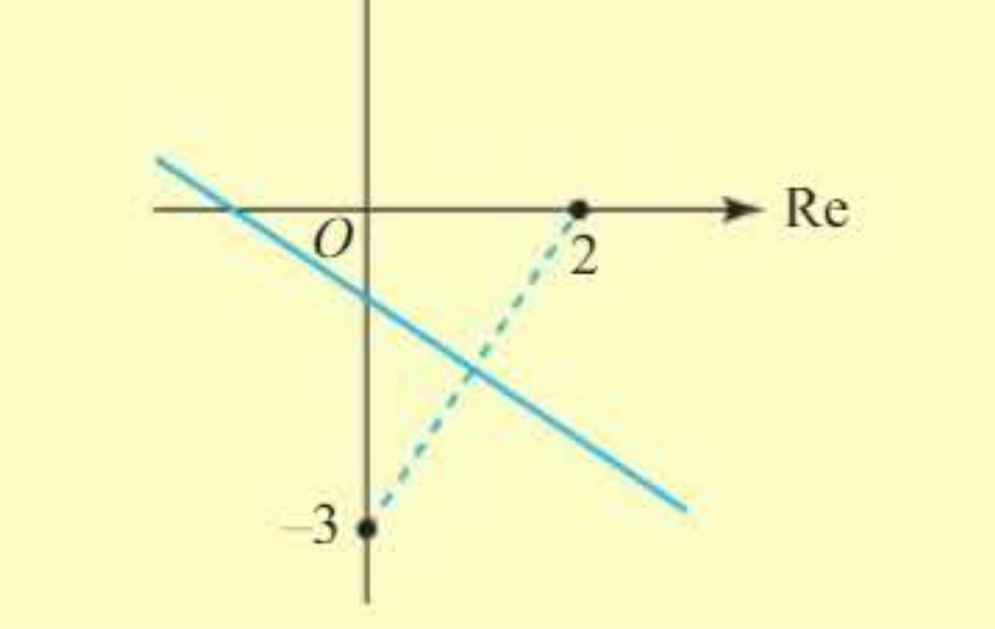
Step 3: Plot both points and connect them with a dotted line. The locus is the perpendicular bisector of this line segment.
Regions bounded by loci
We can use inequalities to describe regions on the Argand diagram.
For modulus inequalities:
- represents the interior of a circle (points closer than to )
- represents the exterior of a circle (points farther than from )
- or include the boundary circle
For argument inequalities:
- represents points below the half-line
- represents points above the half-line
- Strict inequalities ( or ) mean the boundary is not included (shown with a dotted line)
Important
Method for shading regions:
- Sketch the locus of the boundary
- Test a convenient point (often the origin) to see if it satisfies the inequality
- Shade the correct region based on your test
- Use dotted lines for strict inequalities ( or ) and solid lines for inclusive inequalities ( or )
Testing a point is crucial—don't guess which region to shade!
Example
Worked Example: Shading regions
Part 1: Shade the region where .
Step 1: The boundary is a circle with center and radius 3.
Step 2: Test the origin: , which is greater than 3, so the origin satisfies the inequality.
Step 3: Since we want , shade the exterior of the circle (including the boundary with a solid line).
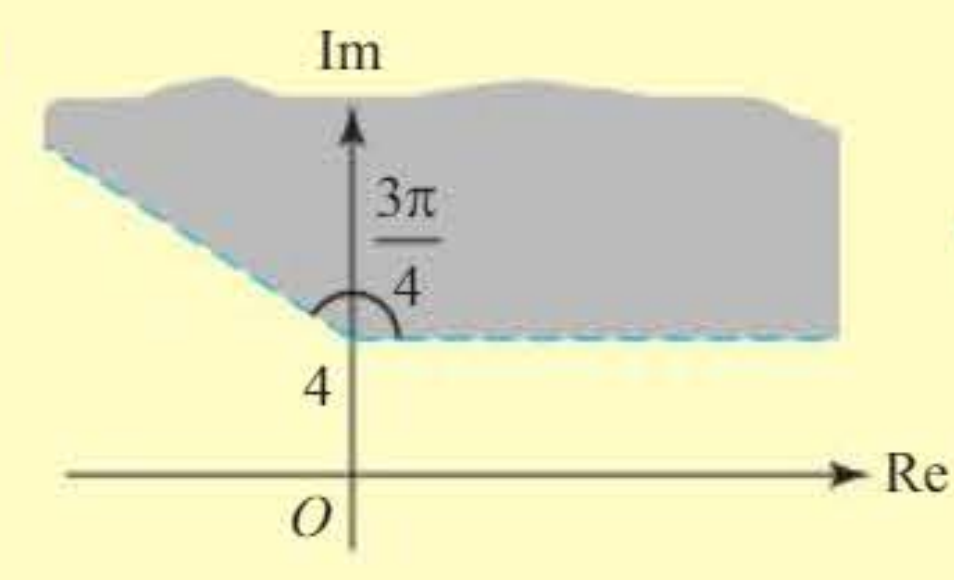
Part 2: For the region where :
Step 1: The boundaries are half-lines from the point . One boundary is at angle 0 (the positive real direction) and the other at angle .
Step 2: Test the origin: , which is outside the required range.
Step 3: Shade the wedge-shaped region between the two half-lines, excluding the boundaries (use dotted lines) and excluding the point .
Finding Cartesian equations of loci
You can convert locus equations to Cartesian form by substituting .
Note
Method for finding Cartesian equations:
- Write as
- Calculate the modulus of the left-hand side
- For argument conditions, use to form an equation
- Rearrange to the required form
This method allows you to express complex loci as familiar equations in and .
Example
Worked Example: Circle locus to Cartesian form
Find the Cartesian equation of .
Step 1: Let :
Step 2: Simplify:
Step 3: Find the modulus:
Step 4: Square both sides:
This is the equation of a circle with center and radius .
Example
Worked Example: Half-line locus to Cartesian form
Find the Cartesian equation of .
Step 1: Let :
Step 2: Since :
Step 3: Rearranging:
Since the locus is a half-line, we only need the part where and (based on the angle and starting point).
Exam tip: When finding Cartesian equations of half-lines, remember to state any restrictions on and that define which part of the line forms the half-line.
Summary
Key Points to Remember:
-
Modulus measures distance from the origin; argument measures angle with the positive real axis, where .
-
Modulus-argument form is , where and . This form is particularly useful for multiplication and division.
-
Key properties: , , and similar rules for division. These properties make calculations with products and quotients much simpler. Remember: "Modulus Multiplies, Argument Adds"
-
Common loci:
- is a circle (center , radius )
- is a half-line (from at angle )
- is the perpendicular bisector
-
For regions: Test a point to determine which side of the boundary to shade. Use solid lines for or and dotted lines for or .