Exponential Form (AQA A-Level Further Maths): Revision Notes
📚Revision Notes
Exponential Form
Understanding exponential form
Exponential form is a powerful way to represent complex numbers using the exponential function. This form connects complex numbers with trigonometric functions through one of mathematics' most elegant formulas.
A complex number can be written in modulus-argument form as:
where (the modulus) and (the argument).
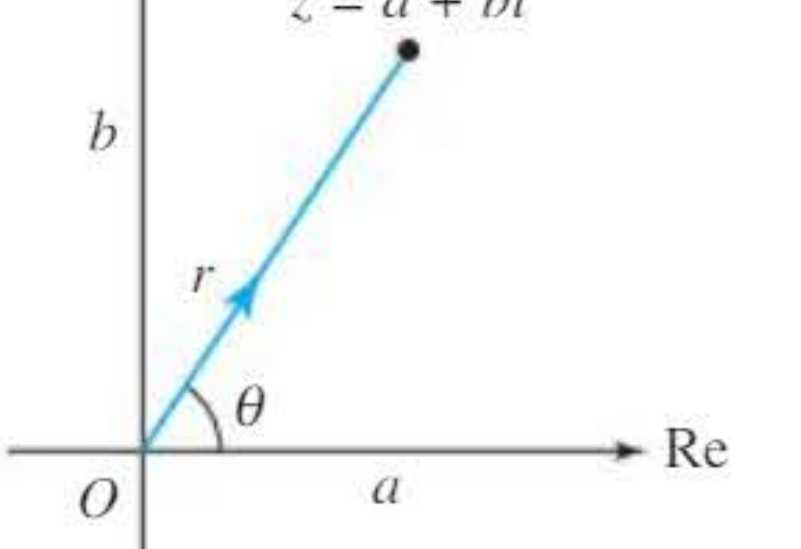
This representation can be further simplified using exponential form, which we'll explore in this note.
Note
The exponential form is particularly useful for multiplication and division of complex numbers, as well as for finding powers and roots. It also provides elegant connections to trigonometry through Euler's formula.
Deriving Euler's formula
To understand exponential form, we start with the Maclaurin series expansions for , , and :
Now, consider the expression
We can rearrange this by grouping terms:
Note
Notice how we're grouping terms with the same powers together. This rearrangement is key to revealing the connection to the exponential function. Watch how the powers of create alternating signs that match the original series.
Notice that this can be rewritten as:
This works because , , , and so on.
The series we've obtained is the Maclaurin expansion of . This leads us to Euler's formula.
Euler's formula
Important
Euler's formula is one of the most important formulas in mathematics:
Equivalently, for a complex number with modulus :
This formula connects exponential functions, trigonometric functions, and complex numbers in a profound way.
Exponential form definition
Using Euler's formula, we can write any complex number in exponential form:
where:
- is the modulus of
- is the argument of , with
This is the exponential form (or Euler form) of a complex number.
Important
Critical Range Requirement: The range for the argument must be (the principal argument). Using values outside this range will result in incorrect representations.
Converting from exponential form to Cartesian form
To convert from exponential form to Cartesian form , use Euler's formula. The key step is to expand using the relationship , then evaluate the trigonometric functions.
Example
Worked Example 1: Converting to Cartesian form
Question: Write in the form .
Solution:
First, convert to modulus-argument form using Euler's formula:
Now evaluate the trigonometric functions:
Simplify by distributing the 2:
Answer:
Note
Exam tip: Remember to use Euler's formula first, then evaluate the trigonometric values carefully. Check your angle is in radians.
Converting from Cartesian form to exponential form
To convert from Cartesian form to exponential form , follow these steps:
- Calculate the modulus:
- Sketch an Argand diagram to visualize the complex number
- Find the argument: Use and adjust based on the quadrant
- Ensure the argument is in the correct range:
- Write in exponential form:
Example
Worked Example 2: Converting to exponential form
Question: Write in exponential form.
Solution:
Step 1: Calculate the modulus of :
Step 2: Draw an Argand diagram. The point is in the fourth quadrant.
Step 3: Find the reference angle:
Step 4: Since the point is in the fourth quadrant, the argument is:
This is already in the required range .
Step 5: Write in exponential form:
Answer:
Important
Avoiding Sign Errors: Always check which quadrant your complex number is in to get the correct sign for the argument. Drawing a quick sketch helps avoid sign errors.
Trigonometric functions in exponential form
Euler's formula can be rearranged to express trigonometric functions in terms of exponentials. These formulas are incredibly useful for proving trigonometric identities.
Key formulas
These follow directly from Euler's formula and its conjugate:
Adding these gives:
Subtracting gives:
Strategy for proving trigonometric identities
Note
Strategy for Using Exponential Form:
When using exponential form to prove trigonometric identities:
- Use Euler's formula: Express and in terms of and
- Apply symmetry properties: Use and
- Substitute exponential forms: Replace all trigonometric functions with their exponential equivalents
- Use index laws: Simplify using laws of exponents (, etc.)
This systematic approach often makes complex trigonometric proofs much more straightforward.
Example
Worked Example 3: Proving the cosine formula
Question: Prove that
Solution:
Step 1: Start with Euler's formula:
Step 2: Write the formula for :
Since and :
Step 3: Add the two equations:
Step 4: Rearrange to isolate :
This completes the proof.
Note
Exam tip: In proofs, clearly state which formula or property you're using at each step. This shows the examiner your logical reasoning.
Example
Worked Example 4: Proving the double angle formula
Question: Prove that
Solution:
Step 1: Write and in terms of exponentials:
Step 2: Expand the brackets:
Step 3: Multiply out using the difference of squares pattern:
Step 4: Simplify:
Step 5: Recognize this as the exponential form of :
Therefore, , as required.
Important
Watch Your Signs: When expanding products of exponentials, be careful with signs. The imaginary unit in the denominator affects the final form, and sign errors are common in exam settings.
Working with products and quotients in exponential form
When complex numbers are in exponential form, multiplication and division become straightforward:
Multiplication: If and , then:
Division: If and , then:
Note
This makes exponential form particularly convenient for calculations involving products and quotients of complex numbers. Simply multiply or divide the moduli and add or subtract the arguments - much easier than working in Cartesian form!
Summary
Summary
Key Points to Remember:
-
Euler's formula is , connecting exponential and trigonometric functions.
-
Exponential form writes a complex number as , where and with .
-
To convert from exponential to Cartesian form, use Euler's formula and evaluate the trigonometric functions.
-
To convert from Cartesian to exponential form, calculate the modulus, find the argument (using a diagram), and write as .
-
Trigonometric functions in exponential form are and , which are powerful tools for proving identities.
-
For products and quotients, exponential form simplifies calculations by allowing you to multiply/divide moduli and add/subtract arguments.