Roots of Unity (AQA A-Level Further Maths): Revision Notes
📚Revision Notes
Roots of Unity
What are roots of unity?
An important principle in mathematics states that an equation of order must have exactly solutions. When we consider the equation , the solutions to this equation are called the nth roots of unity.
Definition: The nth roots of unity are the distinct complex numbers that satisfy the equation .
Note
These roots have a special property - they all lie on the unit circle in the complex plane (they all have modulus 1) and are evenly spaced around the circle.
The cube roots of unity
Let's start with a simple example: finding the cube roots of unity by solving .
For , we can square root both sides to get .
This gives us:
- If , then or
- If , then or
So there are four solutions because the equation has order 4.
For , one solution is clearly (the real root). However, there must be three cube roots of 1 in total - one real and two complex. These three solutions are called the cube roots of unity.
General formula for nth roots of unity
We can use the exponential form of a complex number to solve equations of the form systematically.
Important
Key Formula: The equation has solutions of the form:
where .
This formula works because:
- Any positive real number has argument 0, or , or , etc.
- In general, the argument can be written as where is an integer
- The modulus of 1 is simply 1
Why does the formula work?
Since 1 can be written as (using Euler's formula with modulus 1 and argument ), we have:
Taking the nth root of both sides:
Note
We only need values of from 0 to because values beyond this just repeat the same solutions.
Worked example: finding the 6th roots of unity
Example
Worked Example: Finding the 6th Roots of Unity
Problem: Find all solutions to the equation , giving your answers in Cartesian form.
Solution:
First, write 1 in exponential form:
Taking the 6th root of both sides:
Now we consider each possible value of from 0 to 5:
For :
For :
For :
For :
For :
For :
Geometric representation on an Argand diagram
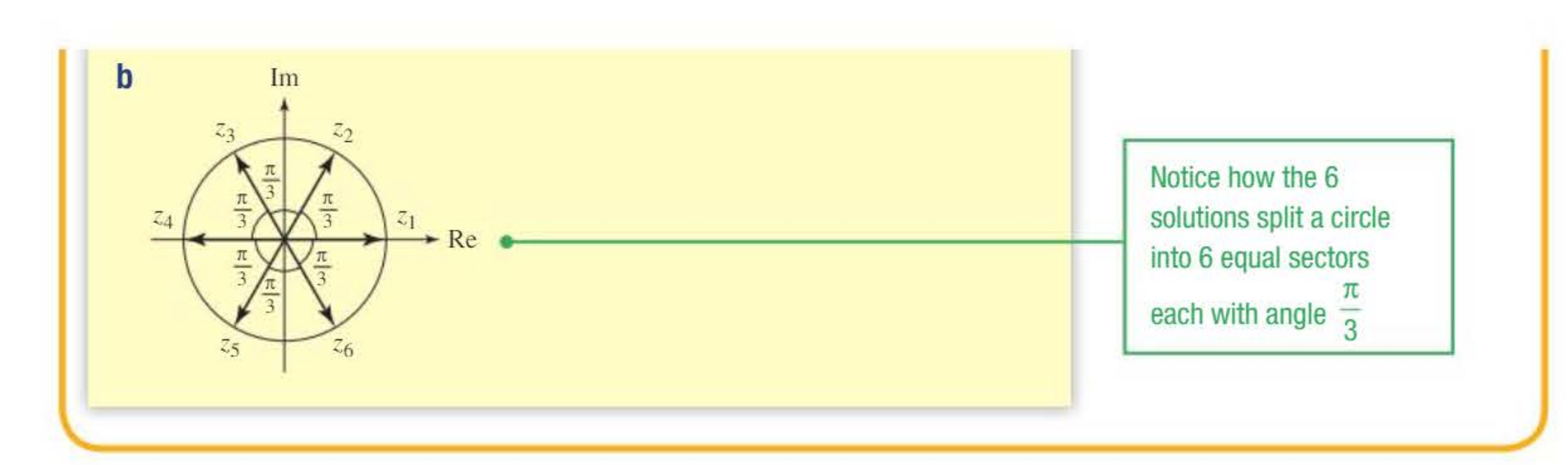
When we plot the roots of unity on an Argand diagram, we observe a beautiful pattern.
Note
Key Observation: The 6 solutions split the unit circle into 6 equal sectors, each with angle (or ).
In general, the roots of unity are evenly distributed around the unit circle, with each adjacent pair separated by an angle of radians.
This geometric property makes roots of unity particularly useful for solving problems involving regular polygons and circular symmetry.
Finding nth roots of any complex number
The method can be extended to find the nth roots of any complex number, not just 1.
Important
General Approach:
- Write the complex number in exponential form:
- The general argument is where is an integer
- Take the nth root:
- Consider values of from 0 to to find all distinct roots
Worked example: finding 4th roots
Example
Worked Example: Finding the 4th Roots of a Complex Number
Problem: Solve the equation , giving your answers in the form where and .
Solution:
Step 1: Find the modulus and argument of :
Modulus:
Argument: (since the complex number is in the fourth quadrant)
Step 2: Write in general form.
In general, the argument is
Therefore:
Step 3: Take the 4th root:
Step 4: Find all solutions.
Now consider each value of from 0 to 3:
For :
For :
For :
For :
Step 5: Adjust to required interval.
The final solution for is not in the required interval . Since , we need to subtract :
So the final answer uses: for .
Important property: sum of roots of unity
A crucial property of roots of unity is that they sum to zero.
Important
Key Result: If is a complex th root of unity, then:
This result can be quoted directly in exam questions without proof.
Proof using geometric series
If is an th root of unity, then the expression forms a geometric series with:
- First term
- Common ratio
- Number of terms
Using the geometric series formula :
Since is an th root of unity, we know that .
Therefore:
Problem-solving strategies
Strategy 1: using properties of roots of unity
When finding complex solutions to equations, follow these steps:
- Expand brackets or simplify fractions - Rearrange the equation into a manageable form
- Use the fact that if is an th root of unity
- Use the sum formula
Example
Worked Example: Using Properties of Roots of Unity
You are given that is a complex 4th root of unity.
a) Show that
This is a geometric series with first term 1 and common ratio .
Using the formula:
Since is a 4th root of unity, .
Therefore:
b) Evaluate
Expanding the brackets:
Rearranging:
From part (a), we know , so:
Wait, let me recalculate this more carefully:
Since , we have .
But using the result from part (a):
Actually, looking at the original more carefully:
But we need to be more careful. Since , we know .
Actually from the image: the final answer is 1, achieved by noting that and .
Strategy 2: solving geometric problems
To solve geometric problems involving roots of unity:
- Write in exponential form
- Find the roots of the equation
- Sketch an Argand diagram showing the roots
- Use Pythagoras' theorem or trigonometry to find lengths and areas
Example
Worked Example: Geometric Problems with Roots of Unity
The points , , and represent the solutions to the equation . Calculate the exact area and perimeter of triangle .
Solution:
Step 1: Write in exponential form.
We need to write in exponential form:
In general, the argument is , so:
Step 2: Find the roots.
Taking the cube root of both sides:
For : (Point )
For : (Point )
For : (Point )
Step 3: Sketch the Argand diagram.
The three points form a triangle:
- is at
- is at
- is at
Step 4: Calculate area and perimeter.
The triangle has a horizontal base from to .
Base length:
Height: The perpendicular distance from at to the line is
Area: square units
For the perimeter, we need (which equals by symmetry):
Perimeter: units
Exam tips
Important
Essential Exam Tips:
-
Remember the formula: The nth roots of unity are where
-
Check your range: When expressing answers in the form , make sure is in the required interval (usually )
-
Count your solutions: An equation of order must have exactly solutions. If you find fewer, you've missed some!
-
Use the sum property: The result can be quoted without proof
-
Sketch diagrams: For geometric problems, always sketch an Argand diagram to visualise the roots
-
Watch your arithmetic: When finding arguments, be careful with the quadrant and signs
Summary
Summary
Key Points to Remember:
-
The nth roots of unity are the solutions to , given by where
-
All roots of unity lie on the unit circle (modulus = 1) and are evenly spaced by angles of radians
-
The sum of all nth roots of unity equals zero: (you can quote this result)
-
To find nth roots of any complex number: write it in exponential form, then use
-
For geometric problems, sketch an Argand diagram and use Pythagoras' theorem or trigonometry to find lengths and areas