Hyperbolic Functions 1 (AQA A-Level Further Maths): Revision Notes
📚Revision Notes
Hyperbolic Functions 1
Introduction to hyperbolic functions
Hyperbolic functions are a family of functions that share similarities with trigonometric functions, but instead of producing points on a circle, they generate points on a hyperbola. While plotting points of the form for creates a circle, plotting points of the form produces a hyperbola.
These functions are called hyperbolic functions because of this geometric property. Unlike trigonometric functions which are defined using angles and ratios in right-angled triangles, hyperbolic functions are defined using exponential expressions. This makes them particularly useful in many areas of mathematics and physics, including calculus and modelling real-world phenomena.
Note
The three main hyperbolic functions are pronounced in a specific way to distinguish them from regular trigonometric functions:
- sinh is pronounced "shine" (not "sin-h")
- cosh is pronounced "cosh" (rhymes with "gosh")
- tanh is pronounced "tanch" or "than" (not "tan-h")
These pronunciations are universally recognized in mathematics and physics.
Definitions of hyperbolic functions
The hyperbolic functions are defined using the exponential function . These exponential definitions are fundamental and must be memorised, as they form the basis for all work with hyperbolic functions.
Important
Key Definitions
Hyperbolic sine:
Hyperbolic cosine:
Hyperbolic tangent:
Notice that sinh uses a subtraction in the numerator whilst cosh uses addition. This difference is crucial and affects their properties. The tanh function can be expressed either as the ratio of sinh to cosh, or directly in exponential form.
Example
Worked Example: Evaluating Hyperbolic Functions
Let's calculate exact values using these definitions.
a) Find tanh 0
Using the definition of tanh:
b) Find sinh(ln 3)
Using the definition of sinh:
Remember that , so:
These examples show how logarithm laws and exponential properties work together with the hyperbolic function definitions.
Graphs of hyperbolic functions
Understanding the shape and properties of hyperbolic function graphs is essential for curve sketching and solving equations. Each of the three main hyperbolic functions has distinct characteristics that reflect their exponential definitions.
The graph of y = cosh x
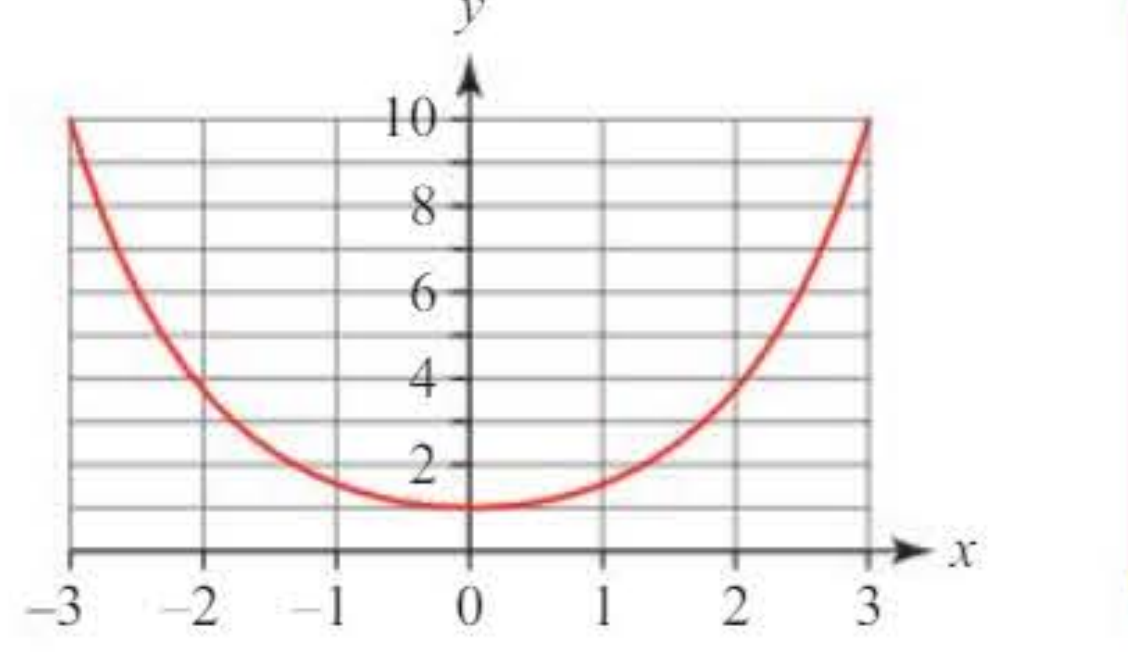
The hyperbolic cosine function creates a U-shaped curve with the following properties:
Note
Key Properties of y = cosh x
- The curve has a minimum point at (0, 1), which means
- For all values of , we have (the function is always at least 1)
- The curve is symmetrical about the y-axis, meaning cosh is an even function:
- As increases (positively or negatively), the function grows exponentially
- The shape resembles a hanging cable or chain, known as a catenary
This U-shape occurs because cosh combines exponential growth in both positive and negative directions. The symmetry about the y-axis is a direct consequence of the addition of and in the definition.
The graph of y = sinh x
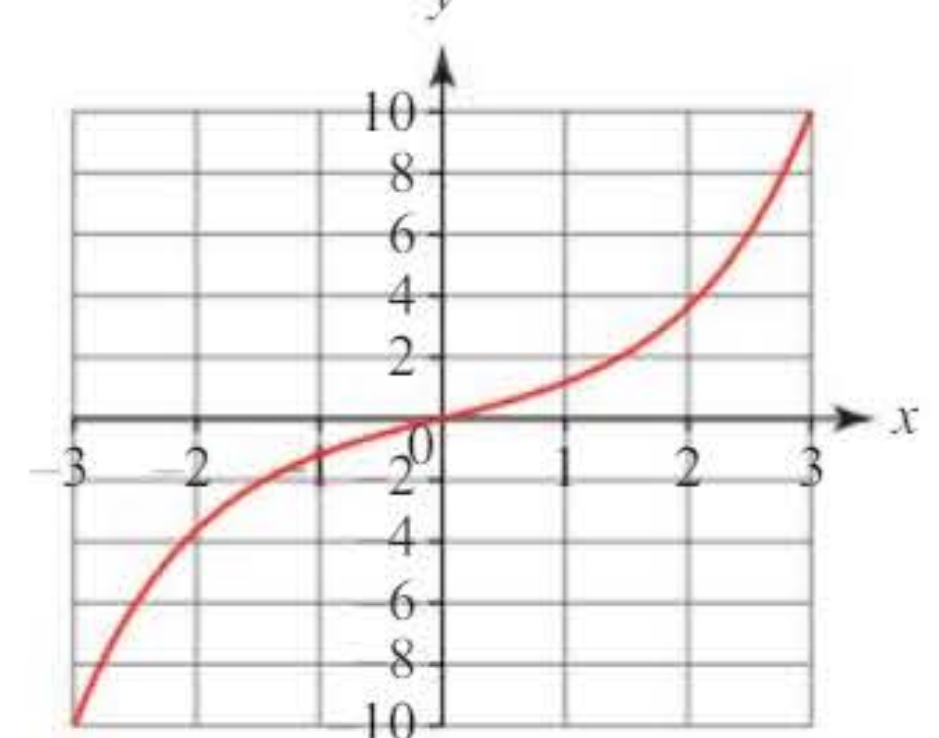
The hyperbolic sine function produces an S-shaped curve with these characteristics:
Note
Key Properties of y = sinh x
- The curve passes through the origin (0, 0), so
- The curve has rotation symmetry about the origin, meaning sinh is an odd function:
- As , the function
- As , the function
- The curve increases for all values of , becoming steeper as increases
The rotational symmetry arises from the subtraction in the definition, creating equal but opposite behaviour on either side of the origin. This is similar to how the regular sine function behaves, but without the periodic oscillation.
The graph of y = tanh x
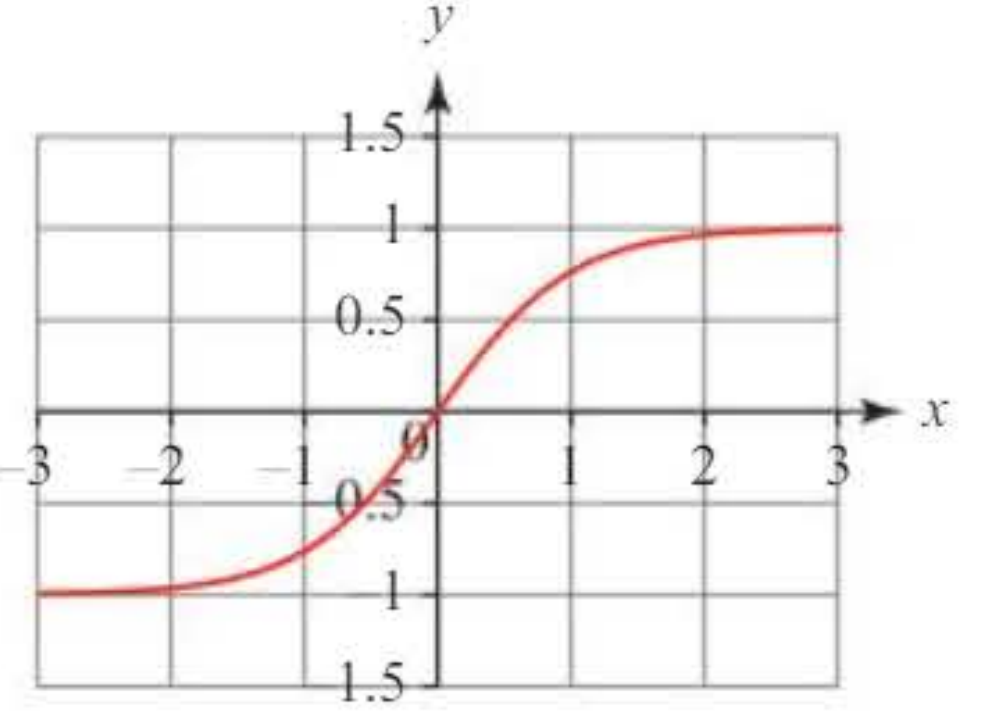
The hyperbolic tangent function creates a bounded S-shaped curve that behaves quite differently from sinh and cosh:
Note
Key Properties of y = tanh x
- The curve passes through the origin (0, 0)
- As , we have , so
- As , we have , so
- The curve has horizontal asymptotes at y = 1 and y = -1
- Therefore, for all values of
- The curve has rotational symmetry about the origin, making tanh an odd function
The bounded nature of tanh makes it particularly useful in applications where values need to be limited to a specific range, such as in neural networks and signal processing.
Transformations of hyperbolic functions
Hyperbolic functions can be transformed using exactly the same rules as other functions you've studied. This is useful for sketching related curves without plotting points.
For any hyperbolic function :
- represents stretched vertically by scale factor
- represents stretched horizontally by scale factor
- represents translated vertically by units
- represents translated horizontally by units
Example
Worked Example: Vertical Translation
Sketch the graph of
This represents the graph of translated upwards by 2 units.
Since cosh has a minimum at , the transformed function has its minimum at (0, 3).
The U-shaped curve maintains its symmetry about the y-axis but is shifted up by 2 units throughout.
Example
Worked Example: Horizontal Stretch
Sketch the graphs of and on the same axes
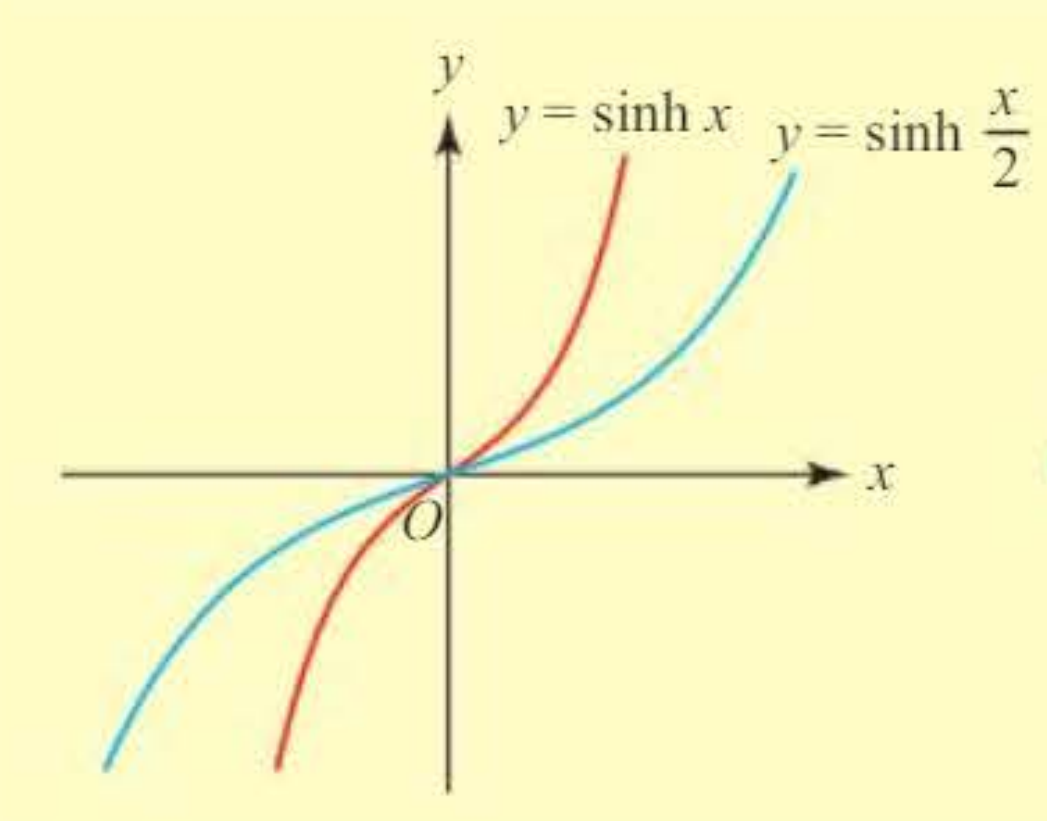
The graph of is obtained from by a horizontal stretch with scale factor 2.
This means points on the curve are moved twice as far from the y-axis. Both curves still pass through the origin, but increases more gradually as it has been "stretched out" horizontally.
Make sure to label each curve clearly when sketching multiple functions on the same axes.
Solving equations involving hyperbolic functions
When solving equations with hyperbolic functions, the key strategy is to substitute the exponential definitions and then use algebraic techniques to solve for . This often involves creating exponential equations or quadratic equations in terms of .
Example
Worked Example: Solving a Simple Hyperbolic Equation
Solve the equation
Start by using the definition of tanh:
Cross-multiply:
Multiply both sides by to clear the negative exponent:
Expand:
Rearrange:
Take logarithms of both sides:
You could verify this answer using a calculator, but the exact logarithmic form is preferable in examinations.
Example
Worked Example: Solving Using Substitution
Solve the equation
Substitute the exponential definitions:
Simplify:
Multiply through by to create a quadratic equation in :
This is a quadratic in . Factorising:
Therefore:
Taking logarithms:
So the solutions are or .
This technique of multiplying by and forming a quadratic is very common when solving hyperbolic equations.
Hyperbolic identities
Hyperbolic functions satisfy identities that are similar to trigonometric identities, but with some important sign differences. These identities can be proved using the exponential definitions and are useful for simplifying expressions and solving more complex equations.
The fundamental hyperbolic identity
Important
The Fundamental Hyperbolic Identity
Notice this is different from the trigonometric identity . The key difference is the minus sign rather than a plus sign.
This identity is essential for solving quadratic equations involving hyperbolic functions.
Example
Worked Example: Proving the Fundamental Identity
Prove that
Start with the exponential definitions:
Expand the squares:
Simplify the numerator (remembering that ):
This proves the identity.
Addition formulas
Hyperbolic functions also have addition formulas similar to trigonometric ones:
These can be proved by substituting the exponential definitions and using index laws to expand the brackets. The process is algebraically involved but follows systematic steps.
Note
Strategy for Solving Problems with Identities
When solving problems involving hyperbolic identities, you should:
- Use the exponential definitions of sinh, cosh, and tanh
- Apply laws of indices and logarithms to simplify expressions
- Look for opportunities to use the fundamental identity
- Remember that identities can often be proved by working with the exponential forms
Inverse hyperbolic functions
Just as we have inverse trigonometric functions (arcsin, arccos, arctan), we have inverse hyperbolic functions. These are denoted as , , and , or alternatively as arsinh , arcosh , and artanh .
The inverse functions can be expressed in logarithmic form, which is essential for finding exact values and solving equations.
Example
Worked Example: Deriving the Inverse of cosh
Derive the logarithmic form of
Let . Then by definition:
Multiply both sides by 2:
Multiply through by to create a quadratic:
Rearrange:
This is a quadratic equation in . Using the quadratic formula with , , :
Taking logarithms:
However, we need to be careful. Consider the expression :
Since , we have:
To avoid ambiguity and ensure the inverse function is well-defined, we define:
The restriction is necessary because for all , so the inverse function can only be defined for .
Logarithmic forms of inverse hyperbolic functions
Important
Inverse Hyperbolic Function Formulas
The three main inverse hyperbolic functions have these logarithmic forms:
Note the domain restrictions on the inverse functions. These formulas allow you to find exact values and are essential for solving certain types of equations.
Solving quadratic equations with hyperbolic functions
Some equations involving hyperbolic functions lead to quadratic equations. Understanding how to handle these efficiently is crucial for examination success.
Note
Strategy for Solving Quadratic Hyperbolic Equations
- Use the identity to write the equation in terms of a single hyperbolic function
- Solve the resulting quadratic equation
- Use the inverse hyperbolic functions (in logarithmic form) to find exact values of
Example
Worked Example: Quadratic with Hyperbolic Functions
Solve the equation
Use the identity to write in terms of :
Substitute into the equation:
This is a quadratic equation in sinh . Let :
Using the quadratic formula or factorising:
Therefore:
Now use the logarithmic form to find . For :
For :
Therefore, the solutions are:
This example demonstrates the complete process: using an identity to simplify, solving a quadratic, and then applying inverse functions to find exact logarithmic answers.
Summary
Key Points to Remember
-
Hyperbolic functions are defined using exponentials: , , and
-
The fundamental identity has a minus sign: (different from )
-
Each function has distinct graph properties: cosh is U-shaped with minimum at ; sinh is S-shaped through the origin; tanh is bounded between and
-
Use exponential definitions to solve equations: Substitute the definitions, multiply by if needed, and form quadratic equations in
-
Inverse hyperbolic functions have logarithmic forms: , for , and for
-
Always give exact answers: Use logarithmic forms unless specifically asked for decimal approximations
-
Remember domain restrictions: requires , and requires
-
Label graphs carefully: Include minimum points, asymptotes, and points of symmetry when sketching