Hyperbolic Functions 2 (AQA A-Level Further Maths): Revision Notes
📚Revision Notes
Hyperbolic Functions 2
Introduction to hyperbolic functions and their inverses
Hyperbolic functions are defined using exponential functions and share many properties with trigonometric functions. They appear frequently in calculus, particularly when dealing with integration and solving differential equations. Understanding both the standard hyperbolic functions and their inverses is essential for A-Level Further Mathematics.
Definitions of hyperbolic functions
The three primary hyperbolic functions are defined in terms of exponential functions:
Hyperbolic sine:
Hyperbolic cosine:
Hyperbolic tangent:
These definitions form the foundation for working with hyperbolic functions.
Note
Notice that sinh x uses subtraction whilst cosh x uses addition in the numerator. This key difference affects their properties and graphs.
Inverse hyperbolic functions
The inverse hyperbolic functions can be expressed in logarithmic form:
Inverse hyperbolic sine:
This function has domain (all real numbers) and range .
Inverse hyperbolic cosine:
Note the domain restriction: . The range is .
Inverse hyperbolic tangent:
This function has the strict domain restriction (excluding the endpoints).
Note
The prefix "ar" stands for "area" (historically related to areas of hyperbolic sectors), distinguishing these from the "arc" prefix used for inverse trigonometric functions.
Domain and range of hyperbolic functions
Hyperbolic sine function
The function accepts all real numbers as input.
- Domain:
- Range:
Since sinh is a one-to-one function, its inverse arsinh exists without domain restriction.
- Domain of arsinh:
- Range of arsinh:
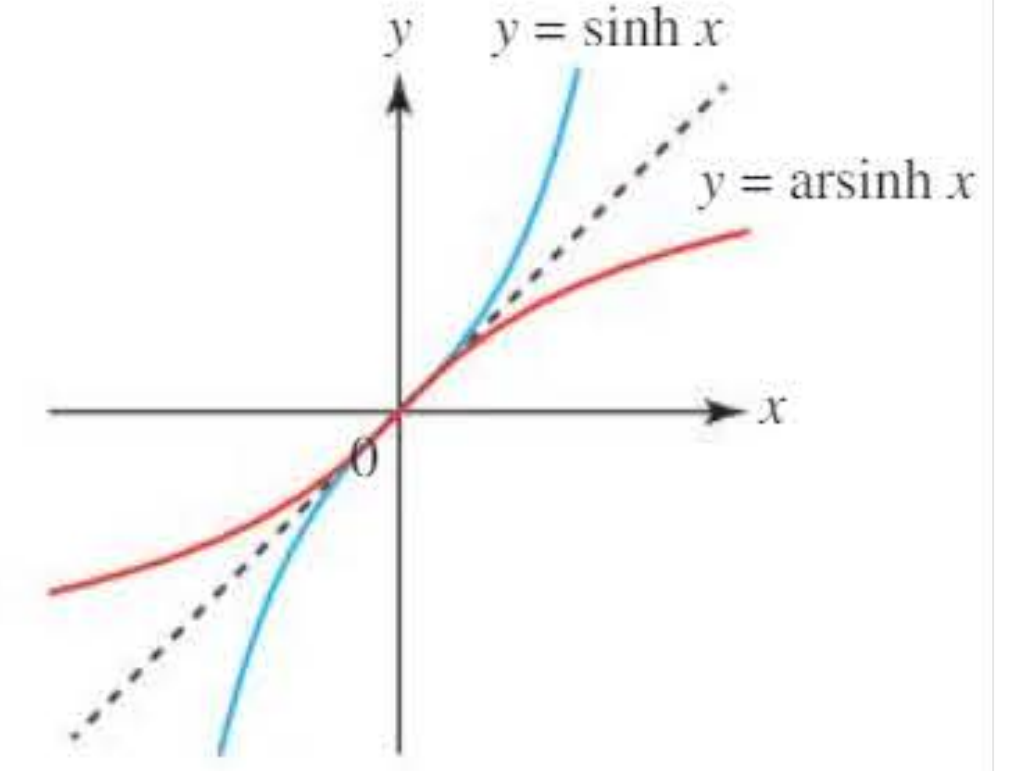
The graph shows that sinh x and arsinh x are reflections of each other in the line , confirming their inverse relationship.
Hyperbolic cosine function
To define an inverse for cosh x, we must restrict the domain because cosh is not one-to-one over all real numbers.
The function has:
- Domain:
- Range:
Important
The minimum value of cosh x is 1, occurring at . This is a key property to remember.
To create the inverse function, we restrict the domain to . This gives:
- Domain of arcosh:
- Range of arcosh:
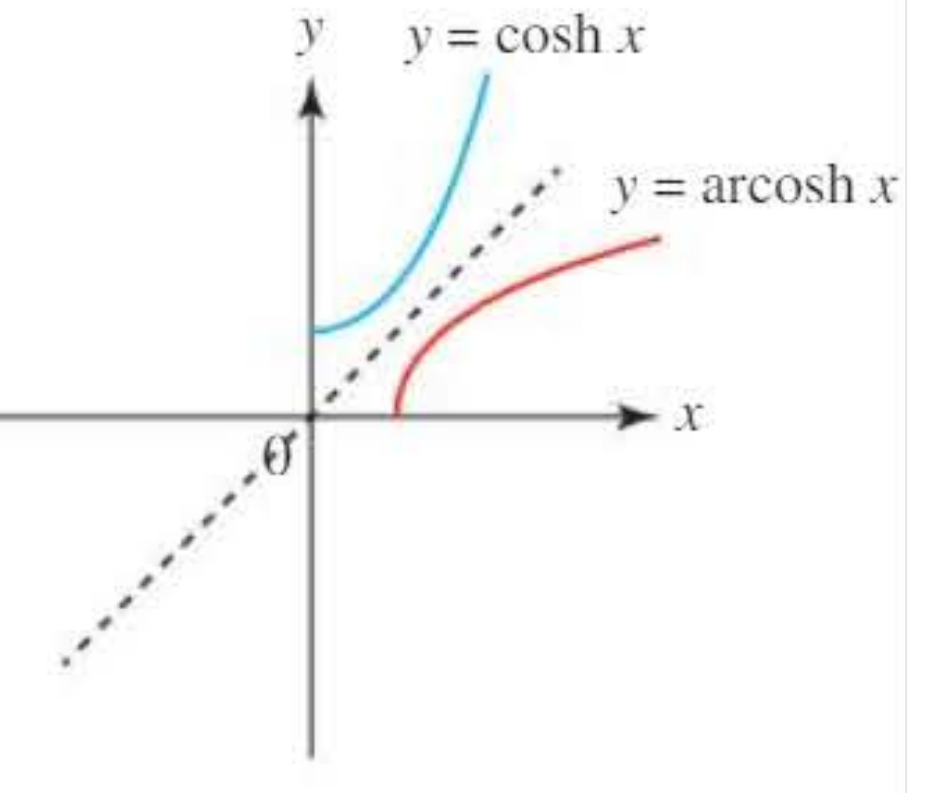
The restriction ensures that arcosh produces only non-negative outputs.
Hyperbolic tangent function
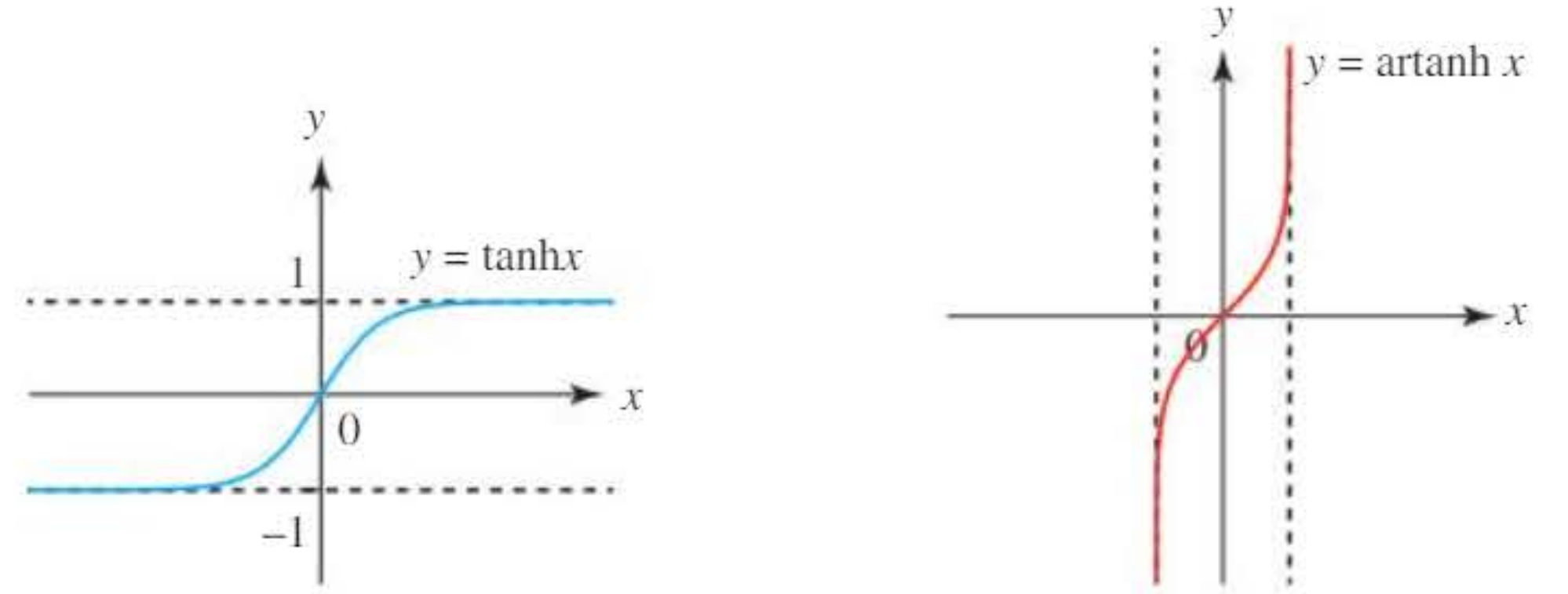
The function has horizontal asymptotes.
- Domain:
- Range:
The graph of approaches as and as .
Consequently, the inverse function has vertical asymptotes:
- Domain of artanh:
- Range of artanh:
Note
The vertical asymptotes occur at for artanh. These correspond to the horizontal asymptotes of tanh x.
Worked example: Sketching transformed inverse hyperbolic functions
Example
Worked Example: Sketching transformations
Sketch the graph of and state its domain and range.
Solution:
The graph represents stretched by a scale factor of 2 in the x-direction.
For the standard function :
- Domain:
- Range:
When we apply the transformation , the domain changes:
- If , then
Therefore:
- Domain:
- Range:
Important
Exam tip: When sketching transformations of inverse hyperbolic functions, always adjust the domain and range accordingly. A horizontal stretch by factor multiplies the domain boundaries by .
Reciprocal hyperbolic functions
Just as with trigonometric functions, we can define reciprocal hyperbolic functions:
Hyperbolic cosecant:
Hyperbolic secant:
Hyperbolic cotangent:
These functions are commonly read as "cosetch", "setch", and "coth".
Domain and range of reciprocal hyperbolic functions
For cosech x:
- Domain: (undefined at x = 0 where sinh x = 0)
- Range:
For sech x:
- Domain: (defined for all real x)
- Range: (maximum value is 1 at x = 0)
For coth x:
- Domain: (undefined at x = 0 where tanh x = 0)
- Range: or
Note
The graphs of these reciprocal functions can be sketched using standard curve sketching techniques, noting asymptotes and key values. Pay particular attention to where the original functions equal zero, as these create vertical asymptotes in the reciprocal functions.
Worked examples: Evaluating hyperbolic expressions
Example 2: Finding exact values using definitions
Example
Worked Example: Finding exact values
Find the exact value of the expression . Show your working.
Solution:
Using the definition :
Since , we have .
Also, .
Therefore:
Important
Exam tip: When evaluating hyperbolic functions at logarithmic values, use the property e to the ln a equals a to simplify expressions.
Example 3: Solving equations involving reciprocal functions
Example
Worked Example: Solving reciprocal equations
Find the exact solution to the equation .
Solution:
First, rearrange the equation:
Since , we have:
Using the inverse hyperbolic tangent formula:
Important
Exam tip: When solving equations with reciprocal hyperbolic functions, convert to the standard hyperbolic functions first, then use the inverse function definitions.
Hyperbolic identities
Hyperbolic functions satisfy several important identities, analogous to trigonometric identities.
The fundamental hyperbolic identity
Important
This is the most important hyperbolic identity and is given in the formula book. Notice the minus sign (compared to for trigonometric functions).
Derived identities
By dividing the fundamental identity by :
Similarly, dividing by gives:
Note
You should memorise these derived identities and be able to derive them from the fundamental identity. They are essential for solving equations and simplifying expressions.
Double angle formulae for hyperbolic functions
Using the exponential definitions, we can prove double angle formulae for hyperbolic functions.
Standard double angle formulae
Note
The first two formulae are given in the formula book. The third can be derived using .
Alternative forms for cosh 2x
Using the fundamental identity , we can rewrite cosh 2x:
or
Important
These alternative forms are particularly useful for integration problems. You should be able to rearrange between these forms quickly.
Note
The double angle formulae for hyperbolic functions are very similar to those for trigonometric functions, but watch for sign differences. These versions of the cosh 2x formula are especially important in the next chapter on integration.
Solving equations involving hyperbolic functions
There are systematic strategies for solving equations that contain hyperbolic functions.
Strategy 1: Equations with reciprocal hyperbolic functions
When solving equations involving hyperbolic functions, follow these steps:
Important
Strategy for solving hyperbolic equations:
Step 1: Use reciprocal hyperbolic identities:
Step 2: Use the definitions of hyperbolic functions in terms of exponentials:
Step 3: Form a quadratic equation in e to the x by multiplying through by appropriate factors.
Step 4: Find the values of x by taking natural logarithms.
Worked example: Applying Strategy 1
Example
Worked Example: Solving hyperbolic equations
Solve the equation .
Solution:
Step 1: Use :
Step 2: Multiply both sides by cosh x:
Use the exponential definitions:
Step 3: Multiply through by 2:
Rearranging:
Multiply through by to form a quadratic:
Step 4: Solve the quadratic (let ):
Using the quadratic formula or factorising:
So or
Therefore:
Strategy 2: Quadratic equations with reciprocal functions
When dealing with quadratic equations involving reciprocal hyperbolic functions:
Important
Strategy for quadratic hyperbolic equations:
Step 1: Use identities to write the equation in terms of a single hyperbolic function.
Step 2: Solve the quadratic to find the possible values of the reciprocal hyperbolic function.
Step 3: Use the definitions of the reciprocal hyperbolic functions to find the values of sinh x, cosh x, or tanh x.
Step 4: Use the definitions of the inverse hyperbolic functions to find the exact values of x.
Worked example: Applying Strategy 2
Example
Worked Example: Quadratic hyperbolic equations
Find the exact solutions to the equation .
Solution:
Step 1: Use the identity :
Substituting:
Step 2: Solve the quadratic (let ):
So or
Step 3: Since :
If , then
If , then
Step 4: Using :
For :
For :
Important
Exam tip: When solving quadratic equations involving reciprocal hyperbolic functions, always use the relevant identity first to express the equation in terms of one function. Check that your solutions are valid by considering domain restrictions.
Remember!
Summary
Key Points to Remember:
-
The fundamental identity is crucial for solving problems and deriving other identities. Note the minus sign, which differs from the trigonometric version.
-
Inverse hyperbolic functions are expressed in logarithmic form: arsinh uses , arcosh uses (with ), and artanh uses (with ).
-
Reciprocal hyperbolic functions (cosech, sech, coth) have domain restrictions where the denominator is zero. Always check: cosech and coth are undefined at .
-
When solving equations, convert reciprocal functions to standard hyperbolic functions, then express in exponential form to create a quadratic in .
-
Double angle formulae for hyperbolic functions are similar to trigonometric versions but watch for sign differences. The alternative forms of cosh 2x are particularly useful for integration.