Transformations (AQA A-Level Further Maths): Revision Notes
📚Revision Notes
Transformations
Introduction to transformations
Transformations are operations that change the position, size, or orientation of a curve in the coordinate plane. For conic sections (ellipses, hyperbolas, and parabolas), we can apply three main types of transformations: enlargements, rotations, and translations. Understanding how to transform curves algebraically is essential for sketching and analysing their properties.
When transforming a curve, we replace the variables and in the original equation with expressions involving the new coordinates. Each type of transformation has specific rules that determine these replacements.
Note
Mastering transformation rules allows you to manipulate and understand complex curves by relating them to simpler, standard forms. This skill is particularly valuable when sketching curves and identifying their key features.
Enlargements
Definition and rule
An enlargement scales a curve by the same factor in both the -direction and the -direction. This transformation changes the size of the curve but preserves its shape and orientation.
Important
Rule for enlargement:
For an enlargement with scale factor , replace with and with in the original equation.
The scale factor determines how much larger (if ) or smaller (if ) the transformed curve becomes. The centre of enlargement is typically the origin unless otherwise stated.
Worked example: ellipse enlargement
Example
Worked Example: Enlarging an Ellipse
Problem: An ellipse with equation is enlarged by scale factor 3.
(a) Find the equation of the transformed curve and state its points of intersection with the axes.
(b) Sketch the transformed curve.
Solution:
(a) Apply the enlargement rule by substituting and :
Simplifying:
To find the intersection points with the axes:
- When :
Coordinates: (0, 9) and (0, -9)
- When :
Coordinates: (6, 0) and (-6, 0)
(b) Sketch the curve using the coordinates found in part (a):
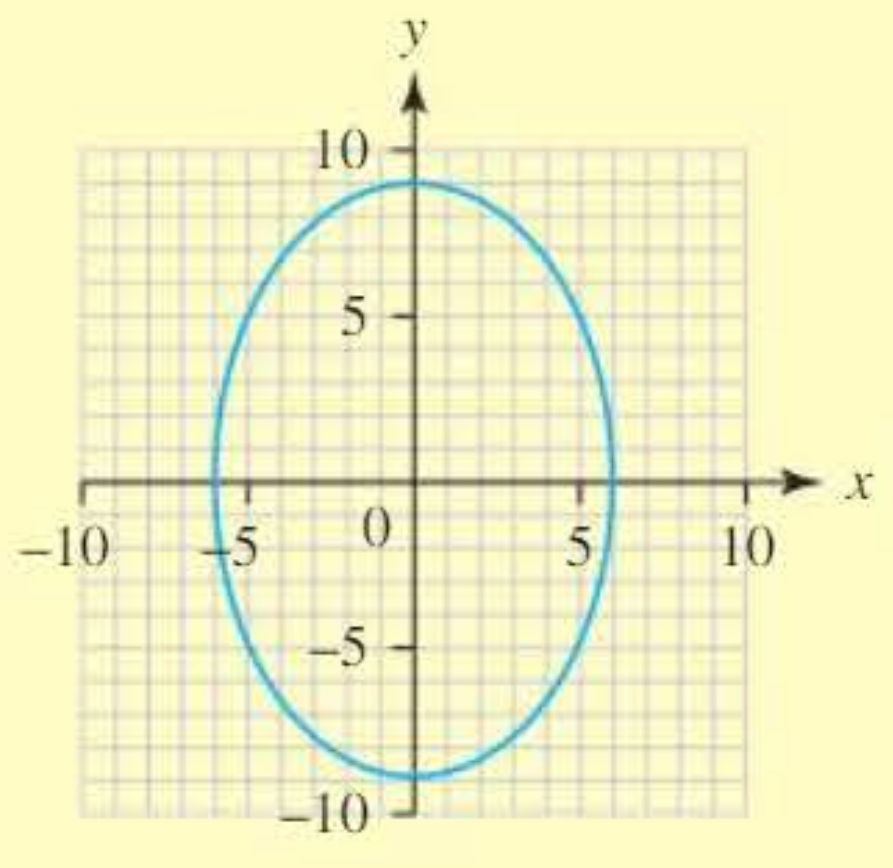
Note
Exam tip: Always simplify the equation after applying the transformation. Find the axis intercepts to help sketch the curve accurately.
Rotations
Definition and rules
A rotation turns a curve through a specific angle about a fixed point (usually the origin). The angle is measured anticlockwise from the positive -axis. In this course, rotations are limited to multiples of radians (90°).
Important
Rules for common rotations about the origin:
-
Rotation by radians (90° anticlockwise): Replace by and by
-
Rotation by radians (180°): Replace by and by
-
Rotation by radians (270° anticlockwise): Replace by and by
General rotation formula
For a rotation through angle radians anticlockwise about the origin, the general transformation formulae are:
where are the coordinates of the transformed point corresponding to the original point .
Note
The common rotation rules given above are derived by substituting , , and into these general formulae. Understanding this connection helps you remember the specific rules.
Worked example: hyperbola rotation
Example
Worked Example: Rotating a Hyperbola
Problem: The hyperbola is rotated anticlockwise through radians about .
(a) Write down the equation of the transformed curve.
(b) Sketch the transformed curve and find the equations of the asymptotes.
Solution:
(a) For a rotation of radians, replace by and by :
Simplifying:
(b) For a hyperbola of the form , the asymptotes are .
The original hyperbola has asymptotes:
After the rotation, the transformed curve has asymptotes:
We can verify this by applying the same transformation to the asymptote equations.
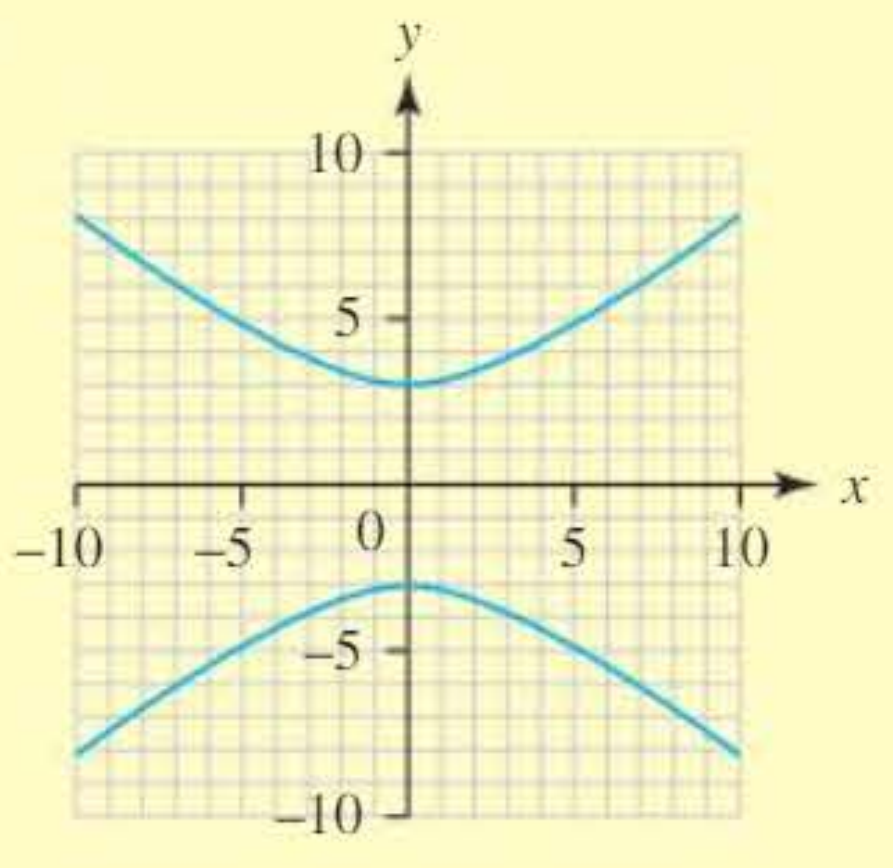
Note
Exam tip: When rotating conics, remember that asymptotes transform in the same way as the curve itself. Apply the rotation rule to the asymptote equations to find the new asymptotes.
Multiple transformations
Order of transformations
When applying multiple transformations to a curve, the order matters. Transformations must be applied sequentially, with each transformation acting on the result of the previous one.
Important
Strategy for finding the equation after multiple transformations:
- Identify the order in which the transformations are applied.
- Transform the original conic using the first transformation.
- Transform the new conic using the next transformation.
- Repeat until all transformations have been applied.
- Ensure the final equation is in the correct form.
- Sketch the graph if required.
Worked example: enlargement, rotation, and translation
Example
Worked Example: Multiple Transformations
Problem: The ellipse with equation is enlarged by scale factor 2, then rotated by radians anticlockwise about before being translated by vector .
Find the equation of the new conic in the form where and are constants, and sketch the graph.
Solution:
Step 1: Enlargement (scale factor 2)
Replace with and with :
Simplifying:
Step 2: Rotation ( radians)
Replace by and by :
Simplifying:
Or equivalently:
Step 3: Translation by
Replace with and with :
Step 4: Expand to standard form
Multiply through by 16:
Expanding:
Simplifying:
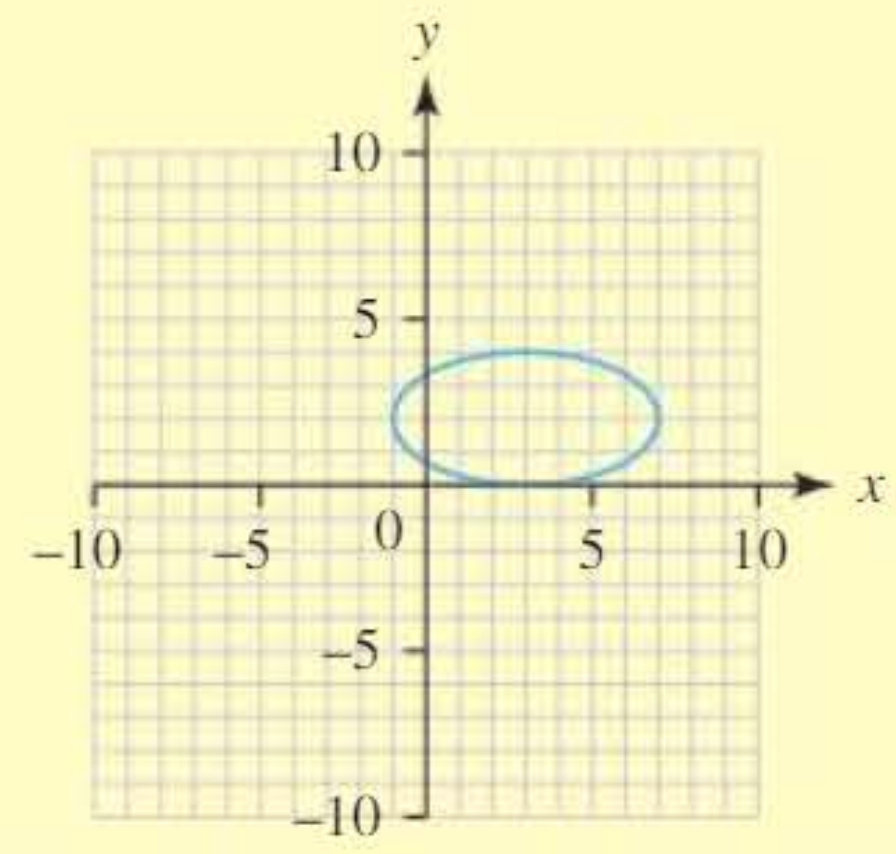
Note
Exam tip: Work through transformations systematically, one at a time. Keep your working clear and check your algebra carefully when expanding to final form.
Identifying transformation sequences
Working backwards from equations
Sometimes you need to identify which transformations have been applied to transform one conic into another. This requires working backwards from the final equation to determine what transformations were used.
Important
Strategy for identifying transformations:
- Rearrange the transformed equation into the standard form for the given conic.
- Determine the transformations that have taken place.
- Determine, where necessary, the order in which they have taken place.
Worked example: parabola transformation
Example
Worked Example: Identifying Transformations of a Parabola
Problem: A parabola has equation .
Describe a sequence of two transformations which maps onto the curve with equation .
Solution:
Step 1: Rearrange into standard form
Starting with:
Complete the square for :
Step 2: Identify transformations
Comparing with the original :
- The term (y - 3)² indicates a translation of 3 units in the positive -direction.
- The term -x indicates a reflection in the -axis.
- The term (x + 2) indicates a translation of 2 units in the positive -direction (since is replaced by , this means moving 2 units left, but combined with the negative sign, it's 2 units right after reflection).
Step 3: Determine the order
One possible sequence is: translation using vector , followed by a reflection in the -axis.
Alternative interpretation:
The equation can also be written as .
This represents a reflection in the -axis followed by a translation using vector .
Key insight: The order of transformations matters. Different sequences can produce the same final result, but you must specify the order clearly.
Note
Exam tip: When identifying transformations, always rearrange the equation into a recognizable form first. Look for completed squares and sign changes to identify translations and reflections.
Worked example: hyperbola transformation sequence
Example
Worked Example: Identifying Hyperbola Transformations
Problem: A hyperbola has equation .
Describe a sequence of transformations which maps onto the curve with equation .
Solution:
Step 1: Rearrange into standard form
Starting with:
Rearranging:
Complete the square for :
This can be written as:
Or:
Step 2: Identify transformations
Comparing with the original :
- The term (x - 2)² indicates a translation of 2 units in the positive -direction.
- The term (y/2)² indicates a stretch parallel to the -axis with scale factor 2.
Step 3: Determine the order
A possible sequence is: a stretch parallel to the y-axis with scale factor 2, followed by a translation in the positive x-direction of 2 units.
Note: These transformations can be applied in either order in this case because the stretch is parallel to the -axis and the translation is in the -direction, so they act independently on different variables.
Note
Exam tip: Look for completed squares to identify translations. Changes in denominators indicate stretches or enlargements. When transformations act on different variables, the order may not matter.
Remember!
Summary
Key Points to Remember:
-
Enlargements: Replace with and with for scale factor . This changes the size but preserves the shape.
-
Rotations about the origin: Use the specific rules for , , and radians, or apply the general rotation formulae for other angles.
-
Order matters: When applying multiple transformations, always work sequentially. Each transformation acts on the result of the previous one.
-
Working backwards: To identify transformations, rearrange the equation into standard form, complete the square where necessary, and compare with the original equation.
-
Check your work: After transforming, verify that intercepts and key features (like asymptotes) have been transformed correctly. Always simplify your final equation to the required form.