Second Order Equations (AQA A-Level Further Maths): Revision Notes
📚Revision Notes
Second Order Equations
What is a second order differential equation?
A second order differential equation is an equation that involves a second derivative (such as ) but no derivatives of higher order. Many second order differential equations can be written in the standard form:
where , , and are constants.
Note
To solve these equations, we use a two-stage approach. First, we solve the related homogeneous equation (where ). Then, we find a particular solution to the full equation. This systematic method ensures we capture all possible solutions.
The first stage is to solve the related homogeneous equation, that is, the equation where .
Solving homogeneous equations
A homogeneous equation is one where the right-hand side equals zero:
The substitution method
Let's see the formal method first. Consider the equation:
Rewrite the equation as
So
Substitute
to get
Multiply throughout by the integrating factor ( e^{-2x} ):
So
Integrate:
Hence
Substitute back:
Multiply throughout by the integrating factor ( e^{3x} ):
So
Integrate both sides:
Rearranging:
Relabel the constant as .
While this detailed method works, there is a much quicker approach using the auxiliary equation.
The auxiliary equation method
We can assume solutions exist in the form , where and are constants. This allows us to skip several steps.
If , then:
Substituting these into the differential equation:
becomes:
Dividing through by gives:
This quadratic equation is called the auxiliary equation. We can use its solutions to find the general solution to the differential equation.
Solving: gives or .
This means both and satisfy the homogeneous equation. Since any linear combination of these solutions also works, the general solution is:
where and are arbitrary constants (we need two constants because there are two solutions).
Types of roots and their solutions
The auxiliary equation can have three different types of roots, each giving a different form for the general solution.
Important
Three Cases for the Auxiliary Equation:
The nature of the roots determines the form of your solution. Always check which case applies before writing your general solution:
- Real distinct roots → Two different exponential terms
- Repeated root → Multiply by with one exponential
- Complex roots → Combine exponential with trigonometric functions
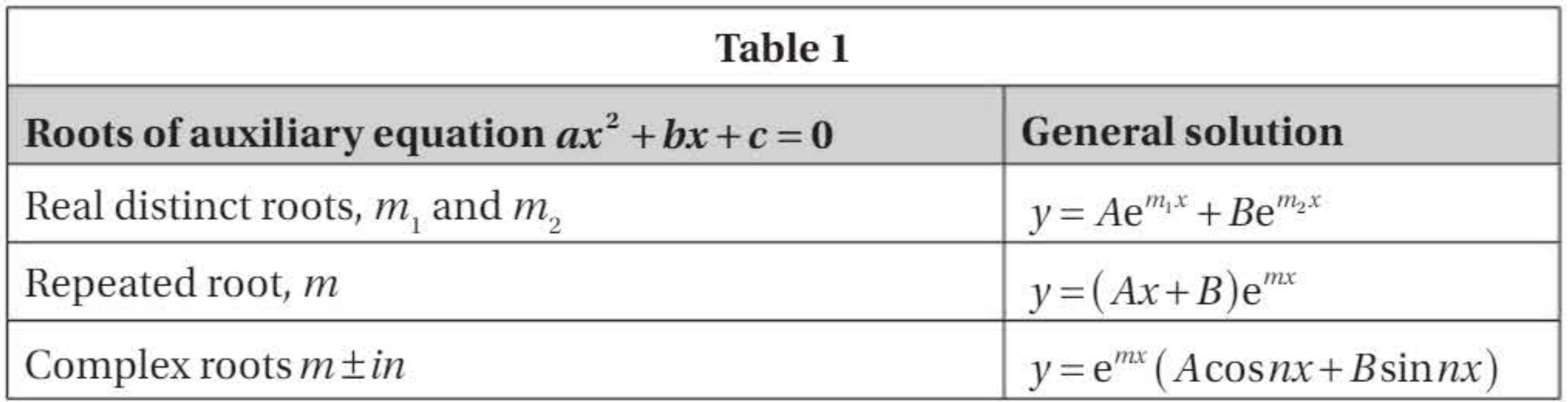
Case 1: Real distinct roots
When the auxiliary equation has two different real roots and , the general solution is:
Example
Worked Example: Real Distinct Roots
Solve
The auxiliary equation is:
Factorising:
So or (two real distinct roots).
The general solution is:
Case 2: Repeated root
When the auxiliary equation has one repeated root , the general solution is:
Important
Notice that we multiply by rather than just having two terms with . This is crucial because without the term, we would only have one independent solution instead of two.
Example
Worked Example: Repeated Root
Solve
The auxiliary equation is:
Factorising:
So (a repeated root).
The general solution is:
Case 3: Complex roots
When the auxiliary equation has complex roots in the form (where ), the general solution is:
This form combines an exponential with trigonometric functions.
Example
Worked Example: Complex Roots
Solve
The auxiliary equation is:
Using the quadratic formula or completing the square:
So (complex roots).
The general solution is:
Non-homogeneous equations
When the right-hand side of the equation is not zero (i.e., ), we need to find both a complementary function and a particular integral.
For an equation like:
The complementary function (CF) is the solution to the homogeneous equation:
We already solved this earlier:
The particular integral (PI) is a specific function that, when substituted into the left-hand side of the differential equation, gives on the right-hand side.
Important
The General Solution Formula:
or simply: GS = CF + PI
This relationship is fundamental to solving all non-homogeneous second order differential equations. Always find both parts and add them together.
Finding particular integrals
To find the particular integral, we make an educated guess about its form based on the function . The following table suggests forms to try:
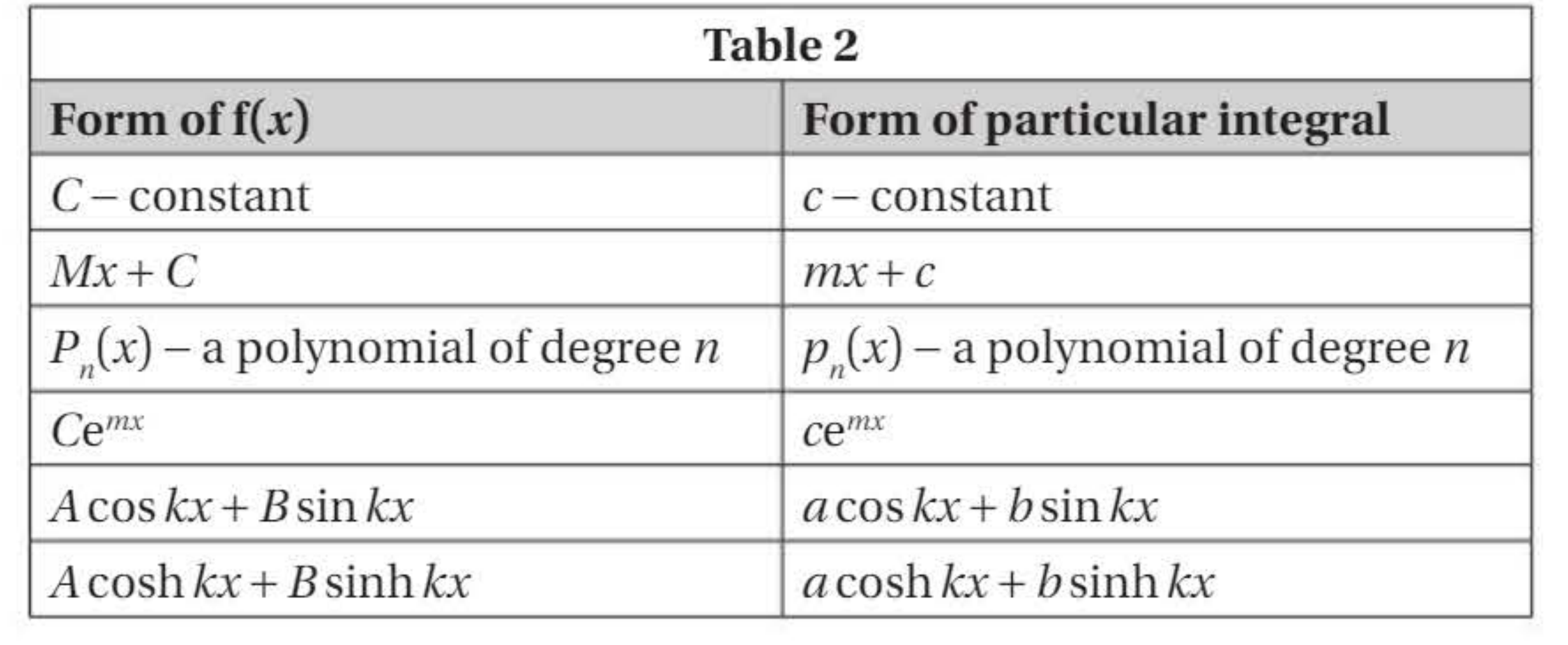
Note
Using Table 2:
Table 2 is your guide for choosing the correct form of particular integral. Match the form of on the left to determine what to try on the right. The key is to use the same type of function with unknown coefficients (usually lowercase letters).
Let's continue the previous example. We need a function that gives when substituted into .
Since , Table 2 suggests we try .
If , then:
Substituting into the differential equation:
Therefore .
The particular integral is .
The general solution is:
Example with polynomial function
Example
Worked Example: Polynomial Function
Solve
Step 1: Find the complementary function.
The auxiliary equation is:
So (repeated root).
The complementary function is:
Step 2: Find the particular integral.
Since is a polynomial of degree 1, Table 2 suggests we try .
If , then:
Substituting:
Comparing coefficients:
- Coefficient of : , so
- Constant term: , so , giving
The particular integral is .
Step 3: Write the general solution.
Using boundary conditions
When we have initial conditions (or boundary conditions), we can find the specific values of the constants and . The resulting solution is called the particular solution.
Example
Worked Example: Using Boundary Conditions
Solve , given that and .
Step 1: Find the complementary function.
The auxiliary equation is:
Using the quadratic formula:
So (complex roots).
The complementary function is:
Step 2: Find the particular integral.
Since , Table 2 suggests we try .
If , then:
Substituting into the differential equation:
Collecting terms:
- :
- :
Solving these simultaneous equations:
- From the first equation:
- From the second equation:
This gives and .
The particular integral is .
Step 3: Write the general solution.
Step 4: Use the boundary conditions to find and .
When , :
To use , we need to differentiate:
When , :
The particular solution is:
Special case: when the particular integral matches the complementary function
Important
Critical Rule: The Multiplication by Technique
If the form you try for the particular integral matches part of the complementary function, it will not work (you'll get ). When this happens, multiply your trial function by (or for repeated roots).
This is a common exam trap - always check if your proposed particular integral appears in your complementary function before proceeding!
Example
Worked Example: Special Case
Solve , given that and .
Step 1: Find the complementary function.
The auxiliary equation is:
So or (real distinct roots).
The complementary function is:
Step 2: Find the particular integral.
Since , we would normally try . However, is already part of the complementary function, so this won't work.
Instead, we multiply by and try .
If , then using the product rule:
Substituting into the differential equation:
Simplifying (notice the terms cancel):
Therefore .
The particular integral is .
Step 3: Write the general solution.
Step 4: Use the boundary conditions.
When , :
Differentiating:
When , :
From the first equation:
From the second equation:
Solving simultaneously:
- Multiply first equation by 2:
- Subtract from second:
- Therefore
The particular solution is:
Problem-solving strategy
When answering exam questions involving second order differential equations, follow these steps:
Summary
Step-by-Step Problem-Solving Strategy:
-
Write down the auxiliary equation - Replace with , with , and with 1 in the homogeneous version of the equation.
-
Find the complementary function - Solve the auxiliary equation and use Table 1 to write the appropriate form based on the type of roots.
-
Decide on the form of the particular integral - Use Table 2 to determine what form to try based on . Remember to multiply by if your choice matches the complementary function.
-
Find the particular integral - Substitute your trial function into the differential equation and solve for the unknown coefficients.
-
Write down the general solution - Add the complementary function and particular integral together.
-
Use the information given in the question to find the values of the constants - Substitute the boundary conditions to find and . This gives the particular solution.
-
Answer the question(s) in context - Write your final answer clearly, checking it addresses what was asked.
Remember!
Summary
Key Points to Remember:
-
A second order differential equation involves but no higher derivatives. The general form is .
-
The auxiliary equation gives you the complementary function. The form depends on whether the roots are real distinct, repeated, or complex (use Table 1).
-
The general solution is always: Complementary Function + Particular Integral (CF + PI = GS).
-
Use Table 2 to decide what form to try for the particular integral based on the form of .
-
If your particular integral trial matches the complementary function, multiply by (or for repeated roots). This is a common exam trap.
-
The particular solution is found when you use boundary conditions to determine the constants and . Always check you've used both conditions correctly.