Simple Harmonic Motion (AQA A-Level Further Maths): Revision Notes
📚Revision Notes
Simple Harmonic Motion
Introduction to simple harmonic motion
Differential equations provide a powerful method for modelling oscillatory systems in the real world. When objects oscillate, they move back and forth in a regular, repeating pattern. Common examples include a weight hanging from a spring bouncing up and down, a pendulum swinging from side to side, or even the changing depth of water in a harbour as tides move in and out.
Note
Real-world oscillatory systems are everywhere in physics and engineering. Understanding SHM helps explain phenomena ranging from the vibration of guitar strings to the behaviour of atoms in molecules, from earthquake motion to the operation of mechanical clocks.
When you plot the displacement against time for these oscillatory systems, the graph typically shows a sine wave pattern. This regular, cyclic behaviour is characteristic of a special type of motion called simple harmonic motion.
Defining simple harmonic motion
Simple harmonic motion (SHM) occurs when a particle's acceleration is directly proportional to its displacement from a fixed point, and is always directed back towards that point.
The mathematical form of this relationship is expressed as:
In this equation:
- represents the displacement from the centre of motion
- is the acceleration
- (Greek letter omega) is the angular frequency, a positive constant that determines how fast the oscillation occurs
- The negative sign indicates that the acceleration is always directed towards the equilibrium position
Important
This equation is the defining characteristic of SHM. Any motion that satisfies this differential equation is simple harmonic motion. The key feature is that acceleration is proportional to negative displacement - the further from equilibrium, the stronger the force pulling back towards the centre.
Deriving the standard results
To find useful formulas for working with SHM, we start from the defining equation and use calculus to derive relationships between displacement, velocity, and time.
Finding the velocity formula
We begin with the SHM equation:
Using the chain rule, we can write the acceleration as:
where is the velocity.
Substituting this into our SHM equation:
Now we separate the variables by rearranging:
Integrating both sides:
where is a constant of integration.
Note
To find the value of , we use a key fact about oscillatory motion: when the particle reaches its maximum displacement (the amplitude ), its velocity becomes zero. At this point, and . This physical insight allows us to evaluate the constant of integration.
Substituting these values:
Substituting back into our equation:
Multiplying through by 2 and rearranging:
Taking the square root:
This formula relates the velocity to the position at any point in the motion.
Finding the position formula
Starting from our velocity relationship and using :
Again, we separate the variables:
Integrating both sides:
Note
The left side requires the standard integration result:
This is a standard integral you should memorize for SHM problems.
Therefore:
where (Greek letter epsilon) is a constant of integration.
Rearranging to make the subject:
The value of depends on the initial conditions - specifically, where we choose to start measuring time from ().
Two common cases:
-
If when , then , giving
-
If when , then , giving
Finding the period
The functions and both have a period of . This means they repeat their values every units.
For the function , the period is:
This formula tells us how long it takes for one complete oscillation.
Standard results for simple harmonic motion
Important
Key Formulas for SHM
For any object moving with SHM where , the following results apply:
Position equations:
Velocity equation:
Period:
where:
- is the amplitude (maximum displacement from the centre)
- is the period (time for one complete oscillation)
- is the angular frequency
The choice between using sine or cosine in the position equation depends on the starting conditions of the motion.
Key properties and characteristics
Maximum speed
The velocity formula reveals important information about when the particle moves fastest.
The maximum speed occurs when (at the centre of the motion):
This makes physical sense: as the particle passes through the equilibrium position, it has maximum kinetic energy and therefore maximum speed.
Conversely, at the extremes of motion where , the velocity is zero:
Note
Physical Interpretation:
- At the centre (): Maximum speed, zero potential energy, maximum kinetic energy
- At the extremes (): Zero speed, maximum potential energy, zero kinetic energy
This represents a continuous interchange between kinetic and potential energy throughout the motion.
Finding the angular frequency
When given a differential equation, you can identify by comparing it to the standard form .
For example, if , then , so ω = 4.
Period independence
An important feature of SHM is that the period does not depend on the amplitude. A particle with a large amplitude oscillates at the same rate as one with a small amplitude (assuming the same value of ).
Solving SHM differential equations
The auxiliary equation method
To solve , we use the auxiliary equation:
Solving for :
where .
Note
When the auxiliary equation has complex roots , the general solution is:
where and are constants to be determined from initial conditions. This form emerges naturally from the theory of differential equations with complex roots.
Using initial conditions
To find the particular solution, substitute the given initial conditions into the general solution and its derivative.
For example, if and :
From : , giving
From the second condition, we can find by substitution.
Converting to harmonic form
The solution can also be written in the form:
where is the amplitude and is a phase shift.
To convert from to this form, use:
and find by comparing coefficients.
Problem-solving strategy for SHM
When tackling SHM problems, follow this systematic approach:
Note
Step-by-Step Strategy:
1. Draw a force diagram
- Mark all forces acting on the particle
- Indicate the positive direction
- Label distances and displacements clearly
2. Apply Newton's second law
- Write where
- Consider the direction of each force
3. Form the second-order differential equation
- Rearrange to get form
- Identify the value of
4. Find the general solution
- Use the auxiliary equation method
- Write
5. Apply initial or boundary conditions
- Substitute given values to find constants and
- This gives the particular solution
6. Answer the question in context
- Calculate required quantities (speed, time, position, etc.)
- Include appropriate units
- Check your answer makes physical sense
Worked examples
Example
Worked Example 1: Solving an SHM equation with initial conditions
Problem: Solve the differential equation , given that and . Sketch the solution and state its amplitude.
Solution:
First, rewrite the equation in standard form:
The auxiliary equation is:
Therefore, the general solution is:
Now we apply the initial conditions to find and .
Using :
So .
Using :
So .
The particular solution is:
To find the amplitude and sketch the graph, we convert this to harmonic form:
The amplitude is metres.
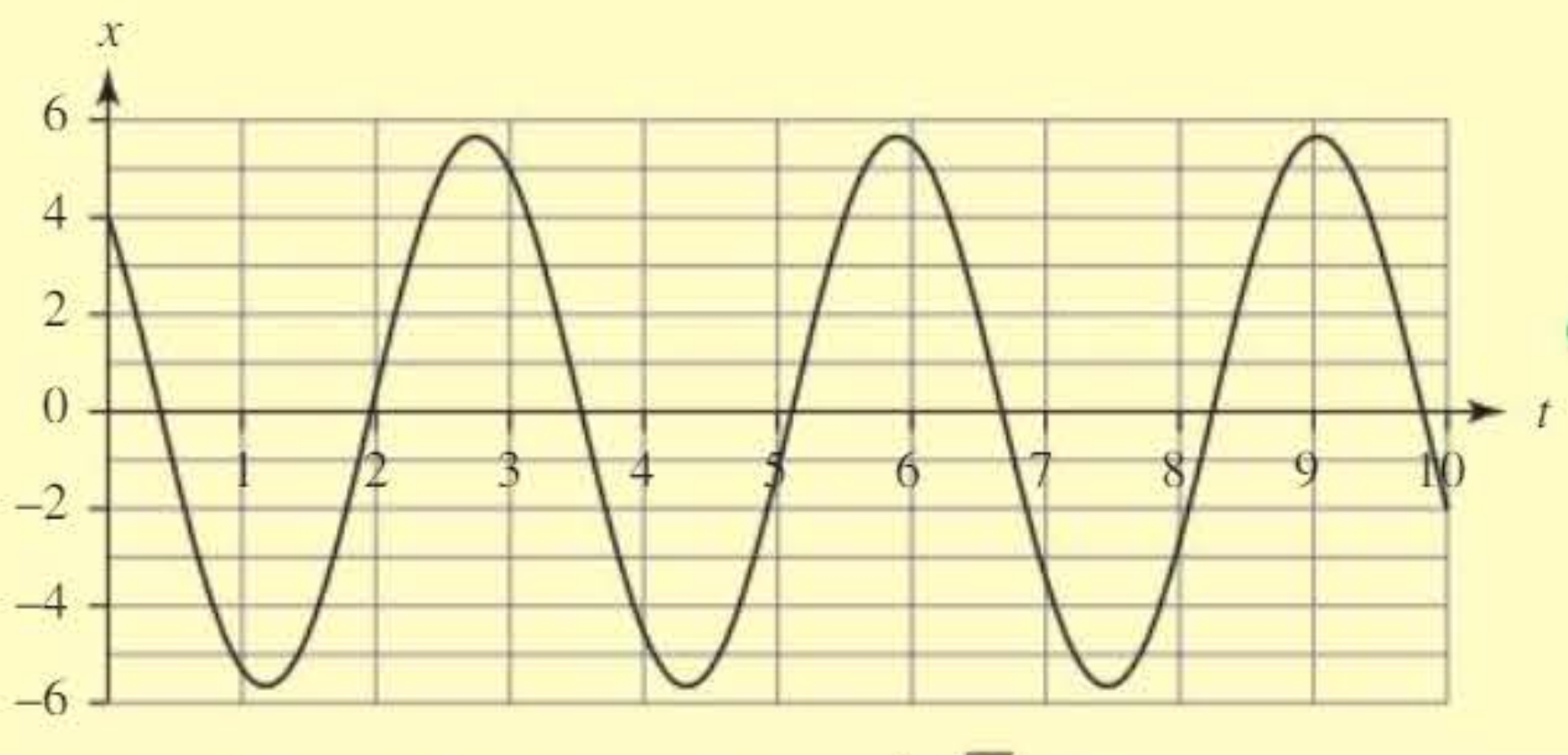
The graph shows the sinusoidal motion with amplitude , oscillating between approximately and metres. The amplitude represents the maximum displacement from the centre of the motion.
Example
Worked Example 2: Finding period and maximum speed
Problem: A particle moves with SHM defined by the equation . The amplitude of the motion is 3 metres.
Find: (a) The period of the motion (b) The maximum speed of the particle
Solution:
First, identify from the equation .
Comparing with , we have , so ω = 4.
(a) Finding the period:
Use the formula :
(b) Finding the maximum speed:
The maximum speed occurs at the centre of motion where .
Using with , , and :
The maximum speed is 12 m⋅s⁻¹.
Example
Worked Example 3: Time to reach a specific position
Problem: A particle is projected from a point at time , and performs SHM with as the centre of oscillation. The motion is of amplitude 5 metres, and the period is seconds.
Find: (a) The speed of projection (b) The time it takes for the particle to first reach a point that is 4 metres from
Solution:
First, find using the period formula :
(a) Speed of projection:
Since the particle is projected from (the centre), we have at .
Using with , , and :
(b) Time to reach metres:
Since the motion starts at when , we use the equation:
We need to find when :
Remember to use radians:
The particle first reaches 4 metres from after approximately 0.155 seconds.
Example
Worked Example 4: Proving motion is SHM from a force
Problem: A particle of mass 0.06 kg moves in a horizontal straight line under the action of a force directed towards a fixed point . The force varies with the distance of the particle from , and is equal to N, where , measured in metres, is the displacement of from . The particle is initially at rest at a displacement of 10 metres from .
(a) Prove that the motion of is SHM
(b) Find the velocity of when is 6 metres from
Solution:
(a) Proving the motion is SHM:
The force acts towards , so in the direction of increasing , the force is (negative because it opposes the displacement).
Applying Newton's second law:
Dividing by 0.06:
This is in the form with , so .
Therefore, the motion is SHM.
(b) Finding the velocity:
The amplitude is the initial displacement: metres (since the particle starts at rest).
Using with , , and :
The velocity when P is 6 metres from O is 40 m⋅s⁻¹.
Example
Worked Example 5: Spring system with specific time calculations
Problem: One end of a light elastic spring of unstretched length 2 metres is fixed to a point on a smooth horizontal table. A particle of mass 0.1 kg is attached to the other end of the spring and rests in equilibrium at a point on the table. The particle is then pulled away from , in the direction , causing the spring to stretch by 20 cm. The force in the spring is directed towards , and has magnitude N, where , measured in metres, is the displacement of the particle from . The body is released from rest at time seconds.
(a) Show that
(b) Solve this differential equation to show that
(c) Calculate the distance of the particle from when
(d) Calculate the speed of the particle when
Solution:
(a) Forming the differential equation:
Apply Newton's second law with the force towards (negative direction):
This confirms the equation.
(b) Solving the differential equation:
The auxiliary equation is:
The general solution is:
Using initial conditions and at :
From :
From : Since , we have , so
Therefore:
(c) Distance from when :
The distance from is 2 + 0.1 = 2.1 metres (adding the unstretched length).
(d) Speed when :
Differentiating to get velocity:
At :
The speed is (approximately 1.73 m⋅s⁻¹).
Example
Worked Example 6: SHM with displaced centre of motion
Problem: A particle of mass 0.5 kg rests at a fixed point on a smooth horizontal surface, attached to one end of a light elastic spring of natural length 3 metres. The other end of the spring is attached to , where is a fixed point on the surface. The particle is pulled a distance 2 metres from , in the direction , and released from rest at time . At time seconds, the displacement of the particle from is metres. The force in the spring is directed towards and has magnitude newtons.
(a) Write down the equation of motion of the particle
(b) Find an expression for in terms of
(c) Sketch the graph of against
(d) Write down the value of when the particle is closest to for the first time
Solution:
(a) Equation of motion:
Applying Newton's second law in the direction (towards ):
(b) Finding in terms of :
The auxiliary equation is:
The complementary function is:
For the particular integral, try (constant):
The general solution is:
Using initial conditions: at , (pulled 2 m from equilibrium at ), and :
From : , so
From : , so
Therefore:
(c) Sketch:
The motion oscillates about x = 3 (not ) with amplitude 2, ranging from to .
(d) Time when closest to :
The particle is closest to when is minimum, which occurs when :
This happens when :
Important
Note about displaced equilibrium:
This motion is still SHM, but it is centred on x = 3 rather than . The particle oscillates symmetrically about this equilibrium position. This is a common situation when dealing with springs and forces - the centre of oscillation may not be at the origin. Always identify the equilibrium position carefully!
Exam tips and common pitfalls
Important
Critical Points to Remember:
1. Always use radians When working with trigonometric functions in SHM, ensure your calculator is in radian mode. Period and angular frequency formulas assume radians.
2. Identify correctly Compare your differential equation to and take the square root: if , then , not 16.
3. Maximum speed location Remember that maximum speed occurs at the centre of motion ( or equilibrium position), not at the extremes.
4. Initial conditions determine the form If motion starts at the centre, use . If it starts at maximum displacement, use .
5. Check the direction of forces When applying Newton's second law, forces acting towards the centre should have a negative sign to give the correct form.
6. Units matter Always include appropriate units in your final answers: metres for distance, m⋅s⁻¹ for speed, seconds for time.
7. Displaced equilibrium Not all SHM is centred at . The centre of oscillation might be at a different point, requiring a complementary function plus particular integral approach.
Summary
Key Points to Remember:
-
SHM is defined by the equation , where acceleration is proportional to displacement and directed towards the centre.
-
Standard formulas for SHM: Position or , velocity , and period .
-
Maximum speed occurs at the centre of motion where , giving .
-
Problem-solving strategy: Draw force diagram → Apply Newton's 2nd law → Form differential equation → Solve for general solution → Apply initial conditions → Answer in context.
-
Always work in radians when using trigonometric functions and period formulas in SHM problems.
-
The period is independent of amplitude - larger oscillations take the same time as smaller ones (for the same ).
-
Energy interchange: At the centre, kinetic energy is maximum and potential energy is zero. At the extremes, kinetic energy is zero and potential energy is maximum.