Lengths and Surface Areas (AQA A-Level Further Maths): Revision Notes
📚Revision Notes
Lengths and Surface Areas
Introduction to arc lengths and surface areas
Integration can be used to calculate the exact length of a curve between two points and the surface area created when a curve is rotated about an axis. These applications combine differentiation and integration techniques with geometric principles.
Note
Understanding arc lengths and surface areas requires strong integration skills. Make sure you're comfortable with substitution and trigonometric/hyperbolic identities before tackling these problems.
Arc length of a curve (Cartesian form)
Deriving the arc length formula
When you want to find the length of a curve between two points, you can approximate the curve using small straight-line segments. Consider two nearby points and on a curve, separated by small distances and in the horizontal and vertical directions respectively.
Using Pythagoras' theorem, the approximate length of the curve segment, , is:
Dividing both sides by gives:
Taking the square root:
As , we have and , so:
Integrating both sides with respect to gives the total arc length.
Important
Key formula: Arc length (Cartesian)
The length of the arc of the curve from to is given by:
This formula is fundamental for calculating exact curve lengths and must be memorised for the exam.
Example
Worked Example 1: Arc length of
Question: Calculate the length of the curve between the points and .
Solution:
First, rewrite the function and find its derivative:
Apply the arc length formula from to :
To integrate, let , so , giving .
When , ; when , .
Note
Exam tip: Always check that you've correctly applied the limits after substitution. A common error is forgetting to change the limits when making a substitution.
Arc length of a curve (Parametric form)
Adapting for parametric equations
When a curve is defined by parametric equations and , you need to modify the arc length formula. Instead of dividing by , divide by .
Starting from:
Divide by :
As :
Important
Key formula: Arc length (Parametric)
The length of the section of the curve , from to is given by:
Example
Worked Example 2: Parametric arc length
Question: Calculate the length of the arc of the curve , from to .
Solution:
Find the derivatives with respect to :
Apply the parametric arc length formula:
Factor out :
Let , so , giving .
When , ; when , .
Surface area of revolution (Cartesian form)
Understanding surface area of revolution
When a curve is rotated through radians (360°) about the -axis, it creates a three-dimensional solid. You can calculate the surface area of this solid using integration.
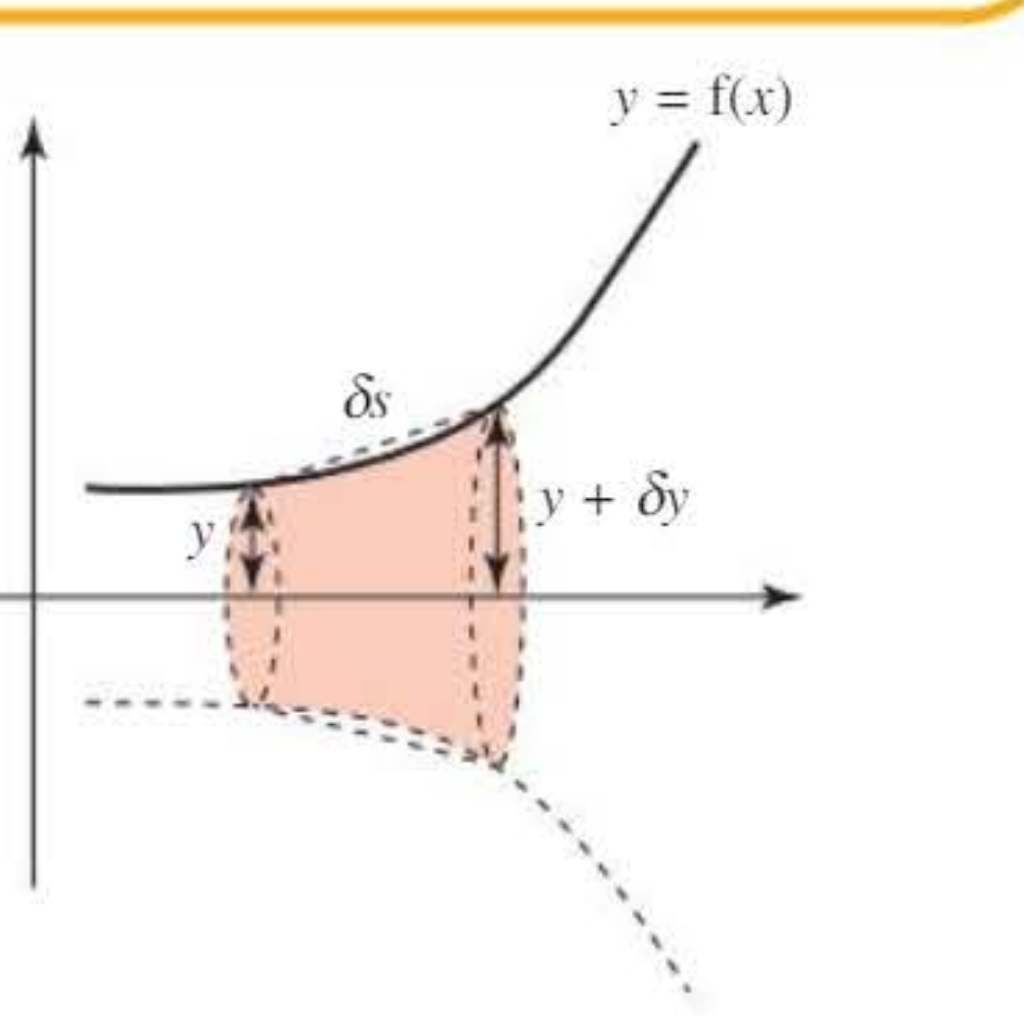
Consider a small section of the curve that, when rotated, creates a frustum (truncated cone). The frustum has:
- Lower radius:
- Upper radius:
- Slant height:
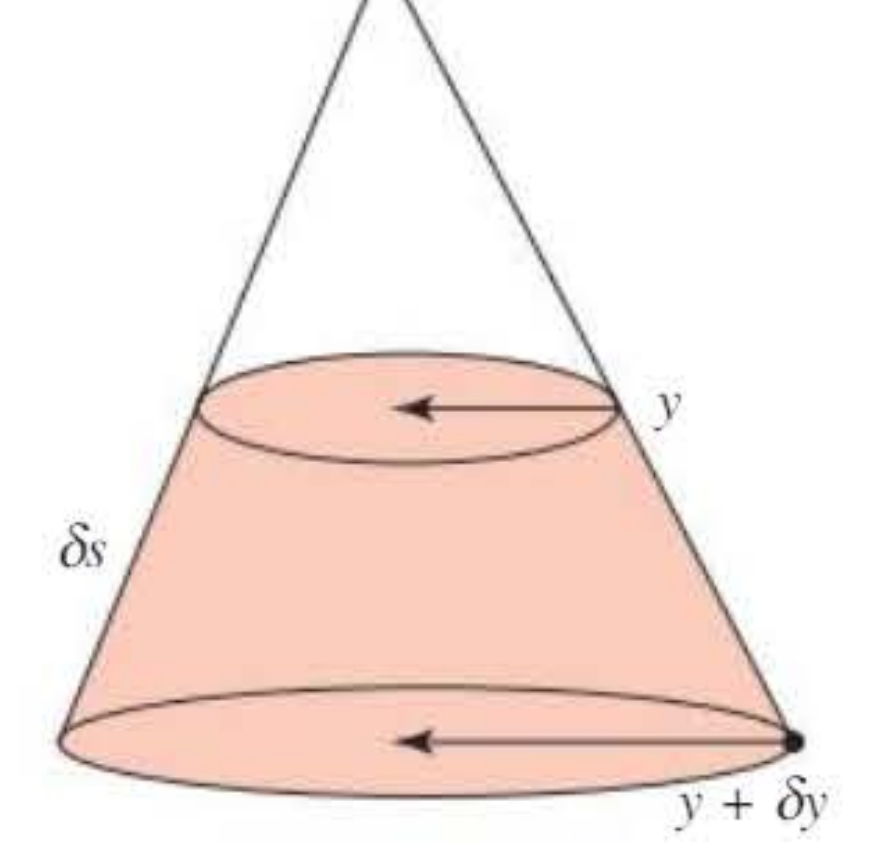
Deriving the surface area formula
The curved surface area of a frustum is given by:
where is the base radius, is the top radius, and is the slant height.
For our small element:
Dividing by :
As , and:
Since :
Integrating gives the total surface area.
Important
Key formula: Surface area of revolution (Cartesian)
The surface area of revolution when the curve from to is rotated through radians around the -axis is given by:
Note the key difference from arc length: multiply by instead of just integrating the arc element.
Example
Worked Example 3: Surface area of
Question: The section of the curve with equation between and is rotated through radians around the -axis. Calculate the exact value of the curved surface area.
Solution:
Find the derivative:
Apply the surface area formula:
Let , so , giving .
When , ; when , .
Surface area of revolution (Parametric form)
Adapting for parametric equations
When the curve is defined by parametric equations , , the surface area formula becomes:
Important
Key formula: Surface area of revolution (Parametric)
The surface area of revolution when the curve , from to is rotated through radians around the -axis is given by:
Note that is replaced by when evaluating the integral.
Integration techniques for lengths and surfaces
Note
Strategy for solving problems
When calculating arc lengths and surface areas of revolution, you often need to use advanced integration techniques:
-
Choose the correct formula based on whether the curve is in Cartesian or parametric form.
-
Use suitable substitutions, ensuring you correctly apply the new limits after substitution.
-
Apply trigonometric or hyperbolic identities to simplify integrals.
Important hyperbolic identities
The following hyperbolic identities are particularly useful for integration:
Also remember:
Example
Worked Example 4: Using hyperbolic identities
Question: The curve has equation . Calculate the length of the curve between and .
Solution:
Find the derivative:
Apply the arc length formula:
Use the substitution , so .
When , , so .
When , , so .
Substitute:
Using the identity , we have :
Using :
Note
Exam tip: When using hyperbolic or trigonometric substitutions, always write down the new limits clearly before substituting. This helps avoid errors and shows clear working to the examiner.
Important
Common exam pitfalls
-
Forgetting to square the derivative in the arc length formula.
-
Confusing arc length and surface area formulas – remember that surface area includes the factor.
-
Not changing limits when making a substitution.
-
Sign errors when simplifying expressions involving squares and square roots.
-
Forgetting the factor when substituting (e.g., forgetting the in Example 3).
Summary
Key Points to Remember:
-
Arc length (Cartesian): – measures the exact length of a curve.
-
Arc length (Parametric): – use when the curve is defined parametrically.
-
Surface area (Cartesian): – calculates the surface area when rotating about the -axis.
-
Surface area (Parametric): – parametric version of surface area formula.
-
Always use substitution or identities to simplify complex integrals involving square roots – look for opportunities to use hyperbolic or trigonometric identities when you see expressions like under a square root.