Finding Distances 1 (AQA A-Level Further Maths): Revision Notes
📚Revision Notes
Finding Distances 1
Understanding shortest distances
The shortest distance from a point to a line is always the perpendicular distance. This fundamental principle applies to all distance calculations involving lines and points in three-dimensional space.
When you need to find the shortest distance from a line to a point with position vector , the shortest route will be along a line segment that meets the original line at a right angle.
Note
The key to solving these problems is using the fact that perpendicular vectors have a scalar product of zero. If vector represents the shortest distance from the line to point , then the perpendicular condition is expressed as:
This equation allows you to find the parameter , which gives you the point of intersection between the perpendicular line and the original line. Once you have this point, you can calculate the distance.
Method 1: Geometric approach using perpendicularity
Finding the distance from a point to a line
Important
Systematic Approach for Point-to-Line Distance:
Follow these steps when finding the shortest distance from a point to a line:
- Construct a vector from the given point to a general point on the line
- Apply the perpendicular condition by setting the scalar product with the direction vector equal to zero
- Solve for the parameter (or , , etc.)
- Find the position vector of the point of intersection
- Calculate the distance between the given point and the intersection point
Example
Worked Example 1: Point to Line Distance
Calculate the shortest distance from the point to the line with equation:
Solution:
First, create a vector from the point to a general point on the line:
Since the vectors are perpendicular, their scalar product equals zero:
Expanding this gives:
Substitute to find the position vector of the intersection point:
Finally, calculate the distance between and :
The shortest distance is 7 units.
Finding the distance between parallel lines
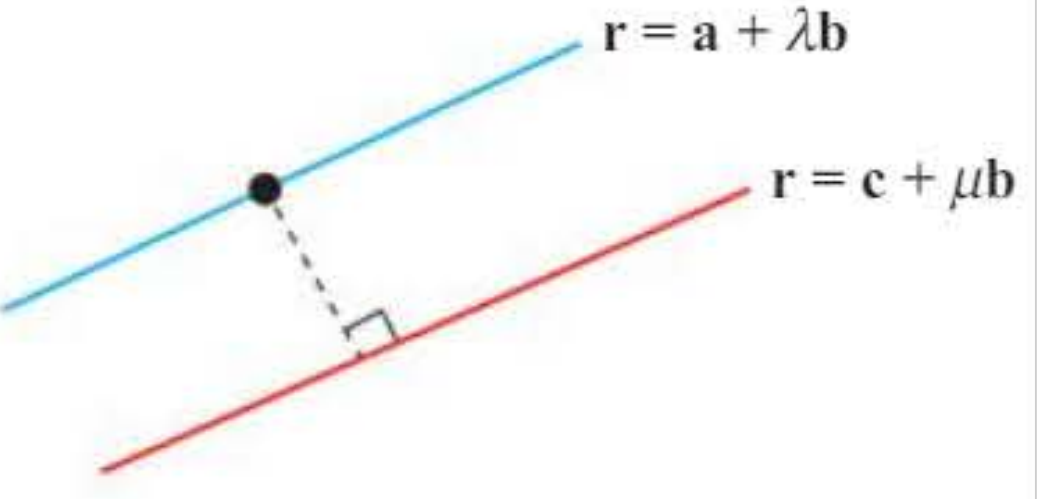
When dealing with parallel lines, their separation remains constant throughout. If two parallel lines have equations and (note they share the same direction vector ), you can:
- Choose any point on one line (typically use the position vector )
- Find the shortest distance from this point to the other line using the perpendicular method
Note
This works because the distance between parallel lines is always the same, regardless of where you measure it. This constant distance property simplifies calculations considerably.
Example
Worked Example 2: Distance Between Parallel Lines
Lines and have equations:
Calculate the shortest distance between and .
Solution:
First, verify the lines are parallel. The direction vector of is:
This confirms the lines are parallel since one direction vector is a scalar multiple of the other.
Choose the point on (when ) and find its distance to line .
Create a vector from this point to a general point on :
Apply the perpendicular condition with the direction vector:
Substitute into the line equation:
Calculate the distance:
The shortest distance is units.
Finding the distance between skew lines
Skew lines are lines that do not intersect and are not parallel. They exist in different planes and maintain a minimum distance between them.
Important
Approach for Skew Lines:
To find the minimum distance between skew lines, use this approach:
- Select a general point on each line
- Form a vector connecting these two points
- This connecting vector must be perpendicular to both direction vectors
- Set up two scalar product equations (one for each direction vector)
- Solve the simultaneous equations for the parameters
- Calculate the distance using these parameter values
Example
Worked Example 3: Distance Between Skew Lines
Find the minimum distance between the skew lines:
Solution:
A general point on the first line has position vector:
A general point on the second line has position vector:
The vector joining these points is:
For minimum distance, must be perpendicular to both direction vectors.
Perpendicular to first line's direction vector:
Perpendicular to second line's direction vector:
Solving equations (1) and (2) simultaneously:
Substitute these values into the vector :
Calculate the magnitude:
The perpendicular distance between the two lines is 1.31 units (to 3 significant figures).
Method 2: Using calculus to find distances
An alternative approach uses calculus to minimise the distance function. This method is particularly useful when the geometric approach becomes algebraically complex.
The calculus strategy
Note
Calculus Method Overview:
For a line and a point with position vector :
- Find the vector joining the point to a general point on the line
- Express the magnitude as a function of the parameter
- Use differentiation: Set to find the minimum (or work with as )
- Substitute the value of back to find the minimum distance
Helpful tip: Minimising also minimises , which often simplifies the algebra considerably.
Example
Worked Example 4: Calculus Method for Point to Line
Find the minimum distance between the line and the point .
Solution:
The vector from a general point on the line to the given point is:
The length of this vector is:
Therefore:
Differentiate with respect to :
Set the derivative equal to zero:
Substitute into the expression for :
The minimum distance is units.
Example
Worked Example 5: Calculus Method for Parallel Lines
Lines and have equations:
Use calculus to calculate the shortest distance between and . Give your answer to 3 significant figures.
Solution:
First, convert to vector form:
Verify the lines are parallel:
The lines are parallel. Consider the shortest distance from point on to line .
Create the vector from to a general point on :
The distance is:
Square both sides:
Differentiate:
Set equal to zero:
Substitute back:
Calculate:
The shortest distance is 4.28 units (to 3 significant figures).
Finding reflections of points in lines
When a point is reflected in a line to give the image , the line acts as a perpendicular bisector of the segment .
Note
Key Properties of Reflections:
- The vector (where is on the line) is perpendicular to the direction vector of
- The relationship holds (this doubling is crucial)
- The midpoint of lies on the mirror line
Strategy for finding reflections
Important
Steps for Finding Reflections:
- Write the vector where is a general point on the line
- Use perpendicularity: The scalar product of with the line's direction vector equals zero
- Apply the doubling relationship:
- Find the image coordinates using
Example
Worked Example 6: Reflection in a Line
Find the coordinates of the image of the point after it is reflected in the line with equation:
Solution:
A general point on the line has position vector:
The vector from to this general point is:
Since is perpendicular to the line:
Substitute :
Using the doubling relationship:
Finally:
The coordinates of the image are .
Exam tips and common pitfalls
Important
Key Exam Techniques:
- Always check whether lines are parallel before choosing your method
- For parallel lines, remember the distance is constant everywhere
- When using the perpendicular method, double-check that you've used the correct direction vector in the scalar product
- The calculus method is often quicker when the algebra becomes complex
- For skew lines, you need two perpendicular conditions (one for each line)
Common Mistakes to Avoid:
- Forgetting that parallel lines must have direction vectors that are scalar multiples of each other
- Confusing the position vector with the direction vector in scalar products
- Not squaring terms correctly when calculating distances
- Forgetting to take the square root at the end
- In reflection problems, using instead of
- Missing the factor of 2 when converting Cartesian equations to vector form
Summary
Key Points to Remember:
- The shortest distance from a point to a line is always perpendicular to the line
- For perpendicular vectors, the scalar product equals zero:
- Parallel lines have direction vectors that are scalar multiples of each other, and their separation is constant
- For skew lines, the minimum distance occurs when the connecting vector is perpendicular to both direction vectors
- The calculus method minimises the distance function using , which is useful when algebra becomes complex
- For reflections, remember that where is the point on the mirror line