The Vector Product (AQA A-Level Further Maths): Revision Notes
📚Revision Notes
The Vector Product
What is the vector product?
The vector product (also called the cross product) is a way of multiplying two vectors together that produces a third vector. Unlike the scalar product which gives a number, the vector product gives a new vector that is perpendicular to both of the original vectors.
Note
Key Difference from Scalar Product:
While the scalar product gives a scalar (number) as a result, the vector product produces a completely new vector that is perpendicular to both input vectors. This makes it particularly useful for finding normal vectors and calculating areas.
Definition
The vector product of two vectors and is defined as:
where:
- is the angle between vectors and
- is a unit vector that is perpendicular to both and
The direction of is determined by the right-hand rule: point your index finger along , your middle finger along , and your thumb will point in the direction of .
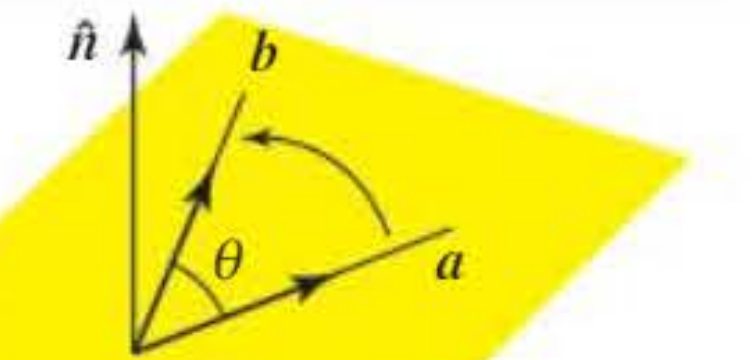
Note
Understanding the Magnitude:
The magnitude of the vector product represents the area of the parallelogram formed by the two vectors. This geometric interpretation is crucial for many applications, particularly in calculating areas.
Properties of the vector product
Anticommutative property
The vector product is not commutative. This means the order matters:
Swapping the order of the vectors changes the sign of the result. The magnitude stays the same, but the direction reverses.
Important
Remember: Swap the Order, Flip the Sign
Unlike ordinary multiplication, switching the order of vectors in a cross product changes the sign of the result. Always pay attention to which vector comes first!
Distributive property
The vector product distributes over addition:
This property is useful when expanding brackets in vector product expressions.
Vector products of unit vectors
The standard unit vectors , , and have special cross product relationships:
These follow a cyclic pattern. If you reverse the order, the sign changes:
Important
Memory Aid: The Cyclic Pattern
Think of the unit vectors in a cycle:
Going forward in the cycle gives a positive result:
Going backward gives a negative result:
Also, any vector crossed with itself gives the zero vector:
Parallel vectors
When two vectors are parallel, their cross product is the zero vector:
This follows from the definition because parallel vectors have or , and .
An important consequence is that any vector crossed with itself equals zero:
Calculating the vector product
Using component form
When vectors are expressed in component form as and , the vector product is:
Important
Watch Out for the Negative Sign!
Notice the middle term has a negative sign. This is a common source of errors. The component always has a minus sign in front when using the component formula.
This formula can be difficult to remember, so the determinant method is often preferred.
Using the determinant method
A more systematic way to calculate the vector product uses a determinant:
Expanding along the first row:
Note
Why Use the Determinant Method?
The determinant method is more systematic and less prone to sign errors than trying to remember the component formula. By always expanding along the first row, you have a consistent procedure to follow.
Important
Critical: The Component Always Has a Minus Sign
When expanding the determinant, be very careful with negative signs. The component always has a minus sign in front, even though you're expanding in a pattern of along the first row. This is the most common mistake in vector product calculations!
Finding angles between vectors
The formula for the vector product can be rearranged to find the angle between two vectors:
This gives an alternative to using the scalar product formula with cosine. Calculate the cross product, find its magnitude, then divide by the product of the magnitudes of the original vectors.
Applications of the vector product
Finding perpendicular vectors
The vector product always produces a vector perpendicular to both original vectors. This is useful when you need to find a normal vector to a plane or a direction perpendicular to two given directions.
To find a vector perpendicular to both and , simply calculate .
Calculating areas of triangles
The magnitude of the vector product equals the area of the parallelogram formed by the two vectors. Therefore, the area of a triangle is half this value.
For a triangle with vertex at the origin and two sides represented by vectors and :
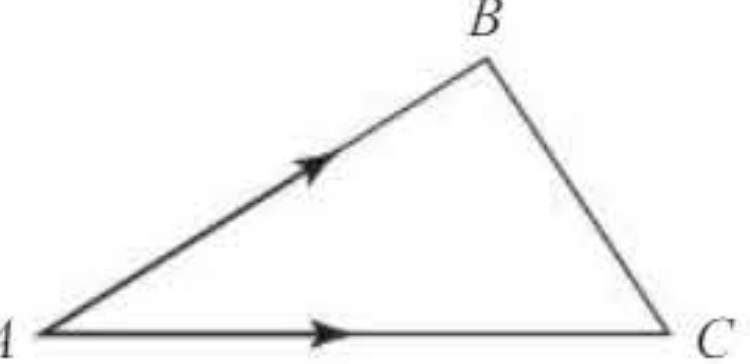
Note
Why the Factor of ?
The magnitude gives the area of the entire parallelogram formed by the two vectors. Since a triangle is exactly half a parallelogram, we multiply by to get the triangle's area.
For a triangle with vertices at specific points, first find the vectors representing two sides:
Calculate and by subtracting position vectors, then use the vector product formula.
Equation of a line in vector product form
A straight line passing through a point with position vector and parallel to vector can be expressed as:
This works because any point on the line creates a vector that is parallel to , and parallel vectors have a zero cross product.
Note
Understanding the Line Equation Form:
Expanding the brackets gives:
Rearranging:
This form is useful because the right-hand side is a constant vector that can be calculated once, and the left-hand side varies with .
Worked examples
Example
Worked Example 1: Proving Unit Vector Cross Products
Show that and
Solution:
Since and are unit vectors perpendicular to each other:
- The angle between them is
Using the formula:
The unit vector perpendicular to both and (using the right-hand rule) is .
Therefore: ✓
For , the angle from to is (or equivalently ): ✓
This demonstrates the anticommutative property.
Example
Worked Example 2: Finding a Perpendicular Vector and Angle
Given and
a) Find a vector perpendicular to both and
b) Calculate the acute angle between and
Solution:
Part a:
Calculate :
Or in column form: (or any scalar multiple, such as or ) ✓
Part b:
First, find the magnitudes:
Now use the rearranged formula:
(to 1 d.p.) ✓
Note: Always check you're calculating the correct angle (acute or obtuse) as required by the question.
Example
Worked Example 3: Using the Determinant Method
Find the vector product of and
Solution:
Set up the determinant:
Expand along the first row:
✓
Example
Worked Example 4: Calculating the Area of a Triangle
Calculate the area of triangle with vertices at , and
Solution:
Step 1: Find vectors and by subtracting position vectors:
Step 2: Calculate the cross product:
Step 3: Find the magnitude:
Step 4: Calculate the area:
(to 3 s.f.) ✓
Example
Worked Example 5: Finding the Equation of a Line
Find the equation of the line through points and in the form
Solution:
Step 1: Find a vector parallel to the line.
Subtract the position vectors of the two points:
Step 2: Use the formula where is the position vector of a point on the line.
Using point :
Step 3: Expand and rearrange.
Calculate the cross product on the right:
Therefore, the equation is:
✓
Or equivalently:
Note: When finding line equations in vector product form, always check your arithmetic carefully, especially when calculating the cross product. The negative signs are easy to get wrong.
Summary
Key Points to Remember:
-
The vector product produces a vector perpendicular to both and
-
Order matters: (anticommutative property) - swap the order, flip the sign!
-
Parallel vectors have zero cross product: if and only if and are parallel
-
Use the determinant method for systematic calculation:
-
Remember: the component always has a minus sign when expanding the determinant
-
Area of a triangle = where and are vectors representing two sides
-
For triangle with vertices: Area of
-
Line equation in vector product form: or