Sensitivity and frequency response (AQA A-Level Physics): Revision Notes
📚Revision Notes
10.2.2 Sensitivity and frequency response
The intensity (I) of a sound measures the amount of energy per second per unit area arriving at the ear. It's given by the formula:
Where:
- is the intensity,
- is the power,
- A is the area. The unit for intensity is .
Inverse Square Law for Sound Intensity
Sound from a point source spreads out equally in all directions. As it does so, its intensity follows an inverse square law. This means that the intensity decreases as the distance from the source increases, because the sound energy is spread over a larger area. The area for a given distance (radius ) can be calculated as the area of a sphere:
Note
Example Calculation:
If a sound source produces 15 W of sound power and you are 5 m away, what is the intensity?
- Calculate the area:
- Calculate the intensity using :
Threshold of Hearing and Pain
- Threshold of Hearing: The quietest sound that a human can hear is defined at 1 pW m⁻² ( 1 × 10⁻¹² W m⁻²) at a frequency of 1 kHz.
- Threshold of Pain: The loudest sound a human can tolerate without pain is 1 W m⁻². This vast range gives humans sensitivity to intensities from 10⁻¹² to 1 W m⁻².
Logarithmic Scale and Decibels (dB)
Because the ear perceives sound logarithmically (a small increase in loudness feels significant), sound intensity is often measured in decibels (dB), which compare a sound's intensity to the threshold of hearing:
where:
- is the intensity of the sound,
- is the threshold of hearing (1 × 10⁻¹² W m⁻²).
Example
Example: 3. If :
Sound Intensity Levels
The table below illustrates the relative intensity levels of various sounds in decibels, alongside their corresponding intensity in watts per square metre () and examples of common situations for each intensity level.
| Relative Intensity Level (dB) | Intensity () | Example/Effect |
|---|---|---|
| 0 | 1 × 10⁻¹² | Threshold of hearing at 1 kHz (the faintest sound detectable by a healthy ear) |
| 20 | 1 × 10⁻¹⁰ | Whisper at a 1-metre distance |
| 40 | 1 × 10⁻⁸ | Average home noise level |
| 60 | 1 × 10⁻⁶ | Normal conversation |
| 80 | 1 × 10⁻⁴ | Loud radio or classroom lecture |
| 100 | 1 × 10⁻² | Noisy factory or siren at 30 metres; prolonged exposure can cause hearing damage |
| 120 | 1 | Loud rock concert or pneumatic chipper at 2 metres; reaches the threshold of pain |
| 140 | 1 × 10² | Jet airplane at 30 metres; causes severe pain and potential damage within seconds |
Understanding Decibel (dB) Scale and Intensity
- Decibel Scale (dB):
- The decibel scale is logarithmic, meaning that each 10 dB increase represents a tenfold increase in intensity. For example, a 20 dB sound is 10 times more intense than a 10 dB sound, and a 30 dB sound is 100 times more intense.
- Intensity Calculation:
- Sound intensity in watts per square metre () quantifies the power per unit area carried by a sound wave. The faintest sound detectable by the average human ear (threshold of hearing) is approximately 1 × 10⁻¹² W/m².
- Threshold of Pain:
- Intensity levels at or above 120 dB can cause physical discomfort or pain and may lead to permanent hearing damage if exposure is prolonged.
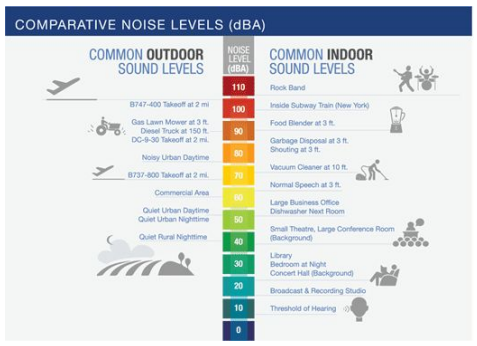
| Noise Level (dB) | Common Outdoor Sound Levels | Common Indoor Sound Levels |
|---|---|---|
| 110 dB | B747-400 takeoff at 2 m | Rock Band, Subway (inside) in New York |
| 100 dB | Lawn Mower at 1 m, Diesel Truck at 10 m | Food Blender at 1 m |
| 90 dB | Noisy Urban Daytime | Garbage Disposal at 1 m, Shouting at 3 ft |
| 80 dB | B737-300 Takeoff at 2 m | Vacuum Cleaner at 10 ft |
| 70 dB | Commercial Area | Normal Speech at 3 ft |
| 60 dB | Quiet Urban Daytime | Large Business Office, Dishwasher Noise at 1 m |
| 50 dB | Quiet Urban Nighttime | Small Theatre, Large Conference Room (Background) |
| 40 dB | Quiet Rural Nighttime | Library, Bedroom at Night |
| 30 dB | --- | Large Business Office at Night, Concert Hall (Background) |
| 20 dB | --- | Broadcast & Recording Studio |
| 0 dB | Threshold of Hearing | Threshold of Hearing |
Loudness vs Intensity
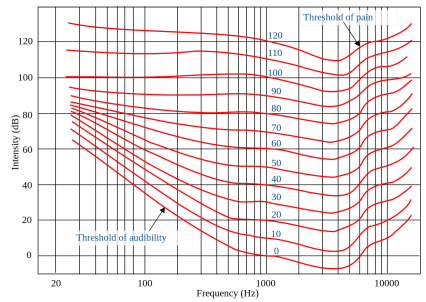
It's important to note that relative intensity level in dB is not a direct measure of loudness, which is a subjective perception and varies by person. Different frequencies are heard differently even if they have the same intensity, which is why equal loudness curves or audiograms are used.
Frequency Sensitivity of the Human Ear
- The human ear is most sensitive to frequencies from 2 kHz to 5 kHz, with peak sensitivity around 3 kHz.
- Equal Loudness Curves show the required dB level at each frequency to perceive sounds as equally loud. This variation is why sound metres use an A-weighting filter (dBA) to replicate human hearing for different frequencies.
Weighting Filters
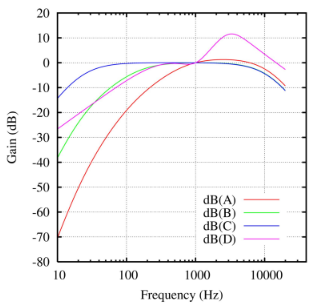
Different weighting filters (dB(A), dB(B), dB(C), dB(D)) adjust sound measurements to match human sensitivity across frequencies, but only dB(A) is used in environmental noise and hearing assessments. The philtre takes into account that humans are less sensitive to very low and very high frequencies, as shown in the red line on equal loudness curves.