Fibre optics and endoscopy (AQA A-Level Physics): Revision Notes
📚Revision Notes
10.4.2 Fibre optics and endoscopy
Optical Fibres
- Definition: Optical fibres are thin, flexible tubes made of plastic or glass that allow light to travel with minimal loss in intensity. They rely on total internal reflexion (TIR), which enables light to bounce down the fibre without escaping, ensuring efficient transmission over long distances.
Total Internal Reflexion (TIR):
-
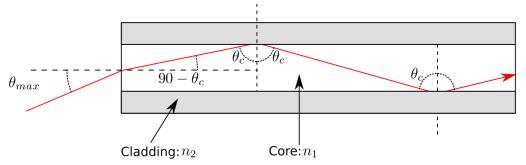
TIR occurs when light hits the boundary between two materials at an angle greater than the critical angle.
-
For TIR to happen:
-
The angle of incidence of the light within the fibre must exceed the critical angle.
-
The refractive index of the core (where the light is travelling) must be higher than that of the surrounding material, known as the cladding. Cladding:
-
Optical fibres are coated with cladding, a material of lower optical density than the core, allowing TIR to occur.
-
Cladding protects the core from physical damage, reduces signal degradation, and prevents light from escaping.
Types of Fibre Bundles
- Coherent Bundle:
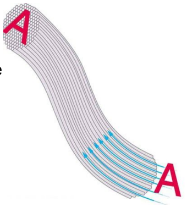
- In a coherent bundle, the relative positions of each fibre are kept constant along the entire length.
- This allows for the accurate transmission of an image from one end of the bundle to the other.
- Used for imaging purposes where a clear image needs to be preserved.
- Incoherent Bundle:
- Fibres are arranged randomly, meaning images cannot be transferred accurately.
- Primarily used for illumination in areas that are difficult to reach, as the light is directed but not in a specific pattern.
- Typically less expensive than coherent bundles.
- Resolution in Fibre Bundles:
- The clarity or resolution of an image depends on:
- The diameter of individual fibres (smaller fibres provide higher resolution).
- The packing density (closer fibres offer clearer details).
- Images can also be enhanced by graduating the diameter of the fibres along the bundle, which magnifies the transmitted image.
Endoscopes
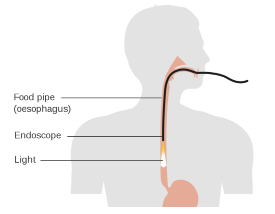
- Purpose: Endoscopes are medical instruments used to visualise the interior of the body. They consist of fibre-optic bundles that transmit light to a specific site in the body and capture an image to be viewed or analysed.
Structure and Function:
-
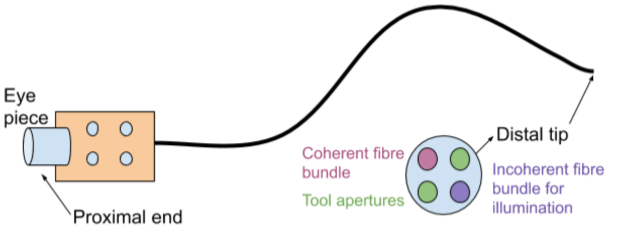
An endoscope has:
-
Coherent fibre bundle with an objective lens at the distal tip to capture images.
-
Incoherent bundle for illumination to light up the area being viewed.
-
Additional Channels:
-
For surgical purposes, some endoscopes have additional channels for instruments or fluids, such as:
-
Water channel: Used to clear the lens of the endoscope.
-
CO₂ channel: Used to create space in the body by inflating the area, improving visibility. Applications:
-
Key-Hole Surgery:
-
Endoscopes allow surgeons to perform minimally invasive procedures by creating small incisions instead of large openings.
-
This reduces recovery time, minimises infection risk, and lowers patient discomfort.
-
Diagnostic Procedures:
-
Used to examine internal organs and tissues, helping doctors identify abnormalities such as tumours or to perform biopsies without open surgery.
Note
Example Explained
- Total Internal Reflexion (TIR) in Optical Fibres:
- Imagine shining a torch down a narrow glass tube at an angle greater than the critical angle. Instead of the light escaping, it reflects down the tube. This continuous reflexion allows light to travel efficiently within optical fibres, forming the basis for both coherent and incoherent bundles.
- Endoscopy in Key-Hole Surgery:
- During a key-hole surgery, a surgeon can insert an endoscope with a coherent bundle to view the surgical area on a monitor. Using additional channels in the endoscope, they can clear the view with water or make precise cuts with other surgical instruments without needing a large opening. This minimally invasive technique reduces the patient's recovery time compared to traditional open surgery.