Radio telescopes (AQA A-Level Physics): Revision Notes
📚Revision Notes
Radio telescopes
Origins of radio astronomy
Radio astronomy began in the 1930s when Karl Jansky, a telephone engineer, was investigating sources of static noise that interfered with radiotelephony communication circuits. Using a radio antenna, Jansky discovered that some of the noise originated from radio sources in space, specifically from the central region of the Milky Way. This discovery led to the development of radio telescopes designed to study these signals from space.
Note
Radio telescopes can be located on the ground, unlike many other types of astronomical instruments, because Earth's atmosphere is transparent to a large range of radio wavelengths. This means radio waves from space can pass through the atmosphere without being significantly absorbed or distorted, allowing ground-based observations.
Basic structure of a radio telescope
A basic radio telescope comprises several key components working together to detect and analyze radio waves from space. The primary component is a parabolic dish antenna, which acts as the objective. This dish collects incoming radio energy and focuses it to a point. At this focus point sits a receiver that detects the concentrated radio signals.
The signal from the receiver is extremely weak, so it passes through an electronic amplifier that strengthens the signal to a level that can be analyzed. The amplified signal is then displayed as an intensity trace, which shows the strength of the radio emission as it varies.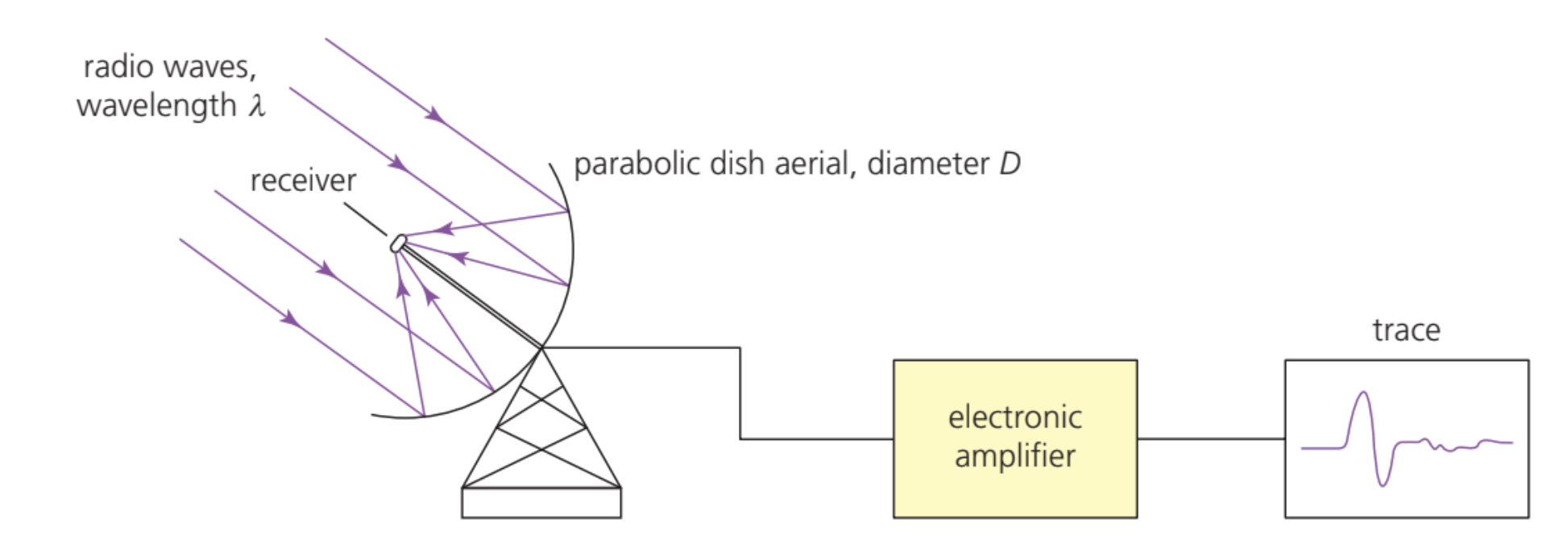
Note
Radio astronomy operates using radio frequencies that have been allocated by international agreement. These frequencies fall primarily in the megahertz (MHz) and gigahertz (GHz) bands, though there can be some overlap with domestic communication channels.
The angular resolution challenge
Radio telescopes face a limitation in their ability to distinguish between objects that appear close together in the sky. This property is called angular resolution, and radio telescopes have relatively poor angular resolution compared to optical telescopes. The reason for this limitation lies in the physical properties of the radiation being observed.
The Rayleigh criterion describes the minimum angular separation at which two point sources can be resolved:
where:
- is the minimum angular resolution (in radians)
- is the wavelength of the radiation
- is the diameter of the telescope aperture
Important
This equation reveals why radio telescopes struggle with angular resolution. Radio waves have wavelengths on the scale of metres, whereas visible light has wavelengths measured in nanometres (one billionth of a metre). Since the wavelength appears in the numerator of the equation, longer wavelengths result in poorer angular resolution for a given aperture size.
To achieve acceptable angular resolution for resolving objects with small angular sizes, radio telescopes must compensate by using much larger apertures. In the case of radio telescopes, the aperture is the parabolic dish itself. This explains why radio telescopes have such enormous dishes compared to the relatively modest mirrors in optical telescopes.
Example
Understanding the Size Requirement:
For visible light ( nm) with a 1-metre telescope:
For radio waves ( m) to achieve the same resolution:
This demonstrates why radio telescopes need dishes hundreds of metres in diameter to achieve even modest angular resolution!
Major radio telescope installations
The largest single-dish radio telescope in the world is located at Arecibo in Puerto Rico. This remarkable instrument has a diameter of 305 metres and features a spherical-shaped dish. Unlike many other radio telescopes, the Arecibo dish is fixed in position, constructed within a natural geologic depression in the landscape.
Other major radio telescopes, such as the Parkes radio telescope in New South Wales, Australia, use different designs. The Parkes telescope has a 64-metre diameter dish and is fully steerable, meaning it can be pointed at different parts of the sky. These steerable designs require substantial mechanical structures to support the massive dishes while allowing them to move accurately.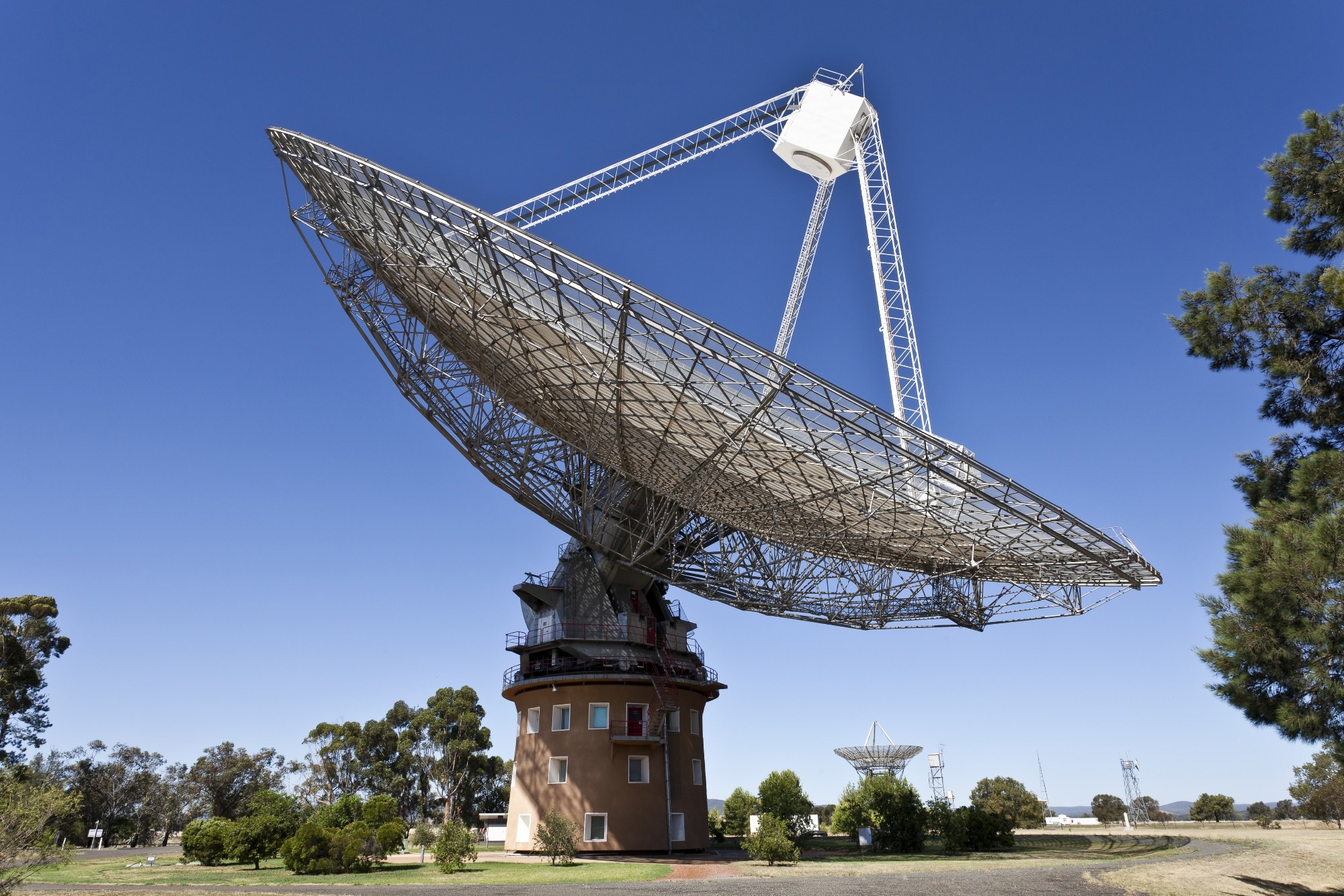
Operating conditions and advantages
Radio telescopes possess operational advantages over optical telescopes. They can operate continuously during both day and night, as sunlight does not interfere with radio observations in the same way it prevents optical observations during daylight hours.
However, radio telescopes are usually situated away from radio transmitters and other sources of Earth-based radio emissions. These artificial signals can overwhelm the extremely weak signals from astronomical objects, making observations impossible. For this reason, radio telescope sites are typically chosen in isolated areas with minimal human radio activity.
Interference and atmospheric limitations
Despite their ability to operate through Earth's atmosphere, radio telescopes are not completely immune from interference. The usable frequency range for ground-based radio astronomy is limited by atmospheric effects at both the low and high ends of the spectrum.
Important
Atmospheric Frequency Limitations:
-
Below approximately 30 MHz: The ionosphere (a layer of charged particles in the upper atmosphere) strongly absorbs radio signals, preventing them from reaching ground-based telescopes.
-
Above approximately 60 GHz: Water vapour in the atmosphere causes significant absorption of radio waves.
Between these frequency limits, artificial interference remains a concern. Mobile phones, radio telephones, and radar scanners all produce radio emissions that can create serious problems for the sensitive instrumentation used in radio telescopes. This is another reason why radio telescopes are typically located in isolated, radio-quiet areas.
Imaging differences between radio and optical astronomy
The images produced by radio telescopes appear quite different from those captured by optical telescopes, revealing different physical processes and structures in space. When the same region of sky is observed at both visible and radio wavelengths, the resulting images can look dramatically different.
For example, observations of the Milky Way at visible wavelengths show the familiar band of stars and dust. However, when the same region is observed using radio telescopes at a wavelength of 21 centimetres, a completely different picture emerges showing the distribution and intensity of radio emission across the galaxy.
Note
The 21 cm Hydrogen Line:
This 21 cm radio emission is produced by changes in the energy state of neutral hydrogen atoms in the hydrogen gas that fills the Milky Way. This emission has a particular advantage: it can penetrate thick dust clouds that completely block visible light. This allows astronomers to map the distribution of hydrogen gas throughout our galaxy, even in regions that are completely obscured at optical wavelengths.
The result is a radio intensity map that reveals structures and distributions invisible to optical telescopes, providing insights into the composition and dynamics of our galaxy that would be impossible to obtain through visible light observations alone.
Summary
Key Points to Remember:
-
Radio astronomy began with Karl Jansky's discovery in the 1930s that radio noise was coming from space, specifically from the Milky Way.
-
Radio telescopes use large parabolic dishes because the Rayleigh criterion () shows that longer wavelengths require larger apertures to achieve good angular resolution.
-
Radio telescopes can operate day and night, but are limited by ionosphere absorption below 30 MHz and water vapour absorption above 60 GHz.
-
The 21 cm radio emission from neutral hydrogen can penetrate dust clouds, allowing radio telescopes to reveal structures in space that are invisible to optical telescopes.
-
Radio telescopes must be located in isolated areas to avoid interference from artificial radio sources like mobile phones and radar.