Corporate Culture (Edexcel A-Level Business): Revision Notes
📚Revision Notes
Corporate Culture
What is corporate culture?
Corporate culture (also called organisational culture or business culture) refers to the values, attitudes, beliefs, meanings and norms shared by people and groups within an organisation. Every workplace has a distinct atmosphere - some are busy and dynamic, others are friendly and relaxed, some are highly structured while others are more informal. This atmosphere reflects the underlying culture of the business.
Note
Understanding corporate culture is crucial because it shapes how employees behave, how decisions are made, and ultimately how successful a business can be. Culture can act as a competitive advantage when it aligns employees toward common goals and values.
Strong and weak corporate cultures
Strong cultures
A strong culture is deeply embedded into how a business operates. Employees clearly understand and share the organisation's values, and these values guide daily behaviour and decision-making.
Advantages of a strong corporate culture:
- Provides identity - Employees feel part of the business, which can lead to flexibility during times of change or difficulty
- Builds connections - Workers identify with colleagues, improving teamwork and collaboration
- Increases commitment - Reduces problems like high labour turnover and industrial relations issues
- Motivates staff - Can lead to increased productivity and performance
- Improves understanding - Employees better comprehend operations and instructions, preventing misunderstandings
- Reinforces values - Supports the beliefs of senior management throughout the organisation
- Acts as a control mechanism - Helps management when setting company strategy and direction
Weak cultures
A weak culture exists when it is difficult to identify the factors forming the culture, or when many sub-cultures exist, making the overall culture hard to define. In weak cultures, different departments or teams may operate with conflicting values and norms.
Important
When multiple sub-cultures exist within an organization, they can create conflicting values and norms that undermine overall business effectiveness and make unified decision-making difficult.
Factors determining culture strength
Corporate culture operates at three levels:
Surface manifestations
These are the visible and tangible aspects of culture that you can observe:
- Artefacts - Physical items like furniture, dress codes, or uniforms that reflect company values
- Ceremonials - Events such as award ceremonies or company traditions (e.g., singing the company song)
- Courses - Induction and training programmes designed to instill organisational culture
- Heroes - Role models within the business (past or present leaders like Bill Gates or Richard Branson)
- Language - Specific terminology used within the business (e.g., calling workers "colleagues" or "crew members")
- Mottoes - Short, unchanging statements expressing organisational values
- Stories - Accounts of important events that exemplify business values, such as the company's founding history
- Myths - Frequently told stories about the business that may not be literally true but convey cultural meaning
- Norms - Expected behaviours, such as punctuality standards or willingness to cover for absent colleagues
- Physical layout - Office design choices like open-plan spaces, hot-desking, or office size reflecting hierarchy
- Rituals - Regular events reinforcing culture, such as charity fundraising days or social gatherings
Note
Surface manifestations are the easiest aspects of culture to change because they are visible and tangible. However, changing these alone may not transform the deeper culture if core values and basic assumptions remain unchanged.
Core organisational values
These sit below surface manifestations and represent consciously thought-out and formally expressed values. Core values appear in mission statements and policy documents, reflecting what senior management believes the organisation should stand for.
However, there can be gaps between stated values and actual culture. For example, a company might claim to be "customer-focused" in its mission statement, but frontline staff dealing with difficult customers daily may not genuinely believe "the customer is always right."
Example
Example: John Lewis Partnership - Cultural Alignment
The John Lewis Partnership demonstrates strong alignment across all three cultural levels:
Surface manifestations: Employees are called "partners"
Core values: Mission statement commits to rewarding employees as stakeholders
Basic assumptions: Consistently pays above-average wages with profit-based bonuses
This alignment between what the company says, how it presents itself, and how it actually behaves creates a strong and effective culture.
Basic assumptions
These are the deepest level of culture - the unsaid beliefs and ingrained ways of working that form the general attitude of the workforce. Basic assumptions represent how individuals actually behave and are often "invisible" and difficult to see, understand or change. They may differ significantly from what management says the culture should be.
Important
Basic assumptions are the most difficult to change because they are deeply ingrained, often unconscious, and represent the actual behaviour of employees rather than stated values. This is why surface-level changes (like dress codes) may fail to transform organizational culture if deeper assumptions remain unchanged.
Classification of company cultures
Charles Handy (1993) identified four main types of organisational culture:
Power culture
In a power culture, a central source of power controls decision-making. Few formal rules and procedures exist, and powerful individuals can override them when convenient.
Characteristics:
- Centralized control and decision-making
- Competitive atmosphere among employees
- Political environment where people compete for power
- Power allows individuals to achieve personal objectives
- Common in small-to-medium businesses founded and still controlled by a single owner
Note
Power cultures are most effective when quick decisions are needed and when the central power figure has strong expertise. However, they can struggle with succession planning and may limit employee empowerment and innovation.
Role culture
In a role culture, decisions follow well-established rules and procedures. Power attaches to positions (like "marketing director" or "supervisor") rather than individuals.
Characteristics:
- Bureaucratic structure with clear hierarchies
- Power lies with roles, not personalities
- Can have tall or flat hierarchies with long chains of command
- Rules and procedures govern operations
- Example: The Civil Service
Task culture
In a task culture, power goes to those who can accomplish tasks successfully. Expertise matters more than position or hierarchy.
Characteristics:
- Power based on expertise and ability
- Common use of teamworking
- Teams form and dissolve as work requirements change
- Values adaptability and dynamism
- Flexible and project-focused
Note
Task cultures are highly adaptable and responsive to changing circumstances because they value expertise over hierarchy. This makes them particularly effective in dynamic industries or project-based work where flexibility is essential.
Person culture
In a person culture, individual experts work relatively independently, with the organisation existing mainly to support them.
Characteristics:
- Collection of individuals with similar expertise
- Limited collaboration between experts
- Organisation supports individual professionals
- Examples: Firms of accountants, lawyers, doctors, or architects
Effects of organisational culture
Impact on motivation
Culture directly affects employee motivation by influencing how staff treat each other. A culture that respects individual workers and their achievements typically increases motivation. Highly competitive cultures may motivate some employees while demotivating others.
Culture also has indirect effects - when organisational culture contributes to business success, employees feel motivated by being part of a winning team.
Impact on organisational structures
Culture influences how businesses structure themselves. For example:
- Person cultures typically have flat hierarchies because key workers share senior management roles (e.g., a doctors' practice has few management layers)
- Large multinationals tend to have more hierarchical layers to accommodate regional managers, divisional managers, and multiple product teams
- The larger and more complex the business, the more layers typically exist to handle specialist roles
Impact on new management
When new management takes over a struggling business, they often must confront existing organisational culture as part of the turnaround strategy. The greater the change needed, the more likely culture change becomes a priority.
Impact on mergers and takeovers
When businesses merge or one takes over another, each organization brings its own culture. Creating a single unified business requires managing culture change.
Important
In takeovers, one approach involves making senior management from the acquired company redundant. Without powerful advocates at the top, those lower down find it harder to resist imposed changes. However, this often causes low motivation and morale for the first year following takeover.
How corporate culture is formed
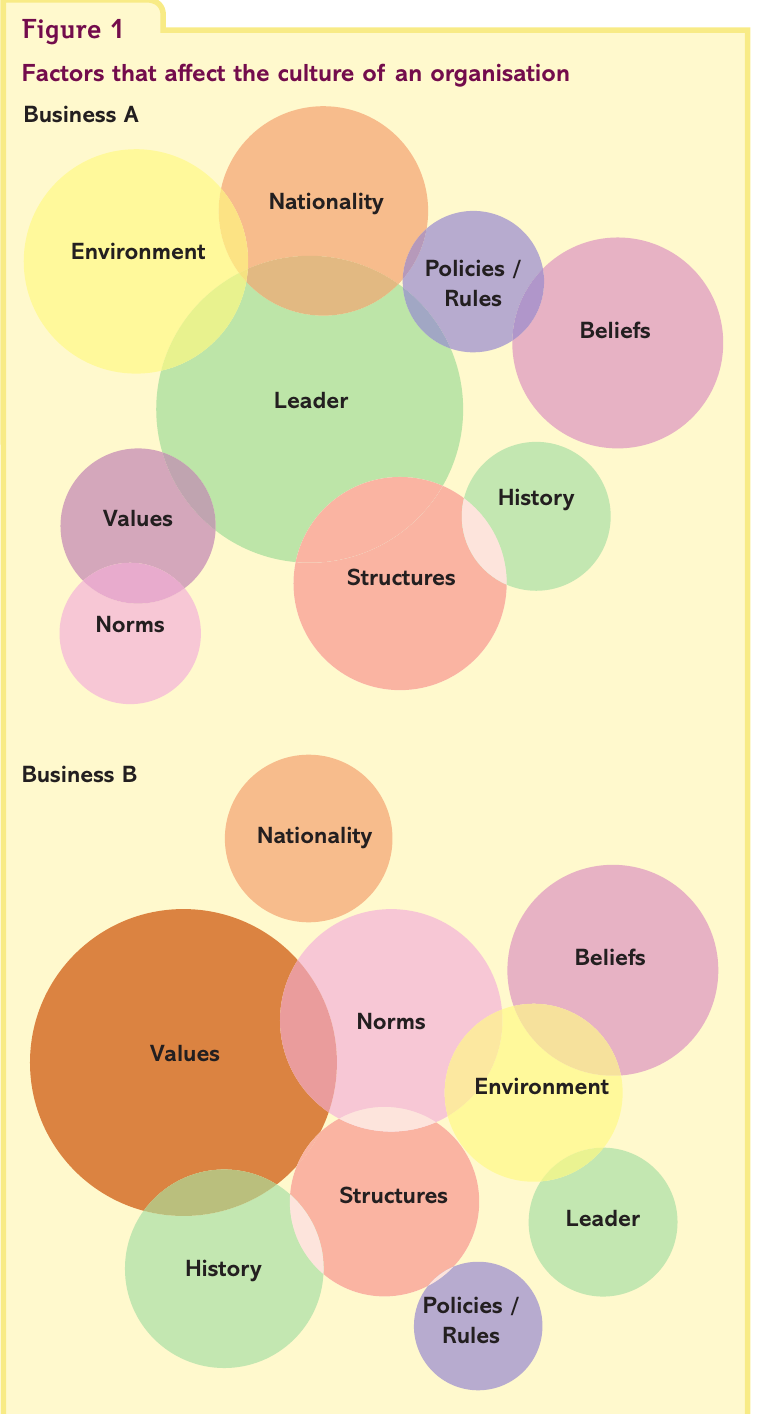
Multiple factors contribute to forming organisational culture:
Leadership and founders - The personalities, beliefs and attitudes of founding members and strong leaders often permeate the organisation. For example, Jan Koum (CEO of WhatsApp) refused to allow advertisers on the platform, influencing company strategy and values.
Environmental factors - The context in which a business operates shapes its culture:
- History and heritage - Long-established businesses may have deeply rooted values and norms that employees "buy into"
- Success levels - Company performance affects employee expectations and motivation
- Nationality - Geographic location and national culture influence business culture
Product characteristics - The type of product or service affects culture:
- Technological complexity determines workforce skill levels and expertise requirements
- The pace of innovation needed influences whether the culture values stability or change
Structures and policies - Formal organizational structures, rules, and policies shape how people work and interact.
Note
As shown in the diagram, these factors overlap and interact differently in each business. In Business A, the leader has major influence on culture formation. In Business B, well-established values play a more significant role in shaping culture.
Difficulties in changing an established culture
Businesses may want to change culture to become stronger and more productive, as culture can provide competitive advantage. John Kay (1993) identified "architecture" - the relationships and networks within an organisation and with external stakeholders - as a distinctive capability that can lead to competitive advantage. Corporate culture falls into this category and represents an intangible asset that adds value.
However, changing culture presents significant challenges:
Complexity and identification - While describing culture may be easy, identifying which specific factors contribute to it and their relative importance is extremely difficult. Changing one factor may not significantly shift the overall culture.
Sub-cultures - Most organizations contain sub-cultures within specific teams or functions, making organization-wide culture change harder to achieve.
Varying difficulty - Some cultural aspects change more easily than others. Visible surface manifestations (like dress codes or office layout) can be altered relatively quickly, but deep-rooted basic assumptions are far more resistant to change.
Resistance - Employees who are comfortable with existing culture may resist changes, especially if they don't understand the reasons for change or feel threatened by it.
Important
Despite these difficulties, culture remains worth managing because it can be manipulated and shaped to meet changing business needs when done carefully and strategically. The key is understanding which aspects of culture to target and having realistic expectations about the time and effort required.
Hofstede's cultural dimensions
Geert Hofstede's research in the 1970s and 1980s examined how culture differs across international organisations. He identified five key dimensions that vary across businesses in different countries and impact how organizations may react in certain circumstances:
Power distance
This measures the gap between managers and subordinates:
- High power distance - Managers have significantly more power and privileges than subordinates, with limited socialization between levels and top-down communication (common in Chinese companies)
- Low power distance - Greater collaboration and discussion between employees of different ranks (common in Scandinavian countries)
Note
Understanding power distance is crucial when working across cultures. What seems like normal management behavior in a high power distance culture might be perceived as autocratic in a low power distance culture, and vice versa.
Individualism
This examines how people see themselves within their organisation:
- High individualism - People focus on personal success above team or organizational success
- High collectivism - People prioritize group and organizational goals over personal achievement
This dimension affects organizational structure, motivation approaches, and internal competition levels.
Masculinity
This describes management style and workplace approach:
- Masculine organizations - Competitive and assertive management style
- Feminine organizations - Caring and cooperative approach
This dimension influences how people respond to targets and goals and how they relate to one another.
Uncertainty avoidance
This measures how organizations handle risk:
- High uncertainty avoidance - Organizations want evidence, security and proof before acting; more risk-averse
- Low uncertainty avoidance - Organizations willing to take chances if rewards seem worthwhile; more entrepreneurial and agile in decision-making
Note
Uncertainty avoidance significantly impacts innovation and entrepreneurship. Organizations with low uncertainty avoidance are typically more agile and innovative, while those with high uncertainty avoidance prioritize stability and proven approaches.
Long-term versus short-term orientation
This addresses a culture's time horizon for decision-making:
- High score (long-term) - Decisions made to achieve long-term success and sustained growth
- Low score (short-term) - Decisions aim for short-term rewards and immediate shareholder value
UK businesses have been criticized for short-termism in their decision-making.
Important
Application: Hofstede's dimensions provide a useful framework for understanding cultural settings, particularly when analyzing international businesses and how they might react in different circumstances such as international trade, partnerships, mergers and takeovers.
Remember!
Summary
Key Points to Remember:
-
Corporate culture consists of the shared values, attitudes, beliefs and norms within an organization, operating at three levels: surface manifestations, core values, and basic assumptions
-
Strong cultures provide competitive advantages through increased employee identity, commitment, motivation, and alignment with organizational goals
-
Handy's four culture types are power (centralized control), role (bureaucratic), task (expertise-based), and person (individual experts)
-
Culture affects motivation levels, organizational structures, and how businesses handle change, mergers and takeovers
-
Culture forms through multiple interacting factors including leadership, history, environment, nationality, product type, and organizational success
-
Changing culture is difficult because of complexity, sub-cultures, and deep-rooted basic assumptions, though it remains an important competitive asset worth managing
-
Hofstede's five dimensions (power distance, individualism, masculinity, uncertainty avoidance, and time orientation) help understand how national culture influences organizational behavior, particularly in international contexts