Improving Workforce Performance (Edexcel A-Level Business): Revision Notes
📚Revision Notes
Improving workforce performance
Workforce performance is central to business success. When employees are productive, motivated, and committed, businesses achieve higher output, lower costs, and stronger competitive advantage. This note explores the key strategies businesses use to improve workforce performance, focusing on reducing absenteeism and staff turnover while increasing productivity and retention.
Understanding absenteeism
Note
Absenteeism occurs when employees fail to attend work when scheduled. While some absence is inevitable due to genuine illness or emergencies, high absenteeism rates damage business performance and increase costs.
Understanding why absenteeism occurs helps businesses develop effective solutions.
Causes of absenteeism
Several factors influence absence rates within organisations:
Business size
Smaller businesses typically experience lower absenteeism than larger organisations. This occurs because smaller teams create stronger commitment and greater sense of teamwork. In large businesses, employees may feel their absence won't impact operations, making absenteeism seem more acceptable.
Health and safety standards
Organisations with robust health and safety procedures suffer less illness-related absence. Poor health and safety practices increase workplace injuries and illnesses. Some industries face inherently higher health risks, naturally leading to higher absence rates.
Task design
The nature of work significantly affects absence levels. Fragmented, repetitive tasks create low job satisfaction and demotivation, encouraging employees to report sick. Conversely, interesting and rewarding work correlates with lower absentee rates as employees find their work fulfilling.
Workplace culture
Toxic workplace cultures drive absenteeism. Environments characterised by overwork, intimidation, bullying, or ignored employee needs create work-related stress. Stress-related absences prove particularly problematic because affected employees often take extended time off—sometimes months at a time.
Supervision and trust
Oversupervision creates stress-related illness. When employees feel constantly monitored and untrusted, they experience anxiety and demotivation, leading to increased absence.
Compensation levels
Workers who feel significantly underpaid are more likely to take time off. They view absence as compensation for inadequate monetary rewards. Low pay also acts as a demotivator, contributing to higher absenteeism rates.
Calculating absenteeism
Businesses measure absenteeism to identify problems and track improvement. The rate shows absent staff as a percentage of total workforce:
Daily absenteeism rate =
Annual absenteeism rate =
Businesses compare these rates against industry averages, national benchmarks, or their own historical data to assess performance.
Example
Worked Example: Tracking Workforce Performance
The table below shows workforce data for Hunter & Co between 2010 and 2014. This data demonstrates how businesses track employment metrics over time.
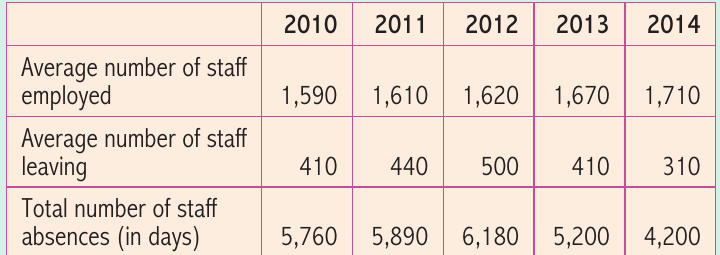
Analysis: Notice that after new working practices were introduced in 2012 (with prior consultation), both staff turnover and absenteeism improved significantly by 2014. This illustrates the impact of good HR management on workforce performance.
Benefits of improving workforce performance
Improving productivity, retention, turnover, and absenteeism creates substantial business advantages:
Increased productivity
Higher output per employee means more products or services to sell. This directly increases revenue and profit. More efficient operations also reduce unit costs, improving profit margins.
Reduced turnover costs
Lower staff turnover saves significant money on recruitment, selection, and training expenses. These cost savings flow directly to the bottom line, increasing profitability. Additionally, experienced employees are more productive and make fewer errors.
Improved quality
Motivated, committed employees produce higher quality work. They take greater care, make better decisions, and deliver superior customer service.
Enhanced reputation
Businesses with engaged, productive workforces develop positive reputations. This attracts high-quality job applicants and improves customer perceptions.
Strategies to improve workforce performance
Businesses employ various HR strategies to enhance workforce performance. These strategies address different aspects of motivation and commitment.
Financial rewards
Financial incentives remain powerful motivators for many employees. Different financial reward systems suit different situations and business models.
Piece rates and Taylor's scientific management
F.W. Taylor, an American engineer and business consultant, developed scientific management theory in the early 20th century. Taylor believed that once businesses identified the most efficient work method, they should pay employees according to output. His philosophy centred on "a fair day's pay for a fair day's work".
Taylor argued that money motivates workers primarily. Therefore, piece rate payment—where workers earn based on units produced—would encourage higher productivity. This system benefits businesses by rewarding productive workers while penalising lazy or slow employees. Hardworking, conscientious staff earn more, creating natural motivation to maintain high performance.
Important
Piece rates only suit situations where individual output is measurable and quality can be maintained despite speed emphasis.
Performance-related pay
Performance-related pay links salary increases or bonuses to achievement of specific targets or objectives. This system works well for roles where output isn't easily measured in units but where clear performance metrics exist. For example, managers might receive bonuses for meeting departmental targets or achieving specific KPIs.
This approach encourages sustained effort throughout the year rather than just at busy periods. It also aligns employee interests with business objectives.
Bonus systems
Bonuses provide additional payments on top of basic wages or salaries. They may be linked to:
- Reaching production targets
- Meeting sales objectives
- Achieving quality standards
- Hitting attendance goals
Note
The key advantage of bonuses is that businesses only pay them when targets are met. This means costs directly correlate with improved performance. Bonuses motivate employees without permanently increasing the wage bill.
Loyalty bonuses
Some businesses pay annual bonuses—often at Christmas—to reward employee loyalty rather than specific productivity achievements. These bonuses help reduce staff turnover by making employees feel valued and appreciated. They create a sense of long-term commitment between employer and employee.
Attendance rewards
Given that sickness absence cost UK organisations approximately $29 billion in 2013, some businesses now offer financial incentives for good attendance. For example:
- $1,000 bonus for 100% attendance over six months
- $200 bonus for 98% attendance over six months
Important
These schemes must be designed carefully to avoid penalising employees who take legitimate, entitled time off. They work best when they reward consistently good attendance rather than perfect attendance.
Profit-related pay and commission
Profit-related pay gives employees a share of company profits, typically through annual bonuses. This aligns employee interests with overall business success and encourages team working.
Commission systems pay employees a percentage of sales value. This suits sales roles where individual performance directly impacts revenue. Commission creates strong motivation to sell more but may encourage aggressive selling that damages customer relationships.
Employee share ownership
Share ownership schemes give employees an ownership stake in the business. This creates psychological commitment and aligns employee interests with long-term business success.
Sharesave schemes
Note
Sharesave schemes (or Savings Related Share Option Schemes) work by allowing employees to save part of their monthly salary for a fixed period (typically 3, 5, or 7 years). At the end of the period, employees can use their savings to buy company shares at a price fixed at the start—often at a discount.
If the share price has risen above the fixed price, employees make a capital gain. If the share price has fallen below the fixed price, employees get their money back, sometimes with a small bonus. This "no-lose" structure makes sharesave schemes very popular.
Over 1,000 UK companies offered sharesave schemes in 2012-13, including major employers like BT, Ocado, Asda, Tesco, and Whitbread.
Benefits for businesses
Employee share ownership improves motivation because workers benefit directly from business success. Shareholders feel greater loyalty to their company and are more likely to:
- Work harder to improve business performance
- Take less sick leave
- Stay with the organisation longer
The commitment is particularly strong with sharesave schemes. Once employees sign up for a five-year scheme, they may be reluctant to leave halfway through and miss potential gains. This significantly reduces turnover.
Benefits for employees
Share ownership provides employees with:
- Potential capital gains if share prices rise
- Dividend income while holding shares
- Greater sense of involvement in business success
- Tax advantages (many schemes offer tax benefits)
Consultation strategies
Involving employees in decision-making improves motivation and productivity. Staff who feel their views matter are more engaged and committed. However, different consultation approaches offer varying levels of genuine employee involvement.

Pseudo-consultation
Pseudo-consultation occurs when management makes decisions then informs employees through their representatives. Employees have no power to influence these decisions. This approach is really information-giving rather than true consultation.
While pseudo-consultation is quick and maintains management control, it doesn't provide the motivational benefits of genuine involvement. Employees may feel patronised or resentful.
Classical consultation
Classical consultation involves employees, through their representatives, in discussions about matters affecting them. This allows employees to influence management decisions, though final authority remains with management.
Trade unions often engage in classical consultation on issues like restructuring, redundancies, or changes to working conditions. This approach balances management authority with employee voice.
Integrative consultation
Integrative consultation is the most democratic approach. Management and employee representatives jointly explore issues of common concern, such as improving productivity or changing work practices. Both groups use problem-solving techniques to reach joint decisions.
This approach goes beyond consultation or negotiation—it's collaborative decision-making. Quality circles (small groups of workers who meet regularly to identify and solve work-related problems) exemplify integrative consultation.
Advantages of consultation
Regardless of type, consultation offers several benefits:
- Reduced resistance to change
- Access to employee ideas and insights
- Improved motivation through involvement
- Better decisions through diverse perspectives
- Enhanced trust between management and workers
Limitations of consultation
Important
Critics argue that consultation:
- Takes too long and slows change
- Can be "cosmetic"—listening without acting
- May raise expectations that cannot be met
- Dilutes management authority
Despite these concerns, genuine consultation generally improves workforce performance and organisational effectiveness.
Empowerment strategies
Empowerment involves granting employees greater authority and autonomy in their work. By making better use of employee knowledge, experience, and creativity, empowerment creates a positive working environment where staff feel valued and motivated.
Effective empowerment requires careful implementation through several key strategies:
Training
You cannot empower staff without first equipping them with necessary skills. Businesses must identify the "skills gap"—the difference between current employee capabilities and those needed for expanded responsibilities. Training programmes bridge this gap, building both technical skills and confidence.
Example
Practical Example: Empowering Team Leaders
Before empowering team leaders to make scheduling decisions, businesses might provide training in workforce planning, conflict resolution, and time management.
Providing necessary resources
Empowerment fails if employees lack required resources and information. When tasked with solving problems or making decisions, employees need:
- Relevant data and information
- Adequate budget allocation
- Access to expert advice
- Appropriate tools and technology
For instance, an employee leading a project to improve customer complaint response times needs access to current complaint data, customer feedback, and the budget to implement solutions.
Handing over authority
Once empowered, employees must feel confident they have complete authority to make decisions. Their chosen methods and approaches should not be constantly questioned or second-guessed.
Important
If managers challenge every decision or require detailed explanations, empowerment becomes meaningless. Employees need genuine autonomy within agreed boundaries.
This doesn't mean zero accountability, but it does mean trusting employees to exercise judgement.
Inspiring confidence
Empowerment may feel daunting to employees accustomed to following instructions. Lack of confidence leads to anxiety, hesitancy, and mistakes. Senior managers can inspire confidence by:
- Emphasising individual strengths
- Showing trust through actions, not just words
- Recognising and praising achievements
- Supporting rather than criticising early mistakes
- Providing encouragement during challenges
Building confidence takes time but is essential for successful empowerment.
Providing feedback
At appropriate times, businesses must provide constructive feedback to empowered workers. Employees need to know how they're performing in their enhanced roles. Effective feedback:
- Focuses on specific behaviours and outcomes
- Balances praise with constructive suggestions
- Guides future decision-making
- Builds confidence and competence
- Occurs regularly, not just annually
Benefits of empowerment
When implemented effectively, empowerment:
- Improves motivation by making work more interesting
- Increases productivity through better use of employee talents
- Enhances employee loyalty and reduces turnover
- Develops future leaders within the organisation
- Reduces absenteeism by increasing job satisfaction and responsibility
- Improves decision quality by involving those closest to issues
Key formulas and calculations
Labour productivity =
This shows output per worker in a given period. Higher productivity means greater efficiency.
Staff turnover rate =
This shows the percentage of the workforce that leaves over a period. Lower turnover is generally preferable.
Absenteeism rate =
This shows absence as a percentage of possible working time. Lower rates indicate better attendance.
Exam guidance
Important
For "Analyse" questions:
- Identify the specific strategy being used
- Explain how it works in the context given
- Explore both positive and negative impacts
- Consider short-term versus long-term effects
- Link to appropriate motivation theory
For "Evaluate" questions:
- Make supported judgements about effectiveness
- Consider the specific business context (size, industry, culture)
- Weigh up advantages and disadvantages
- Consider alternatives that might be more suitable
- Reach a justified conclusion based on the context
- Consider implementation challenges and costs versus benefits
For "Assess" questions:
- Examine the extent to which a strategy will achieve objectives
- Consider multiple factors affecting success
- Evaluate the relative importance of different factors
- Make judgements about likelihood of success
- Support all points with reasoning and context
Remember!
Summary
Key takeaways for improving workforce performance:
-
Absenteeism results from multiple causes including business size, health and safety standards, task design, workplace culture, supervision style, and pay levels. Understanding these causes helps businesses develop targeted solutions.
-
Financial rewards remain powerful motivators when designed appropriately. These include piece rates, performance-related pay, bonuses, profit sharing, and commission. Each suits different situations and must align with business objectives.
-
Employee share ownership creates psychological commitment by giving workers a stake in business success. Sharesave schemes are particularly popular because they offer capital gains potential without financial risk.
-
Consultation improves motivation and decision quality by involving employees in changes that affect them. The three types—pseudo, classical, and integrative—offer increasing levels of employee involvement and influence.
-
Empowerment enhances performance by granting employees greater authority and autonomy. Success requires adequate training, resources, authority, confidence building, and constructive feedback. When done well, empowerment increases motivation, productivity, and loyalty while reducing turnover and absenteeism.