Trade Protectionism (Edexcel A-Level Economics A): Revision Notes
📚Revision Notes
Trade Protectionism
Introduction to restrictions on free trade
International trade brings many potential benefits to countries and consumers. Trade allows countries to access goods that cannot be produced domestically, gives producers access to larger markets, and can enable economies of scale. From the perspective of a country, export-led growth becomes possible. Some countries, particularly in South East Asia including China, have benefited significantly from international trade opportunities.
Exposure to competition from overseas firms can provide incentives for domestic firms to become more efficient. This can improve the quality of goods and the efficiency of production processes. As a result, consumers may benefit from a wider variety of available products, improved quality, and lower prices.
Note
Despite the clear theoretical benefits of free trade, most countries maintain at least some restrictions on international trade. Understanding why governments choose to limit trade is crucial for analyzing real-world economic policy decisions.
However, despite these potential gains from trade, countries have often been reluctant to open their economies fully to international competition. Instead, governments have frequently intervened in various ways to protect their domestic producers from foreign competition. This practice is known as protectionism.
Protectionism refers to measures taken by a country to restrict international trade and protect domestic industries from foreign competition.
Reasons for protectionism
Many arguments have been put forward to justify protectionist measures. Not all of these reasons have a strong grounding in economic analysis, and some are primarily political rather than economic in nature.
Political and strategic reasons
Governments may want to protect certain domestic industries for political or strategic reasons. A common argument concerns food security. Countries may wish to maintain a strong agricultural sector to ensure they are not overly dependent on imported foodstuffs. This could prove disastrous during times of war or international conflict when supply chains might be disrupted. Such strategic arguments were used historically when setting up the Common Agricultural Policy in Europe.
Example
Real-World Example: Steel Tariffs
President Trump's decision in 2018 to impose a levy on steel imports claimed that the USA's steel industry was suffering from unfair competition, which was presented as a threat to national security. Similarly, in 2022, Boris Johnson announced a two-year extension to tariffs on steel, aimed at protecting British steelworkers. These examples demonstrate how national security arguments are used to justify protectionist measures in modern economies.
More recently, similar national security arguments have been employed to justify trade restrictions.
Sunset industries
Some economists and policymakers argue that domestic industries should be protected because of the impact of high unemployment among workers displaced from declining sectors. These are known as sunset industries.
Sunset industry refers to an industry in decline that needs protection for its displaced workers.
This argument is really about managing the period of transition towards more open trade. Workers released from declining sectors could, in time, be redeployed to sectors that have comparative advantage and are more efficient. However, this transitional process can be painful for firms that need to close down or move into new markets, and for workers who may need to undergo retraining before they are ready for employment in newly expanding parts of the economy.
Note
Structural Change in Practice
The UK has experienced significant structural change in recent decades. Manufacturing activity has declined while financial services have expanded. This reflects the changing pattern of the UK's comparative advantage. Banking, finance, and insurance have become major strengths of the economy, whereas the manufacturing sector has found it more difficult to compete with new entrants to global markets.
Infant industries
A common line of argument centres on the need to protect so-called infant industries. This may be especially important for developing countries wanting to develop their manufacturing sectors.
Infant industry refers to an industry that needs protection from international competition in the short run so that it can learn to become competitive.
The argument is that protecting a domestic industry from international competition will allow new activities to become familiar with the market. In the longer term, they should then be able to compete effectively.
Important
The Protection Problem
A significant problem with both infant and sunset industries is that once protection is in place, it becomes difficult to remove. Infant industries may never grow up, and declining sectors may never fully expire. This creates a political economy challenge where temporary protection becomes permanent.
There have been some exceptions to this pattern. For example, South Korea protected its manufacturing sector during its initial drive to achieve economic growth in the 1960s. This was facilitated by high subsidies for firms and tariff barriers. The South Korean economy went through a period of rapid economic growth during this time. However, industries that have been protected to allow rapid economic growth sometimes do so at the expense of potential competing nations.
Anti-dumping measures
A contentious issue concerns whether a country is justified in taking steps to protect domestic economic activity from dumping by firms in other countries. Dumping occurs when a country or large firm sells its product in another country at a price below cost in order to gain a foothold in the economy.
This may be seen as unfair competition, designed to force domestic producers out of business. WTO rules allow countries to implement countervailing duties to combat such unfair practices. In other words, if a country subsidises its exports in order to be competitive, the importing country is entitled to impose restrictions in defence.
Note
It is noteworthy that an appreciable number of disputes raised with the WTO relate to alleged dumping activities. However, dumping has been contentious partly because it is difficult to identify whether a firm is pricing its product competitively simply because it is efficient, or whether it is looking to enter a market by eliminating competitors unfairly.
Prices might be raised in the future once domestic firms are forced out of business. As with predatory pricing, consumers may gain from low prices in the short run, but may suffer in the longer run if domestic firms are eliminated.
The debate on free trade
David Ricardo's theory of comparative advantage, developed in the early nineteenth century, formed the basis of arguments for free trade. This theory still has resonance today, suggesting that countries can benefit from specialising in goods where they have the lowest opportunity cost of production.
However, the idea of free trade is not without its critics among economists, such as Ha-Joon Chang.
Historical criticisms
One line of criticism is historically based. During the Industrial Revolution, Britain led the world in the development of manufacturing industry. But was this based on the principles of free trade?
Example
Historical Example: Britain and India
It can be argued that Britain's success was built on being able to import raw materials from its colonies. Although Britain was keen to import these materials under free trade conditions, it was also ready to restrict the ability of other nations to follow in its footsteps.
For example, India was subjected to heavy tariffs on its textile workshops, forcing it to become a source of raw cotton rather than producing finished textiles. This protected the Lancashire textile mills and prevented India from developing its own textile manufacturing industry.
This historical example challenges the narrative that developed countries achieved their economic success through free trade alone.
Factor mobility
A second line of argument notes that Ricardo's analysis rested on the assumption that capital and other factors of production were immobile. This provided support for local specialisation, as factors of production would remain in the country. When factors of production are more mobile, as they are in today's globalised world, this argument becomes less compelling.
International institution advice
There has been a tendency for institutions such as the World Bank and the International Monetary Fund to provide policy advice for developing countries based on becoming more open to international trade and promoting exports of goods in which developing countries may hold a comparative advantage. This advice has not always produced the expected results. This is partly because these countries are not in a position to take full advantage of trading opportunities in a hostile global market environment.
Forms of protectionism
When recession began to threaten in 2008, there was strong lobbying in several countries in favour of introducing protectionist measures. In the lead-up to the G20 Summit in April 2009, the World Bank reported that 17 members of that group had taken a total of 47 trade-restricting steps in the previous months.
However, the drive towards globalisation had created a more integrated global economy, in which many firms relied on global supply chains. With production processes fragmented between different parts of the world, the dangers of protectionism became more severe, and the possibilities of rapid contagion from a crisis became acute.
Tariffs
A policy instrument commonly used in the past to give protection to domestic producers is the imposition of a tariff.
Tariff is a tax imposed on imported goods.
Tariff rates in developed countries have been considerably reduced since the Second World War, but they are nonetheless still in place.
The operation of a tariff
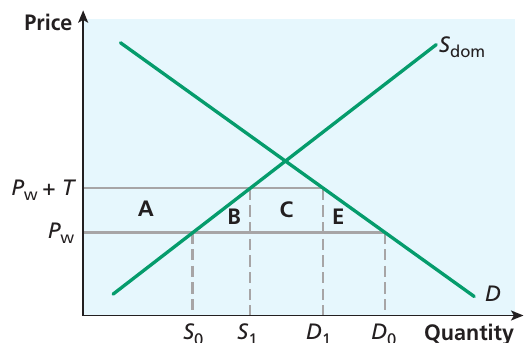
The diagram above shows how a tariff is expected to operate. The curve labelled D represents the domestic demand for a commodity, and Sdom shows how much domestic producers are prepared to supply at any given price.
The price at which the good can be imported from world markets is given by Pw (the world price). When dealing with a global market, it is reasonable to assume that the supply at the world price is perfectly elastic. This is especially true for a small economy that is unable to influence the world price. Another way of thinking about this is that supply is perfectly elastic in the sense that the country can import as much as it wishes at the going world price.
In the absence of a tariff, domestic demand is given by D0, of which S0 is supplied by domestic producers within the economy, and the remainder (D0 − S0) is imported.
Note
Understanding the Tariff Mechanism
If the government wishes to protect this industry within the domestic economy, it needs to find a way of restricting imports and encouraging home producers to expand their capacity. A tariff achieves this by raising the domestic price above the world price.
By imposing a tariff, the domestic price rises to Pw + T, where T is the amount of the tariff. This has two key effects:
- It reduces demand for the good from D0 to D1
- It encourages domestic producers to expand their output from S0 to S1
As a consequence, imports fall substantially, to (D1 − S1). On the face of it, the policy has achieved its objective of protecting the domestic industry. Furthermore, the government has been able to raise some tax revenue, shown by area C in the diagram.
Negative effects of a tariff
However, not all the effects of the tariff are favourable for the economy. Consumers are certainly worse off, as they have to pay a higher price for the good. They therefore consume less, and there is a loss of consumer surplus. This is represented in the diagram by the sum of areas A + B + C + E.
Some of what was formerly consumer surplus has been redistributed to others in society:
- The government has gained the tariff revenue (area C)
- Producers gain producer surplus, shown by area A
There is also a deadweight loss to society, represented by areas B and E. These areas were formerly part of consumer surplus, but are now lost.
Important
Key Economic Impact of Tariffs
Overall society is worse off as a result of the imposition of the tariff. The deadweight loss areas (B and E) represent a permanent loss to economic welfare that benefits no one. Notice that the impact of the tariff will depend on the elasticity of demand and supply in the domestic market.
Effectively, the government is subsidising inefficient local producers, and forcing domestic consumers to pay a price that is above that of similar goods imported from abroad.
Justification and criticism of tariffs
Some would defend this policy on the grounds that it allows the country to protect an industry, thus saving jobs that would otherwise be lost. However, this goes against the principle of comparative advantage. In the longer term, it may delay structural change that is necessary for the economy to remain competitive.
For an economy to develop new specialisations and new sources of comparative advantage, there needs to be a transitional process in which old industries contract and new ones emerge. Although this process may be painful, it is necessary in the long run if the economy is to remain competitive.
Furthermore, the protection which firms enjoy as a result of the tariff may foster complacency and an inward-looking attitude. This is likely to lead to X-inefficiency, where firms fail to minimise costs and become unable to compete effectively in the global market.
Trade wars and retaliation
Even worse is the situation that develops where nations respond to tariffs raised by competitors by putting up tariffs of their own. This has the effect of further reducing trade between countries, and everyone ends up worse off as the gains from trade are sacrificed.
Example
Trade War Example: Trump's Steel Tariffs
President Trump's decision to extend tariffs on steel to Canada, the EU, and Mexico in 2018 brought an immediate response from those countries, threatening a trade war that would leave all involved worse off as a result. Although the WTO is committed to reducing tariffs over time, retaliation in the form of 'countervailing duties' is permitted.
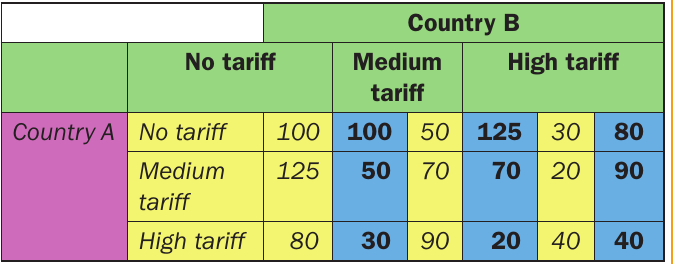
The table above illustrates this prisoner's dilemma situation using a game theory pay-off matrix. It shows hypothetical gains that two countries could make under different tariff rates. The matrix demonstrates how individual countries pursuing their own interests can lead to a collectively worse outcome, as both countries end up imposing high tariffs that reduce overall welfare.
Quotas
An alternative policy that a country may adopt is to limit the imports of a commodity to a given volume.
Quota is an agreement by a country to limit its exports to another country to a given quantity or quota.
For example, a country may come to an agreement with another country that only a certain quantity of imports will be accepted by the importing country. Such arrangements are known as voluntary export restraints (VERs) or more commonly as quotas.
The effects of a quota
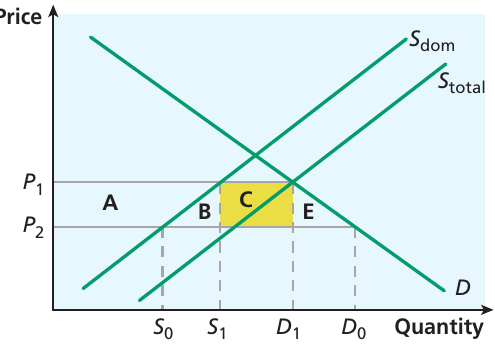
The diagram above illustrates the effects of a quota. D represents the domestic demand for a commodity, and Sdom is the quantity that domestic producers are prepared to supply at any given price.
Suppose that without any agreement, producers from country X would be prepared to supply any amount of the product at a price P2. If the product is sold at this price, D1 represents domestic demand, of which S0 is supplied by domestic producers and the remainder (D0 − S0) is imported from country X.
By imposing a quota of S1−D1, total supply is now given by Stotal, which is domestic supply plus the quota of imports allowed into the economy from country X. The market equilibrium price rises to P1 and demand falls to D1, of which S1 is supplied by domestic producers and the remainder is the agreed quota of imports.
Gainers and losers
Domestic producers gain by being able to sell at the higher price. They receive additional economic rent given by area A. Furthermore, the producers exporting from country X also gain, receiving the shaded area C.
This area represents the quota rent received by foreign producers. As in the case of the tariff, the two triangles (areas B and E) represent the deadweight loss of welfare suffered by the importing country.
Such an arrangement effectively subsidises the foreign producers by allowing them to charge a higher price than they would have been prepared to accept. Furthermore, although domestic producers are encouraged to produce more, the protection offered to them is likely to lead to X-inefficiency and weak attitudes towards competition.
Note
Study Tip: Comparing Tariffs and Quotas
Notice that the diagram for a quota is very similar to the diagram for a tariff. Make sure you understand the differences: both measures raise prices and reduce imports, but they differ in terms of who gains. With a tariff, the government receives tax revenue. With a quota, foreign producers receive the quota rent instead.
Real-world example: textile industry
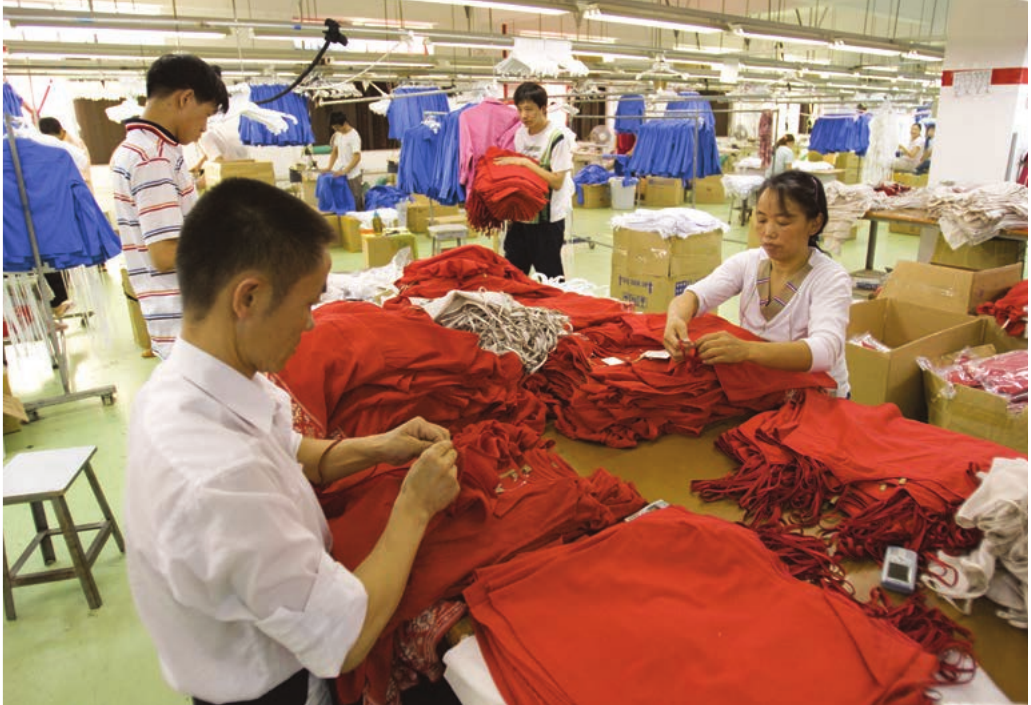
There have been many examples of quota agreements, especially in the textile industry. For example, the USA and China had long-standing agreements on quotas for a range of textile products. Ninety-one such quotas expired at the end of 2004 as part of China's accession to the WTO.
As you might expect, this led to extensive lobbying by producers in the USA, especially during the run-up to the 2004 presidential election. Notice that it could be argued that the removal of the quotas would allow domestic consumers to benefit from lower prices, and would allow American textile workers to be released for employment in higher-productivity sectors, where the USA maintains a competitive advantage.
Production subsidies
Another way in which a country may attempt to restrict trade is by subsidising domestic producers to enable them to compete more effectively with imports.
This approach shows domestic demand and supply for a product that can be imported at the world price Pw. Without intervention, demand is D0, of which S0 is supplied by domestic producers, with the remainder being imported.
Assume that the country is too small a producer to affect the world price. If the government decides to pay a subsidy of an amount Sub to domestic producers, this affects the supply curve such that it is horizontal at (Pw + Sub) up to S1.
This encourages domestic firms to increase production up to S1. Unlike the case of the tariff, domestic consumers are still able to buy the good at the world price, so there is not the same impact on consumer surplus. Imports fall to D0 − S1, so this measure has reduced the country's dependence on imported goods.
Producers gain from the subsidy, receiving the additional producer surplus given by area A. However, this needs to be covered by the government through taxation. The total cost to the government of providing the subsidy is thus the sum of areas A and B.
Note
Comparing Subsidies to Tariffs
Area B represents the production inefficiency that was a deadweight loss in the case of the tariff. The downside of this approach is that government funds need to be raised from elsewhere in the economy, thus distorting the allocation of resources in other markets.
Although consumers are better off in respect of this product with the subsidy than with a tariff, as taxpayers they may pay the price in other ways.
Furthermore, it is not clear that subsidising domestic production in this way provides any better incentives for efficiency than the tariff approach.
If governments wish to encourage firms to become more efficient in order to compete, a better approach might be to subsidise education and training or research and development to improve production techniques, thus tackling the problem more directly. Of course, this would depend on what was causing the inefficiency in the first place.
Note
At the WTO ministerial summit in Nairobi in 2015, it was agreed that developed country members would eliminate all export subsidies immediately, and that developing country members would eliminate them by the end of 2018.
Non-tariff barriers
There are other ways in which trade can be hampered.
Non-tariff barriers are measures imposed by a government that have the effect of inhibiting international trade.
One example is the use of what are known as non-tariff barriers. These often comprise rules and regulations that control the standard of products that can be sold in a country.
Important
The Grey Area of Non-Tariff Barriers
This is a grey area. Some rules and regulations may seem entirely sensible and apply equally to domestic and overseas producers. For example, laws that prohibit the sale of refrigerators that contain CFCs are designed to protect the ozone layer, and may be seen as wholly appropriate. In this case, the regulation is for purposes other than trade restriction.
However, there may be other situations in which a regulation is more clearly designed to limit trade. For example, countries might make it more difficult for foreign firms to meet technical or quality standards.
Such rules and regulations may operate especially against producers in developing countries, who may find it especially difficult to meet demanding standards of production. This applies in particular where such countries are trying to develop new skills and specialisations to enable them to diversify their exports and engage more actively in international trade.
The impact of protectionist policies
Protectionist policies have a number of effects on economic agents in a country. These effects differ according to which policy is in operation, but the main impacts can be clearly illustrated with reference to the imposition of a tariff, which is the most common form of protectionist policy.
Effects on consumers
In general, consumers are likely to be worse off as a result of protectionist measures. In the case of a tariff, consumer surplus is lower after the tariff is imposed, as consumers must pay a higher price for the good and will consume less.
Effects on producers
Producers in the domestic economy will gain from protection. They will receive higher producer surplus at the expense of consumers. However, their incentives to produce efficiently will be low. In the long run they may never become able to compete effectively in world markets. The infant industry benefits are rarely delivered.
Effects on governments
When a government imposes a tariff, it gains revenue from the tax it raises. This may be valuable for the government of a developing country that faces problems with raising revenue through other forms of taxation, because of the lack of an administrative structure to collect taxes efficiently.
Effects on living standards
For society as a whole, the imposition of a tariff carries a deadweight welfare loss. Overall well-being is lower with a tariff in place compared to free trade.
Effects on equality
Protectionist measures entail a redistribution of resources from consumers to producers. There may therefore be an increase in inequality in the society, as income and wealth are transferred from one group to another.
Summary
Key Points to Remember
-
Protectionism refers to measures that countries use to restrict international trade and protect domestic industries from foreign competition.
-
Common reasons for protectionism include political and strategic concerns (food security, national security), protection of sunset industries during economic transition, support for infant industries in developing economies, and prevention of dumping.
-
The main forms of protectionism are tariffs (taxes on imports), quotas (limits on import quantities), production subsidies, and non-tariff barriers (regulations that restrict trade).
-
Tariffs raise prices for consumers, reduce consumer surplus, increase producer surplus, generate government revenue, but create deadweight loss for society overall.
-
The critical difference between tariffs and quotas is who benefits: with tariffs, the government receives revenue; with quotas, foreign producers receive the quota rent.
-
Trade wars occur when countries retaliate against each other's tariffs, making all parties worse off by reducing the gains from trade. This creates a prisoner's dilemma situation where pursuing individual interests leads to collectively worse outcomes.
-
Protection may help certain groups in the short run (domestic producers, government revenue), but society as a whole experiences a net welfare loss due to higher prices, reduced choice, and economic inefficiency.