Plato's understanding of reality (Edexcel A-Level Religious Studies): Revision Notes
📚Revision Notes
Plato's understanding of reality
Context
Heraclitus
Heraclitus was an Ancient Greek Philosopher who thought the world was in a constant state of change called "flux."
Note
Plato took this as a challenge to the possibility of gaining knowledge, if everything we experience is constantly changing, then we can't have knowledge of anything since as soon as we know something it has changed.
Plato's rationalism
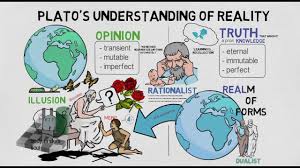
Plato believed that we cannot gain true unchanging knowledge from the ever-changing world that we experience.
Therefore, to gain true knowledge we need to experience the world differently.
The world of appearances
True reality must be unchanging and eternal to be perfect (The world of the forms.)
Our minds are trapped in a state of ignorance therefore we experience imperfect, transient ever changing things in the world of appearances.
True knowledge can only be gained through the world of the forms.
Particulars are imperfect "replicas" and representations of the form they take partake in.
Note
For Example: If we look at a tree, we are looking at a perfect, eternal, and immutable form of treeness however because of our ignorance, we see a transient and mutable tree.
True knowledge, knowledge of the forms is gained through a priori reasoning. A Posteriori reasoning cannot be relied on.
Allegory of the cave
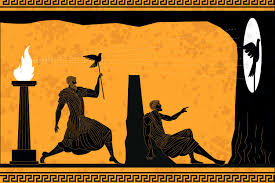
- Prisoners (Humans) are stuck in a cave (our reality)
- They cannot move as they are chained (the chains represent humans being trapped by ignorance, something we need to break away from.)
- The humans watch shadows (the particulars.)
- Escapee (the philosopher) gets blinded by the sun (the form of the good) and sees the real world (world of the forms.)
- The escapee goes back to tell the other prisoners (as his duty) however they are unwilling to understand, representing human naivety and unwillingness to learn.
- The experience involves shadows and experiences cannot give us knowledge. Plato uses the allegory of the cave to justify "Philosophers king". Philosophers are superior intellect as opposed to the naivety and stubbornness of humans and therefore philosophers should rule.
The form of the good and the hierarchy of the forms
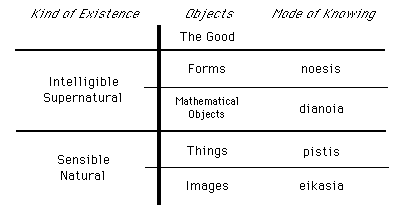
The form of the good is the highest form.
It illuminates and allows us to see the world of the forms as well as being responsible for all the existence of life and all the other forms.
According to Plato, if you understand the form of the good then you cannot do wrong.
Philosophers see the form of the good and therefore they should rule ("Philosopher King".)
Underneath the form of the good are the higher forms like justice and beauty which are aspects of goodness.
Below the higher forms are the forms that we experience (e.g., the form of treeness.)
Below the forms that we experience are particulars, and material objects.
Plato's argument from recollection
Plato points out that we have knowledge of perfect, eternal, and unchanging concepts,
Note
For example, concepts such as beauty and justice.
Plato concludes that since we have never experienced perfect beauty or justice, we must have prior knowledge of it.
In the Meno, Plato tells a story of how Socrates proved that an uneducated slave boy could be prompted by a series of questions and some shapes drawn in the sand to figure out how to solve a geometric question, showing how he had pre-existing knowledge.
Plato concludes that we must have gained these concepts before we were born. It follows that there must be a part of us (our soul) that exists in a realm where there are perfect forms.
Plato's one-over-many argument
Plato points out that we recognise that particulars share something in common.
For example, we can recognise that all trees share something in common, the quality of "treeness." Plato therefore argues that we must already have a perfect abstract ideal of a tree.
This abstract cannot come from the world of particulars since it is constantly changing and universal principles cannot change, there must be a world of forms.
Criticisms of Plato's reality
Plato commits a logical fallacy.
- We can easily deny the original premise that we have a concept of beauty and justice as this is subjective, the foundations of the conclusion are already weakened.
David Hume
Hume argues we can still gain a concept of perfection in our minds even if we have not experienced it.
Note
For example, mathematical knowledge could come from experience.
Evolution
Why is a world of forms the solution? Evolution could have programmed us to have a sense of morality and beauty, Plato has therefore committed a leap in logic.
Lack of evidence
- Plato's theory cannot be justified due to the lack of evidence, his theory cannot be supported as it has no explanatory power.
- Plato would counter this by arguing this is good as evidence cannot be trusted.
- Is Plato right to reject evidence?
Aristotle
- Plato is wrong to suggest that the source of immorality is ignorance of the good.
- Solely knowing what is good is not enough to make yourself morally perfect.
- The idea of goodness is subjective, so you can't have just a form of "goodness."
Elitist theory
- Is Plato using his theory to justify the type of society he wants, one ruled by philosophers?
- Nietzsche: Plato's form of the good is a "dangerous error." Philosophers invent ideas that suit their emotional prejudices and desire for power.
The third man argument:
when you create a new group of things that share the same characteristics, you need another form to explain it. This would go on forever and therefore undermines the idea that there is a singular particular form.
Plato would respond to this by arguing the particulars partake in a form as they are imperfect copies of it, the forms themselves cannot be copied.
Wittgenstein's criticism of the One Over Many argument
Wittgenstein argued that there is no definable form or ideal of a category.
Note
He uses the example of a family picture, whilst there are recognisable similarities between the family members, it does not justify the belief in an abstract form of family.