The metaphysics of consciousness: Substance dualism (Edexcel A-Level Religious Studies): Revision Notes
📚Revision Notes
The metaphysics of consciousness: Substance dualism
Substance dualism: the view that the mind and body are two distinct substances with two distinct sets of properties.
Substance dualists argue that since the body is material and has physical form, and the soul is immaterial without form, the two cannot be the same thing and must be separate.
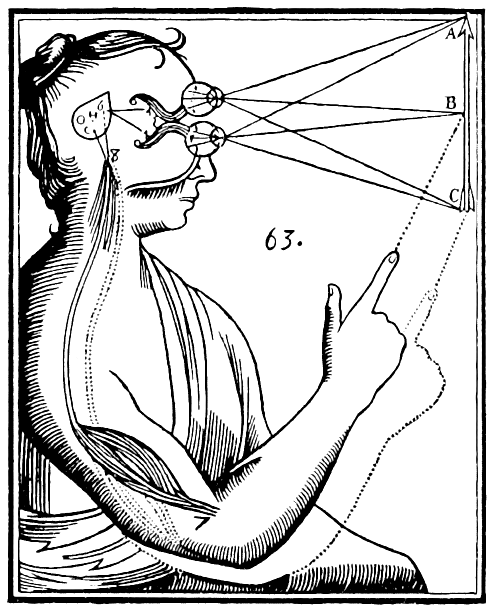
Rene Descartes
📎 Descartes was a philosopher and mathematician, in his book "The Meditations" he sought to find the answer to the question 'what, if anything, can I know for certain?'
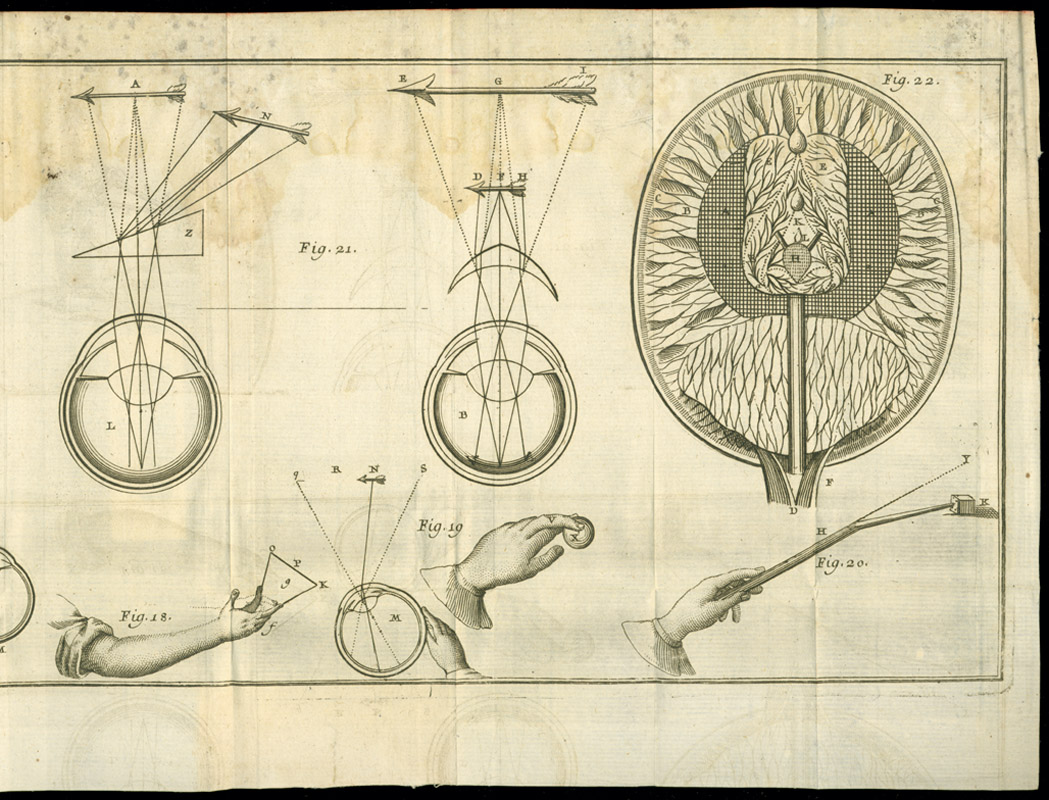
In The Meditations, Descartes is describing a scenario where he is sitting in a room on an armchair, by the fire. Through his process of hyperbolic doubt, he concludes that he cannot trust the knowledge that he gains empirically, because there have been times when his senses have deceived him in the past.
Furthermore, he states that he cannot know with absolute certainty that he is in the room by the fire because he remembers times when he has been dreaming and thought those experiences to be real until he woke up.
He argues that whilst it is unlikely, he could not rule out that his mind was in some way being manipulated by an evil demon who was causing him to believe that mathematical truths were real.
Note
From this, he concludes that he cannot be certain that he has a body because he only knows about his body empirically and this cannot lead to certain truth.
Cogito ergo sum
He argues that if his senses are being deceived, or if he is in a dream, or if he is being deceived by an evil demon, he in some way has to exist.
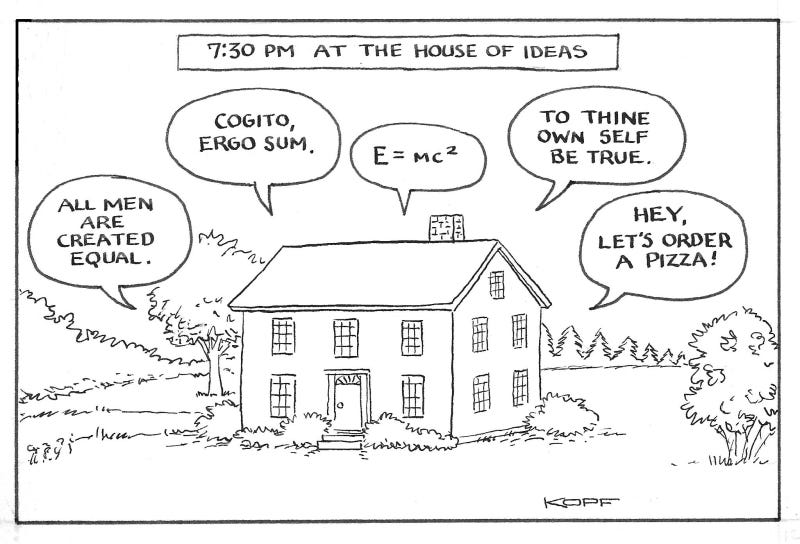
💡This is where we reach potentially the most famous of all philosophical conclusions: cogito ergo sum "I think therefore I am". He argues that because he is a thinking being, in some form his mind must exist.
Descartes is a dualist because if he cannot be certain that his body exists, but, he can be certain that his mind does then they cannot be the same substance.
Descartes, who was also very interested in anatomy, thought that the pineal gland (a small organ in the centre of the brain) had something to do with the connection between the soul and the body. He argued that the pineal gland contained 'animal spirits' which controlled imagination, sense perception, bodily movement and memory.
He states that the pineal gland is the "the principle seat of the soul" and connected the soul and the body together, although he was not entirely clear how this worked