Negative and Positive Feedback (OCR A-Level Biology A): Revision Notes
📚Revision Notes
Negative and Positive Feedback
Introduction
Feedback mechanisms regulate how the body maintains or adjusts its internal conditions. Two main types exist: negative feedback and positive feedback. Of these, negative feedback is by far the most common and operates in most homeostatic systems throughout the body.
Note
Negative feedback is the primary mechanism used throughout the body for maintaining homeostasis. When you encounter feedback systems in biology, you can assume they involve negative feedback unless explicitly stated otherwise.
Negative feedback
Definition and mechanism
Important
Negative feedback is a control mechanism in which a change from the normal value of a physiological factor is detected, triggering a response that restores the value back to normal.
The key principle is straightforward: when a deviation occurs, it triggers a sequence of responses that counteract the original deviation. This self-correcting mechanism ensures stability and prevents excessive fluctuations in physiological factors.
How negative feedback maintains stability
Negative feedback automatically leads to control and stabilisation. When a physiological factor moves away from its set point:
- The change is detected
- Corrective mechanisms are activated
- These mechanisms work to reverse the change
- The factor returns to its normal range
- The corrective mechanisms are switched off
Example
Worked Example: Thyroid Hormone Control of Metabolic Rate
The body maintains a relatively constant metabolic rate through thyroid hormones. This system demonstrates negative feedback clearly:
The control pathway:
- The hypothalamus (in the brain) releases thyrotropin-releasing hormone (TRH)
- TRH stimulates the pituitary gland to release thyroid-stimulating hormone (TSH)
- TSH causes the thyroid gland to release thyroid hormones
- Thyroid hormones increase metabolic rate
The negative feedback loop:
The thyroid hormones do two things simultaneously:
- Boost metabolism when it drops
- Inhibit (switch off) the production of TRH in the hypothalamus
This creates a self-regulating cycle. When thyroid hormone levels rise sufficiently, they suppress TRH production, which reduces TSH release, which then reduces thyroid hormone production. This prevents metabolic rate from rising too high and keeps it within a specific range.
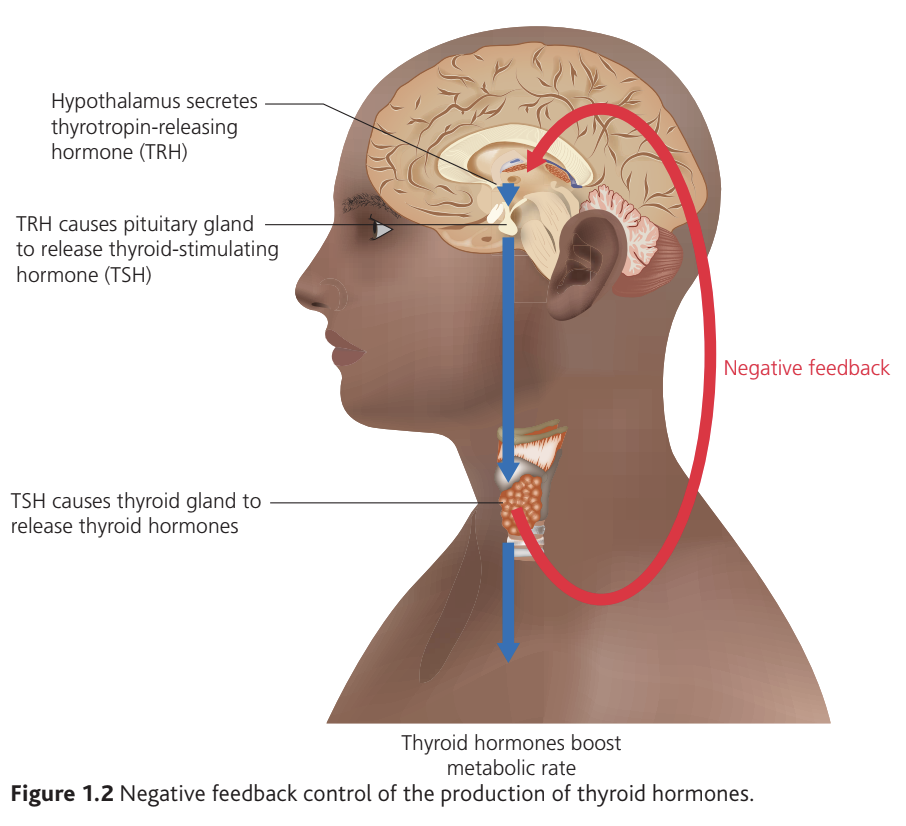
Figure 1.2: Negative feedback control of thyroid hormone production. The red arrow indicates the negative feedback pathway where thyroid hormones inhibit TRH production.
Note
You may encounter unfamiliar negative feedback examples in examinations. The thyroid mechanism is used here simply to illustrate the principle—you won't need to recall this specific pathway, but you should be able to recognise negative feedback when you see it.
Positive feedback
Definition and characteristics
Positive feedback is a control mechanism that causes amplification rather than regulation. Unlike negative feedback, it does not maintain a steady state but instead leads to proliferation—a progressive increase in the response.
In positive feedback:
- A change occurs
- The response amplifies that change
- The amplified change causes an even greater response
- This cycle continues to escalate
Important
Because positive feedback leads to escalation rather than stabilisation, it is not involved in maintaining homeostasis.
Example: oxytocin in childbirth
Example
Worked Example: Oxytocin in Childbirth
The hormone oxytocin provides a clear example of positive feedback during labour:
The amplification cycle:
- Uterine contractions begin
- Contractions trigger the release of oxytocin
- Oxytocin intensifies uterine contractions
- Stronger contractions stimulate even more oxytocin release
- This creates a cycle of increasing intensity
Why positive feedback must be terminated:
Unrestricted positive feedback would cause hormone levels to spiral out of control. Therefore, positive feedback loops always require an external factor to bring them to an end.
In the childbirth example, birth itself stops oxytocin release and terminates the positive feedback loop. Without this external termination point, oxytocin levels would continue rising dangerously.
Why positive feedback is not used in homeostasis
Homeostasis requires stability and control—keeping physiological factors within narrow ranges. Positive feedback does the opposite: it creates instability and amplification. This makes it unsuitable for maintaining steady internal conditions.
Positive feedback is reserved for specific processes that require rapid, progressive changes, such as:
- Childbirth (oxytocin amplification)
- Blood clotting (platelet aggregation)
- Nerve impulse generation (sodium channel opening)
Each of these has a clear endpoint that terminates the positive feedback loop.
Comparison table
| Feature | Negative Feedback | Positive Feedback |
|---|---|---|
| Effect on change | Reverses/counteracts the change | Amplifies the change |
| Result | Stabilisation and control | Proliferation and escalation |
| Role in homeostasis | Essential—used in most homeostatic mechanisms | Not involved—unsuitable for maintaining steady states |
| Example | Thyroid hormone control of metabolic rate | Oxytocin intensifying uterine contractions |
| Termination | Self-terminating when normal value restored | Requires external factor to stop |
Summary
Key Points to Remember:
- Negative feedback reverses changes and maintains stability—it's the foundation of homeostasis
- In negative feedback, the response counteracts the original change, creating a self-correcting system
- Positive feedback amplifies changes and creates escalation—it's not used for homeostasis
- Positive feedback always needs an external factor to terminate the loop and prevent dangerous escalation
- Most physiological control systems use negative feedback because it automatically leads to control and stabilisation