Factors Affecting Photosynthesis (OCR A-Level Biology A): Revision Notes
📚Revision Notes
Factors Affecting Photosynthesis
Photosynthesis is a complex biochemical process involving multiple sequential reactions. Various environmental conditions influence how quickly these reactions proceed. Understanding which factors restrict the overall rate helps us comprehend plant growth and productivity.
Note
The study of limiting factors in photosynthesis is crucial for optimizing crop yields in agriculture and understanding how plants adapt to different environmental conditions.
Limiting factors in photosynthesis
Limiting factor – an environmental variable that restricts the rate of a biochemical process. When this factor increases, the process rate increases proportionally. If multiple factors are limiting simultaneously, the one at its lowest value determines the overall rate.
The principle states that whichever factor is closest to its minimum requirement will control the rate at which photosynthesis proceeds. Changes to other factors will have no effect until the primary limiting factor is relieved.
Important
Key Concept: Even if all other conditions are optimal, a single limiting factor at its minimum level will determine the maximum rate of photosynthesis. This is known as the Law of Limiting Factors or Blackman's Law of Limiting Factors.
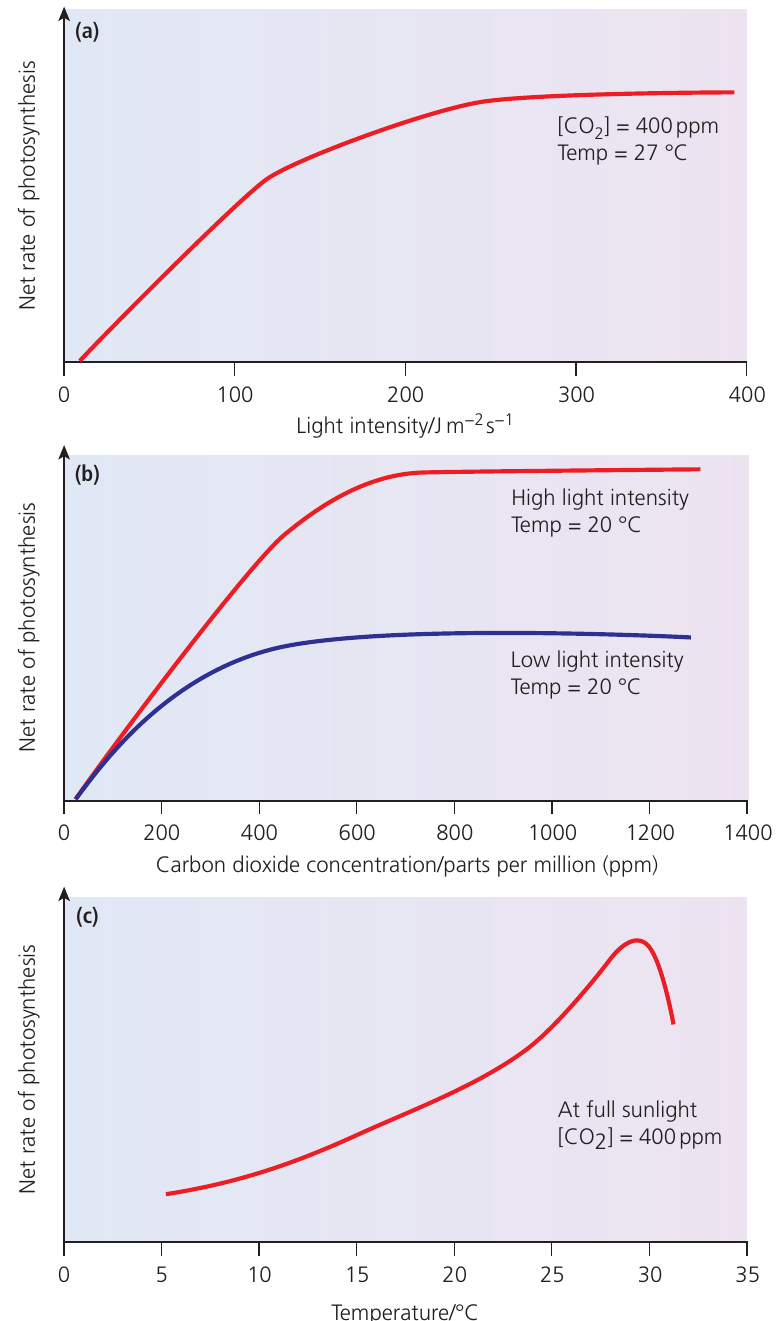
The graphs above demonstrate how temperature, light intensity, and carbon dioxide concentration each influence photosynthetic rate in Atriplex patula. Notice how these factors can interact – for example, high light intensity can partially compensate for low carbon dioxide levels.
Temperature as a limiting factor
Effect on photosynthetic rate
Temperature influences the rate of enzyme-catalysed reactions in the light-independent stage. The relationship between temperature and photosynthetic rate follows a characteristic curve with three distinct regions.
Between and : The rate approximately doubles for every rise in temperature. This follows the relationship – a temperature coefficient describing how reaction rates change with temperature. The value for most enzyme-controlled reactions is approximately .
Example
Worked Example: Calculating Rate Change Using
If photosynthesis occurs at a rate of at , what would be the expected rate at ?
Solution:
- Temperature increase:
- Using : Rate doubles for every increase
- New rate:
Optimum temperature (): Photosynthesis reaches its maximum rate when all other factors are non-limiting. The exact optimum varies between species depending on their natural habitat.
Above optimum: The rate declines rapidly as enzymes involved in the light-independent stage begin to denature. Proteins lose their tertiary structure, and active sites become non-functional, stopping the reactions.
Important
Critical Point: The light-dependent stage does not directly respond to temperature changes since it depends on light energy rather than thermal energy. Temperature primarily affects the light-independent (Calvin cycle) reactions.
When temperature becomes limiting
Temperature becomes a limiting factor below approximately (unless another factor is already restricting the rate). In cooler conditions, enzyme activity slows, reducing the rate at which carbon dioxide is fixed and products are formed.
Light intensity as a limiting factor
Effect on photosynthetic rate
Light intensity directly affects the light-dependent stage of photosynthesis, which occurs in the thylakoid membranes of chloroplasts.
At low light intensities: The rate of photosynthesis increases linearly with light intensity. More photons are absorbed by chlorophyll molecules, driving more photolysis of water and generating more ATP and reduced NADP.
At higher intensities: The rate plateaus as another factor (typically carbon dioxide concentration or temperature) becomes limiting. All available chlorophyll molecules are saturated with light energy, so additional light has no further effect.
Note
Stomatal Response: Increasing light intensity causes stomatal pores to open wider, facilitating greater gas exchange. This allows more carbon dioxide to enter the leaf while oxygen exits more easily, indirectly supporting higher photosynthetic rates.
When light intensity becomes limiting
In many plant species, light intensity becomes limiting below approximately . Plants growing in shaded environments or during early morning and late afternoon hours often experience light as their primary limiting factor.
Carbon dioxide concentration as a limiting factor
Effect on photosynthetic rate
Rubisco (ribulose bisphosphate carboxylase oxygenase) catalyses the fixation of carbon dioxide in the light-independent stage. This enzyme combines CO₂ with ribulose bisphosphate (RuBP) in a process called carboxylation.
When carbon dioxide supply decreases, less triose phosphate (TP) forms in the Calvin cycle. This reduces the demand for ATP and reduced NADP, which indirectly slows the light-dependent stage through end-product inhibition – accumulating ATP and reduced NADP inhibit the enzymes producing them.
Note
End-Product Inhibition: This is a negative feedback mechanism where the products of a reaction (ATP and reduced NADP) accumulate and inhibit the enzymes that produce them. This creates a self-regulating system that prevents wasteful overproduction.
Atmospheric concentration: Normal air contains approximately carbon dioxide (equivalent to – parts per million). This concentration varies geographically and temporally.
In crop fields: On warm, still days, carbon dioxide concentrations near ground level can fall significantly by afternoon due to:
- High photosynthetic activity depleting local CO₂
- Minimal air movement preventing replenishment
- Multiple plants competing for the same carbon dioxide supply
In greenhouses: Intensive plant growth rapidly depletes carbon dioxide. Commercial growers often burn paraffin or similar fuels to raise both CO₂ concentration and temperature simultaneously.
Photorespiration
Rubisco evolved when atmospheric oxygen levels were much lower. Consequently, it can catalyse reactions with both oxygen and carbon dioxide. Under normal conditions, high CO₂ concentrations in the chloroplast stroma favour carbon fixation.
Important
Photorespiration – A Wasteful Process:
In hot conditions:
- Stomata partially close to reduce water loss
- Carbon dioxide concentration inside the leaf decreases
- Oxygen concentration increases
- Oxygen competes with carbon dioxide for Rubisco's active site
- Carbon fixation decreases – this wasteful process is called photorespiration
Photorespiration can reduce photosynthetic efficiency by up to 50% in some plants under hot, dry conditions.
When carbon dioxide becomes limiting
Carbon dioxide concentration becomes limiting below approximately in the atmosphere. The rate increases as CO₂ rises to about (), after which other factors become limiting.
Effects of limiting factors on Calvin cycle intermediates
Changes in light intensity and carbon dioxide concentration alter the relative concentrations of three key molecules in the light-independent stage:
- GP – glycerate 3-phosphate
- TP – triose phosphate
- RuBP – ribulose bisphosphate
When light intensity decreases
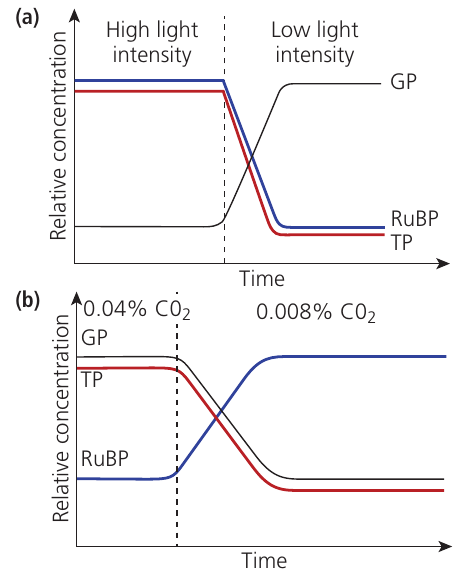
RuBP concentration: Decreases because the light-dependent stage produces insufficient ATP to regenerate RuBP from TP.
TP concentration: Decreases because GP cannot be reduced to TP without adequate reduced NADP from the light-dependent stage.
GP concentration: Increases initially because:
- Carbon dioxide continues to combine with remaining RuBP, forming GP
- GP cannot be converted to TP due to lack of ATP and reduced NADP
- GP accumulates temporarily until carbon fixation stops
Eventually, GP concentration plateaus when RuBP is depleted and carbon fixation ceases.
Note
Understanding the Pattern: When light decreases, the light-dependent reactions slow down, reducing ATP and reduced NADP supply. This creates a "bottleneck" at the GP → TP conversion step, causing GP to accumulate while TP and RuBP are depleted.
When carbon dioxide concentration decreases
RuBP concentration: Increases because it is the carbon dioxide acceptor molecule. Without sufficient CO₂ to react with, RuBP accumulates unfixed in the stroma.
GP concentration: Decreases because less carbon dioxide is fixed, so less GP forms from the RuBP-CO₂ combination.
TP concentration: Decreases proportionally to GP since TP is formed by reducing GP.
Note
Understanding the Pattern: When CO₂ decreases, the carbon fixation step (RuBP + CO₂ → GP) slows down. This creates a "bottleneck" at the start of the cycle, causing RuBP to accumulate while GP and TP are depleted. The pattern is essentially opposite to when light decreases.
Measuring the rate of photosynthesis
Net versus gross photosynthetic rate
Experiments typically measure the apparent (net) rate of photosynthesis by collecting oxygen gas released. However, this doesn't account for oxygen consumed by respiration occurring simultaneously in the plant.
Important
Key Distinction:
- Net photosynthetic rate = Oxygen produced by photosynthesis − Oxygen consumed by respiration
- Gross photosynthetic rate = Total oxygen produced by photosynthesis
The gross rate is always higher than the net rate because it doesn't account for respiratory oxygen consumption.
The true (gross) rate of photosynthesis is difficult to measure because:
- Some oxygen from photosynthesis is immediately used in respiration
- Some oxygen dissolves in cell water
- During hot weather, closed stomata limit gas exchange
- At night, no photosynthesis occurs, only respiration
Aquatic plant experiments
Aquatic plants like Cabomba and Elodea are commonly used because:
- Oxygen bubbles released are easily visible and collected
- The experimental setup is simpler than for terrestrial plants
- Light intensity can be easily controlled
- Temperature can be monitored and controlled
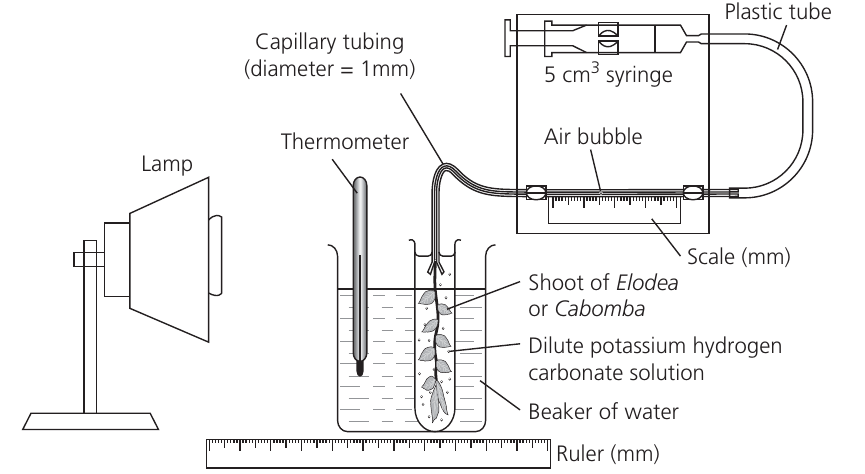
Photosynthometer method
This apparatus measures oxygen production by collecting gas bubbles in capillary tubing. The basic procedure involves:
- Placing an aquatic plant shoot in dilute potassium hydrogen carbonate solution (provides CO₂)
- Illuminating the plant with a lamp at a measured distance
- Collecting oxygen bubbles in narrow capillary tubing
- Measuring bubble length using a millimetre scale
- Calculating volume from bubble length and tube diameter using
Note
Light Intensity Relationship: Light intensity is proportional to , where is the distance between the lamp and plant. This inverse square law means doubling the distance reduces light intensity to one-quarter.
Example
Worked Example: Inverse Square Law
If a lamp produces a light intensity of at from a plant, what intensity would it produce at ?
Solution: Using the inverse square law:
Therefore:
Doubling the distance quarters the light intensity.
Leaf disc flotation method
This technique uses the principle that photosynthesising leaf discs produce oxygen, making them buoyant:
- Cut leaf discs from thin leaves
- Evacuate air from the air spaces using a syringe
- Place discs in sodium hydrogen carbonate solution
- Illuminate the setup
- Record the time taken for discs to float to the surface
As photosynthesis produces oxygen, gas accumulates in the leaf's air spaces, increasing buoyancy. The time taken for discs to rise inversely correlates with photosynthetic rate – faster photosynthesis means quicker rising.
| Light intensity (lux) | Mean time for leaf discs to rise (min) |
|---|---|
The data shows an inverse relationship – as light intensity increases, the time required for discs to float decreases, indicating a faster rate of photosynthesis.
Summary
Key Points to Remember:
-
Limiting factors are environmental conditions that restrict photosynthetic rate. The factor closest to its minimum value determines the overall rate, regardless of other factors.
-
Temperature affects enzyme activity in the light-independent stage. The optimum is typically , with the rate doubling every below this ( relationship). Above the optimum, enzymes denature rapidly.
-
Light intensity drives the light-dependent stage, affecting ATP and reduced NADP production. It also influences stomatal opening, affecting gas exchange.
-
Carbon dioxide concentration is the raw material for carbon fixation. Normal atmospheric levels ( or ) can become limiting, especially in enclosed environments or dense vegetation.
-
When limiting factors change, they affect Calvin cycle intermediates differently:
- Decreased light → GP rises, TP and RuBP fall
- Decreased CO₂ → RuBP rises, GP and TP fall
-
Photorespiration is a wasteful process where Rubisco binds oxygen instead of carbon dioxide, reducing photosynthetic efficiency in hot, dry conditions.
-
Measurement methods include the photosynthometer (collecting oxygen bubbles) and leaf disc flotation (measuring buoyancy changes). Both measure net photosynthetic rate, not gross rate.