Differentiation (OCR A-Level Biology A): Revision Notes
📚Revision Notes
Differentiation
What is differentiation?
In multicellular organisms, specialized cells develop from stem cells. Stem cells are unspecialized cells that lack the specific adaptations needed for particular functions. Through differentiation, these cells undergo structural and biochemical changes that allow them to perform specialized roles.
Note
Stem Cell Capabilities
Stem cells possess two important capabilities:
- They divide by mitosis to produce new cells
- Some daughter cells remain as stem cells (self-renewal), while others differentiate into specialized cell types
This dual ability ensures both maintenance of the stem cell population and production of specialized cells as needed by the organism.
Erythrocyte differentiation
Erythrocytes (red blood cells) transport oxygen throughout the body and assist in carbon dioxide removal. These cells form from stem cells located in bone marrow through a process called erythropoiesis.
Important
Since mature erythrocytes lack a nucleus, they cannot divide. The body must continuously produce new red blood cells from stem cells to maintain adequate numbers in the bloodstream.
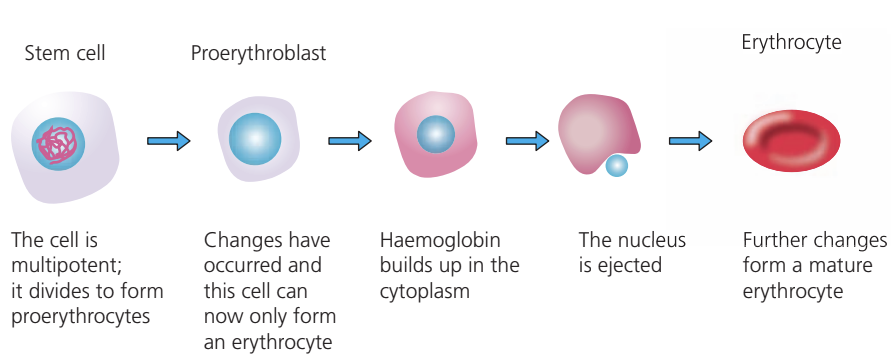
Multipotent stem cells
Bone marrow stem cells are multipotent, meaning they can differentiate into several different cell types. However, early in the differentiation pathway, specific changes occur that restrict the developmental potential of the cell. Once these changes happen, the cell can only develop into one particular cell type - in this case, an erythrocyte.
Stages of erythropoiesis
Example
Worked Example: Erythropoiesis Pathway
The transformation from stem cell to mature erythrocyte involves several distinct stages:
Step 1: The multipotent stem cell divides to form proerythroblasts
Step 2: The proerythroblast undergoes changes that commit it to becoming an erythrocyte
Step 3: Haemoglobin accumulates in the cytoplasm - this oxygen-carrying pigment gives red blood cells their function
Step 4: The nucleus is expelled from the cell
Step 5: Further structural modifications occur, including the development of the characteristic biconcave disc shape
Even after nucleus ejection, the cell requires additional changes before it becomes a fully functional erythrocyte.
Structure and function in erythrocytes
Differentiation creates structural adaptations that enable erythrocytes to transport oxygen efficiently:
Biconcave disc shape: The cell's double indentation increases surface area compared to a sphere of the same volume. Since oxygen diffuses across the cell membrane, greater surface area allows more rapid gas exchange.
High haemoglobin concentration: The cytoplasm contains approximately 280 million haemoglobin molecules. This protein binds oxygen in areas of high oxygen concentration (the lungs) and releases it where oxygen levels are low (respiring tissues).
Absence of nucleus and organelles: Mature erythrocytes lack a nucleus, mitochondria, endoplasmic reticulum, and Golgi apparatus. This absence creates additional space for haemoglobin, increasing the cell's oxygen-carrying capacity.
Elastic membrane: The flexible cell membrane allows erythrocytes to deform as they squeeze through narrow capillaries (which may be smaller in diameter than the cell itself).
Neutrophil differentiation
Neutrophils are white blood cells that originate from the same multipotent stem cells in bone marrow that produce erythrocytes. The differentiation changes are less extensive than in erythrocytes but remain significant.
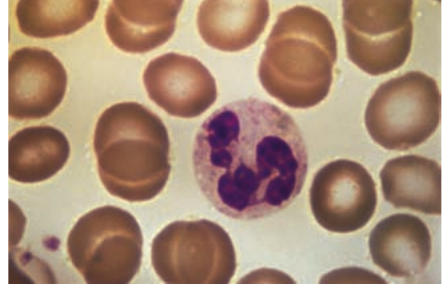
The main structural modifications during neutrophil differentiation include:
- Formation of a lobed nucleus through indentations of the nuclear membrane
- Accumulation of numerous granules throughout the cytoplasm
- These granules are lysosomes containing hydrolytic enzymes
Note
The term "neutrophil" reflects that these granules show neutral staining properties - they do not stain strongly with either acidic or basic dyes.
Structure and function of neutrophils
Neutrophils serve as the first line of cellular defense at infection sites. They leave the bloodstream by squeezing between capillary wall cells, gather around foreign materials in tissues, and destroy pathogens through phagocytosis and enzyme secretion.
Their structural adaptations support this immune function:
Flexible shape: The cell can change shape readily, allowing it to penetrate gaps between capillary endothelial cells and form pseudopodia (cytoplasmic projections) to engulf microorganisms.
Abundant lysosomes: The numerous lysosomes produce digestive enzymes that break down engulfed pathogens and foreign materials.
Flexible nuclear membrane: The nuclear membrane shows greater flexibility than in most cells, presumably assisting the cell's movement through tiny gaps in capillary walls. While the functional advantage of the lobed nuclear structure remains unclear, it may result from the membrane's enhanced flexibility.
Xylem and phloem differentiation
In plants, the transport tissues - xylem vessels and phloem sieve tubes - differentiate from stem cells in the cambium. The cambium is an example of a meristem: undifferentiated plant tissue capable of producing new cells. Other meristems exist at shoot tips and root tips.
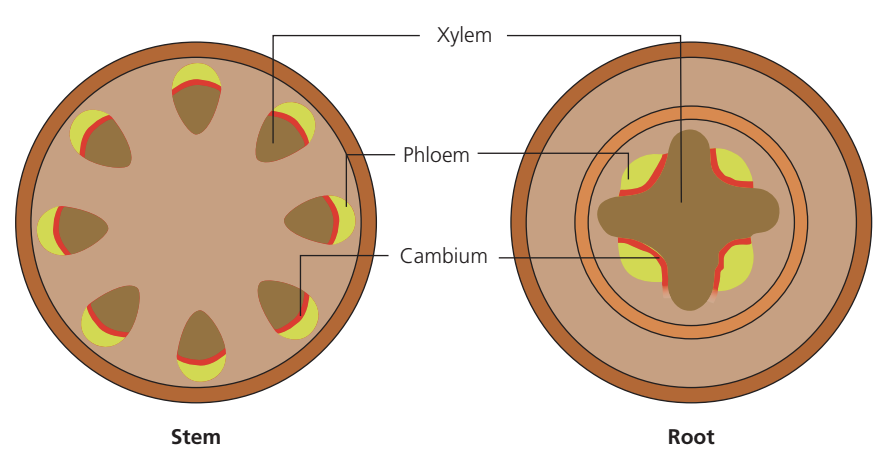
The cambium's position differs between stems and roots, but in both organs it produces phloem cells toward the outside and xylem cells toward the inside.
Regulation of xylem and phloem production
Important
Hormonal Control of Differentiation
Hormones control the production of xylem and phloem from cambium cells. A hormone is an organic substance synthesized in one part of an organism, transported to other locations, and producing specific effects there.
The balance between different plant hormones can shift cambium cell production between xylem and phloem formation.
Although cambium cells appear similar, their position determines their fate:
- Cells toward the outside produce only phloem
- Cells toward the inside produce only xylem
Differentiation processes
Xylem formation: Cells destined to become xylem lose their cytoplasm and deposit lignin in their cell walls. Lignin provides structural strength and waterproofing. The end walls between adjacent cells may disappear entirely, creating continuous tubes for water transport.
Phloem formation: Differentiating phloem cells undergo partial loss of cytoplasm and organelles. Sieve plates develop at cell ends - these perforated structures allow fluid movement between cells while maintaining some separation.
Summary
Key Points to Remember:
- Stem cells are unspecialized cells that can divide and differentiate into specialized cell types
- Erythropoiesis produces red blood cells through stages involving haemoglobin accumulation, nucleus loss, and shape change to a biconcave disc
- Multipotent stem cells can form multiple different cell types
- Erythrocyte adaptations include:
- Biconcave shape (increased surface area)
- High haemoglobin content
- No nucleus (more space for haemoglobin)
- Elastic membrane (flexibility in capillaries)
- Neutrophils differentiate from the same bone marrow stem cells, developing lobed nuclei and numerous lysosomes for immune defense
- Plant cambium (a meristem) produces phloem externally and xylem internally, with hormones regulating this process