Nomenclature of Organic Compounds (OCR A-Level Chemistry A): Revision Notes
📚Revision Notes
Nomenclature of Organic Compounds
Introduction to IUPAC nomenclature
With millions of different organic compounds in existence, chemists need a universal system to name and communicate about them clearly. The International Union of Pure and Applied Chemistry (IUPAC) provides this standardised naming system. IUPAC was established in 1919 by chemists from industry and education who recognised the need for consistent nomenclature across the globe. This system ensures that any chemist, anywhere in the world, can identify a compound from its systematic name.
Note
The IUPAC system was created to solve the confusion caused by different naming conventions used across countries and institutions. Before IUPAC, the same compound might have several different names depending on where you were in the world, making scientific communication extremely difficult.
Classification of hydrocarbons
Hydrocarbons are organic compounds containing only carbon and hydrogen atoms. They can be classified into three main categories based on how their carbon atoms are arranged:
Aliphatic hydrocarbons have carbon atoms joined together in unbranched (straight) or branched chains. These chains do not form closed ring structures.
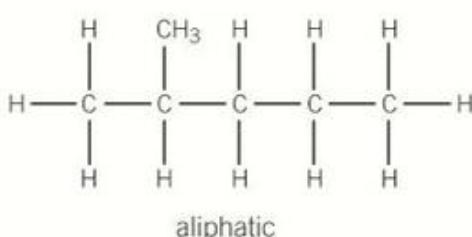
Alicyclic hydrocarbons contain carbon atoms joined together in ring (cyclic) structures. Despite being arranged in a ring, these compounds behave similarly to aliphatic compounds.
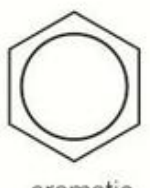
Aromatic hydrocarbons contain one or more benzene rings in their structure. A benzene ring consists of six carbon atoms arranged in a hexagonal ring with alternating single and double bonds.
Note
Don't confuse alicyclic with aromatic! While both contain rings, alicyclic hydrocarbons (like cyclohexane) behave like their straight-chain counterparts, whereas aromatic compounds (like benzene) have unique stability and reactivity due to their delocalised electron system.
Homologous series
Within aliphatic hydrocarbons, there are three important homologous series you need to know. A homologous series is a family of compounds that share the same functional group and general formula, with each successive member differing by a unit.
Alkanes are saturated hydrocarbons containing only single carbon-to-carbon bonds. They have the general formula .
Alkenes are unsaturated hydrocarbons containing at least one carbon-to-carbon double bond (). They have the general formula (for compounds with one double bond).
Alkynes are unsaturated hydrocarbons containing at least one carbon-to-carbon triple bond (). They have the general formula (for compounds with one triple bond).
Important
Memorise these general formulas! They are essential for:
- Identifying the type of hydrocarbon from its molecular formula
- Calculating the degree of unsaturation in a molecule
- Predicting the products of reactions
- Solving problems involving empirical and molecular formulas
Understanding stem, prefix, and suffix
IUPAC names are constructed using three key components:
The stem indicates the number of carbon atoms in the longest continuous chain in the molecule. This longest chain is called the parent chain. For example, 'meth-' means one carbon, 'eth-' means two carbons, 'prop-' means three carbons, and so on.
A prefix is added before the stem to indicate the presence and position of side chains (alkyl groups) or certain functional groups. Multiple prefixes may be used when there are several substituents. Prefixes are listed in alphabetical order.
A suffix is added after the stem to indicate the main functional group present in the molecule. The suffix determines the compound's chemical class (alkane, alkene, alcohol, etc.).
Important
Think of IUPAC names like building blocks:
- Stem = backbone (how many carbons)
- Prefix = decorations on the side (substituents)
- Suffix = identity (what type of compound it is)
Understanding this structure makes complex names much easier to decode!
The first ten alkanes and their alkyl groups
You must be able to name the first ten alkanes and recognise their corresponding alkyl groups. An alkyl group is formed when one hydrogen atom is removed from an alkane, creating a substituent that can attach to a parent chain.
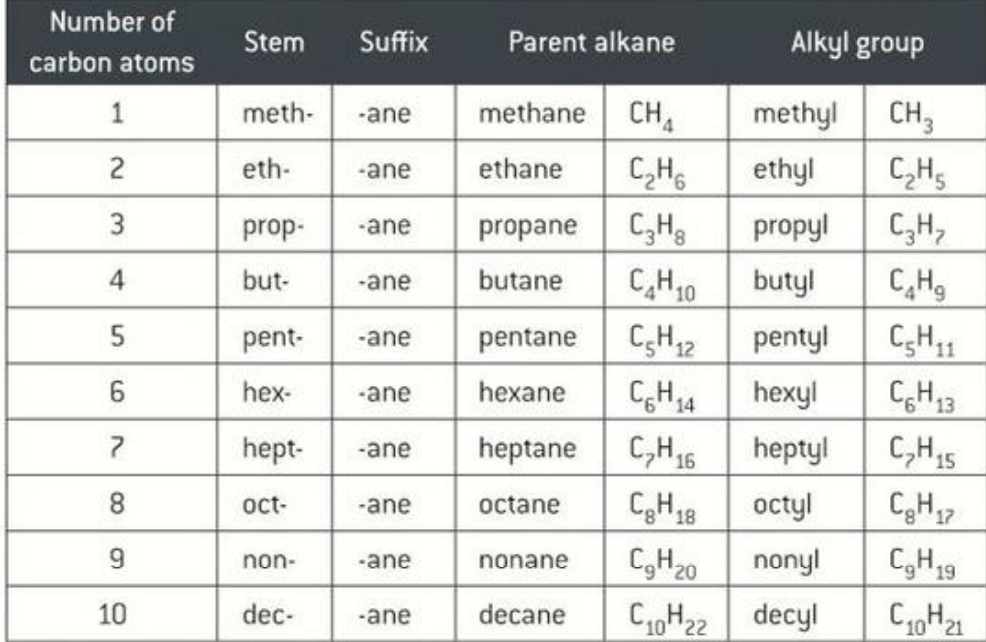
The table shows the relationship between the number of carbon atoms, the stem name, and both the parent alkane and its alkyl group. Notice that alkyl groups have one fewer hydrogen atom than the corresponding alkane (e.g., methane becomes methyl ).
Note
Memory tip: Learn these in order from 1-10. Many students find it helpful to create flashcards or mnemonics. The stems (meth-, eth-, prop-, but-, pent-, hex-, hept-, oct-, non-, dec-) form the foundation of all organic nomenclature, so investing time to memorise them now will save you countless hours later!
Naming aliphatic alkanes
When naming alkanes, follow this systematic four-step process:
Step 1: Identify the suffix
All alkanes use the suffix -ane. This immediately tells you the compound contains only single carbon-to-carbon bonds.
Step 2: Identify the parent chain
Find the longest continuous chain of carbon atoms in the molecule. This becomes your parent chain. Count the carbon atoms in this chain to determine the stem name. If you find two or more chains of equal length, choose the chain with the most branches (substituents) attached.
Step 3: Identify and name side chains
Look for any side chains (alkyl groups) attached to the parent chain. These are branches coming off the main carbon chain. Name each alkyl group using the appropriate name from the table (methyl, ethyl, propyl, etc.).
Step 4: Number the substituents
Number the carbon atoms in the parent chain starting from the end that gives the lowest possible numbers for the positions where substituents are attached. Write these numbers before the names of the alkyl groups. When naming the compound, list alkyl groups in alphabetical order, preceded by their position numbers. If the same alkyl group appears more than once, use prefixes: di- (two), tri- (three), or tetra- (four). These multiplying prefixes are ignored when alphabetising.
Example
Worked Example: Naming a Simple Branched Alkane
Consider the compound shown below:
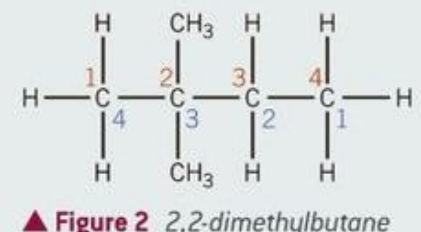
Step 1: The suffix is -ane (it's an alkane).
Step 2: The longest continuous chain contains four carbon atoms, so the stem is but-.
Step 3: Two methyl groups () are attached as side chains.
Step 4: Both methyl groups are attached to carbon 2 (counting from either end gives the same result, so we use the lower numbers). Since there are two methyl groups on the same carbon, we use the prefix 'di-' and write '2,2-dimethyl'.
The complete name is 2,2-dimethylbutane.
Example
Worked Example: Naming a Complex Branched Alkane
For more complex branched alkanes:
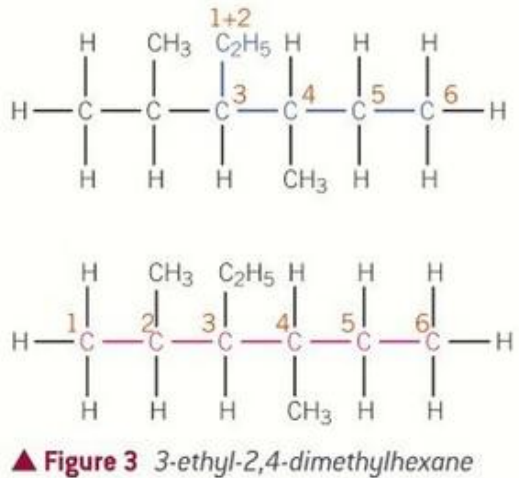
Step 1: The suffix is -ane.
Step 2: The longest chain contains six carbon atoms, giving the stem hex-.
Step 3: There are three side chains: one ethyl group and two methyl groups.
Step 4: Numbering from the left gives positions 2, 3, and 4 for the substituents. Numbering from the right gives positions 3, 4, and 5. We choose the left-to-right numbering because it gives the lowest combination (2,3,4 is lower than 3,4,5). The ethyl group is at position 3, and methyl groups are at positions 2 and 4. Listing alphabetically: ethyl comes before methyl.
The complete name is 3-ethyl-2,4-dimethylhexane.
Important
Common mistake: Students often forget to number from the end that gives the lowest numbers. Always check both directions before committing to your numbering! The goal is to minimise the position numbers of substituents.
Naming alicyclic alkanes
Cyclic alkanes follow the same basic rules as aliphatic alkanes, with one key addition: the prefix cyclo- is added in front of the stem to indicate the carbon atoms are arranged in a ring structure.
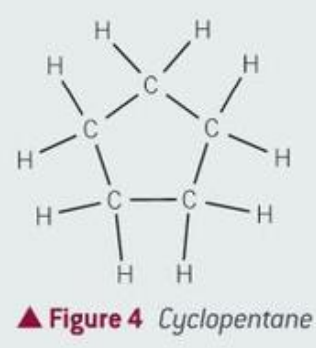
For example, this five-membered ring alkane has five carbon atoms (stem: pent-) arranged in a ring (prefix: cyclo-). The name is cyclopentane.
If substituents are present on the ring, number around the ring to give the lowest possible position numbers, just as with branched alkanes.
Note
When substituents are present on cyclic alkanes, start numbering from the carbon bearing a substituent and continue around the ring in the direction that gives the lowest set of position numbers. If there's only one substituent, you don't need to specify its position (it's automatically position 1).
Naming alkenes
Alkenes follow similar rules to alkanes but with important differences:
Step 1: Use the suffix -ene instead of -ane to indicate the presence of a carbon-carbon double bond.
Step 2: Identify the longest continuous chain containing the double bond. This chain determines the stem.
Step 3: For alkenes with four or more carbon atoms in the longest chain, you must indicate the position of the double bond. Number the parent chain from the end that gives the double bond the lowest position number. Place this number before the suffix (-ene).
Important
Important naming rule: When the suffix begins with a vowel (like -ene), remove the final 'e' from the alkane stem. For example, 'propane' becomes 'prop-1-ene', not 'propane-1-ene'. However, when the suffix begins with a consonant (like -nitrile), keep the final 'e' (e.g., 'ethanenitrile').
Example
Worked Example: Naming an Alkene
Consider pent-2-ene:
Step 1: The suffix is -ene (it's an alkene).
Step 2: The longest chain contains five carbon atoms, so the stem is pent-.
Step 3: The double bond is between carbons 2 and 3. We only need to state the lower number, so it's at position 2.
Step 4: Combine to give pent-2-ene.
Note: For propene and smaller alkenes, you don't need to specify the position because there's only one possible location for the double bond.
Functional groups and their nomenclature
Functional groups are specific groups of atoms that determine the chemical properties and reactions of organic compounds. Each functional group has characteristic prefixes and suffixes for naming.
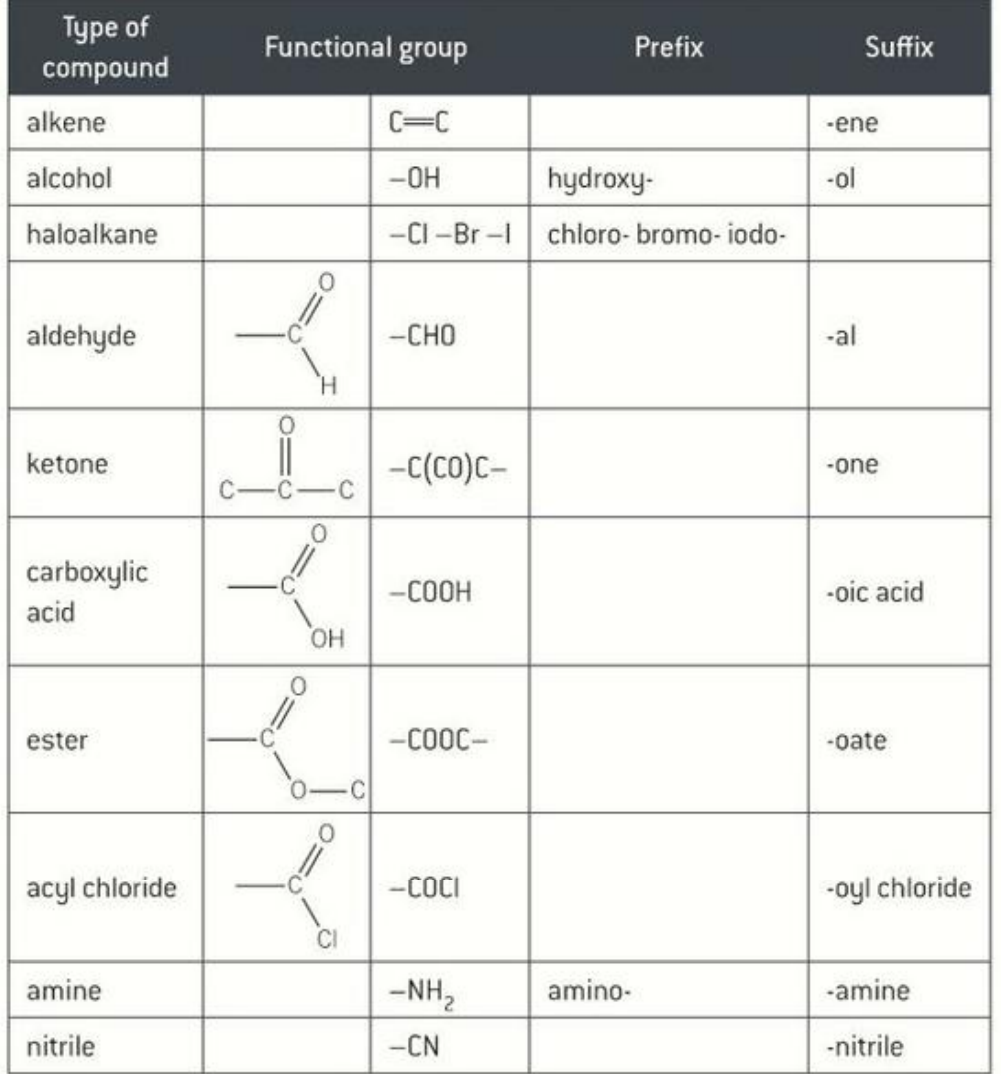
The table shows common functional groups you'll encounter at A-Level:
- Alkenes (): suffix -ene
- Alcohols (): prefix hydroxy- or suffix -ol
- Haloalkanes (, , ): prefix chloro-, bromo-, or iodo-
- Aldehydes (): suffix -al
- Ketones (): suffix -one
- Carboxylic acids (): suffix -oic acid
- Esters (): suffix -oate
- Acyl chlorides (): suffix -oyl chloride
- Amines (): prefix amino- or suffix -amine
- Nitriles (): suffix -nitrile
Important
Make flashcards for these functional groups! You need to be able to:
- Recognise the structure of each functional group instantly
- Know whether it's a prefix or suffix
- Remember the exact spelling (e.g., -oic acid, not -oic acid)
These form the vocabulary of organic chemistry - you can't speak the language without knowing the words!
Naming compounds containing functional groups
The principles for naming compounds with functional groups are similar to those for alkanes:
Step 1: Identify the longest unbranched chain of carbon atoms. The stem comes from the corresponding alkane name.
Step 2: Identify all functional groups and alkyl side chains present. Choose the appropriate prefixes or suffixes for them.
Step 3: Number the carbon atoms in the longest unbranched chain. Start from the end that gives functional groups the lowest position numbers. Functional groups take priority over alkyl groups when numbering.
Example
Worked Example: Naming an Alcohol
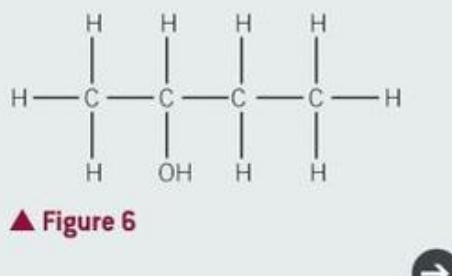
Step 1: The functional group is (alcohol), so the suffix is -ol.
Step 2: The longest chain contains four carbon atoms, giving the stem butan-.
Step 3: The group is attached to carbon 2.
Step 4: Combine the suffix and stem to give butan-2-ol.
Example
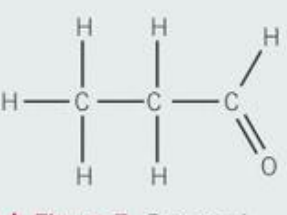
Worked Example: Naming an Aldehyde
Step 1: The functional group is (aldehyde), so the suffix is -al.
Step 2: The longest chain contains three carbon atoms, giving the stem propan-.
Step 3: Aldehydes always have the carbonyl group () at the end of the chain, which is always position 1. Therefore, we don't need to include a number in the name.
The complete name is propanal.
Example
Worked Example: Naming a Haloalkane
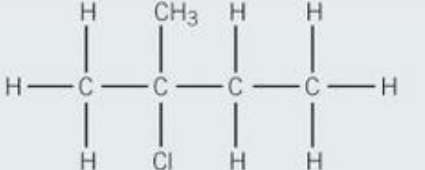
Step 1: The longest chain has four carbons (butan-).
Step 2: A chlorine atom is attached, giving the prefix chloro-.
Step 3: The chlorine is on carbon 2.
The complete name is 2-chlorobutane.
Note
When a molecule contains both a functional group and alkyl side chains, follow the same systematic approach:
- Identify the longest carbon chain
- Identify the functional groups and their positions, then identify alkyl groups and their positions
- Combine everything, listing substituents in alphabetical order
For example, 2-chloro-2-methylbutane has both a chloro group and a methyl group, both on carbon 2. The groups are listed alphabetically: chloro before methyl.
Important naming conventions
Priority rules
When multiple functional groups are present, there is a priority order. The highest priority functional group determines the suffix, while lower priority groups become prefixes. Generally, the priority order is: carboxylic acids > aldehydes > ketones > alcohols > amines > alkenes > halogens.
Numbering conventions
Always number to give the functional group (if present) or the first substituent the lowest possible number. When you have a choice between multiple valid numbering systems, choose the one that gives the lowest set of numbers overall.
Alphabetical ordering
When listing multiple prefixes, arrange them alphabetically. Ignore multiplying prefixes (di-, tri-, tetra-) when determining alphabetical order. For example, in 'diethyl' and 'methyl', you alphabetise based on 'e' and 'm', not 'd' and 'm'.
Important
Remember the priority order! When you have multiple functional groups in one molecule:
- The highest priority group becomes the suffix
- Lower priority groups become prefixes
- The carbon chain is numbered to give the highest priority group the lowest possible number
This is crucial for naming complex molecules correctly.
Summary
Key Points to Remember:
-
IUPAC provides a universal naming system so chemists worldwide can identify organic compounds systematically.
-
The three key components of an IUPAC name are: stem (number of carbons in the longest chain), prefix (side chains and some functional groups), and suffix (main functional group).
-
Learn the first ten alkanes and their alkyl groups - this is essential foundation knowledge for all organic nomenclature.
-
Always find the longest continuous carbon chain to determine the parent chain, and number it to give substituents the lowest possible position numbers.
-
Different functional groups have specific suffixes and prefixes - make sure you can recognise each functional group's structure and know its corresponding nomenclature.
-
Practice is essential! The more compounds you name, the more intuitive the process becomes. Start with simple molecules and gradually work up to more complex structures.