Organic Chemistry (OCR A-Level Chemistry A): Revision Notes
📚Revision Notes
Organic chemistry
Introduction to organic chemistry
Organic chemistry is the branch of chemistry that studies carbon-containing compounds. Originally, scientists believed these compounds could only come from living organisms. This view changed dramatically in 1828 when German chemist Friedrich Wöhler accidentally synthesised urea whilst attempting to prepare a different compound from inorganic starting materials. This breakthrough demonstrated that organic compounds could be made in the laboratory from non-living sources, opening up the field of synthetic organic chemistry.
Note
Wöhler's accidental synthesis of urea was a pivotal moment in chemistry. It shattered the belief in "vitalism" – the idea that organic compounds required a mysterious "vital force" from living organisms. This discovery established that the same chemical principles apply to both organic and inorganic substances.
Today, organic chemistry has enormous practical importance. The subject focuses on understanding the structure, properties, composition, reactions, and preparation of carbon-based compounds. Millions of organic compounds are now known, and they are essential to modern life. Pharmaceuticals that treat diseases, detergents that clean our clothes, dyes and pigments that add colour to our world, cosmetics, plastics, and agricultural chemicals are all examples of organic materials. Much of our energy supply also comes from organic compounds, particularly crude oil derivatives used as fuels for heating and transport.
Why carbon is special
Carbon occupies a unique position in the periodic table that explains why it forms so many different compounds. Located in Group 14, carbon has four electrons in its outer shell. This electronic configuration allows each carbon atom to form four covalent bonds to other atoms.
The versatility of carbon bonding is remarkable. Carbon atoms can form:
- Single bonds ()
- Double bonds ()
- Triple bonds ()
Furthermore, carbon atoms can bond to other carbon atoms, creating long chains and complex structures. This ability to form extended carbon chains, combined with the possibility of different bond types, explains why carbon can form such an enormous variety of compounds.
Important
Why does carbon form so many compounds?
Carbon's position in Group 14 gives it exactly four valence electrons – halfway to a full outer shell. This makes it equally likely to gain or lose electrons, so instead carbon shares electrons through covalent bonding. The ability to form four bonds, combined with carbon's capacity to bond with itself in chains and rings, enables the formation of millions of different molecular structures. No other element has this unique combination of properties.
Hydrocarbons
A hydrocarbon is defined as a compound that contains carbon and hydrogen only. These are the simplest organic compounds and serve as the foundation for understanding more complex organic molecules.
Examples of hydrocarbons include methane, but-2-ene, and propyne, which demonstrate the different types of carbon-carbon bonding:
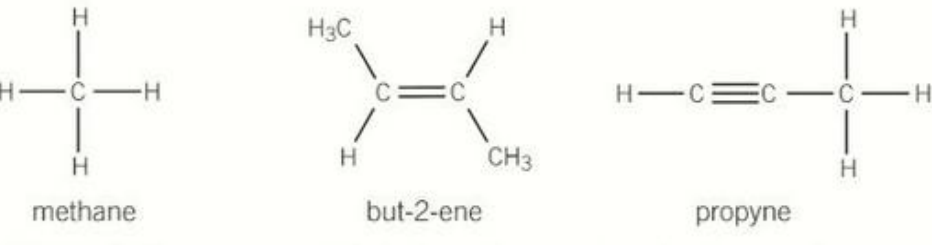
As shown in the structures above, hydrocarbons can contain single, double, or triple bonds between carbon atoms.
Note
Hydrocarbons are the building blocks of organic chemistry. By understanding how carbon and hydrogen bond together, you can then understand more complex molecules that include additional elements like oxygen, nitrogen, or halogens. Think of hydrocarbons as the "skeleton" upon which other functional groups can be attached.
Saturated and unsaturated hydrocarbons
Hydrocarbons are classified into two main categories based on the types of bonds present between carbon atoms:
Saturated hydrocarbons contain only single carbon-carbon bonds. The structure of methane exemplifies a saturated hydrocarbon – every bond in the molecule is a single covalent bond. The term "saturated" indicates that the molecule contains the maximum possible number of hydrogen atoms.
Unsaturated hydrocarbons contain at least one carbon-to-carbon multiple bond. This means they have either double bonds () or triple bonds () present in their structure. The structures of but-2-ene and propyne shown above are examples of unsaturated hydrocarbons, containing a double bond and triple bond respectively.
Important
Understanding the Saturated vs Unsaturated Distinction
Think of "saturated" as meaning "fully loaded with hydrogen". A saturated hydrocarbon has the maximum number of hydrogen atoms possible – there's no room for more. When a molecule has double or triple bonds, it has fewer hydrogen atoms than the maximum possible, making it "unsaturated".
This classification is fundamental in organic chemistry because saturated and unsaturated compounds have distinctly different chemical properties and reactivity. Unsaturated compounds are generally more reactive due to their multiple bonds.
Homologous series
The vast number of carbon compounds makes it convenient to organise them into families that share similar characteristics. A homologous series is defined as a family of compounds with similar chemical properties whose successive members differ by the addition of a group.
The simplest homologous series is the alkanes, which contain only single carbon-to-carbon bonds. The first three members of the alkane series are shown below:
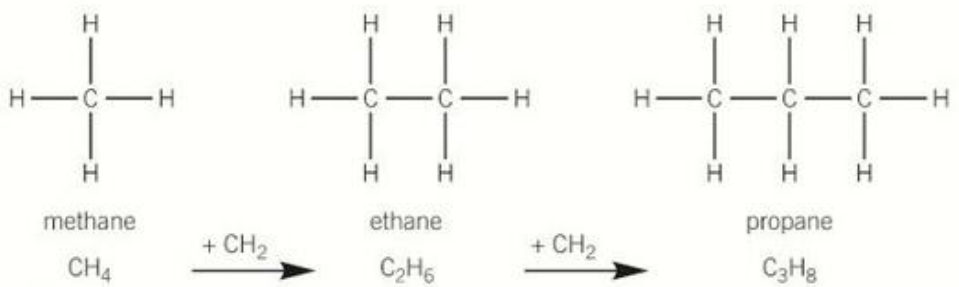
Notice the pattern: methane () becomes ethane () by adding , and ethane becomes propane () by adding another unit. This systematic increment continues throughout the entire series.
Note
The Pattern of Homologous Series
Each member of a homologous series differs from the next by exactly one unit. This regular pattern makes organic chemistry much more manageable. Instead of memorizing properties of millions of individual compounds, you can learn the patterns that apply to entire families.
For example, in the alkane series:
- Methane () has 1 carbon
- Ethane () has 2 carbons (added )
- Propane () has 3 carbons (added another )
- Butane () has 4 carbons (added another )
Members of a homologous series share similar chemical properties because they have the same functional group and general structure. However, their physical properties (such as boiling point and melting point) change gradually as the carbon chain length increases. This regular pattern makes it easier to predict the properties of unfamiliar compounds within the series.
Functional groups
Whilst hydrocarbons contain only carbon and hydrogen, most organic compounds include other elements bonded to the carbon framework. A functional group is the part of an organic molecule that largely determines the molecule's chemical properties and behaviour.
Carbon atoms can form bonds to several other elements besides hydrogen, including:
- Oxygen
- Nitrogen
- Halogens (fluorine, chlorine, bromine, iodine)
These additional elements create molecules with different functional groups. Two common examples are alcohols (containing the group) and amines (containing the group):
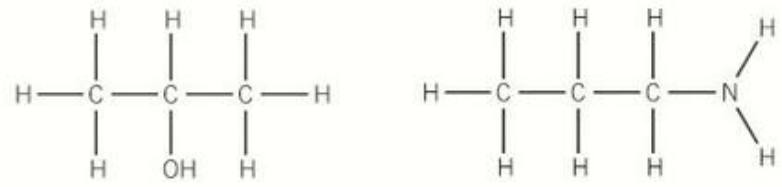
The structures above show propanol with a hydroxyl functional group () and propylamine with an amino functional group (). The functional group determines how these molecules react chemically, which is why substances with the same functional group tend to undergo similar types of reactions.
Note
The Power of Functional Groups
Functional groups act like chemical "personalities". Molecules with the same functional group behave similarly in chemical reactions, regardless of the size of the carbon chain they're attached to. For example, all alcohols (containing ) will react with sodium metal to produce hydrogen gas, whether it's methanol (1 carbon) or octanol (8 carbons).
This concept allows chemists to predict how unfamiliar molecules will react by simply identifying their functional groups. Understanding functional groups is essential for predicting chemical behaviour and designing synthesis routes in organic chemistry.
Summary
Key Points to Remember:
- Organic chemistry is the study of carbon-containing compounds, which can now be synthesised from inorganic starting materials
- Carbon's four outer electrons allow it to form four covalent bonds, including single, double, and triple bonds, creating vast numbers of different compounds
- Saturated hydrocarbons contain only single bonds, whilst unsaturated hydrocarbons contain at least one carbon-carbon multiple bond
- A homologous series is a family of compounds with similar properties where each member differs from the next by a unit
- Functional groups are specific atoms or groups of atoms that determine the chemical properties of organic molecules