The Chemistry of the Haloalkanes (OCR A-Level Chemistry A): Revision Notes
📚Revision Notes
The Chemistry of the Haloalkanes
Introduction to haloalkanes
Haloalkanes (also called halogenoalkanes) are organic compounds that contain carbon, hydrogen, and at least one halogen atom. The halogen elements that appear in these compounds are fluorine (F), chlorine (Cl), bromine (Br), and iodine (I). These compounds form an important class of organic molecules with distinctive chemical properties.
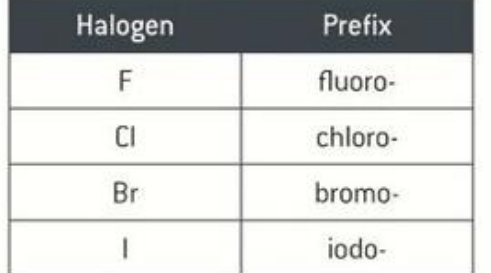
When we name haloalkanes, we add a prefix to identify which halogen is present. Each halogen has its own specific prefix that appears before the main chain name:
Note
If a molecule contains more than one type of halogen, we list them in alphabetical order when naming the compound. This follows standard IUPAC nomenclature rules.
The haloalkanes we study most commonly are aliphatic, meaning the halogen atom is attached to either a straight or branched carbon chain. Similar to alcohols, we can classify these compounds as primary, secondary, or tertiary, depending on how many carbon atoms are bonded to the carbon that carries the halogen.

Important
This classification system becomes very important when we consider how quickly different haloalkanes react, which we'll explore later in these notes.
Polarity of the carbon-halogen bond
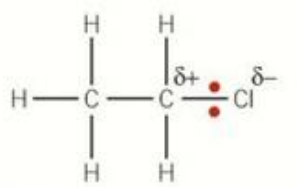
The carbon-halogen bond in haloalkanes possesses a distinctive property - it is polar. This polarity arises from the difference in electronegativity between carbon and halogen atoms. Halogen atoms are more electronegative than carbon atoms, which means they have a stronger attraction for electrons in the bond.
As a result of this electronegativity difference, the electron pair in the carbon-halogen bond sits closer to the halogen atom than to the carbon atom. We represent this unequal sharing using partial charges: the carbon atom becomes slightly positive (written as ) whilst the halogen atom becomes slightly negative (written as ).
Important
This polar bond is absolutely crucial to understanding haloalkane chemistry. The partially positive carbon atom becomes an attractive target for species that can donate electron pairs. These electron-donating species are called nucleophiles.
Nucleophiles and nucleophilic substitution
A nucleophile is defined as an atom or group of atoms that possesses a lone pair of electrons and is attracted to an electron-deficient (partially positive) carbon atom. When a nucleophile encounters such a carbon, it donates its pair of electrons to form a new covalent bond. The term "nucleophile" literally means "nucleus-loving", reflecting the attraction to positive centres.
Note
Common examples of nucleophiles include:
- Hydroxide ions,
- Water molecules,
- Ammonia molecules,
When a haloalkane reacts with a nucleophile, a substitution reaction occurs. In this process, the nucleophile replaces the halogen atom, and a new compound containing a different functional group is produced. The reaction mechanism for this process is called nucleophilic substitution.
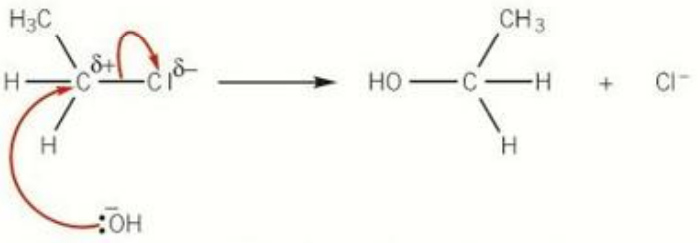
The mechanism proceeds through several key steps. The nucleophile approaches the carbon atom that is bonded to the halogen, attacking from the opposite side to the halogen atom. This direction of attack is crucial - it minimises repulsion between the nucleophile (which is either negatively charged or has a lone pair) and the halogen atom (which is partially negative). As the nucleophile donates its lone pair to form a new bond with the carbon, the carbon-halogen bond breaks through heterolytic fission, with both electrons going to the halogen atom. This produces a halide ion as one of the products.
Hydrolysis of haloalkanes
Hydrolysis is a specific type of chemical reaction involving water or an aqueous solution of a hydroxide. The term literally means "breaking with water". In hydrolysis reactions, water (or hydroxide ions from an aqueous solution) causes the breaking of a bond in a molecule, resulting in the molecule being split into two products.
When we carry out the hydrolysis of a haloalkane, the halogen atom is replaced by an group. This is an example of nucleophilic substitution where the nucleophile is the hydroxide ion ().
The mechanism of hydrolysis
Example
Worked Example: Step-by-Step Hydrolysis Mechanism
The hydrolysis mechanism follows a specific sequence of events:
Step 1: The nucleophile () approaches the carbon atom that is attached to the halogen. Crucially, it approaches from the opposite side of the molecule to where the halogen atom is located.
Step 2: This direction of attack by the ion minimises repulsion between the nucleophile and the partially negative () halogen atom.
Step 3: A lone pair of electrons on the hydroxide ion is attracted to the partially positive () carbon atom and is donated to it.
Step 4: A new bond forms between the oxygen atom of the hydroxide ion and the carbon atom.
Step 5: As the new bond forms, the carbon-halogen bond breaks by heterolytic fission (both bonding electrons go to one atom - in this case, the halogen).
Step 6: The products formed are an alcohol (the new organic product) and a halide ion.
Note
When drawing reaction mechanisms, it's essential to show curly arrows correctly. These arrows start from either a lone pair or a bonding pair of electrons and point to the atom where the electron pair is moving. The arrows represent the movement of electron pairs, not atoms.
Practical hydrolysis with sodium hydroxide
To convert haloalkanes to alcohols in the laboratory, we use aqueous sodium hydroxide as the source of hydroxide ions. At room temperature, this reaction proceeds very slowly. To obtain a reasonable yield of product in a sensible timeframe, we heat the mixture under reflux. Reflux ensures that any volatile components don't escape whilst allowing the reaction mixture to be heated.
Example
Worked Example: Hydrolysis of 1-Bromobutane
The hydrolysis of 1-bromobutane can be represented by the equation:
The product butan-1-ol is formed along with sodium bromide.
Bond strength and rate of hydrolysis
The rate at which different haloalkanes undergo hydrolysis depends fundamentally on the strength of the carbon-halogen bond. During hydrolysis, this bond must be broken, so the strength of the bond directly affects how quickly the reaction can occur.
The bond enthalpy (bond energy) tells us how strong a bond is - the larger the bond enthalpy value, the more energy is required to break the bond, and therefore the stronger the bond. We can compare the bond enthalpies of different carbon-halogen bonds:
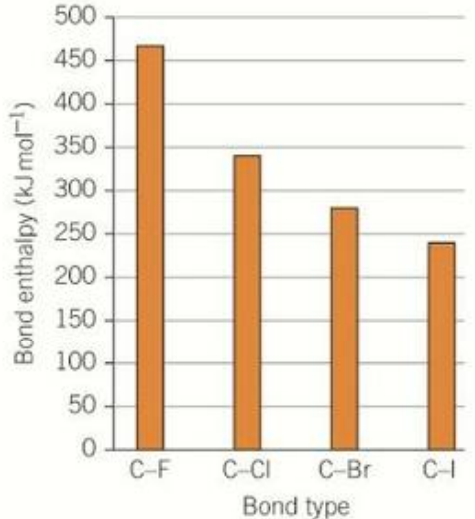
From this data, we can see a clear pattern:
- The bond is the strongest carbon-halogen bond (approximately )
- The bond is the weakest carbon-halogen bond (approximately )
- Less energy is required to break the bond than any other carbon-halogen bond
Important
Predicting Relative Rates of Hydrolysis
Based on these bond enthalpies, we can predict the relative rates of hydrolysis:
- Iodoalkanes react faster than bromoalkanes - because the bond is weaker than the bond
- Bromoalkanes react faster than chloroalkanes - because the bond is weaker than the bond
- Fluoroalkanes are essentially unreactive - because a very large quantity of energy is required to break the strong bond
This trend can be explained by considering the size of the halogen atoms. As we move down Group 7 from fluorine to iodine, the halogen atoms become larger. The larger the halogen atom, the further its outer electrons are from the carbon atom, and the weaker the orbital overlap in the bond. This results in a weaker bond that is easier to break.
Experimental investigation of hydrolysis rates
We can test the predictions about relative rates of hydrolysis by carrying out a practical experiment comparing three primary haloalkanes: 1-chlorobutane, 1-bromobutane, and 1-iodobutane.
General equation for hydrolysis with water
The general equation for the hydrolysis of these haloalkanes with water is:
where X represents any of the halogens (Cl, Br, or I).
Following the reaction with silver nitrate
The rate of each hydrolysis reaction can be monitored by carrying out the reaction in the presence of aqueous silver nitrate. As the hydrolysis takes place, halide ions () are produced. These halide ions react with silver ions () from the silver nitrate to form a precipitate of the silver halide:
Note
Identifying Silver Halide Precipitates
The silver halide forms as a coloured precipitate, and importantly, each halogen produces a different colour:
- Silver chloride = white precipitate
- Silver bromide = cream precipitate
- Silver iodide = yellow precipitate
The nucleophile in this reaction is water, which is present in the aqueous silver nitrate solution. Haloalkanes are insoluble in water, so we carry out the reaction in the presence of ethanol as a solvent. The ethanol allows the water and the haloalkane to mix together and produce a single homogeneous solution rather than two separate layers.
Experimental procedure
Example
Worked Example: Comparing Hydrolysis Rates Experimentally
The experiment is set up as follows:
Preparation:
- Tube 1: of ethanol and two drops of 1-chlorobutane
- Tube 2: of ethanol and two drops of 1-bromobutane
- Tube 3: of ethanol and two drops of 1-iodobutane
Procedure:
-
Stand all test tubes in a water bath at
-
Place a test tube containing silver nitrate in the same water bath and allow all tubes to reach the constant temperature
-
Add of the silver nitrate solution quickly to each of the test tubes containing the haloalkanes, and immediately start a stop-clock
-
Observe the test tubes for five minutes and record the time taken for each precipitate to form
Important
Critical Experimental Detail
It is absolutely essential that all test tubes are placed in a water bath at the same constant temperature (). Temperature significantly affects the rate of chemical reactions, so maintaining the same temperature ensures that we are making a fair comparison. Any temperature differences would affect the reaction rates and make our comparison invalid.
Observations and results
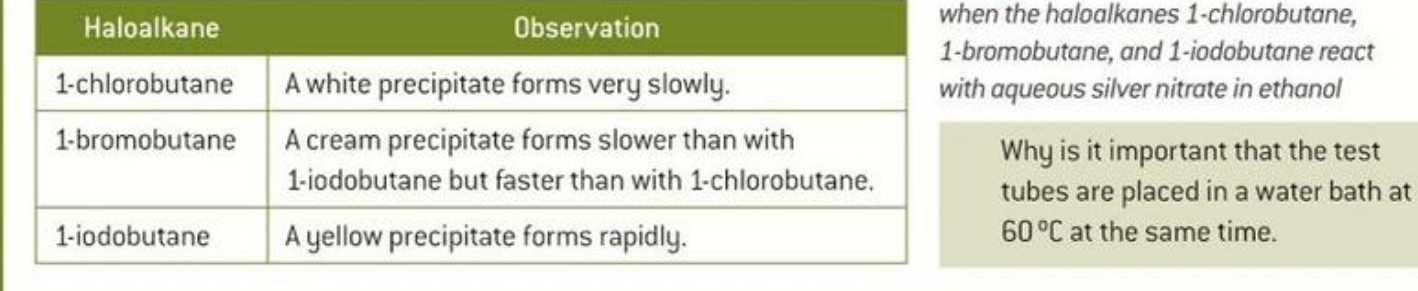
The observations clearly show a pattern in the rate of precipitate formation:
- 1-chlorobutane: white precipitate forms very slowly
- 1-bromobutane: cream precipitate forms at a moderate speed (slower than iodobutane but faster than chlorobutane)
- 1-iodobutane: yellow precipitate forms rapidly
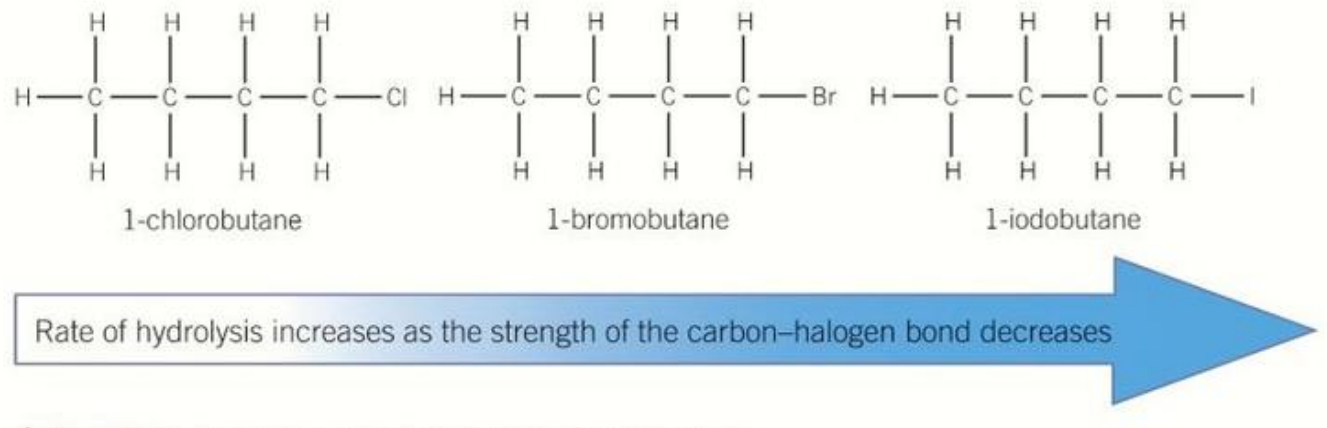
These observations are explained perfectly by considering the bond enthalpies we examined earlier. The compound with the slowest rate of reaction is the one with the strongest carbon-halogen bond, whilst the fastest reaction occurs with the weakest carbon-halogen bond:
- 1-Chlorobutane reacts slowest because the bond is the strongest of the three
- 1-Iodobutane reacts fastest because the bond is the weakest
Important
The Fundamental Principle
Rate of hydrolysis increases as the strength of the carbon-halogen bond decreases.
Hydrolysis of primary, secondary, and tertiary haloalkanes
Whilst bond strength is clearly important in determining the rate of hydrolysis, it is not the only factor that influences how quickly haloalkanes react. This becomes evident when we examine structural isomers of bromoalkanes with the molecular formula .
Comparing rates for structural isomers
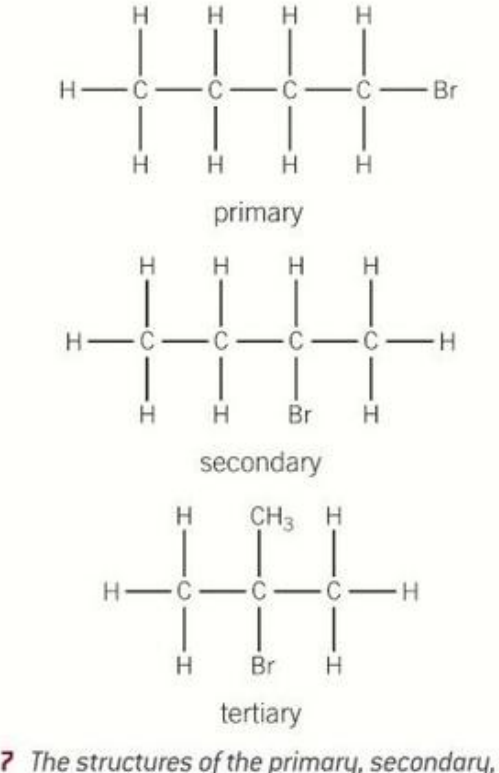
When we compare the hydrolysis rates of three structural isomers of bromoalkanes, we observe something surprising:
Note
Observed Rate Pattern
The relative rates show a clear pattern:
- (1-bromobutane, primary): slowest rate
- (2-bromobutane, secondary): intermediate rate
- (2-bromo-2-methylpropane, tertiary): fastest rate
All three compounds have the same bond, so bond strength cannot explain these different rates. The key difference lies in whether the haloalkane is primary, secondary, or tertiary.
When we examine the structures carefully, we see that:
- One haloalkane is primary - the carbon bearing the bromine is bonded to only one other carbon
- One is secondary - the carbon bearing the bromine is bonded to two other carbons
- One is tertiary - the carbon bearing the bromine is bonded to three other carbons
Different reaction mechanisms
Important
Different Mechanisms for Different Structures
The explanation for these different rates lies in the reaction mechanism. Primary and tertiary haloalkanes actually react by different pathways:
Primary haloalkanes undergo hydrolysis via a one-step mechanism. This is the mechanism we examined earlier with curly arrows, where the hydroxide ion attacks and the bond breaks in a single concerted step.
Tertiary haloalkanes undergo hydrolysis via a two-step mechanism:
Step 1: The carbon-halogen bond of the tertiary haloalkane breaks by heterolytic fission. Both electrons from the bond go to the halogen, forming a halide ion. This leaves behind a positively charged tertiary carbocation () as an intermediate.
Step 2: A hydroxide ion then attacks the positively charged carbocation to form the final organic product (an alcohol).
The key to understanding the different rates is recognising that tertiary carbocations are more stable than primary carbocations. The increased stability of the tertiary carbocation intermediate makes it easier to form, which means the two-step mechanism for tertiary haloalkanes proceeds faster than the one-step mechanism for primary haloalkanes.
Note
Secondary haloalkanes show intermediate behaviour because secondary carbocations have intermediate stability between primary and tertiary carbocations.
This connection to carbocation stability relates back to concepts covered in alkene chemistry, specifically Markovnikov's rule, which also depends on the relative stability of carbocations.
Remember!
Summary
Key Points to Remember:
-
Haloalkanes contain carbon, hydrogen, and at least one halogen (F, Cl, Br, I). Naming uses prefixes: fluoro-, chloro-, bromo-, iodo-.
-
The bond is polar due to electronegativity differences, with carbon being and halogen being . This makes the carbon susceptible to nucleophilic attack.
-
Nucleophiles (such as , , ) donate a lone pair of electrons to the electron-deficient carbon, replacing the halogen in a substitution reaction.
-
Rate of hydrolysis depends on bond strength: Weaker bonds break faster. The order of reactivity is: iodoalkanes > bromoalkanes > chloroalkanes >> fluoroalkanes (virtually unreactive). Bond enthalpies: () > () > () > ().
-
Silver nitrate test can compare hydrolysis rates: halide ions form coloured precipitates with ions (chloride = white, bromide = cream, iodide = yellow). Experiments must be conducted at constant temperature for fair comparison.
-
Classification matters: Tertiary haloalkanes hydrolyse faster than secondary, which are faster than primary haloalkanes, due to greater carbocation stability in the tertiary case and different mechanisms (two-step vs one-step).