Acids, Bases and Neutralisation (OCR A-Level Chemistry A): Revision Notes
📚Revision Notes
Acids, Bases and Neutralisation
Understanding acids
What are acids?
Hydrogen is present in every acid molecule. When an acid dissolves in water, it releases hydrogen ions (also called protons, with the symbol H⁺) into the solution. This release of hydrogen ions is what gives acids their characteristic properties.
For example, when hydrogen chloride gas dissolves in water, it releases hydrogen ions:
Note
The notation "+ aq" indicates that excess water is present, showing the acid is forming an aqueous solution. This is a common way to represent the dissolving process in water.
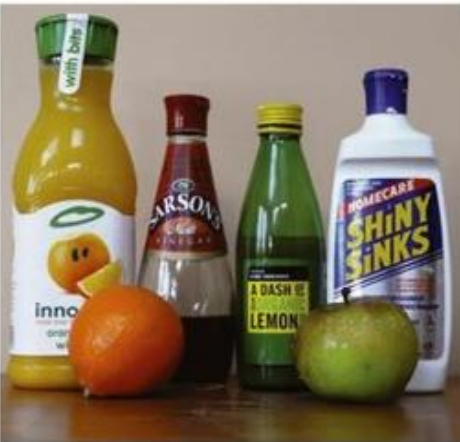
Strong acids and complete dissociation
A strong acid releases all of its hydrogen atoms into solution as H⁺ ions when dissolved in water. This process is called complete dissociation. Common strong acids include hydrochloric acid, sulfuric acid, and nitric acid.
For example, hydrochloric acid completely dissociates in water:
Note
The single arrow (→) indicates the reaction goes to completion, with all HCl molecules breaking apart into ions. This is different from the equilibrium arrow (⇌) used for reversible reactions.
Important
Recognizing Strong Acids
You need to memorize the three common strong acids:
- Hydrochloric acid (HCl)
- Sulfuric acid (H₂SO₄)
- Nitric acid (HNO₃)
If an acid isn't one of these three, it's likely a weak acid!
Weak acids and partial dissociation
A weak acid only releases a small proportion of its available hydrogen atoms into solution as H⁺ ions. This is called partial dissociation. Ethanoic acid (found in vinegar) is a typical weak acid.
The equilibrium sign (⇌) shows that the forward reaction is incomplete - only about one molecule in every hundred dissociates. Most organic acids, like ethanoic acid, are weak acids.
Important
Common Misconception About Acidic Hydrogens
Not all hydrogen atoms in a molecule necessarily act as acidic hydrogens. In ethanoic acid (CH₃COOH), there are four hydrogen atoms, but only the hydrogen attached to the COOH group is released as H⁺. The three hydrogens in the CH₃ group remain bonded and are not acidic.
Common acids you need to know
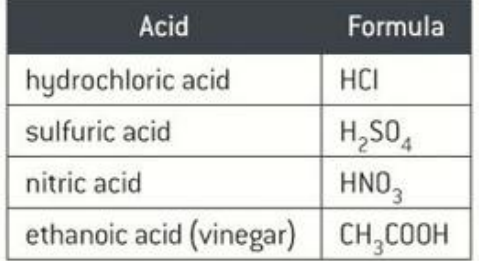
| Acid | Formula |
|---|---|
| Hydrochloric acid | HCl |
| Sulfuric acid | H₂SO₄ |
| Nitric acid | HNO₃ |
| Ethanoic acid (vinegar) | CH₃COOH |
Understanding bases and alkalis
What are bases?
Substances classified as bases include metal oxides, metal hydroxides, metal carbonates, and ammonia (NH₃). The key property of a base is that it neutralises an acid to form a salt.
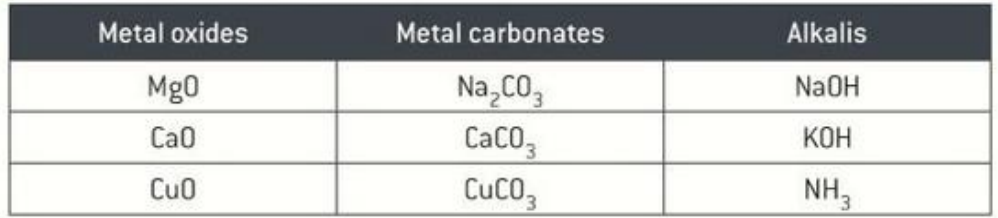
| Metal oxides | Metal carbonates | Alkalis |
|---|---|---|
| MgO | Na₂CO₃ | NaOH |
| CaO | CaCO₃ | KOH |
| CuO | CuCO₃ | NH₃ |
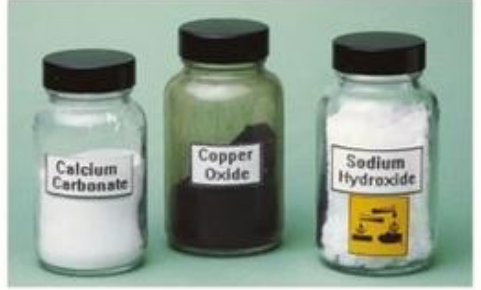
What makes an alkali special?
An alkali is a specific type of base that dissolves in water, releasing hydroxide ions (OH⁻) into the solution. Not all bases are alkalis - for example, copper oxide is a base but not an alkali because it doesn't dissolve in water.
Note
Key Distinction: Base vs Alkali
All alkalis are bases, but not all bases are alkalis. Think of alkalis as a special subcategory of bases - they're the bases that dissolve in water to produce OH⁻ ions. Metal oxides like CuO are bases but not alkalis because they don't dissolve in water.
Sodium hydroxide dissolving in water demonstrates alkali behavior:
Common alkalis you should know include sodium hydroxide (NaOH), potassium hydroxide (KOH), and ammonia (NH₃).
Neutralisation reactions
The basic concept of neutralisation
Neutralisation occurs when H⁺ ions from an acid react with a base. The products formed are a salt and neutral water. During this process, the H⁺ ions from the acid are replaced by metal ions or ammonium ions from the base to form the salt.
Neutralising acids with metal oxides and hydroxides
When an acid reacts with a metal oxide or metal hydroxide, the products are a salt and water only. The general pattern is:
Example
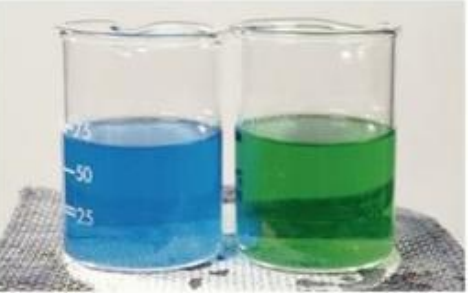
Worked Example: Copper(II) Oxide with Acids
When copper(II) oxide reacts with sulfuric acid:
When copper(II) oxide reacts with hydrochloric acid:
Notice both reactions follow the same pattern: salt + water are the only products.
Note
Exam Tip
The reactions for neutralising an acid with a metal oxide or hydroxide are essentially the same pattern - they always produce salt plus water. Remember this simple rule and you can write the equation for any such reaction!
Neutralising acids with alkalis
When working with alkalis, the reactants are already in solution. As with metal oxides, the overall reaction produces a salt and water only:
The full equation for hydrochloric acid with sodium hydroxide is:
The ionic equation is much simpler and shows the essence of neutralisation - H⁺ ions combining with OH⁻ ions to form neutral water:
Important
Universal Ionic Equation
This ionic equation applies to all acid-alkali neutralisation reactions, regardless of which specific acid or alkali you're using. It captures the fundamental process: hydrogen ions and hydroxide ions combine to form water.
Neutralising acids with carbonates
Metal carbonates also neutralise acids to form a salt and water, but there is an additional product - carbon dioxide gas. The general pattern is:
Example
Worked Example: Carbonate Reactions
Zinc carbonate with sulfuric acid:
Magnesium carbonate with hydrochloric acid:
The key difference from oxide/hydroxide reactions: carbon dioxide gas is also produced.
Note
Exam Tip
Remember the equation pattern for carbonate neutralisation - it will help you write the equation for any neutralisation involving a metal carbonate. Just add CO₂(g) to the products compared to the oxide/hydroxide pattern!
Understanding salt formation and naming
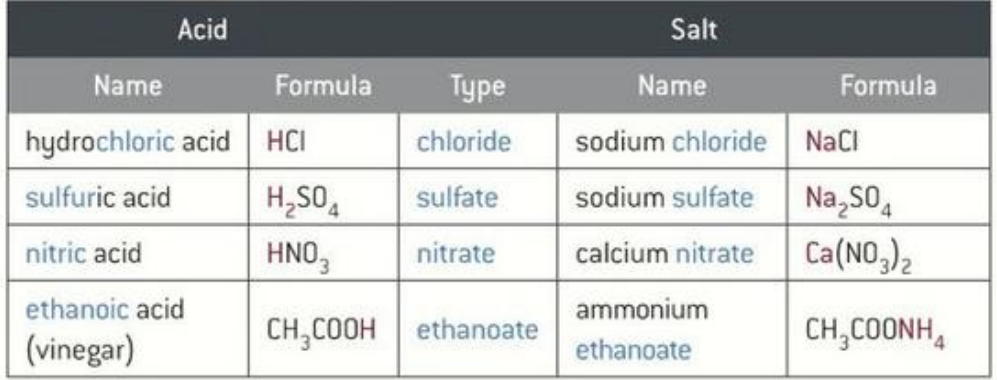
The salt formed in neutralisation takes its name from two sources:
- The metal (or ammonium) comes from the base
- The rest of the salt name comes from the acid
| Acid | Salt type | Example salt |
|---|---|---|
| Hydrochloric acid (HCl) | Chloride | Sodium chloride (NaCl) |
| Sulfuric acid (H₂SO₄) | Sulfate | Sodium sulfate (Na₂SO₄) |
| Nitric acid (HNO₃) | Nitrate | Calcium nitrate (Ca(NO₃)₂) |
| Ethanoic acid (CH₃COOH) | Ethanoate | Ammonium ethanoate (CH₃COONH₄) |
Note
Pattern for Salt Formation
Notice the pattern: to form the salt, the hydrogen shown in the acid formula is replaced by a metal or ammonium ion.
For example:
- H in HCl is replaced by Na to give NaCl
- H₂ in H₂SO₄ is replaced by Na₂ to give Na₂SO₄
This helps you predict the formula of any salt formed in a neutralisation reaction!
Special case: sulfuric acid dissociation
Sulfuric acid (H₂SO₄) behaves differently from other acids because it contains two hydrogen atoms. It dissociates in two stages:
First dissociation (complete - strong acid behavior):
This stage releases just one of the two hydrogen atoms as H⁺. This dissociation is complete, so sulfuric acid behaves as a strong acid at this stage.
Second dissociation (partial - weak acid behavior):
The hydrogen sulfate ion (HSO₄⁻) formed in the first step only partially dissociates, behaving as a weak acid.
Important
Two-Stage Behavior
This two-stage behavior is important to understand:
- Sulfuric acid first acts as a strong acid (complete dissociation)
- The HSO₄⁻ ions then act as a weak acid (partial dissociation)
Other strong acids containing more than one hydrogen atom show similar behavior.
Summary
Key Points to Remember:
-
Acids release H⁺ ions when dissolved in water. Strong acids completely dissociate; weak acids only partially dissociate.
-
Common strong acids to memorize: HCl (hydrochloric), H₂SO₄ (sulfuric), and HNO₃ (nitric). Ethanoic acid (CH₃COOH) is a weak acid.
-
Bases include metal oxides, metal hydroxides, metal carbonates, and ammonia. Alkalis are bases that dissolve in water to release OH⁻ ions.
-
Neutralisation patterns to learn:
- Acid + metal oxide/hydroxide → salt + water
- Acid + carbonate → salt + water + carbon dioxide
- The ionic equation for acid-alkali reactions: H⁺(aq) + OH⁻(aq) → H₂O(l)
-
Salt naming: The salt name comes from the metal (or ammonium) in the base and the acid type (chloride from HCl, sulfate from H₂SO₄, nitrate from HNO₃, ethanoate from CH₃COOH).