Amount of Substance and the Mole (OCR A-Level Chemistry A): Revision Notes
📚Revision Notes
Amount of substance and the mole
Introduction: counting particles in chemistry
Chemical reactions happen at the atomic level, involving individual atoms, molecules, or ions. However, we measure chemicals using mass (grams) or volume. This creates a challenge: how do we connect the mass we can measure to the actual number of particles taking part in a reaction?
The answer lies in using a concept called amount of substance, which gives us a way to count particles indirectly by weighing them.
The mole and Avogadro constant
What is a mole?
In chemistry, the term amount of substance (symbol: ) represents the quantity of particles present in a sample. This is measured using a unit called the mole (symbol: mol).
Important
A mole is defined as the quantity of substance that contains exactly particles. These particles could be atoms, molecules, ions, or electrons - the mole simply counts them.
The Avogadro constant
The number is called the Avogadro constant and is given the symbol . Its units are , meaning "per mole".
This represents the number of particles in each mole of any substance.
Why this specific number?
Note
The Avogadro constant is directly linked to carbon-12, which serves as the standard for measuring atomic masses. Exactly 12 g of carbon-12 contains precisely atoms. This provides the foundation for the mole concept.
The Avogadro constant is an incredibly large number. To put it in perspective: if pennies were distributed evenly among every person on Earth, each person could spend $1 million every hour for their entire lifetime and still have money left over!
Molar mass
Definition and units
Molar mass (symbol: ) acts as a conversion factor between moles and mass. It is defined as the mass of one mole of a substance.
The units of molar mass are always grams per mole ().
Molar mass of elements
For elements, there's a simple rule:
Note
The mass of one mole of atoms of an element equals the relative atomic mass in grams.
This means you can find the molar mass of any element directly from the periodic table by taking the relative atomic mass value and adding "g mol⁻¹" as the unit.
Examples of molar masses for common elements:
- One mole of carbon (C) atoms has a mass of , so
- One mole of hydrogen (H) atoms has a mass of , so
- One mole of magnesium (Mg) atoms has a mass of , so
- One mole of iron (Fe) atoms has a mass of , so
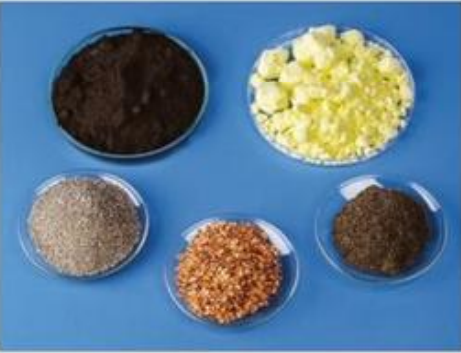
The image above shows equal numbers of atoms (equal moles) of different elements. Notice how their masses differ even though each sample contains the same number of atoms - this is because different elements have different molar masses.
Molar mass of compounds
For compounds, calculate the molar mass by adding together the relative atomic masses of all the atoms in the formula.
Examples:
- Nitrogen dioxide ():
- Sodium carbonate ():
The importance of molar mass
Knowing the molar mass of a substance means that if you have a sample and know its mass, you can work out the number of moles present, and therefore the number of particles. This is fundamental to all chemical calculations involving amounts.
The key equation:
Understanding the relationship
Amount of substance (), mass (), and molar mass () are connected by a key equation:
Where:
- = amount of substance in moles (mol)
- = mass in grams (g)
- = molar mass in grams per mole (g mol⁻¹)
This equation can be rearranged to find any of the three variables if you know the other two:
- To find mass:
- To find molar mass:
The triangle method
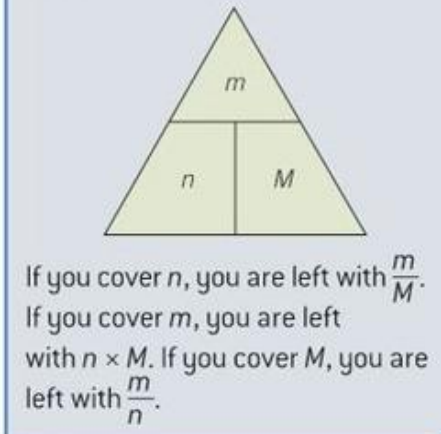
A useful way to remember these rearrangements is the triangle method:
Note
Using the triangle method:
Place at the top, and and at the bottom. To find any variable, cover it up, and what remains shows you the calculation:
- Cover : you get (so )
- Cover : you get (so )
- Cover : you get (so )
Make sure you're comfortable rearranging this equation - it's essential for almost all mole calculations in chemistry.
Worked examples
Example
Worked Example 1: Finding amount of substance from mass
Question: Calculate the amount of substance, in moles, in 96.0 g of carbon (C).
Solution: Use where and
Answer: 8.0 mol
Example
Worked Example 2: Finding mass from amount of substance
Question: Calculate the mass, in g, of 0.050 mol of nitrogen dioxide ().
Solution: Step 1: Find the molar mass
Step 2: Rearrange to give
Step 3: Calculate the mass
Answer: 2.3 g
Example
Worked Example 3: Finding molar mass from mass and amount
Question: Calculate the molar mass when 2.65 g contains 0.025 mol of a substance.
Solution: Step 1: Identify the known values We have and
Step 2: Rearrange the equation From , rearrange to find :
Step 3: Calculate
Answer: 106.0 g mol⁻¹
Particles matter: atoms vs molecules
When working with moles, it's crucial to use the correct formula for the substance you're dealing with. The formula tells you what type of particle you're counting.
Important
Understanding the difference between atoms and molecules:
Consider hydrogen:
- 1 mol of H means 1 mole of hydrogen atoms (individual H atoms)
- 1 mol of H₂ means 1 mole of hydrogen molecules (H₂ molecules, each containing 2 H atoms)
These are different quantities! One mole of H₂ molecules contains twice as many hydrogen atoms as one mole of H atoms.
Always check whether you're working with:
- Individual atoms (e.g., C, Mg, Fe)
- Molecules (e.g., H₂, O₂, CO₂, H₂O)
- Ions in ionic compounds (e.g., Na⁺, Cl⁻ in NaCl)
Using the unambiguous name or correct formula ensures clarity in your calculations and prevents errors.
Remember!
Summary
Key Takeaways:
-
The mole is the unit for amount of substance; one mole contains particles (Avogadro constant)
-
Molar mass is the mass of one mole of a substance in g mol⁻¹; for elements, it equals the relative atomic mass in grams
-
The key equation is , which you must be able to rearrange to find or
-
Always check whether you're working with atoms, molecules, or formula units - use the correct formula (e.g., H vs H₂)
-
Units matter: amount () in mol, mass () in g, molar mass () in g mol⁻¹
Exam Focus Checklist:
✓ Can you define the mole and state the value of the Avogadro constant?
✓ Can you explain why the mass of one mole of atoms equals the relative atomic mass in grams?
✓ Can you calculate the molar mass of a compound from its formula?
✓ Can you confidently use and rearrange to solve problems?
✓ Can you distinguish between atoms and molecules when working with moles?
✓ Do you always include correct units in your calculations?