Determination of Formulae (OCR A-Level Chemistry A): Revision Notes
📚Revision Notes
Determination of formulae
Understanding how to work out chemical formulae from experimental data is a fundamental skill in chemistry. This topic shows you how to calculate empirical and molecular formulae, work with relative masses, and investigate hydrated salts through practical experiments.
Molecular formulae
When elements combine to form molecules (small units of atoms held together by covalent bonds), we describe their composition using a molecular formula. This formula tells you exactly how many atoms of each element are present in one molecule.
For example, a water molecule contains two hydrogen atoms and one oxygen atom, giving it the molecular formula . Similarly, glucose has the molecular formula , showing it contains 6 carbon atoms, 12 hydrogen atoms, and 6 oxygen atoms per molecule.
Note
Many simple substances exist as molecules - including common elements like hydrogen (), nitrogen (), oxygen (), and the halogens such as fluorine (), chlorine (), bromine (), and iodine (). These elements naturally exist as diatomic molecules (molecules containing two atoms). Compounds like carbon dioxide (), methane (), and water also exist as discrete molecules.
Empirical formulae
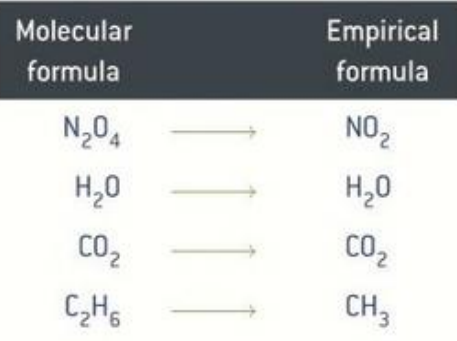
The empirical formula represents the simplest whole-number ratio of atoms of each element in a compound. While molecular formulae show actual numbers of atoms, empirical formulae reduce these to the smallest possible whole numbers.
Why empirical formulae matter
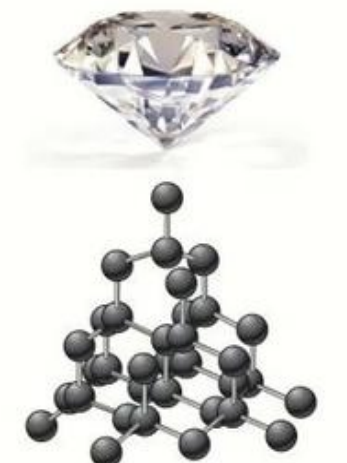
Not all substances exist as molecules. Some materials form giant structures made up of millions upon millions of atoms or ions arranged in regular patterns. These include:
- Metals like carbon, copper, and silicon
- Non-metals such as diamond (a form of carbon)
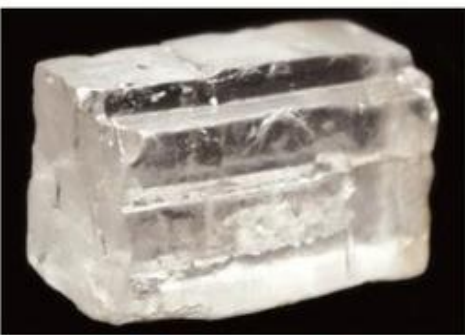
- Ionic compounds like sodium chloride ()
Important
For these giant structures, it would be impossible to write a molecular formula based on the actual number of atoms present - the numbers would vary depending on the size of your sample and would be astronomically large. Instead, we use the empirical formula to show the ratio in which atoms or ions are present.
The empirical formula represents the ratio of atoms or ions in the structure and remains constant regardless of sample size. For example, in any sample of sodium chloride, there is always one sodium ion for every one chloride ion, giving the empirical formula .
Relationship between molecular and empirical formulae
For molecular substances, the empirical formula is simply the molecular formula reduced to its simplest ratio:
- Dinitrogen tetroxide () has the empirical formula
- Ethane () has the empirical formula
- Water () already shows the simplest ratio, so its empirical and molecular formulae are identical
- Carbon dioxide () similarly has the same empirical and molecular formula
Relative masses in chemistry
Different terms are needed to describe the mass of simple molecules versus giant structures.
Relative molecular mass
Relative molecular mass () compares the mass of a molecule to the mass of a carbon-12 atom. You calculate it by adding together the relative atomic masses () of all the atoms in the molecular formula.
Example
Worked Examples: Calculating Relative Molecular Mass
For water ():
For methane ():
For glucose ():
Relative formula mass
Relative formula mass is calculated in exactly the same way as relative molecular mass, but the term is used for ionic compounds and other substances that exist as giant structures rather than discrete molecules. You add together the relative atomic masses of the elements shown in the empirical formula.
Example
Worked Examples: Calculating Relative Formula Mass
For sodium chloride:
For calcium nitrate ():
Finding formulae by experiment
While you can predict the formula of an ionic compound if you know which ions are present, you can also determine formulae experimentally. The process of investigating the chemical composition of a substance through experiments is called analysis.
The key to these calculations is the mole concept and the relationship: where is the number of moles, is mass in grams, and is the molar mass.
Method 1: Determining empirical formula from mass data
When you know the mass of each element in a compound, follow these steps:
Step 1: Convert each mass to moles using
Step 2: Find the simplest whole-number ratio by dividing all mole values by the smallest number of moles
Step 3: Write the empirical formula using these ratio numbers as subscripts
Example
Worked Example: Finding Empirical Formula from Mass Data
In an experiment, 1.203 g of calcium combines with 2.13 g of chlorine to form a compound. The relative atomic masses are: Ca = 40.1, Cl = 35.5.
Step 1: Convert masses to moles:
Step 2: Divide by the smallest value to find the ratio:
Step 3: Write the empirical formula:
Important
Dealing with Non-Whole Number Ratios
Sometimes you'll calculate a ratio like 1:1.67 which is close to but not exactly a whole number. Don't be tempted to round prematurely. Instead, multiply both sides by the same factor to convert to whole numbers. For example, 1:1.67 becomes 3:5 when multiplied by 3.
Method 2: Determining molecular formula from percentage composition
When you know the percentage composition by mass and the relative molecular mass, you can find the molecular formula:
Step 1: Convert percentage by mass to moles using (treat the percentage as grams)
Step 2: Find the simplest whole-number ratio to determine the empirical formula
Step 3: Calculate the relative mass of the empirical formula
Step 4: Divide the given relative molecular mass by the empirical formula mass to find how many empirical formula units are in one molecule
Step 5: Multiply the empirical formula by this number to get the molecular formula
Example
Worked Example: Finding Molecular Formula from Percentage Composition
A compound has percentage composition by mass: C = 40.00%, H = 6.67%, O = 53.33%. The relative molecular mass is 180.0. Find the molecular formula.
Step 1: Convert percentages to moles (using values: C = 12.0, H = 1.0, O = 16.0):
Step 2: Find the simplest ratio:
This gives the empirical formula:
Step 3: Calculate the relative mass of :
Step 4: Find how many units are in the molecule:
Step 5: Write the molecular formula:
Hydrated salts
Many coloured crystals are hydrated - they contain water molecules as part of their crystalline structure. This water is called water of crystallisation.
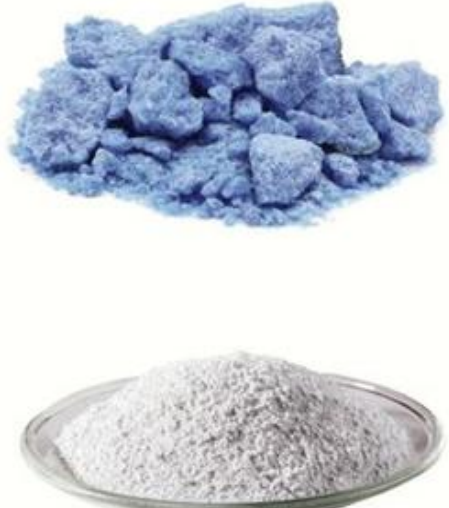
A common example is copper(II) sulfate pentahydrate, which forms blue crystals. When heated, the bonds holding water within the crystal structure break, and the water is driven off as steam. This leaves behind white anhydrous (water-free) copper(II) sulfate.

The equation for this process is:
Note
Notice the large dot (•) in the formula of the hydrated salt - this separates the compound formula from the water molecules. Without water, the crystalline structure collapses and a white powder remains.
Determining the formula of a hydrated salt experimentally
You can find out how many water molecules are in a hydrated salt by heating it and measuring the mass change. The method is similar to determining an empirical formula.
Apparatus and method:
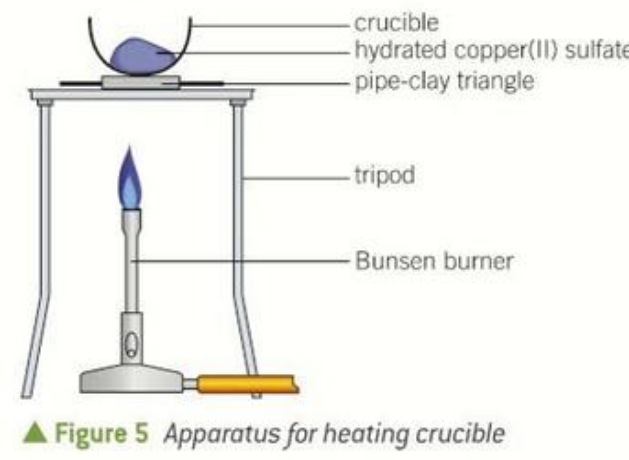
Step 1: Weigh an empty crucible
Step 2: Add the hydrated salt and weigh again
Step 3: Support the crucible on a pipe-clay triangle on a tripod. Heat gently for about one minute, then strongly for three more minutes
Step 4: Allow to cool, then weigh the crucible with the anhydrous salt
Example
Worked Example: Determining the Formula of a Hydrated Salt
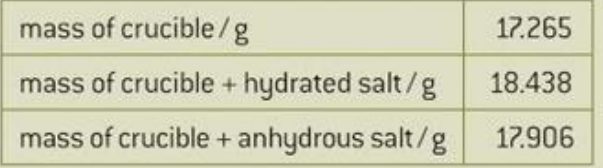
Given data:
- Mass of empty crucible = 18.742 g
- Mass of crucible + hydrated salt = 28.726 g
- Mass of crucible + anhydrous salt = 25.126 g
Step 1: Calculate the mass and moles of anhydrous formed:
(where )
Step 2: Calculate the mass and moles of water removed:
Step 3: Find the simplest ratio:
Step 4: Write the formula of the hydrated salt:
The value tells us there are 5 water molecules for every formula unit of copper(II) sulfate.
Accuracy considerations in experimental formulae
Real experiments involve assumptions that can affect accuracy:
Note
Assumption 1 - All water has been removed:
If the hydrated and anhydrous forms have different colours, you can be fairly confident when all water has been removed. However, you only see the surface - some water might remain inside the crystals. The solution is to heat to constant mass: repeatedly heat and weigh until the mass no longer changes, confirming all water is gone.
Important
Assumption 2 - No further decomposition:
Some salts decompose further when heated strongly. For example, copper(II) sulfate can decompose to form black copper(II) oxide if overheated. This makes it difficult to judge the endpoint if there's no clear colour change. Gentle heating and careful observation are essential.
Summary
Key Points to Remember:
- Molecular formula shows the actual number of atoms of each element in a molecule; empirical formula shows the simplest whole-number ratio
- Giant structures (metals, ionic compounds) use empirical formulae because counting individual atoms is impossible
- Calculate by adding up all the values in a molecular formula
- To find empirical formula from mass: convert to moles using , then divide by the smallest number to get ratios
- To find molecular formula: determine empirical formula first, then use to find the multiple
- Hydrated salts contain water of crystallisation shown with a dot (•) in the formula
- Anhydrous means water-free; heating hydrated salts drives off water
- Always heat to constant mass when determining water of crystallisation to ensure complete water removal
- When ratios aren't whole numbers, multiply all values by the same factor (e.g., multiply by 2 to convert 1:1.5 to 2:3)
Exam focus checklist
Note
Check Your Understanding:
✓ Can you explain the difference between molecular and empirical formulae?
✓ Can you calculate relative molecular mass and relative formula mass?
✓ Can you determine an empirical formula from mass or percentage composition data?
✓ Can you work out a molecular formula when given the empirical formula and relative molecular mass?
✓ Do you understand what hydrated salts are and what water of crystallisation means?
✓ Can you describe the practical method for determining the formula of a hydrated salt?
✓ Can you perform calculations to find the value of in a hydrated salt formula?
✓ Do you understand the assumptions made in these experiments and how they affect accuracy?