Moles and Volumes (OCR A-Level Chemistry A): Revision Notes
📚Revision Notes
Moles and Volumes
Introduction to volume measurements
In chemistry, we frequently measure liquids and gases using volume rather than mass. Just as we can convert mass to moles, we can also convert volume measurements into moles, which allows us to count the number of particles present.
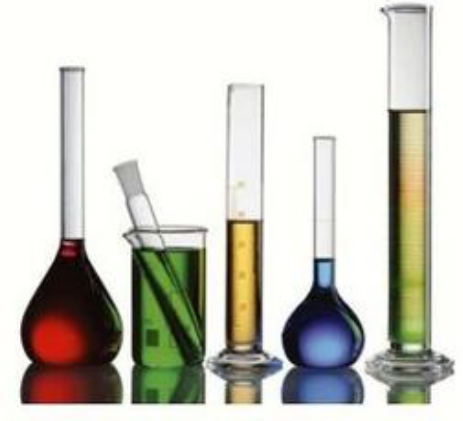
The standard volume units used in chemistry are:
-
The cubic centimetre (cm³) or millilitre (ml):
-
The cubic decimetre (dm³) or litre (l):
Note
When working in the laboratory, you will typically use glassware graduated in ml and litres, but you should record your measurements and perform calculations in cm³ and dm³. This ensures consistency in your work and makes conversions easier.
Moles and solutions
To determine the amount in moles of a measured volume of solution, you need to know two pieces of information: the volume of the solution and its concentration.
Understanding concentration
The concentration of a solution (measured in ) tells us how much solute (the dissolved substance) is present in the solution. Specifically, concentration is defined as the amount of solute, in moles, that is dissolved in each 1 dm³ (or 1000 cm³) of solution.
For example, a solution contains exactly 1 mole of solute dissolved in every 1 dm³ of solution.
Converting between moles and solution volumes
For any solution, the amount in moles (), volume ( in dm³), and concentration ( in ) are linked by the equation:
Important
Since we typically measure volumes in cm³ in the laboratory, we need to convert to dm³ by dividing by 1000. The equation then becomes:
Remember: divide by 1000 when converting cm³ to dm³!
Example
Worked Example: Converting between solution volumes and moles
Example 1: Calculate the amount of NaCl, in mol, in 30.0 cm³ of a 2.00 mol dm⁻³ solution.
Using the formula:
Example 2: Calculate the volume of a 0.160 mol dm⁻³ solution that contains mol of NaCl.
Starting with , we rearrange to find volume:
Standard solutions
A standard solution is a solution that has a precisely known concentration. In practical chemistry, you will encounter bottles of standard solutions labelled with their concentration, often as .
Preparing a standard solution
Standard solutions are prepared by dissolving an exact, known mass of solute in a solvent and then making up the solution to an exact, known volume. Using your understanding of the mole concept, you can calculate the mass needed to prepare any required standard solution.
Example
Worked Example: Preparing a standard solution
Calculate the mass of Na₂CO₃ required to prepare 100 cm³ of a 0.250 mol dm⁻³ standard solution.
Step 1: First, determine the amount in moles required.
Step 2: Then calculate the molar mass of Na₂CO₃.
Step 3: Rearrange to find the mass of Na₂CO₃ required.
Alternative ways of expressing concentration
Sometimes you will see concentrations expressed using mass per unit volume rather than moles per unit volume. A common unit is .
To convert between molar concentration and mass concentration, you can use the relationship :
Therefore, a Na₂CO₃ solution with a concentration of has a mass concentration of 26.5 g dm⁻³.
Moles and gas volumes
While we previously learned how to convert between mass and moles, measuring the mass of a gas can be challenging. Fortunately, measuring gas volumes is straightforward, and this gives us an alternative method for determining the amount of gas present.
Important
An important principle in chemistry is that at the same temperature and pressure, equal volumes of different gases contain the same number of molecules. This means when you measure a gas volume, you are effectively counting the number of gas molecules (or determining the amount in moles).
Molar volume
The molar gas volume () is defined as the volume occupied by one mole of gas molecules at a stated temperature and pressure.
The volume occupied by a gas depends on both temperature and pressure. Many chemistry experiments are conducted at room temperature and pressure.
Note
Room Temperature and Pressure (RTP):
- Temperature: approximately 20°C
- Pressure: 101 kPa (1 atm)
At RTP, one mole of any gas molecules occupies a volume of approximately 24.0 dm³ or 24,000 cm³.
Therefore, at RTP, the molar gas volume = 24.0 dm³ mol⁻¹.
Converting between moles and gas volumes
The relationship between the amount of gas ( in mol) and its volume () is given by:
At RTP, where :
-
When is measured in dm³:
-
When is measured in cm³:
Example
Worked Example: Converting between gas volumes and moles
Example 1: Calculate the amount (mol) of hydrogen, H₂(g), in 480 cm³ at RTP.
Example 2: Calculate the volume, in dm³, of 0.150 mol O₂(g) at RTP.
Rearranging the formula:
The ideal gas equation
Room temperature and pressure (RTP) conditions are approximate values chosen to match typical laboratory conditions. But what if you need to perform calculations for experiments where gases are at different temperatures or pressures, or if you require more accurate results? The ideal gas equation provides the solution.
Assumptions of the ideal gas model
Important
The ideal gas equation is based on four key assumptions about the behaviour of gas molecules:
- Gas molecules are in random motion
- Gas molecules undergo elastic collisions (no energy is lost)
- Gas molecules have negligible size compared to the container
- There are no intermolecular forces between gas molecules
These assumptions are most accurate at low pressures and high temperatures, when gas molecules are far apart and moving rapidly.
The ideal gas equation
The ideal gas equation is:
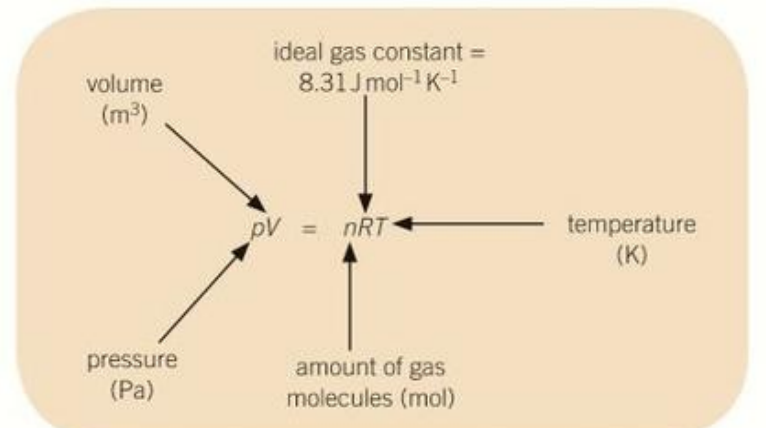
Where:
- = pressure in pascals (Pa)
- = volume in cubic metres (m³)
- = amount of gas in moles (mol)
- = the ideal gas constant = 8.314 J mol⁻¹ K⁻¹
- = temperature in kelvin (K)
The ideal gas constant, , always has the same value of .
Temperature in kelvin
Temperature must be measured in kelvin (K) for the ideal gas equation. The Kelvin scale starts at absolute zero (−273°C), and each 1 K rise equals a 1°C rise in temperature.
To convert from Celsius to Kelvin:
Important unit conversions
Important
Before using the ideal gas equation, you must convert all quantities into the correct units: Pa, m³, and K. Common conversions include:
- : multiply by
- : multiply by
- : add 273
- : multiply by
Exam tip: The most challenging part of calculations using the ideal gas equation is ensuring you work in the correct units of Pa, m³, and K. Always check your conversions carefully!
Using the ideal gas equation
If you know any three of the variables (, , , or ), you can calculate the fourth unknown variable by rearranging the equation.
Example
Worked Example: Calculating temperature using the ideal gas equation
You can use the ideal gas equation to determine what constitutes room temperature and pressure. Assume the pressure is 1 atm = 101 kPa, and use this to calculate room temperature for a molar gas volume of .
Step 1: Convert all quantities to match the ideal gas equation units.
Step 2: Use the ideal gas equation to calculate the unknown.
Rearranging:
This confirms that room temperature is indeed approximately 20°C.
A common misconception
Note
Many people incorrectly assume that room temperature is 25°C (298 K), which is actually the standard temperature commonly used in chemistry. Using the ideal gas equation, you can show that the molar gas volume at 25°C and atmospheric pressure (101 kPa) is actually 24.5 dm³ mol⁻¹, not 24.0 dm³ mol⁻¹.
Finding relative molecular mass using the ideal gas equation
The ideal gas equation can be used to determine the relative molecular mass of a volatile liquid (a liquid that evaporates easily at room temperature but has a boiling point below 100°C).
Experimental method
The procedure involves three main steps:
-
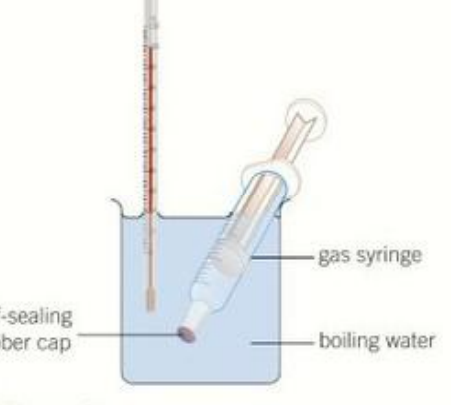
Add a sample of the volatile liquid to a small syringe using a needle. Weigh the small syringe carefully.
-
Inject the sample into a gas syringe sealed with a self-sealing rubber cap. Reweigh the small syringe to find the mass of volatile liquid added to the gas syringe.
-
Heat the gas syringe in a boiling water bath at 100°C. The liquid vaporises to produce a gas, and the pressure is recorded.
Example
Worked Example: Finding relative molecular mass
Let's work through a complete example using typical experimental data:
| Measurement | Value |
|---|---|
| Mass of volatile liquid | 0.2245 g |
| Volume of gas in gas syringe | 81.0 cm³ |
| Atmospheric pressure | 100 kPa |
Step 1: Convert all quantities to match the ideal gas equation units.
Step 2: Use the ideal gas equation to calculate the amount in moles.
Rearranging:
Step 3: Find the molar mass.
Using , we can rearrange to find :
Therefore, the relative molecular mass,
Practice question
A 0.320 g sample of a volatile liquid was heated until it vaporised. The resulting vapour occupied 61.5 cm³ at 101 kPa and 100°C. Calculate the relative molecular mass of the volatile liquid.
Extension: real gases
Note
The ideal gas equation makes two critical assumptions that become invalid under certain conditions:
- Forces between molecules are negligible
- Gas molecules have negligible size compared to their container
These assumptions are valid at low pressures and high temperatures when gas molecules are far apart and moving quickly.
However, when gas molecules are brought close together (at high pressures or low temperatures), the volume of the molecules themselves becomes significant compared to the container volume. Additionally, when molecules move more slowly, intermolecular forces become important.
Scientists have developed improved equations for real gases that account for both the volume of gas molecules and intermolecular forces. These real gas equations provide more accurate results under conditions where the ideal gas equation breaks down.
Remember!
Summary
Key Points to Remember:
-
Volume units: In chemistry, volumes are measured in cm³ (= ml) and dm³ (= l), with
-
Concentration and solutions: Use to convert between moles, concentration, and volume. Remember to convert cm³ to dm³ by dividing by 1000.
-
Molar gas volume at RTP: At room temperature (20°C) and pressure (101 kPa), one mole of any gas occupies 24.0 dm³. Use this to convert between gas volumes and moles.
-
The ideal gas equation: links pressure, volume, temperature, and amount of gas. The gas constant R = 8.314 J mol⁻¹ K⁻¹. Always use the correct units: Pa, m³, K, and mol.
-
Unit conversions are critical: Convert cm³ to m³ (×10⁻⁶), dm³ to m³ (×10⁻³), °C to K (+273), and kPa to Pa (×10³) before using the ideal gas equation.
-
Finding Mr: The ideal gas equation can determine the relative molecular mass of volatile liquids by measuring the mass and volume of vapour produced under known temperature and pressure conditions.