Atomic Structure and Isotopes (OCR A-Level Chemistry A): Revision Notes
📚Revision Notes
Atomic Structure and Isotopes
The nuclear atom
All matter is made up of atoms. At GCSE level, you learned about the nuclear model of the atom, which describes the structure of atoms in terms of subatomic particles.
An atom consists of:
- A central nucleus containing two types of subatomic particles: protons and neutrons
- Electrons occupying regions called shells that surround the nucleus
Note
The nucleus is very small compared to the overall size of the atom, but it contains nearly all of the atom's mass. Electrons orbit the nucleus in shells at relatively large distances from the centre.
Properties of subatomic particles
Atoms and their subatomic particles have extremely small masses. Rather than working in grams, chemists find it more convenient to compare the masses of subatomic particles using relative masses.
Mass
The relative masses of the three subatomic particles are:
- A proton has a relative mass of 1
- A neutron has virtually the same mass as a proton, with a relative mass of 1
- An electron has negligible mass, approximately the mass of a proton
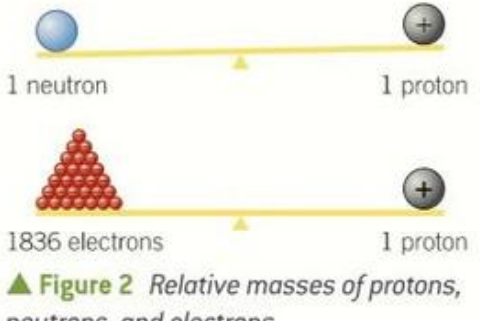
While accurate measurements show that a neutron has a slightly greater mass than a proton (by a factor of 1.001375), this difference is so small that chemists usually assume protons and neutrons have identical masses. The tiny mass of electrons means they contribute almost nothing to the overall mass of an atom.
Charge
Subatomic particles also carry electric charge:
- A proton has a positive charge with a relative charge of
- An electron has a negative charge with a relative charge of
- A neutron is neutral and has no charge (relative charge of )
The charge on a proton is equal in magnitude but opposite in sign to the charge on an electron. In actual values, a proton carries a charge of C (coulombs), while an electron carries C. However, it's much easier to work with relative charges of and .
Summary of subatomic particles
| Particle | Abbreviation | Relative charge | Relative mass |
|---|---|---|---|
| proton | |||
| neutron | |||
| electron |
Building atoms
Several important principles govern how atoms are constructed:
Important
Charge balance in atoms:
Atoms contain equal numbers of protons and electrons. The total positive charge from protons is cancelled by the total negative charge from electrons. Therefore, the overall charge of an atom is zero - atoms are electrically neutral.
Role of neutrons:
Neutrons act as the "glue" holding the nucleus together. Without neutrons, the electrostatic repulsion between positively charged protons would cause the nucleus to break apart. Most atoms contain the same number of neutrons as protons, or slightly more. As the nucleus gets larger, increasingly more neutrons are needed to hold it together stably.
Note
Mass distribution:
Nearly all of an atom's mass is concentrated in the nucleus, because protons and neutrons each have a relative mass of 1, while electrons have negligible mass.
Atomic number - the identity of an element
The atomic number (also called the proton number, symbol ) is the number of protons in the nucleus of an atom. This is the most important property of an atom because it determines which element the atom belongs to.
Key facts about atomic number:
- Every atom of the same element contains the same number of protons
- Different elements contain atoms with different numbers of protons
- The periodic table lists elements in order of increasing atomic number
- Each element is assigned its own unique atomic number
Example
Examples of Atomic Numbers:
- Every nitrogen atom contains 7 protons (atomic number 7)
- Every oxygen atom contains 8 protons (atomic number 8)
- Every atom with 29 protons is copper
- Every atom with 30 protons is zinc
The periodic table shows each element labeled with its atomic number, allowing you to quickly determine the number of protons (and therefore electrons) in any atom.
Isotopes
What are isotopes?
While every atom of an element must have the same number of protons, the number of neutrons can vary. This gives rise to isotopes.
Important
Isotopes are atoms of the same element that have different numbers of neutrons and therefore different masses.
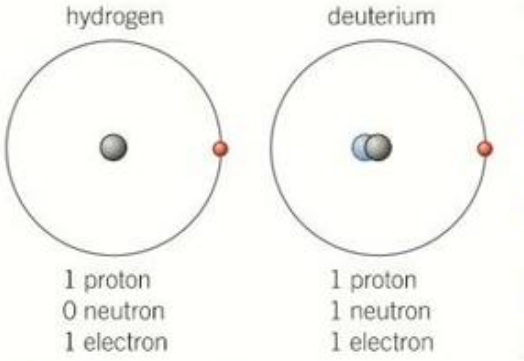
The diagram above shows two isotopes of hydrogen:
- Normal hydrogen has 1 proton, 0 neutrons, and 1 electron
- Deuterium has 1 proton, 1 neutron, and 1 electron
Both are isotopes of hydrogen because they both have 1 proton (atomic number 1), but they differ in their neutron count and mass.
Note
Most elements found in nature are mixtures of different isotopes. For example, oxygen exists naturally as a mixture of three isotopes, and carbon has several isotopes including carbon-12 and carbon-14.
Representing isotopes
Chemists use a special notation to represent different isotopes, showing both the mass number and atomic number.
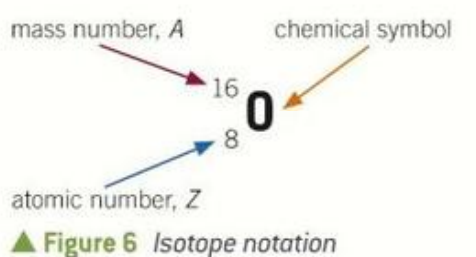
The notation includes:
- Mass number (, also called nucleon number): written as a superscript to the upper left of the element symbol
- Atomic number (, also called proton number): written as a subscript to the lower left of the element symbol
- The chemical symbol in the middle
The relationships between these numbers are:
To find the number of neutrons in an isotope:
Example: oxygen isotopes
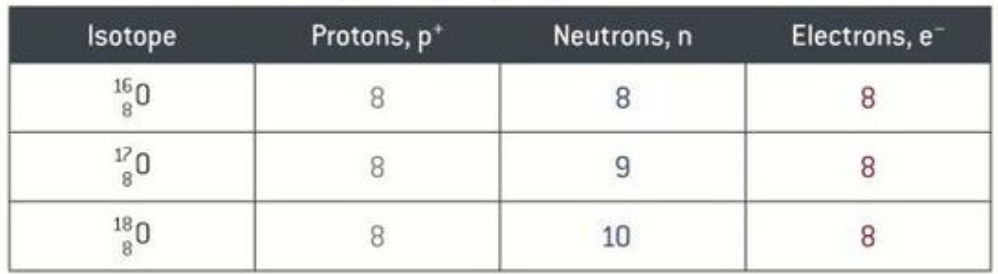
Oxygen has three naturally occurring isotopes: oxygen-16, oxygen-17, and oxygen-18.
Example
Working with Oxygen Isotopes:
All three isotopes have:
- 8 protons (because they're all oxygen, atomic number 8)
- 8 electrons (to balance the 8 protons)
- Different numbers of neutrons: 8, 9, and 10 respectively
- Different mass numbers: 16, 17, and 18 respectively
Calculating neutrons:
- Oxygen-16: neutrons
- Oxygen-17: neutrons
- Oxygen-18: neutrons
Alternative ways of writing isotopes
You may encounter isotopes written in different formats:
- Full notation:
- Mass number only: or or simply "oxygen-16"
Note
When the atomic number is omitted (as in ), you can still determine the number of protons because each element has a unique atomic number. For oxygen, if you know it has 8 protons, you can calculate neutrons as .
Isotopes and chemical reactions
Important
Isotopes of the same element have identical chemical properties. This is because:
- Chemical reactions involve the electrons surrounding the nucleus
- Different isotopes of the same element have the same number of electrons
- The number of neutrons has no effect on the electron arrangement
- Therefore, different isotopes react in exactly the same way
However, isotopes do have slightly different physical properties:
- Higher-mass isotopes have higher melting points, boiling points, and densities
- These differences arise from the greater mass but don't affect chemical reactivity
Heavy water - a practical example
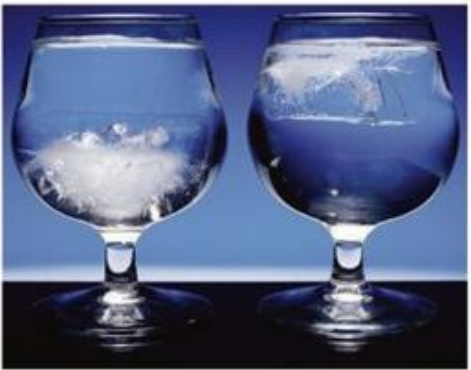
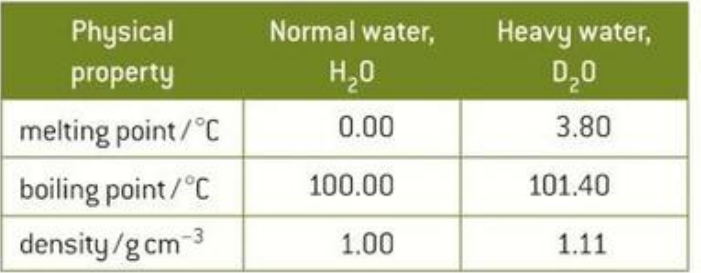
An interesting example of isotopes in practice is heavy water. In normal water (), nearly all hydrogen atoms are the isotope. In heavy water, all hydrogen atoms are replaced with deuterium (, also symbolized as D), giving the formula .
Comparing normal and heavy water:
| Physical property | Normal water () | Heavy water () |
|---|---|---|
| Melting point / °C | 0.00 | 3.80 |
| Boiling point / °C | 100.00 | 101.40 |
| Density / g cm⁻³ | 1.00 | 1.11 |
Note
The greater density of heavy water gives it its name. Because heavy water freezes at a higher temperature than normal water, ice cubes made from heavy water would sink in normal water (as shown in the photograph).
Despite these physical differences, heavy water has almost identical chemical properties to normal water. Heavy water is used to control processes in nuclear reactors.
Tritium ( or T) is a third isotope of hydrogen containing two neutrons, which forms "super-heavy water" ().
Ions
What are ions?
An ion is a charged atom in which the number of electrons is different from the number of protons.
There are two types of ions:
Cations (positive ions):
- Atoms with fewer electrons than protons
- Have an overall positive charge
- Formed when atoms lose electrons
- Examples: , ,
Anions (negative ions):
- Atoms with more electrons than protons
- Have an overall negative charge
- Formed when atoms gain electrons
- Examples: , ,
Writing ions
Ions are always shown with their overall relative charge written as a superscript to the right of the element symbol. For example:
- represents a magnesium ion with a charge
- represents a chlorine ion with a charge
Atomic structure of ions
Let's examine the composition of two common ions:
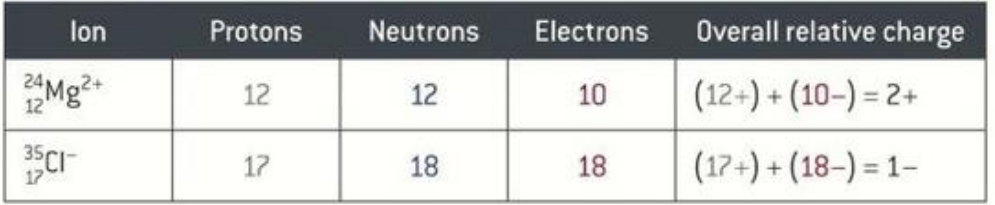
Example
Worked Example: Magnesium Ion ()
- Protons: 12 (from atomic number)
- Neutrons: 12 (from )
- Electrons: 10 (two fewer than protons)
- Overall charge:
The magnesium ion has lost 2 electrons, leaving it with 2 more protons than electrons, hence the charge.
Example
Worked Example: Chloride Ion ()
- Protons: 17 (from atomic number)
- Neutrons: 18 (from )
- Electrons: 18 (one more than protons)
- Overall charge:
The chloride ion has gained 1 electron, giving it 1 more electron than protons, hence the charge.
Important
Key principle:
Ions and atoms of an element have the same number of protons (same atomic number) but a different number of electrons. The difference in electron number creates the charge on the ion.
Remember!
Summary
Key Points to Remember:
-
Atoms consist of a nucleus containing protons (positive charge, mass 1) and neutrons (no charge, mass 1), with electrons (negative charge, negligible mass) in shells around the nucleus.
-
Atomic number () equals the number of protons and determines the element's identity. All atoms of the same element have the same atomic number.
-
Isotopes are atoms of the same element with different numbers of neutrons. They have identical chemical properties but slightly different physical properties. Use the formula: neutrons .
-
Mass number () equals protons plus neutrons. Isotopes are written as where X is the element symbol.
-
Ions are charged atoms. Cations have fewer electrons than protons (positive charge), while anions have more electrons than protons (negative charge). The number of protons never changes when forming ions.