Relative Mass (OCR A-Level Chemistry A): Revision Notes
📚Revision Notes
Relative mass
Introduction to relative mass
Chemists need a practical system for comparing the masses of different atoms. Rather than working with the incredibly small actual masses (which would be extremely inconvenient), they use a relative mass scale. This scale allows us to express atomic masses as simple numbers by comparing them to a standard reference.
Note
The relative mass system is fundamental to chemistry because it extends beyond just atoms – you'll use this same approach when working with ions, molecules, and all other chemical species.
The carbon-12 standard
Subatomic particles and mass
Before understanding relative mass, let's review the masses of subatomic particles. Atoms contain three types of particle, each with different masses:
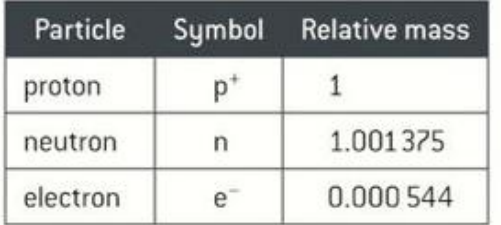
Notice that protons and neutrons have very similar masses (both approximately 1), whilst electrons are much lighter at roughly 1/2000th the mass of a proton. This means that almost all of an atom's mass comes from its nucleus.
Why we need a standard
When you try to find the mass of an isotope by adding up the masses of its particles, you hit a problem. The strong nuclear force that holds protons and neutrons together in the nucleus actually causes a tiny amount of mass to be lost – this is called the mass defect. Albert Einstein's famous work showed this over 100 years ago.
So chemists needed to establish a practical standard for measuring atomic masses that accounts for this effect.
The carbon-12 isotope
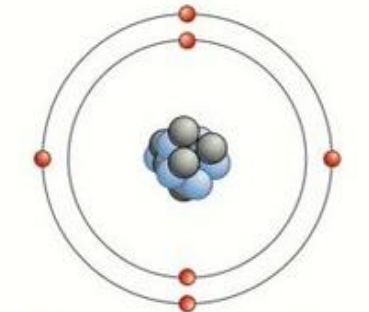
Carbon-12 has been chosen as the international standard for atomic mass measurements. This isotope contains 6 protons, 6 neutrons, and 6 electrons:
Important
Key definition: The mass of one atom of carbon-12 is defined as exactly 12 atomic mass units (12 ).
From this, we can establish:
- The atomic mass unit () is defined as of the mass of one carbon-12 atom
- On this scale, 1 is approximately the mass of one proton or one neutron
Note
The actual mass of a carbon-12 atom is kg, but working in kg would be incredibly awkward, which is why the atomic mass unit is so useful.
Relative isotopic mass
Important
Definition: The relative isotopic mass is the mass of an atom of a specific isotope compared to of the mass of one carbon-12 atom.
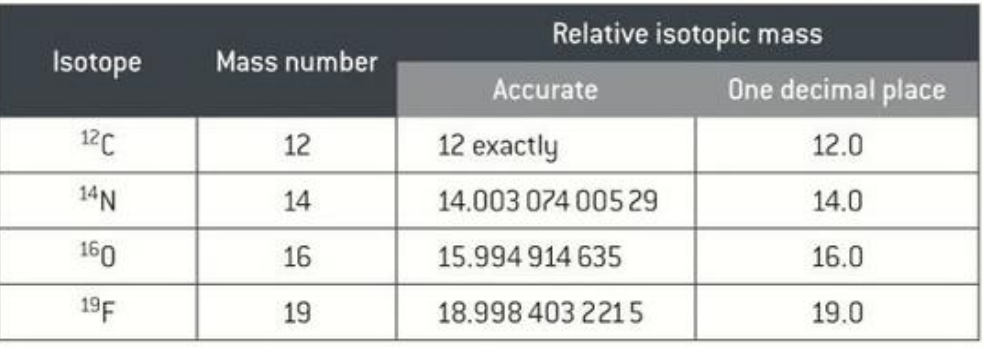
This is a dimensionless quantity (it has no units) because it's a ratio of two masses. For most purposes in A-Level chemistry, you can assume that the relative isotopic mass is the same as the mass number (the number of protons plus neutrons).
However, when accurate values are needed, relative isotopic masses show small deviations from whole numbers:
Note
Exam tip: You may be given relative isotopic masses in exam questions, or you may be told to use mass numbers as approximations. Read the question carefully!
Relative atomic mass
Understanding weighted mean
Most elements exist naturally as a mixture of different isotopes. For example, chlorine exists as both chlorine-35 and chlorine-37. The relative atomic mass () takes this into account.
Important
Definition: The relative atomic mass () is the weighted mean mass of an atom of an element compared to of the mass of one carbon-12 atom.
The key word here is weighted mean – this means we must account for:
- The percentage abundance of each isotope
- The relative isotopic mass of each isotope
Like relative isotopic mass, is dimensionless.
Finding relative atomic mass values
You can find relative atomic mass values in the periodic table. Each element box shows the atomic number (smaller number at top) and the relative atomic mass (larger number underneath):
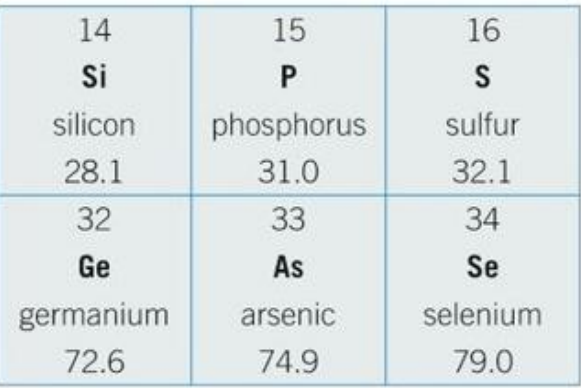
Notice that relative atomic mass values are rarely whole numbers – this is because they represent weighted averages of isotopic masses.
Note
Study tip: Make sure you learn the definitions for both relative isotopic mass and relative atomic mass – they're commonly tested!
Determination of relative atomic mass using mass spectrometry
How mass spectrometry works
Scientists use an instrument called a mass spectrometer to find the percentage abundances of isotopes in a sample. Although different types exist, they all work on the same basic principle.
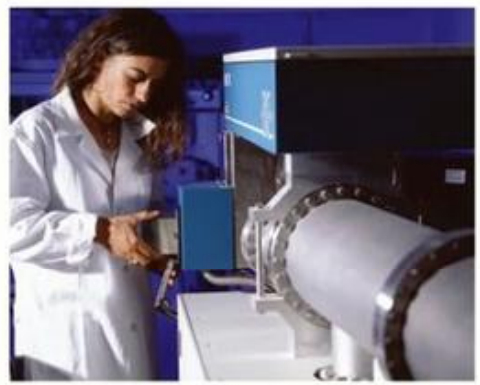
The mass spectrometry process involves four main stages:
-
Sample introduction
The sample is placed into the mass spectrometer. -
Vaporisation and ionisation
The sample is vaporised (turned into a gas) and then ionised to form positive ions. -
Acceleration and separation
The ions are accelerated using an electric field. Heavier ions move more slowly and are harder to deflect than lighter ions, so ions of different isotopes become separated. -
Detection
Ions are detected as they reach the detector. Each ion that arrives adds to the signal, so the more abundant an isotope is, the larger its signal will be.
Mass-to-charge ratio
The mass spectrometer measures the mass-to-charge ratio () of each ion:
Important
For ions with a single positive charge (which is most common), this ratio equals the relative isotopic mass. The results are displayed as a mass spectrum.
Interpreting a mass spectrum
Let's look at the mass spectrum of chlorine:
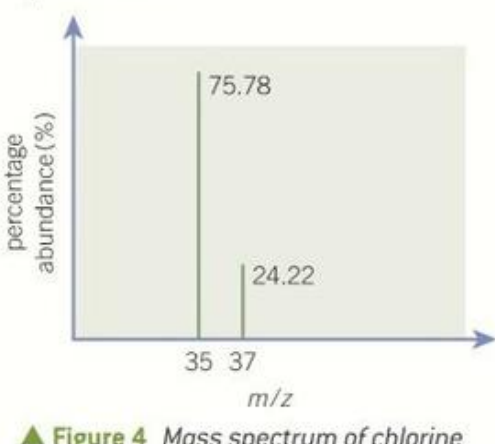
This spectrum reveals two distinct isotopes:
- Chlorine-35 (): 75.78% abundance
- Chlorine-37 (): 24.22% abundance
Note
The height of each peak represents the percentage abundance of that isotope.
Calculating relative atomic mass
The calculation method
Once you know the percentage abundances and isotopic masses, you can calculate relative atomic mass using:
For an element with two isotopes:
Worked example: chlorine
Example
Worked Example: Calculating the Relative Atomic Mass of Chlorine
Let's calculate the relative atomic mass of chlorine using the data from its mass spectrum.
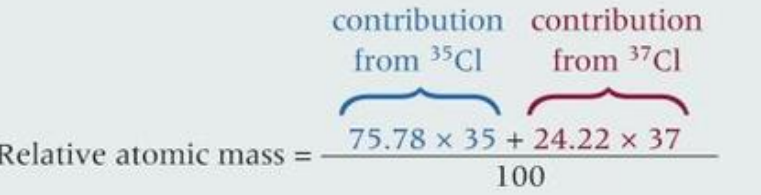
Given information:
- 75.78% chlorine-35
- 24.22% chlorine-37
Step 1: Since accurate isotopic masses aren't provided, we use the mass numbers (35 and 37)
Step 2: Apply the formula:
Step 3: Calculate each term:
Step 4: Complete the calculation:
Step 5: Round to one decimal place:
This matches the value shown in the periodic table for chlorine.
Note
Calculation tip: Always check that your percentages add up to 100% before starting – this helps catch errors early!
Accurate isotopic masses
If you're given accurate relative isotopic masses (like 34.968852... for Cl), use these instead of mass numbers for more precise calculations. However, the method remains exactly the same.
Additional notes on relative atomic mass values
Modern periodic tables sometimes show relative atomic mass as a range rather than a single value for some elements. This is because isotopic abundances can vary slightly depending on where the sample originated. The International Union of Pure and Applied Chemistry (IUPAC) reviews these values every two years.
Note
For A-Level chemistry, you'll work with relative atomic masses to one decimal place in most cases, and any variations are too small to affect your calculations significantly.
Remember!
Summary
Key Points to Remember:
- Carbon-12 is the standard: One carbon-12 atom = exactly 12 atomic mass units (12 )
- Relative isotopic mass refers to one specific isotope; relative atomic mass () is the weighted mean for all isotopes of an element
- Both are dimensionless – they're ratios, not actual masses
- Mass spectrometry separates isotopes and measures their abundances based on mass-to-charge ratio ()
- To calculate : multiply each isotope's abundance by its mass, add them together, and divide by 100
- Learn the definitions – they're frequently tested and you need to know them precisely!