Covalent Bonding (OCR A-Level Chemistry A): Revision Notes
📚Revision Notes
Covalent Bonding
What is covalent bonding?
Covalent bonding occurs when atoms share pairs of electrons to form strong bonds. Unlike ionic bonding where electrons are transferred completely from one atom to another, covalent bonding involves both atoms contributing electrons that are shared between them.
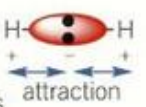
In covalent bonding, there is a strong electrostatic attraction between the shared pair of electrons and the nuclei of both bonded atoms. This attraction holds the atoms together in a stable arrangement.
Note
The key characteristic that makes covalent bonding different from ionic bonding is that electrons are shared between atoms rather than being transferred. This electron sharing creates individual units called molecules.
Covalent bonding is found in:
- Non-metallic elements, such as and
- Compounds of non-metallic elements, such as and
- Polyatomic ions, such as
The covalent bond
How covalent bonds form through orbital overlap
A covalent bond forms when atomic orbitals from two atoms overlap. Each orbital contains a single unpaired electron, and when they overlap, these two electrons become a shared pair. This shared pair is attracted to the nuclei of both atoms, creating the bond.
The diagram below shows how two hydrogen atoms combine to form a hydrogen molecule:
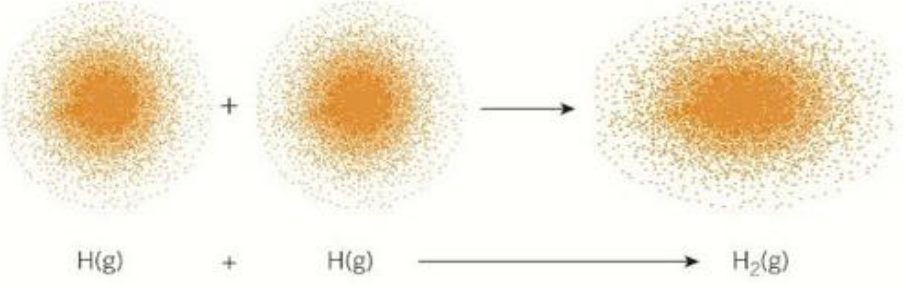
When two hydrogen atoms approach each other, their 1s orbitals overlap. The equation for this process is:
The shared pair of electrons is attracted to both nuclei, creating a stable bond. After bonding, each hydrogen atom has the electron configuration of helium (the nearest noble gas), with two electrons in its outer shell.
Covalent bonds are localised
An important difference between covalent and ionic bonding is how localised the attractive forces are.
In ionic bonding, each ion attracts oppositely charged ions in all directions around it. This creates a giant three-dimensional lattice structure containing billions of ions.
Important
In covalent bonding, the situation is very different. The attraction only acts between the shared electron pair and the two nuclei directly involved in the bond. This localised nature means that covalent bonds create small, discrete units rather than giant structures.
When atoms bond covalently, they typically form a molecule. A molecule is the smallest unit of a covalent compound that can exist independently whilst still retaining the chemical properties of that compound. Molecules can contain just two atoms (like and ) or many more atoms in larger structures.
Electron structures after bonding
An important principle in covalent bonding is that bonded atoms usually end up with the same electron structure as the nearest noble gas. This means their outer shells become full, creating a stable arrangement.
Representing covalent bonds
Dot-and-cross diagrams
Chemists use dot-and-cross diagrams to show how electrons are arranged in covalently bonded molecules. These diagrams help us track which electrons came from which atom, although in reality the electrons become indistinguishable once the bond forms.
Note
Convention for dot-and-cross diagrams:
Electrons from one atom are shown as dots (•), while electrons from the other atom are shown as crosses (×). This notation helps us track electron origin during bond formation, even though the electrons themselves become identical once bonded.
The diagram below shows dot-and-cross representations for some common molecules:
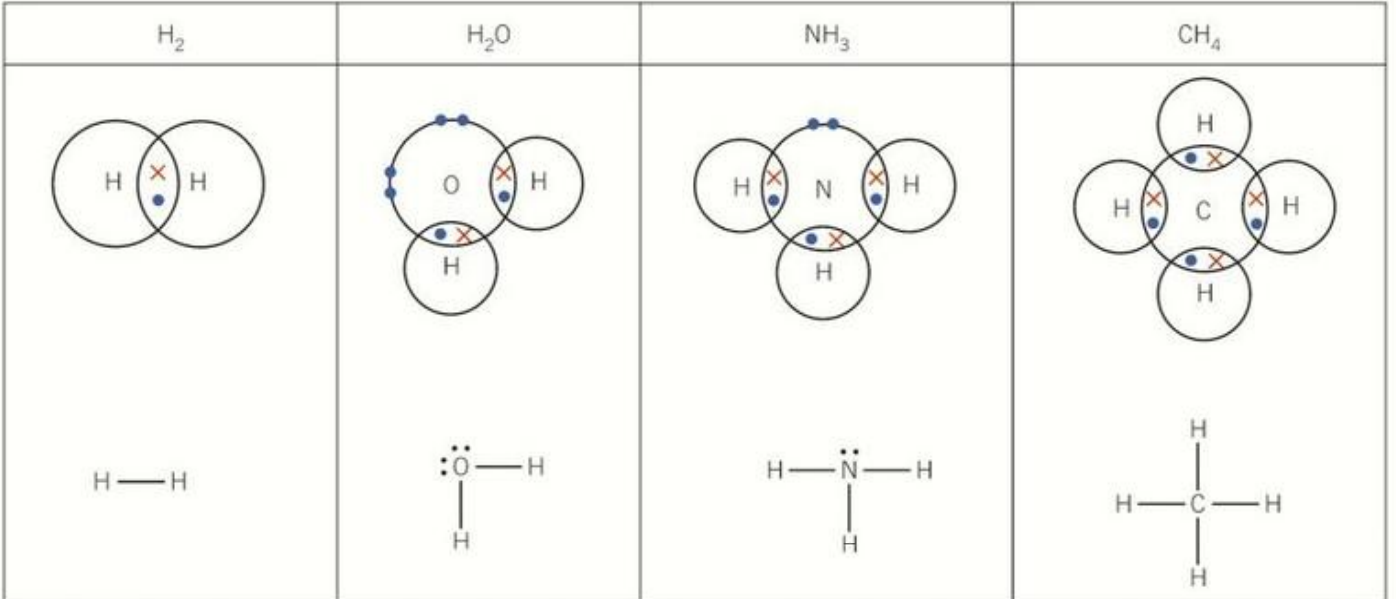
In these diagrams, you can see that each bonding atom now has a full outer shell with the same electron structure as the nearest noble gas.
Displayed formulae
Another way to represent molecules is using displayed formulae. In a displayed formula:
- Atoms are shown with their chemical symbols
- Bonds are shown as straight lines connecting the atoms
- Each line represents one shared pair of electrons
For example, water can be shown as:
- Dot-and-cross diagram: showing all electrons
- Displayed formula: H—O—H
Lone pairs
Not all electron pairs in a molecule are involved in bonding. Pairs of electrons that belong to one atom but are not shared with another atom are called lone pairs. These are also called non-bonding pairs.
Lone pairs are important because:
- They occupy space around an atom
- They can be donated to form dative bonds (covered later)
- They affect molecular shape
In the dot-and-cross diagrams above, you can see lone pairs on the oxygen atom in water and the nitrogen atom in ammonia.
Number of covalent bonds
Most covalent compounds you will encounter contain hydrogen, carbon, nitrogen, and oxygen. These elements follow predictable patterns for how many bonds they form:
Important
Standard bonding patterns (4-3-2-1 rule):
- Carbon forms 4 bonds
- Nitrogen forms 3 bonds
- Oxygen forms 2 bonds
- Hydrogen forms 1 bond
These numbers are based on how many electrons each atom needs to share to achieve a noble gas electron structure:
- Carbon has 4 outer-shell electrons and needs 4 more (like neon)
- Nitrogen has 5 outer-shell electrons and needs 3 more (like neon)
- Oxygen has 6 outer-shell electrons and needs 2 more (like neon)
- Hydrogen has 1 outer-shell electron and needs 1 more (like helium)
Expansion of the octet
Boron - an exception to the octet rule
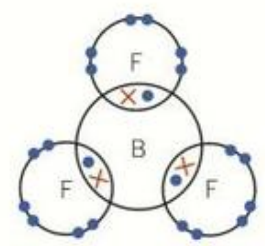
Boron is in Period 2 with electron configuration . This means it only has three outer-shell electrons that can be paired for bonding.
When boron forms boron trifluoride (), all three outer-shell electrons are paired with electrons from fluorine atoms:
Note
In , the boron atom only has six electrons around it, not eight. This shows that predictions for bonding based solely on achieving a noble gas structure have limitations. Boron is stable with only six electrons in its outer shell in this compound.
Period 3 elements - phosphorus, sulfur, and chlorine
Elements in Period 3 and beyond can form more bonds than you might expect from the octet rule. This is possible because these elements have access to d-orbitals for bonding.
The table below shows the fluoride compounds formed by phosphorus, sulfur, and chlorine:
| Element | Electron structure | Outer-shell electrons | Formula of fluoride |
|---|---|---|---|
| phosphorus | [Ne]3s²3p³ | 5 | PF₃, PF₅ |
| sulfur | [Ne]3s²3p⁴ | 6 | SF₂, SF₄, SF₆ |
| chlorine | [Ne]3s²3p⁵ | 7 | ClF, ClF₃, ClF₅ |
Notice that each element can form different numbers of bonds. For example, sulfur forms , , and .
How does expansion of the octet work?
In Period 2 elements, the outer shell can hold a maximum of eight electrons. However, for Period 3 elements, the shell can accommodate up to 18 electrons when d-sub-shell orbitals become available.
Important
Expansion of the octet only occurs from Period 3 onwards when the d-sub-shell becomes available for bonding. Period 2 elements (like carbon, nitrogen, and oxygen) cannot expand their octet because they lack accessible d-orbitals.
The diagram below shows how sulfur can have different numbers of unpaired electrons:
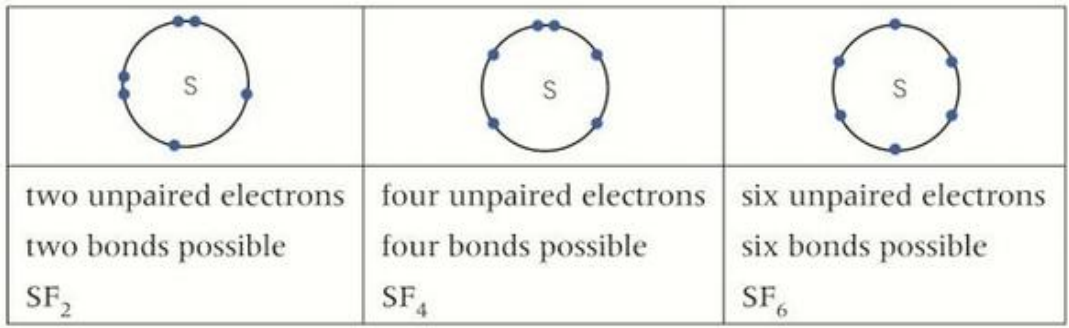
- With 2 unpaired electrons, sulfur can form 2 bonds ()
- With 4 unpaired electrons, sulfur can form 4 bonds ()
- With 6 unpaired electrons, sulfur can form 6 bonds ()
The structure of sulfur hexafluoride shows all six unpaired electrons paired with electrons from fluorine:
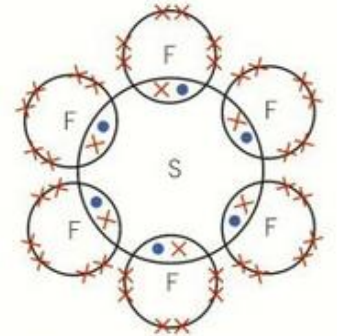
In , the sulfur atom has 12 electrons in its outer shell - far more than the eight predicted by the octet rule. This is only possible because the shell can expand to use the d-sub-shell.
Multiple covalent bonds
When two atoms share more than one pair of electrons, they form a multiple covalent bond. These bonds are stronger than single bonds because more electrons are being shared.
Double covalent bonds
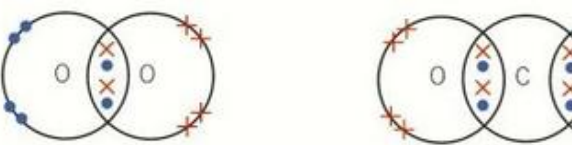
A double bond forms when two atoms share two pairs of electrons (four electrons total). The electrostatic attraction is between these two shared pairs and the nuclei of both bonded atoms.
Example
Examples of molecules with double bonds:
- Oxygen gas ( or O=O): Each oxygen atom shares two pairs of electrons
- Carbon dioxide ( or O=C=O): Carbon forms two double bonds, one with each oxygen atom
In these molecules:
- All atoms have eight electrons in their outer shell
- All atoms have the electron structure of the nearest noble gas
- Double bonds (C=C and C=O) are very important in organic chemistry
Triple covalent bonds
A triple bond forms when two atoms share three pairs of electrons (six electrons total). Triple bonds are even stronger than double bonds.
Examples include:
- Nitrogen gas ( or N≡N)
- Hydrogen cyanide (HCN or H—C≡N)
Again, all atoms achieve the electron structure of the nearest noble gas after bonding:
- In , each nitrogen atom has eight outer-shell electrons
- In HCN, nitrogen has eight, carbon has eight, and hydrogen has two outer-shell electrons
Dative covalent bonds
What is a dative covalent bond?
A dative covalent bond (also called a coordinate bond) is a special type of covalent bond where both electrons in the shared pair come from the same atom. One atom donates a lone pair of electrons to form the bond.
In a regular covalent bond, each atom contributes one electron to the shared pair. In a dative bond, one atom provides both electrons while the other provides none.
Formation of the ammonium ion
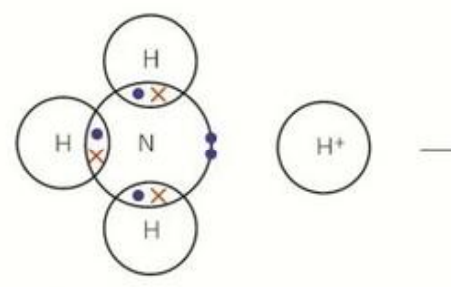
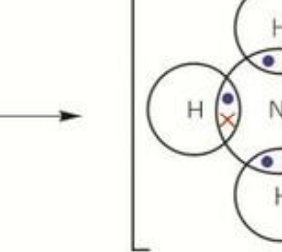
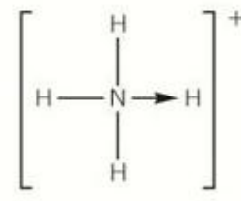
A good example of dative bonding is the formation of the ammonium ion () from ammonia () and a hydrogen ion ():
Example
Worked Example: Forming the Ammonium Ion
The ammonia molecule has a lone pair of electrons on the nitrogen atom. When a hydrogen ion (which has no electrons, just a proton) approaches, the nitrogen donates its lone pair to form a bond:
The resulting ammonium ion has four bonds around the nitrogen atom:
Representing dative bonds
In dot-and-cross diagrams, dative bonds can be shown with an arrow (→) pointing from the atom that donates the electron pair to the atom that receives it. The arrow shows that the nitrogen atom provides both electrons for this particular bond.
Note
Important concept about dative bonds:
Once the dative bond forms, all four N-H bonds in become equivalent. You cannot tell which bond was formed datively just by looking at the final structure. The arrow notation is simply an accounting tool to help us track where electrons came from during formation.
Average bond enthalpy
What is average bond enthalpy?
Average bond enthalpy is a measure of covalent bond strength. It tells us how much energy is needed to break a particular type of bond.
The relationship between bond enthalpy and strength is straightforward:
- Higher bond enthalpy = stronger bond
- Lower bond enthalpy = weaker bond
Bond enthalpy is measured in kilojoules per mole ().
Bond enthalpy values
The table below shows some example average bond enthalpies:
| Bond | Average bond enthalpy / kJ mol⁻¹ | Relative strength |
|---|---|---|
| Br—Br | 193 | ↓ |
| C—Br | 290 | Increasing |
| C—O | 358 | bond |
| O—H | 464 | strength ↑ |
From this data, we can see that:
- The O—H bond is the strongest (464 kJ mol⁻¹)
- The Br—Br bond is the weakest (193 kJ mol⁻¹)
- Bond strength increases going down the table
Average bond enthalpies are useful for:
- Comparing the strengths of different bonds
- Calculating energy changes in reactions
- Predicting which bonds are most likely to break in a reaction
Summary
Key Points to Remember:
-
Covalent bonding involves sharing electron pairs between atoms, creating strong electrostatic attraction between the shared electrons and both nuclei.
-
Orbital overlap creates covalent bonds - when atomic orbitals overlap, the electrons become shared and localised between just those two atoms, unlike ionic bonding where attraction acts in all directions.
-
Common bonding patterns (4-3-2-1 rule): Carbon forms 4 bonds, nitrogen forms 3 bonds, oxygen forms 2 bonds, and hydrogen forms 1 bond - these patterns help predict molecular formulae.
-
Expansion of the octet occurs in Period 3 elements onwards because the d-sub-shell becomes available, allowing elements like sulfur to form compounds such as with more than eight electrons around the central atom.
-
Multiple bonds form when atoms share more than one pair of electrons - double bonds share two pairs, triple bonds share three pairs, and these are stronger than single bonds with higher bond enthalpies.
-
Dative covalent bonds form when one atom donates both electrons in the shared pair to an electron-deficient species (like ), but once formed, dative bonds are equivalent to regular covalent bonds.
-
Bond enthalpy measures bond strength - higher values indicate stronger bonds that require more energy to break.
Exam focus checklist
When revising covalent bonding, make sure you can:
- ✓ Define covalent bonding as the electrostatic attraction between shared electrons and nuclei
- ✓ Explain how orbital overlap creates a shared pair of electrons
- ✓ Draw accurate dot-and-cross diagrams showing electron origin
- ✓ Convert between dot-and-cross diagrams and displayed formulae
- ✓ Predict the number of bonds formed by C, N, O, and H
- ✓ Explain expansion of the octet for Period 3 elements using d-orbitals
- ✓ Recognise and draw double and triple bonds
- ✓ Identify and represent dative covalent bonds with arrow notation
- ✓ Explain how bond enthalpy relates to bond strength
- ✓ Calculate using bond enthalpy values