Electron Structure (OCR A-Level Chemistry A): Revision Notes
📚Revision Notes
Electron structure
Introduction to electrons and shells
Atoms contain electrons that surround the nucleus in shells. Understanding how these electrons are arranged is fundamental to explaining chemical behaviour and bonding. At A-Level, you'll learn about the detailed structure of these electron shells, moving beyond the simple 2,8,8 rule from GCSE.
What are electron shells?
Electron shells are energy levels that exist around the nucleus of an atom. They help us visualise and understand the arrangement of electrons, even though we cannot see atoms directly.
Note
Each shell has a specific energy associated with it, and this energy increases as you move further from the nucleus. The shells are numbered using the principal quantum number, represented by , which tells us both the shell number and its relative energy level.
The energy hierarchy of shells follows a clear pattern:
- Shells are numbered using the principal quantum number, represented by
- The energy of a shell increases as the value of increases
- The first shell is closest to the nucleus and has the lowest energy ()
- Higher shells () are further from the nucleus and have higher energies
Maximum electron capacity of shells
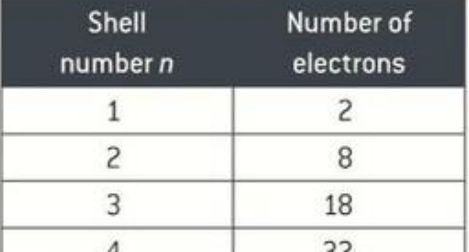
Each shell can hold a specific maximum number of electrons, which follows a mathematical pattern. The maximum number of electrons that can occupy a shell is calculated using the formula:
where is the principal quantum number (shell number).
Example
Worked Example: Calculating Maximum Electrons
For the first four shells, we can calculate their maximum electron capacity:
Shell 1 ():
Shell 2 ():
Shell 3 ():
Shell 4 ():
This formula arises from the quantum mechanical nature of electrons. Electrons behave as both waves and particles (wave-particle duality), and can only occupy specific energy levels defined by their wave properties.
Atomic orbitals
Shells are composed of smaller regions called atomic orbitals. An atomic orbital is a region of space around the nucleus where there is a high probability of finding an electron.
Key properties of atomic orbitals
Understanding orbitals requires thinking about electrons in a probabilistic way rather than as particles following fixed paths.
Important
Essential Properties of Orbitals:
- An orbital represents a three-dimensional region where an electron is likely to be found
- We visualise orbitals as electron clouds - regions of negative charge density
- Each orbital can hold a maximum of two electrons
- The two electrons in an orbital must have opposite spins
This is fundamentally different from the simple circular orbit model you may have seen before!
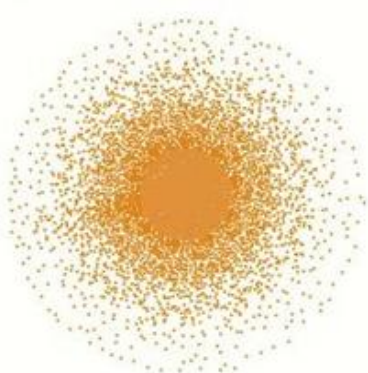
There are four main types of atomic orbitals, each with a characteristic shape:
- s-orbitals: spherical in shape
- p-orbitals: dumbbell-shaped (two lobes)
- d-orbitals: more complex shapes (four and five-lobed)
- f-orbitals: even more complex shapes
For A-Level, you need to know the shapes of s-orbitals and p-orbitals in detail, while d-orbitals and f-orbitals require less detailed knowledge of their shapes.
Types of orbitals and their shapes
s-orbitals
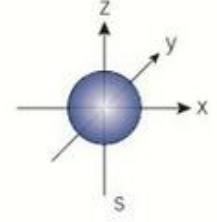
Every shell from onwards contains one s-orbital. The s-orbital has a spherical shape, meaning the electron cloud forms a sphere centred on the nucleus.
Note
Key Features of s-orbitals:
- Each shell contains exactly one s-orbital
- The s-orbital is spherical in shape
- As the shell number increases, the radius of the s-orbital increases (the sphere gets bigger)
- An s-orbital can hold up to 2 electrons
- The s-orbital is denoted as 1s, 2s, 3s, 4s... depending on which shell it belongs to
The spherical shape means that electrons in an s-orbital have equal probability of being found at any angle around the nucleus, though they're most likely to be found at a specific distance from it.
p-orbitals
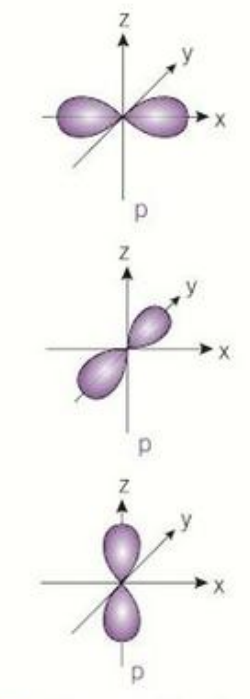
Starting from shell , each shell contains three p-orbitals. Unlike the spherical s-orbital, p-orbitals have a distinctive dumbbell shape with two lobes.
Note
Key Features of p-orbitals:
- Each shell from onwards contains three p-orbitals
- Each p-orbital has a dumbbell shape (also called figure-of-eight)
- The three p-orbitals are orientated at right angles (90°) to each other along the x, y, and z axes
- They are labelled as , , and according to their orientation
- Each p-orbital can hold up to 2 electrons
- Together, the three p-orbitals can hold up to 6 electrons
- As the shell number increases, the p-orbitals extend further from the nucleus
The perpendicular arrangement of the three p-orbitals creates a three-dimensional electron distribution around the nucleus.
d-orbitals and f-orbitals
As we move to higher shells, additional types of orbitals appear with increasingly complex shapes.
d-orbitals:
- Begin appearing from shell onwards
- Each shell from contains five d-orbitals
- d-orbitals have more complex shapes than s and p-orbitals
- Together, five d-orbitals can hold up to 10 electrons
f-orbitals:
- Begin appearing from shell onwards
- Each shell from contains seven f-orbitals
- f-orbitals have the most complex shapes
- Together, seven f-orbitals can hold up to 14 electrons
Important
For A-Level, you don't need to know the detailed shapes of d-orbitals and f-orbitals, but you must know:
- How many of each type exist in each shell
- How many electrons they can hold
- From which shell they begin to appear
Sub-shells and their organisation
Within each shell, orbitals of the same type are grouped together into sub-shells. A sub-shell is simply a collection of orbitals of the same type within a particular shell.
Sub-shell notation
Sub-shells are labelled by combining the shell number with the orbital type. This notation provides a clear way to identify which electrons we're referring to.
For example:
- The s-orbital in shell 2 forms the 2s sub-shell
- The three p-orbitals in shell 2 form the 2p sub-shell
- The five d-orbitals in shell 3 form the 3d sub-shell
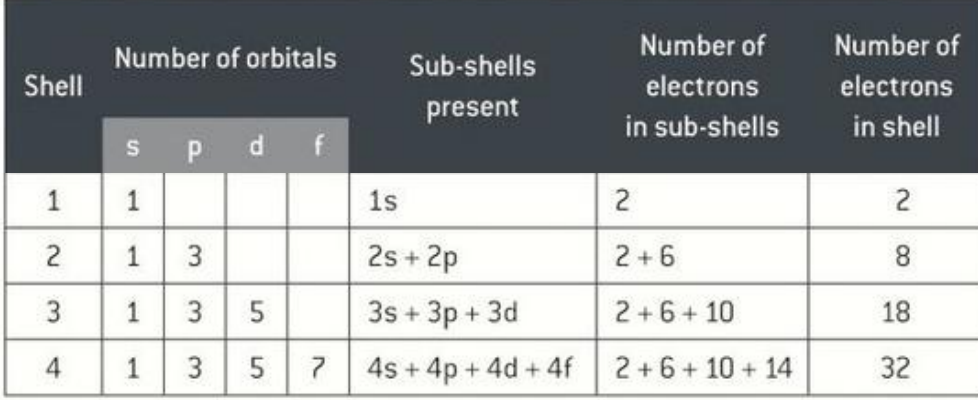
Summary of sub-shells in the first four shells
| Shell () | Sub-shells present | Number of orbitals | Total electrons in shell |
|---|---|---|---|
| 1 | 1s | 1 | 2 |
| 2 | 2s, 2p | 1 + 3 = 4 | 8 |
| 3 | 3s, 3p, 3d | 1 + 3 + 5 = 9 | 18 |
| 4 | 4s, 4p, 4d, 4f | 1 + 3 + 5 + 7 = 16 | 32 |
Note
Notice the pattern:
- Each new shell introduces a new type of orbital
- The number of orbitals increases: s(1), p(3), d(5), f(7)
- The number of electrons in each sub-shell: s(2), p(6), d(10), f(14)
This pattern follows from the quantum mechanical principles governing electron behaviour in atoms.
Filling of orbitals
When electrons occupy orbitals in an atom, they follow specific rules. Understanding these rules is essential for determining electron configurations and predicting chemical behaviour.
Rule 1: Orbitals fill in order of increasing energy
Sub-shells within different shells have slightly different energies. Electrons always occupy the lowest available energy level first. This follows the Aufbau principle (from German "aufbauen" meaning "to build up").
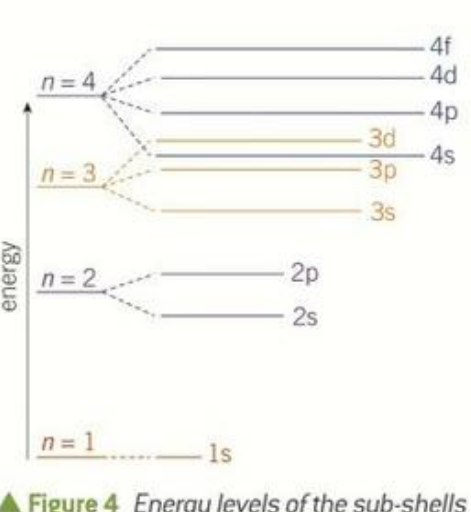
The order of filling for the first few sub-shells is:
Important
Critical Energy Ordering:
Notice something important: the 4s sub-shell has a lower energy than the 3d sub-shell, even though 4s is in a higher shell. This energy overlap occurs because:
- Within shell , the filling order is 3s, then 3p, then 3d
- Within shell , the filling order is 4s, then 4p, then 4d, then 4f
- However, the 4s sub-shell fills before the 3d sub-shell because 4s has slightly lower energy
This unusual ordering has important consequences for the electron configurations of transition metals and must be memorized!
Rule 2: Electrons pair with opposite spins
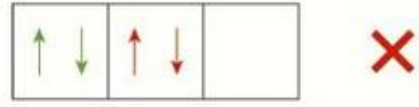
Each orbital can hold up to two electrons, but these electrons must have opposite spins. Spin is a quantum mechanical property of electrons that can take one of two values, conventionally represented as "up" (↑) or "down" (↓).

Note
Understanding Electron Spin:
- Electrons are negatively charged and therefore repel each other
- Two electrons can only occupy the same orbital if they have opposite spins
- We represent electron spin using arrows: ↑ for spin-up and ↓ for spin-down
- A pair of electrons with opposite spins is shown as ↑↓
- Opposite spins help to counteract the repulsion between the negatively charged electrons
Important
Two electrons in the same orbital cannot have the same spin - this would violate the Pauli exclusion principle, a fundamental rule in quantum mechanics that states no two electrons in an atom can have the same set of quantum numbers.
Rule 3: Orbitals of the same energy are occupied singly first
Within a sub-shell, all orbitals have the same energy. When electrons fill these equal-energy orbitals, they occupy them singly before any pairing occurs. This is known as Hund's rule.
The reason for this behaviour is electron repulsion:
- Electrons are negatively charged and repel each other
- Placing two electrons in the same orbital (pairing them) brings them close together, increasing repulsion
- By occupying separate orbitals first, electrons can maintain maximum distance from each other
- Only when no empty orbitals remain at that energy level do electrons begin to pair up
Example
Worked Example: Filling p-orbitals
When filling the three p-orbitals in a p-sub-shell with four electrons:
Step 1: Place one electron in each of the three p-orbitals first
Step 2: The fourth electron pairs in one orbital
Correct approach - minimizes electron repulsion by keeping electrons as far apart as possible
Incorrect approach - pairing electrons before all three p-orbitals contain one electron: This would increase repulsion unnecessarily.
This rule ensures that electron repulsion is minimised, giving the atom its most stable (lowest energy) electron arrangement.
Electron configuration of atoms
An electron configuration shows how electrons are distributed among the sub-shells in an atom. It provides a shorthand way to represent which sub-shells contain electrons and how many electrons each sub-shell holds.
Writing electron configurations
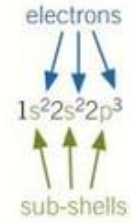
Electron configurations are written using a specific notation that combines sub-shell labels with superscript numbers:
- The sub-shell label (e.g., 1s, 2p, 3d)
- A superscript number showing how many electrons occupy that sub-shell
- Sub-shells are listed in order of filling (increasing energy)
Example
Worked Example: Nitrogen (7 electrons)
Nitrogen has the electron configuration:
What this tells us:
- The 1s sub-shell contains 2 electrons
- The 2s sub-shell contains 2 electrons
- The 2p sub-shell contains 3 electrons
- Total: electrons ✓
Worked example: Krypton (36 electrons)
Let's work through the electron configuration for krypton, which has 36 electrons, following the filling order carefully.

Example
Worked Example: Krypton Electron Configuration
Following the order of sub-shell filling:
Step-by-step filling:
- 1s: 2 electrons (total so far: 2)
- 2s: 2 electrons (total so far: 4)
- 2p: 6 electrons (total so far: 10)
- 3s: 2 electrons (total so far: 12)
- 3p: 6 electrons (total so far: 18)
- 4s: 2 electrons (total so far: 20) - note: 4s fills before 3d
- 3d: 10 electrons (total so far: 30)
- 4p: 6 electrons (total so far: 36) ✓
Final electron configuration:
Verification: electrons ✓
Electron configurations of Period 2 elements
The table below shows the electron configurations for elements in Period 2 of the periodic table, illustrating the progressive filling of the second shell.

| Element | Atomic number | Electron configuration |
|---|---|---|
| Li | 3 | |
| Be | 4 | |
| B | 5 | |
| C | 6 | |
| N | 7 | |
| O | 8 | |
| F | 9 | |
| Ne | 10 |
Notice the pattern: electrons fill the 2s sub-shell first (2 electrons), then progressively fill the 2p sub-shell (up to 6 electrons).
Shorthand (noble gas) electron configurations
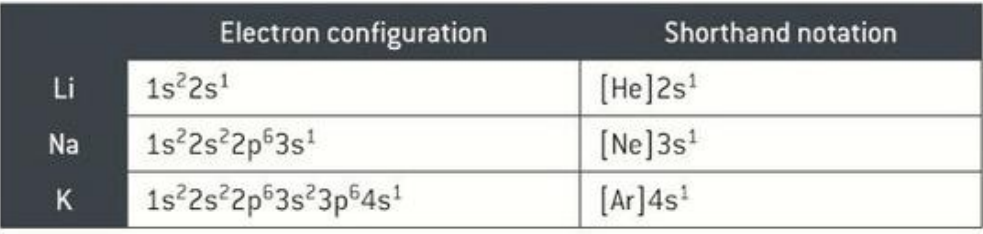
Full electron configurations can become very long for elements with many electrons. A more convenient shorthand notation uses the previous noble gas as a starting point.
Note
Noble gases have completely filled outer shells, making them chemically stable. We can represent their electron configuration using a symbol in square brackets, then add the remaining electrons. This shorthand emphasizes the outer shell electrons, which are most important for chemical bonding and reactivity.
| Element | Full configuration | Shorthand notation |
|---|---|---|
| Li | ||
| Na | ||
| K |
Where:
- represents the electron configuration of helium:
- represents the electron configuration of neon:
- represents the electron configuration of argon:
Important note about writing configurations
Important
When writing electron configurations, always write them in shell order rather than strict energy order. For example, krypton should be written as:
Notice that 3d comes before 4s in this notation, even though 4s fills before 3d. This shell-order convention is standard practice and makes configurations easier to read and compare.
Electron configuration of ions
When atoms form ions by losing or gaining electrons, their electron configurations change. Understanding these changes is crucial for explaining ionic bonding and the properties of compounds.
Formation of ions
Ions form through the loss or gain of electrons, and the type of ion formed depends on whether the element is a metal or non-metal.
Cations (positive ions):
- Form when atoms lose electrons
- Metals typically form cations
- Electrons are removed from the highest energy sub-shell first
Anions (negative ions):
- Form when atoms gain electrons
- Non-metals typically form anions
- Electrons are added to the lowest available energy sub-shell
Example: Calcium ion (Ca²⁺)
Example
Worked Example: Formation of Ca²⁺
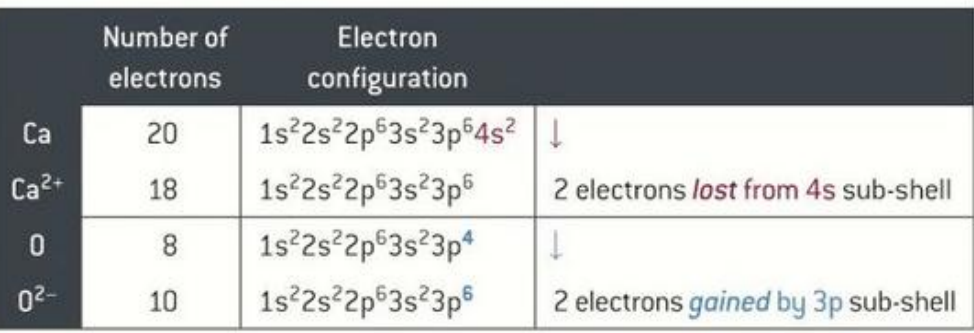
Calcium (atomic number 20) has the electron configuration:
To form the Ca²⁺ ion: Calcium loses 2 electrons from its highest energy sub-shell (the 4s sub-shell):
Result: The Ca²⁺ ion has 18 electrons and has the same electron configuration as the noble gas argon. This stable noble gas configuration explains why calcium readily forms 2+ ions.
Example: Oxide ion (O²⁻)
Example
Worked Example: Formation of O²⁻
Oxygen (atomic number 8) has the electron configuration:
To form the O²⁻ ion: Oxygen gains 2 electrons in its partially filled 2p sub-shell:
Result: The O²⁻ ion has 10 electrons and has the same electron configuration as the noble gas neon. This stable configuration explains why oxygen readily forms 2- ions.
Important note about transition metal ions
Important
The 4s/3d Rule for Transition Metals:
For transition metals and other d-block elements, there's a special rule: when forming positive ions, electrons are removed from the 4s sub-shell first, even though 4s filled before 3d.
Example: Nickel (Ni, atomic number 28) forms Ni²⁺:
Nickel atom:
Nickel(II) ion (loses 2 electrons from 4s):
Remember: "4s in first, 4s out first" - the 4s sub-shell fills before 3d but empties before 3d when forming ions.
Blocks of the periodic table
The periodic table can be divided into blocks based on which type of sub-shell is being filled with electrons. This block structure helps explain patterns in chemical properties and is a powerful tool for understanding element behaviour.
The four blocks
s-block (Groups 1 and 2):
- Highest energy electrons occupy an s-sub-shell
- Contains the alkali metals and alkaline earth metals
- Includes hydrogen and helium
p-block (Groups 13-18):
- Highest energy electrons occupy a p-sub-shell
- Contains many non-metals, metalloids, and some metals
- Includes the noble gases
d-block (Groups 3-12):
- Highest energy electrons occupy a d-sub-shell
- Contains the transition metals
- The d-block is positioned between the s-block and p-block
f-block:
- Highest energy electrons occupy an f-sub-shell
- Contains the lanthanides and actinides
- Usually shown separately at the bottom of the periodic table
Note
Understanding which block an element belongs to helps predict its:
- Chemical behaviour
- Types of ions it forms
- Types of compounds it forms
- Physical properties
- Reactivity patterns
The block structure is directly related to electron configuration and explains many periodic trends in chemistry.
Remember!
Summary
Key Points to Remember:
Electron Shells and Orbitals:
- Electron shells are energy levels around the nucleus, numbered by the principal quantum number
- The maximum number of electrons in a shell is given by
- Atomic orbitals are regions where electrons are likely to be found; each orbital holds up to 2 electrons with opposite spins
- There are four types of orbitals: s (spherical), p (dumbbell), d (complex), and f (more complex)
Filling Rules:
- Sub-shells fill in order of increasing energy: 1s, 2s, 2p, 3s, 3p, 4s, 3d, 4p... (note that 4s fills before 3d)
- Within a sub-shell, electrons occupy orbitals singly before pairing (Hund's rule)
- Electrons in the same orbital must have opposite spins (Pauli exclusion principle)
Electron Configurations:
- Electron configurations show the distribution of electrons in sub-shells, written as ... etc.
- When forming ions, s-block and p-block elements lose or gain electrons from their outermost sub-shell
- d-block elements lose 4s electrons before 3d electrons - "4s in first, 4s out first"
Periodic Table:
- The periodic table is divided into s, p, d, and f blocks based on which type of sub-shell is being filled
- An element's block tells you about its electron configuration and chemical properties
Exam focus checklist
Summary
Essential Skills for Exams:
Calculations and Formulas:
- ✓ Be able to calculate maximum electrons in a shell using
- ✓ Know the shapes of s-orbitals (spherical) and p-orbitals (dumbbell)
Orbital Filling:
- ✓ Understand that orbitals fill in order of increasing energy (know the sequence up to 4p)
- ✓ Remember that electrons pair with opposite spins and fill orbitals singly first
Electron Configurations:
- ✓ Be able to write full electron configurations for atoms up to atomic number 36
- ✓ Be able to write shorthand electron configurations using noble gas notation
- ✓ Understand how to write electron configurations for ions (especially the 4s/3d rule for transition metals)
Critical Rules:
- ✓ Know that 4s fills before 3d, but 4s empties before 3d when forming ions
- ✓ Be able to identify which block of the periodic table an element belongs to from its electron configuration