Ionic Bonding and Structure (OCR A-Level Chemistry A): Revision Notes
📚Revision Notes
Ionic Bonding and Structure
What is ionic bonding?
Note
Ionic bonding occurs through electrostatic forces of attraction between oppositely charged ions. This type of bonding forms when electrons are transferred from metal atoms to non-metal atoms, creating positive ions (cations) and negative ions (anions) that are held together in ionic compounds.
Common cations include:
- Metal ions such as , , and
- Ammonium ions ()
Common anions include:
- Non-metal ions such as and
- Polyatomic ions such as , , and
Formation of ionic compounds through electron transfer
The electron transfer model
The simplest ionic compounds form when metal atoms transfer their outer-shell electrons to non-metal atoms. This electron transfer process results in the formation of ions with stable electron configurations.
During ionic bonding:
- Outer-shell electrons from metal atoms are transferred to the outer shell of non-metal atoms
- Both positive and negative ions are created in the process
- The ions produced typically achieve electron configurations matching the nearest noble gas
- These stable configurations make the ions energetically favorable
Using dot-and-cross diagrams
Dot-and-cross diagrams provide a clear visual representation of ionic bonding. In these diagrams, electrons in the original atoms are shown as either dots or crosses, making it straightforward to track which electrons came from which atom and to determine the charge on each ion formed.
Note
Key features of dot-and-cross diagrams:
- Only outer-shell electrons are displayed (inner shells are full and not involved in bonding)
- Square brackets around each ion show that the charge is spread over the entire ion
- The ions exist as separate entities, not bonded pairs
- Electron configurations are labeled to show the noble gas structure achieved
Example: potassium fluoride ()
Example
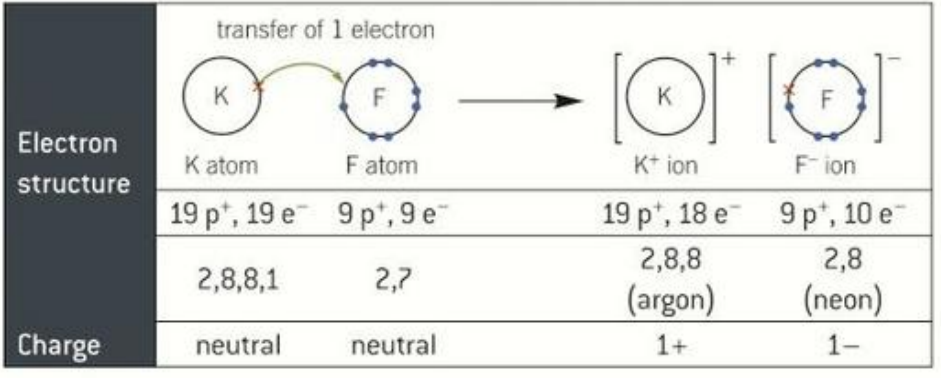
Worked Example: Formation of Potassium Fluoride
When potassium and fluorine react, the single outer-shell electron from the potassium atom is transferred to the outer shell of a fluorine atom. This creates a ion and an ion.
Before the transfer:
- Potassium atom: 19 protons, 19 electrons, configuration 2,8,8,1 (neutral)
- Fluorine atom: 9 protons, 9 electrons, configuration 2,7 (neutral)
After the transfer:
- ion: 19 protons, 18 electrons, configuration 2,8,8 (matches argon, charge 1+)
- ion: 9 protons, 10 electrons, configuration 2,8 (matches neon, charge 1-)
Example: magnesium chloride ()
Example
Worked Example: Formation of Magnesium Chloride
Magnesium has two outer-shell electrons that must be transferred to achieve a stable configuration. Since each chlorine atom can only accept one electron, two chlorine atoms are needed to react with one magnesium atom.
The electron transfer shows:
- One magnesium atom transfers both outer-shell electrons
- Each of the two chlorine atoms receives one electron
- An ion forms (configuration 2,8, matching argon)
- Two ions form (each with configuration 2,8,8, matching argon)
Result: The compound has the formula because the ratio is one magnesium ion to two chloride ions, ensuring overall electrical neutrality (one 2+ charge balanced by two 1- charges).
Giant ionic lattice structure
What is a giant ionic lattice?
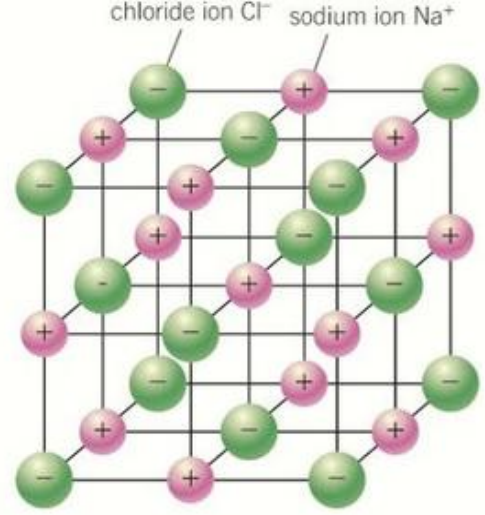
While it is convenient to examine ionic bonding between just a few ions, in reality each ion attracts oppositely charged ions from all directions. This creates an extensive three-dimensional structure called a giant ionic lattice, containing billions upon billions of ions. The actual number of ions present is determined only by the size of the crystal.
Important
This giant lattice arrangement is a fundamental structural feature found in all ionic compounds.
Structure of sodium chloride
Sodium chloride provides an excellent example of a giant ionic lattice structure:
- Each ion is surrounded by six ions
- Each ion is surrounded by six ions
- Every ion is surrounded by oppositely charged ions, forming the extended giant ionic lattice
Note
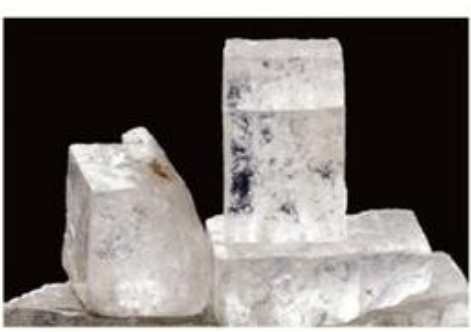
The regular cubic arrangement of and ions within the giant ionic lattice gives sodium chloride crystals their characteristic cubic shape.
Properties of ionic compounds
The physical properties of ionic compounds can be understood by examining both the giant ionic lattice structure and the nature of ionic bonding within these structures.
High melting and boiling points
Nearly all ionic compounds exist as solids at room temperature. At room temperature, there is insufficient energy available to overcome the powerful electrostatic forces of attraction between the oppositely charged ions throughout the giant ionic lattice.
To melt or boil an ionic compound, high temperatures are required to provide the large quantity of energy needed to overcome these strong electrostatic attractions between the ions. Consequently, ionic compounds typically have very high melting and boiling points.
Factors affecting melting points
Note
The melting points of ionic compounds are influenced by the charges on the ions present. Lattices containing ions with greater ionic charges experience stronger electrostatic attraction between the ions.
| Ionic compound | Ions | Melting point / °C |
|---|---|---|
| and | 993 | |
| and | 1423 | |
| and | 1275 | |
| and | 2614 |
Comparing these values shows that melting points are higher for lattices containing ions with greater ionic charges. For instance, calcium oxide (with both doubly charged ions) has a much higher melting point than sodium fluoride (with singly charged ions).
Important
Ionic attraction also depends on the size of the ions, though in the examples above the and ions have similar sizes, so ionic charge is the dominant factor.
Solubility in water
Many ionic compounds dissolve readily in polar solvents, particularly water. When dissolution occurs, polar water molecules break down the ionic lattice structure and surround each ion individually in solution. This process is called hydration.
However, in compounds composed of ions with large charges, the ionic attraction within the lattice may be too strong for water molecules to overcome and break down the lattice structure effectively. Such compounds will have very low solubility.
Comparing solubility values
| Ionic compound | Ions | Solubility at 20°C / mol dm⁻³ |
|---|---|---|
| and | 6.1 | |
| and | 0.62 | |
| and | 2.0 | |
| and |
Sodium chloride shows the highest solubility, while calcium carbonate (containing doubly charged ions) has extremely low solubility.
Important considerations about solubility
Note
Solubility of an ionic compound requires two key processes to occur:
- The ionic lattice must be broken down (requires energy)
- Water molecules must attract and surround the separated ions (releases energy)
The solubility of an ionic compound in water therefore depends on the relative strengths of the attractions within the giant ionic lattice compared to the attractions between ions and water molecules. Generally, as ionic charge increases, the attractions within the giant ionic lattice become dominant, and solubility decreases.
Important
Predictions of solubility should always be treated with caution as multiple factors are involved.
Electrical conductivity
The ability of ionic compounds to conduct electricity depends on whether the ions are free to move and act as mobile charge carriers.
Solid state behavior
In the solid state, an ionic compound does not conduct electricity:
- The ions are held in fixed positions within the giant ionic lattice
- There are no mobile charge carriers available
- The compound acts as a non-conductor (insulator) of electricity
Liquid and aqueous states
When melted or dissolved in water, an ionic compound becomes able to conduct electricity:
- The solid ionic lattice breaks down completely
- The ions are now free to move throughout the liquid or solution
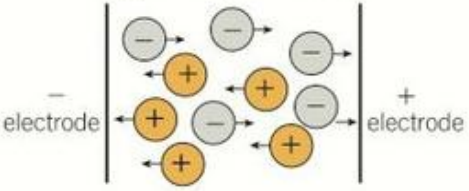
- These mobile ions act as charge carriers
- The compound becomes a conductor of electricity in these states
Note
When an electric field is applied (using electrodes), the mobile ions migrate toward the oppositely charged electrode. Positive ions (cations) move toward the negative electrode (cathode), while negative ions (anions) move toward the positive electrode (anode). This movement of charged particles constitutes an electric current.
Summary of ionic compound properties
Summary
Key Properties to Remember:
Most ionic compounds:
- Have high melting and boiling points (typically >1000°C)
- Tend to dissolve in polar solvents such as water (though this varies considerably)
- Conduct electricity only when in the liquid state or in aqueous solution, but not in the solid state
Real-world application: ionic compounds in teeth
Your body relies on ionic compounds for structural support. The main ionic compound in bones and teeth is calcium hydroxyapatite, which can be represented by the formula . This compound serves as the primary constituent of tooth enamel.
Unfortunately, ions in tooth enamel can be removed under acidic conditions. Once the enamel breaks down, gaps form that allow tooth decay to develop underneath. Saliva helps to neutralize acidic food and can partially replace lost ions, but this may not always be sufficient protection.
Note
Fluoride ions help to replace lost ions by forming calcium fluoroapatite, , which is stronger and more resistant to acid attack than hydroxyapatite. This is why many toothpastes contain fluoride compounds, most commonly as sodium fluoride.
Your water supply may also contain added fluoride depending on local regulations and policies in your area.
Remember!
Summary
Key Concepts to Remember:
-
Ionic bonding forms through electrostatic attraction between oppositely charged ions, created when electrons transfer from metal atoms to non-metal atoms
-
Dot-and-cross diagrams show electron transfer clearly, with ions achieving stable noble gas electron configurations (displayed in square brackets with charges)
-
Giant ionic lattices are three-dimensional structures where each ion is surrounded by oppositely charged neighbors in all directions, containing billions of ions
-
High melting and boiling points result from the strong electrostatic forces throughout the lattice; compounds with higher ionic charges have higher melting points
-
Solubility in water varies widely – while many ionic compounds dissolve in polar solvents, those with very high ionic charges may be virtually insoluble due to very strong lattice forces
-
Electrical conductivity only occurs when ions are mobile – solids cannot conduct (ions fixed in lattice), but molten and aqueous ionic compounds conduct well (ions free to move as charge carriers)