Shapes of Molecules and Intermolecular Forces (OCR A-Level Chemistry A): Revision Notes
📚Revision Notes
Hydrogen bonding
What is a hydrogen bond?
A hydrogen bond is a special type of permanent dipole-dipole interaction that forms between specific molecules. It is the strongest type of intermolecular force, making it particularly important in chemistry and biology.
For a hydrogen bond to form, two key requirements must be met:
- One molecule must contain an electronegative atom with a lone pair of electrons (specifically fluorine, oxygen, or nitrogen)
- Another molecule must have a hydrogen atom covalently bonded to an electronegative atom (forming bonds like , , or )
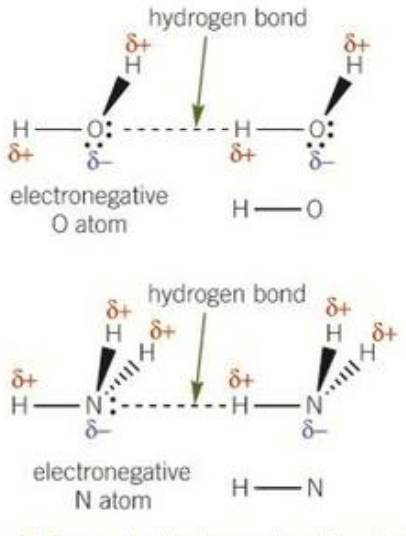
The hydrogen bond forms between the lone pair of electrons on the electronegative atom in one molecule and the hydrogen atom in a different molecule. Because the electronegative atom pulls electrons away from the hydrogen in a covalent bond, the hydrogen becomes partially positive () while the electronegative atom becomes partially negative (). This creates the attraction that we call a hydrogen bond.
Important
The FON Rule
Only three elements are electronegative enough to participate in hydrogen bonding: fluorine, oxygen, and nitrogen (remember this as FON). These elements have high electronegativity values and lone pairs of electrons available for bonding.
No other elements, not even chlorine, are sufficiently electronegative to form true hydrogen bonds.
Representing hydrogen bonds
When drawing hydrogen bonds in diagrams, we use specific conventions to make them clear:
- Hydrogen bonds are shown as dashed or dotted lines (not solid lines like covalent bonds)
- Partial charges must be indicated: on hydrogen atoms and on electronegative atoms
- The arrangement around the hydrogen atom involved in the hydrogen bond is linear (approximately 180°)
- Always show lone pairs of electrons on the electronegative atoms, as these are essential to the hydrogen bond formation
Note
Drawing Hydrogen Bonds in Exams
When drawing hydrogen bonding diagrams for exam questions, make sure to include all of these features:
- Dashed lines for hydrogen bonds
- Lone pairs shown on electronegative atoms
- Partial charges ( and ) clearly marked
A common mistake is forgetting to show the lone pairs or partial charges, which are critical for demonstrating your understanding of how hydrogen bonds work.
Anomalous properties of water
Hydrogen bonding has a profound influence on the properties of many molecules, but its effects are most dramatic in water (). Water exhibits several unusual (anomalous) properties that are directly caused by hydrogen bonding, and these properties are essential for supporting life on Earth.
Ice is less dense than water
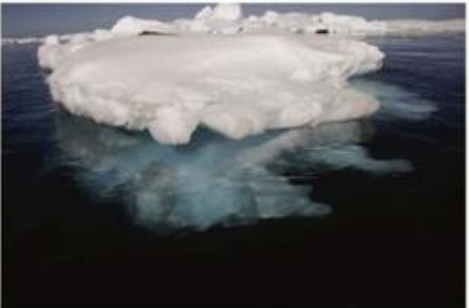
One of water's most remarkable properties is that solid ice is less dense than liquid water, causing ice to float. This behaviour is highly unusual—for most substances, the solid form is denser than the liquid and therefore sinks.
This phenomenon occurs because of the way hydrogen bonds arrange water molecules in ice:
- In solid ice, hydrogen bonds hold water molecules in a rigid open tetrahedral lattice structure
- Each water molecule forms four hydrogen bonds with neighbouring molecules (using its two lone pairs as acceptors and its two bonds as donors)
- These hydrogen bonds hold the molecules slightly apart from each other, creating a structure with large gaps or "holes"
- The bond angle around each hydrogen atom involved in hydrogen bonding is close to 180°, contributing to this open arrangement
When ice melts, the rigid lattice structure collapses. The hydrogen bonds break (though not completely—they reform and break rapidly in liquid water), and the molecules can move closer together. As a result, liquid water is actually denser than solid ice.
Density comparison:
- Ice at 0°C: 0.917 g cm⁻³
- Liquid water at 0°C: 1.029 g cm⁻³
This means that only about of an iceberg's volume sits above the water surface—the rest is hidden below.
Important
Why Ice Floating Matters for Life
The fact that ice floats has crucial implications for life on Earth:
- When ponds and lakes freeze in winter, ice forms an insulating layer on top
- This layer prevents the water underneath from freezing solid
- Aquatic organisms (like fish) can survive beneath the ice layer throughout winter
- If ice sank, bodies of water would freeze from the bottom up, likely killing all aquatic life
Without this property, life in cold climates would be impossible for many species.
Water has relatively high melting and boiling points
Water has much higher melting and boiling points than would be expected for a molecule of its size. This is because hydrogen bonds provide additional intermolecular forces beyond the London forces present in all molecules.
Energy considerations:
- All molecules experience London (dispersion) forces between them
- Water molecules also experience strong hydrogen bonding
- To melt or boil water, energy must be supplied to overcome both London forces and hydrogen bonds
- This means considerably more energy is needed than for similar-sized molecules without hydrogen bonding
What happens during phase changes:
- When the ice lattice melts, the rigid arrangement of hydrogen bonds is broken, but hydrogen bonds between water molecules continue to form and break rapidly in the liquid state
- When water boils, the hydrogen bonds break completely and water molecules separate into the gas phase
- The extra energy required to break these hydrogen bonds results in higher melting and boiling points
Example
The Impact of Hydrogen Bonding on Water's Boiling Point
Without hydrogen bonding, calculations suggest water would have a boiling point of approximately -75°C.
At this temperature, water would exist as a gas at room temperature and pressure, and there would be no liquid water on most of Earth's surface. Life as we know it would not exist.
This dramatic difference shows just how significant hydrogen bonding is for water's properties.
Boiling points of hydrides
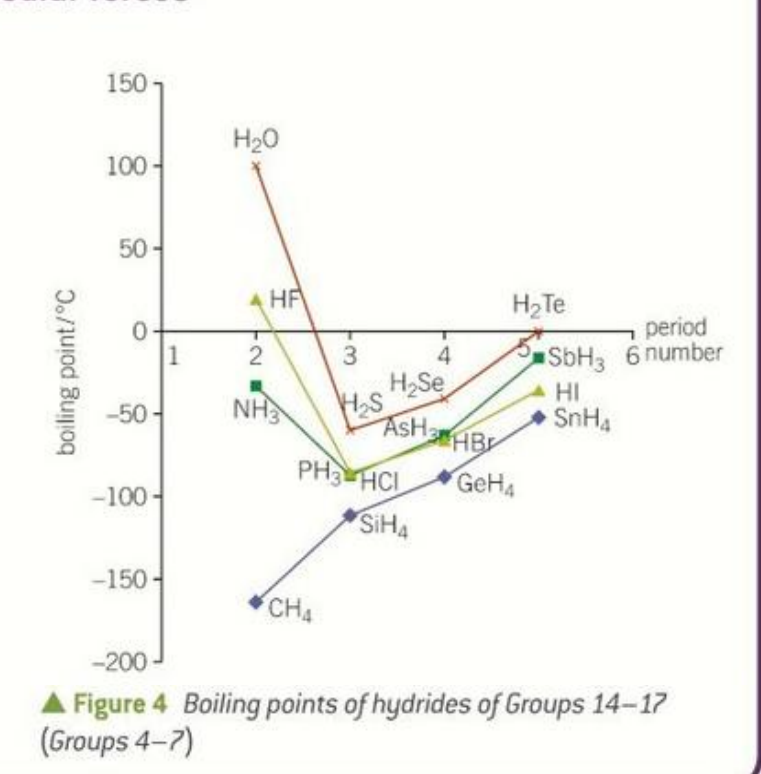
The effect of hydrogen bonding becomes particularly clear when we examine the boiling points of hydrides across Groups 14-17 in the periodic table. A hydride is simply a compound of hydrogen with another element.
Observed trends:
The graph reveals several important patterns:
-
General trend: For most hydrides, boiling point increases going down each group (from Period 2 to Period 6). This occurs because as the central atom gets larger, there are more electrons present, leading to stronger London forces between molecules.
-
Anomalous behaviour: Three compounds show dramatically higher boiling points than expected:
- (water)
- (hydrogen fluoride)
- (ammonia)
-
Explanation: These three compounds contain hydrogen bonded to nitrogen, oxygen, or fluorine—precisely the conditions needed for hydrogen bonding. The additional strength from hydrogen bonding causes their boiling points to be much higher than predicted from the group trend.
-
No hydrogen bonding in other hydrides: Compounds like , , , and don't exhibit hydrogen bonding because they lack sufficiently electronegative atoms (carbon, silicon, sulfur, and chlorine aren't electronegative enough, despite chlorine being quite electronegative).
Note
Why the Anomalies Occur
The dramatic differences in boiling points for , , and compared to their group members demonstrate the significant effect hydrogen bonding has on physical properties.
Without hydrogen bonding, these compounds would follow the expected trend and have much lower boiling points, similar to their heavier group members.
Other anomalous properties of water
The extensive hydrogen bonding network in water is responsible for several additional unusual properties:
Surface tension:
Water has a relatively high surface tension compared to other liquids of similar molecular mass. The hydrogen bonds between water molecules at the surface create a "film" effect. This property allows:
- Some insects to walk on water surfaces without sinking
- Water droplets to form beads on surfaces rather than spreading out completely
Detergents reduce surface tension by interfering with hydrogen bonding, which is why they make water "wetter" and better at cleaning.
Viscosity:
Water has higher viscosity than expected for its molecular size. Viscosity is the resistance to flow—honey has high viscosity while petrol has low viscosity. The network of hydrogen bonds between water molecules creates resistance to flow, though water still flows quite easily compared to many other liquids.
These dozens of unusual properties make water a remarkable solvent and an essential substance for life, though for A-Level chemistry you primarily need to focus on density, melting point, and boiling point.
Hydrogen bonding in biological systems
Hydrogen bonding plays crucial roles beyond water chemistry. One particularly important example is in DNA structure.
The famous double helix structure of DNA is held together by hydrogen bonds between complementary base pairs:
- Adenine (A) pairs with thymine (T) forming two hydrogen bonds
- Cytosine (C) pairs with guanine (G) forming three hydrogen bonds
These hydrogen bonds are strong enough to hold the DNA strands together, but weak enough to be separated when DNA needs to replicate. This balance is essential for genetic information storage and transfer.
You'll encounter many more examples of hydrogen bonding when you study organic chemistry and biochemistry later in your course, particularly in alcohols, carboxylic acids, and amino acids.
Summary
Key Points to Remember
-
A hydrogen bond is the strongest type of intermolecular force, forming between a hydrogen atom bonded to F, O, or N and a lone pair on another F, O, or N atom
-
Only fluorine, oxygen, and nitrogen (FON) are electronegative enough to participate in hydrogen bonding due to their high electronegativity and available lone pairs
-
Ice is less dense than liquid water because hydrogen bonds create an open tetrahedral lattice structure with gaps; when ice melts, molecules move closer together, increasing density
-
Water has anomalously high melting and boiling points because energy is needed to overcome both London forces and hydrogen bonds; without hydrogen bonding, water would boil at about -75°C
-
The boiling points of , , and are much higher than expected compared to other hydrides in their groups, demonstrating the significant effect of hydrogen bonding on physical properties
Exam Focus Checklist:
- ✓ Can you identify molecules capable of hydrogen bonding?
- ✓ Can you draw hydrogen bond diagrams with correct notation (dashed lines, /, lone pairs)?
- ✓ Can you explain why ice floats and why this matters biologically?
- ✓ Can you explain why water has higher melting/boiling points than expected?
- ✓ Can you interpret graphs showing boiling points of hydrides and identify anomalies?