Electronegativity and Polarity (OCR A-Level Chemistry A): Revision Notes
📚Revision Notes
Electronegativity and Polarity
What is electronegativity?
When atoms form covalent bonds, they share electrons between them. In the simplest molecules made from just one element (like , , , or ), both atoms are identical, so the bonding electrons are shared equally between them. Both atomic nuclei attract the electron pair with the same strength.
However, when the bonded atoms are different elements, the situation changes. The atoms now have different properties:
- Different nuclear charges (different number of protons)
- Different atomic sizes
- Different abilities to attract electrons
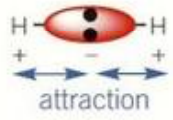
This means the shared electron pair may be closer to one nucleus than the other. One atom attracts the bonding electrons more strongly than its partner.
Note
Electronegativity is a measure of how strongly an atom attracts the bonding electron pair towards itself in a covalent bond. The greater the electronegativity of an atom, the stronger its pull on shared electrons.
Measuring electronegativity: the Pauling scale
Electronegativity is measured using the Pauling scale, which assigns numerical values to different elements. These values allow us to compare how strongly different atoms attract bonding electrons.
Pauling electronegativity values
Here are some important Pauling electronegativity values you should know:
| Element | Pauling Value |
|---|---|
| Hydrogen (H) | 2.1 |
| Lithium (Li) | 1.0 |
| Beryllium (Be) | 1.5 |
| Boron (B) | 2.0 |
| Carbon (C) | 2.5 |
| Nitrogen (N) | 3.0 |
| Oxygen (O) | 3.5 |
| Fluorine (F) | 4.0 |
| Sodium (Na) | 0.9 |
| Magnesium (Mg) | 1.2 |
| Aluminium (Al) | 1.5 |
| Silicon (Si) | 1.8 |
| Phosphorus (P) | 2.1 |
| Sulfur (S) | 2.5 |
| Chlorine (Cl) | 3.0 |
| Potassium (K) | 0.8 |
| Bromine (Br) | 2.8 |
Trends in electronegativity
Note
Electronegativity shows clear patterns across the periodic table:
Across a period (left to right):
- Nuclear charge increases
- Atomic radius decreases
- Electronegativity increases
Down a group (top to bottom):
- Atomic radius increases
- Distance from nucleus to bonding electrons increases
- Electronegativity decreases
Memory aid: Think "up and right towards fluorine" in the periodic table for increasing electronegativity!
Most and least electronegative elements
Important
Most electronegative elements:
- The non-metals nitrogen, oxygen, fluorine, and chlorine have the highest electronegativity values
- Fluorine is the most electronegative element with a Pauling value of 4.0
- These elements strongly attract bonding electrons towards themselves
- Memory aid: "FONCl" - Fluorine, Oxygen, Nitrogen, Chlorine
Least electronegative elements:
- Group 1 metals (lithium, sodium, potassium) have the lowest electronegativity values
- These elements have little attraction for bonding electrons
- Potassium has one of the lowest values at 0.8
Note: Noble gases are not included in the Pauling scale because they rarely form compounds.
Classifying bonds by electronegativity difference
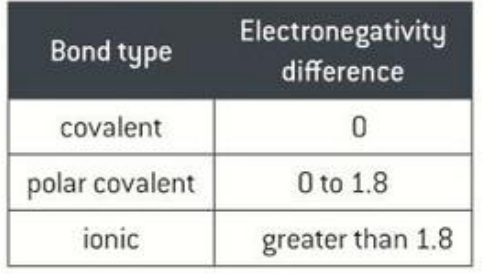
The type of chemical bond formed between two atoms depends on the difference in their electronegativity values. When the electronegativity difference is large, one atom has a much greater pull on the electrons than the other, and the more electronegative atom gains control of the electrons.
Important
We can classify bonds into three categories based on electronegativity difference:
Pure covalent bonds
- Electronegativity difference: 0
- The bonding electrons are shared equally between the two atoms
- Forms when bonded atoms are the same element (e.g., , )
- Also forms when atoms have identical or very similar electronegativity values
Polar covalent bonds
- Electronegativity difference: 0 to 1.8
- The bonding electrons are shared unequally between the two atoms
- One atom attracts the electrons more strongly
- Creates partial charges on the atoms
- Most common type of bond between different non-metal elements
Ionic bonds
- Electronegativity difference: greater than 1.8
- The electronegativity difference is so large that electrons are effectively transferred from one atom to another
- Forms between metals and non-metals
- Creates fully charged ions rather than molecules
Bond polarity
Non-polar bonds
A non-polar bond is one where the bonding electron pair is shared equally between the atoms. This happens when:
- The bonded atoms are the same element, OR
- The bonded atoms have the same or very similar electronegativity values
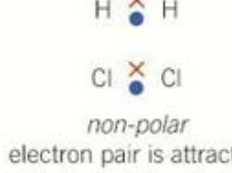
For example, in molecules like hydrogen () and chlorine (), both atoms are identical, so the electron pair is attracted equally to each nucleus. The bond is perfectly non-polar.
Note
Carbon and hydrogen atoms have very similar electronegativity values (C = 2.5, H = 2.1), so C—H bonds are essentially non-polar. This is why hydrocarbons like hexane () are non-polar solvents that don't mix with water.
Polar bonds
A polar bond is one where the bonding electron pair is shared unequally between the atoms. This happens when the bonded atoms are different elements with different electronegativity values, creating a polar covalent bond.
Partial charges
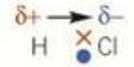
When a bond is polar, the unequal sharing of electrons creates small electrical charges on the atoms:
- The more electronegative atom gains a greater share of the electrons and develops a partial negative charge, written as
- The less electronegative atom has a reduced share of the electrons and develops a partial positive charge, written as
Note
The Greek letter delta () indicates these are only partial charges - much smaller than the full charges found on ions. Think of as meaning "small" or "partial".
Important
Rule for assigning partial charges:
When comparing electronegativity values:
- The atom with the larger electronegativity value gets the charge
- The atom with the smaller electronegativity value gets the charge
This is a common exam question - make sure you can identify which atom gets which charge!
Example: Hydrogen chloride
Hydrogen chloride (HCl) is a classic example of a polar molecule:
- From the Pauling scale: hydrogen has electronegativity 2.1, chlorine has electronegativity 3.0
- Chlorine is more electronegative than hydrogen
- The chlorine atom attracts the bonding electrons more strongly
- This creates a polar H—Cl bond
The H—Cl bond becomes polarised with:
- A partial positive charge () on the hydrogen atom
- A partial negative charge () on the chlorine atom
Permanent dipoles
This separation of opposite charges along a bond is called a dipole. In polar covalent bonds, this dipole doesn't change - it's always there as long as the molecule exists. We call this a permanent dipole to distinguish it from induced dipoles (which you'll meet in the topic on intermolecular forces).
The hydrogen chloride molecule is polar, with and charges at different ends of the H—Cl bond.
Molecular polarity
For molecules with just two atoms (like HCl), a polar bond automatically means a polar molecule. But what about molecules with more than two atoms?
When a molecule contains multiple bonds, it may have two or more polar bonds creating multiple dipoles. Whether the overall molecule is polar or non-polar depends on the shape of the molecule and whether these dipoles cancel out or reinforce each other.
Polar molecules: Water
A water molecule () is polar.
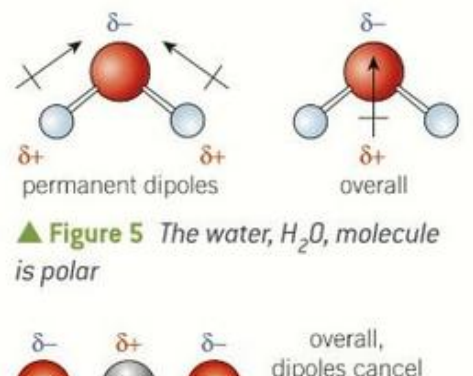
Water has:
- Two O—H bonds, each with its own permanent dipole
- The two dipoles point in different directions but don't exactly oppose each other
- The bent shape of the water molecule means the dipoles don't cancel
Overall result for water:
- The oxygen end of the molecule has a charge
- The hydrogen end of the molecule has a charge
- The whole molecule is polar with an overall permanent dipole
Non-polar molecules: Carbon dioxide
A carbon dioxide molecule () is non-polar, even though it contains polar bonds.
Carbon dioxide has:
- Two C=O bonds, each with its own permanent dipole
- The two dipoles point in exactly opposite directions
- The linear shape of the molecule means the dipoles exactly cancel each other
Note
Overall result for carbon dioxide:
- The dipoles cancel out completely
- There is no overall dipole across the whole molecule
- The molecule is non-polar despite having polar bonds
This shows that molecular shape is crucial in determining whether a molecule is polar or non-polar.
Polar solvents and ionic solubility
Water is a polar solvent, which makes it excellent at dissolving ionic compounds. When an ionic compound like sodium chloride dissolves in water, the ionic lattice breaks down and the ions become surrounded by water molecules.
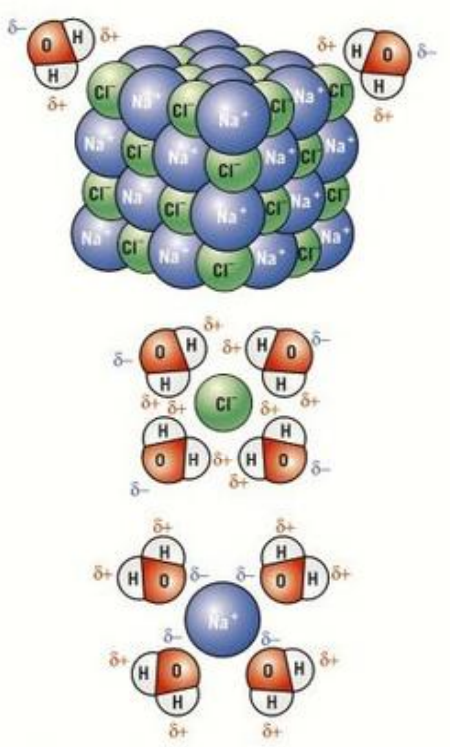
The dissolution of sodium chloride can be represented by the equation:
How water dissolves ionic compounds
The process works through ion-dipole interactions:
- Water molecules are attracted to the ions at the surface of the ionic lattice
- The ionic lattice structure breaks down as ions are pulled away
- In the resulting solution, water molecules surround each ion
Note
The orientation of water molecules around the ions depends on the charge:
- ions are attracted to the oxygen atoms in water molecules (which carry charges)
- ions are attracted to the hydrogen atoms in water molecules (which carry charges)
This process is called hydration - the ions become hydrated by surrounding water molecules.
The ability of polar solvents to dissolve ionic compounds is one reason why water is such an important solvent in chemistry and in biological systems.
Note
"Like dissolves like" principle:
Polar solvents dissolve ionic and polar compounds; non-polar solvents dissolve non-polar compounds. This explains why water (polar) dissolves salt (ionic) but not oil (non-polar).
Remember!
Summary
Key points to take away:
-
Electronegativity measures how strongly an atom attracts bonding electrons towards itself. It's measured on the Pauling scale with fluorine being the most electronegative element (4.0)
-
Electronegativity increases across periods (left to right) and decreases down groups in the periodic table. The most electronegative elements are F, O, N, and Cl; the least are Group 1 metals
-
Bond type depends on electronegativity difference: pure covalent (0), polar covalent (0-1.8), ionic (>1.8)
-
Polar bonds form between atoms with different electronegativity values, creating partial charges ( on less electronegative atom, on more electronegative atom) and permanent dipoles
-
Molecular polarity depends on both bond polarity and molecular shape. Dipoles can cancel (making non-polar molecules like ) or reinforce (making polar molecules like )
-
Polar solvents like water dissolve ionic compounds through ion-dipole interactions, with water molecules surrounding ions with opposite partial charges facing the ion
Exam focus checklist:
- ✓ Can you define electronegativity?
- ✓ Can you describe electronegativity trends in the periodic table?
- ✓ Can you use electronegativity differences to predict bond type?
- ✓ Can you identify partial charges in polar bonds?
- ✓ Can you explain why some molecules with polar bonds are non-polar overall?
- ✓ Can you explain how polar solvents dissolve ionic compounds?