Shapes of Molecules and Ions (OCR A-Level Chemistry A): Revision Notes
📚Revision Notes
Shapes of Molecules and Ions
Electron-pair repulsion theory
Understanding the shapes of molecules and ions is fundamental to chemistry. The electron-pair repulsion theory (also called VSEPR theory - Valence Shell Electron Pair Repulsion theory) provides a model for predicting and explaining these shapes.
Note
The key principles of this theory are:
- Electrons carry negative charge, so electron pairs around a central atom push away from each other due to electrostatic repulsion
- The electron pairs surrounding a central atom determine the overall shape of the molecule or ion
- Electron pairs arrange themselves to be as far apart as possible in three-dimensional space
- This arrangement minimizes the repulsion forces between the electron pairs and holds the bonded atoms in a fixed, definite shape
- Different numbers of electron pairs around the central atom result in different molecular shapes
Representing molecules in three dimensions
When drawing molecular structures on flat paper, chemists use a special notation system called wedge notation to show the three-dimensional arrangement of atoms:
- A solid line (—) represents a bond lying in the plane of the paper
- A solid wedge (▲) represents a bond coming out of the plane toward you
- A dotted wedge (⋯⋯) represents a bond going back into the plane away from you
This notation is particularly useful for representing the structures of organic molecules and helps visualize how atoms are arranged in space.
Understanding bonded pairs and lone pairs
Not all electron pairs around a central atom are the same. We distinguish between:
- Bonded pairs - electrons shared between two atoms in a covalent bond
- Lone pairs - pairs of electrons that belong to one atom and are not involved in bonding
Important
An important principle is that lone pairs occupy more space than bonded pairs. This is because a lone pair is held closer to the central atom and is not shared with another atom, so it spreads out more.
Relative repulsion strengths
The different types of electron pair repulsions have different strengths, which affects bond angles:
Important
bonded-bonded < bonded-lone < lone-lone
(weakest repulsion) → (strongest repulsion)
This means:
- Repulsion between two bonded pairs is the weakest
- Repulsion between a bonded pair and a lone pair is intermediate
- Repulsion between two lone pairs is the strongest
Because lone pairs repel more strongly, they push bonded pairs closer together, reducing the bond angles between bonded atoms. As a general rule, each lone pair reduces the bond angle by approximately 2.5°.
Molecular shapes from four electron pairs
When there are four electron pairs around a central atom, they arrange themselves in a tetrahedral arrangement to minimize repulsion. However, the actual molecular shape depends on how many of these are bonded pairs versus lone pairs.
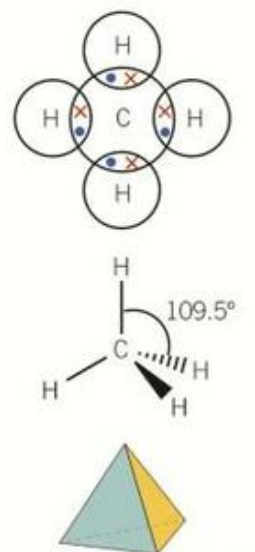
Methane () - tetrahedral shape
Methane has four carbon-hydrogen () covalent bonds, meaning four bonded pairs of electrons surround the central carbon atom.
Example
Worked Example: Methane Structure
- The four electron pairs repel each other equally and spread out as far apart as possible in three-dimensional space
- This creates a tetrahedral shape with the carbon atom at the center
- All four bond angles are equal at 109.5°
- The molecule has perfect symmetry
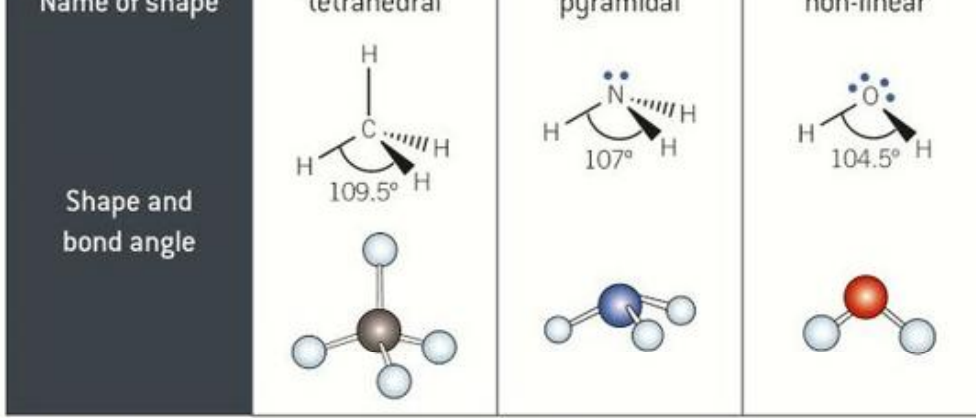
Ammonia () - pyramidal shape
Ammonia has three nitrogen-hydrogen bonds and one lone pair of electrons on the nitrogen atom.
Example
Worked Example: Ammonia Structure
- The four electron pairs (3 bonded + 1 lone) still arrange tetrahedrally
- However, the lone pair occupies more space and repels the bonded pairs more strongly
- This pushes the three bonds closer together
- The molecular shape (considering only the positions of atoms, not the lone pair) is pyramidal
- The bond angle is reduced to 107° (about 2.5° less than tetrahedral)
Water () - non-linear (bent) shape
Water has two oxygen-hydrogen bonds and two lone pairs of electrons on the oxygen atom.
Example
Worked Example: Water Structure
- The four electron pairs (2 bonded + 2 lone) arrange tetrahedrally
- The two lone pairs repel each other strongly and also repel the bonded pairs
- This pushes the two bonds even closer together
- The molecular shape is non-linear or bent (like a boomerang)
- The bond angle is reduced to 104.5° (about 5° less than tetrahedral - approximately 2.5° for each lone pair)

Molecular shapes from multiple bonds
When a molecule contains double or triple bonds (multiple bonds), each multiple bond is treated as a single bonding region. This is important for predicting molecular shapes.
Carbon dioxide () - linear shape
Carbon dioxide has the structure with two double bonds.
Example
Worked Example: Carbon Dioxide Structure
- The central carbon atom forms two double bonds to oxygen atoms
- Although there are four bonded pairs in total (two pairs per double bond), these four pairs form two bonding regions (one on each side of the carbon)
- The two bonding regions repel each other to be as far apart as possible
- This creates a linear shape with all three atoms in a straight line
- The bond angle is 180°
Molecular shapes from other numbers of electron pairs
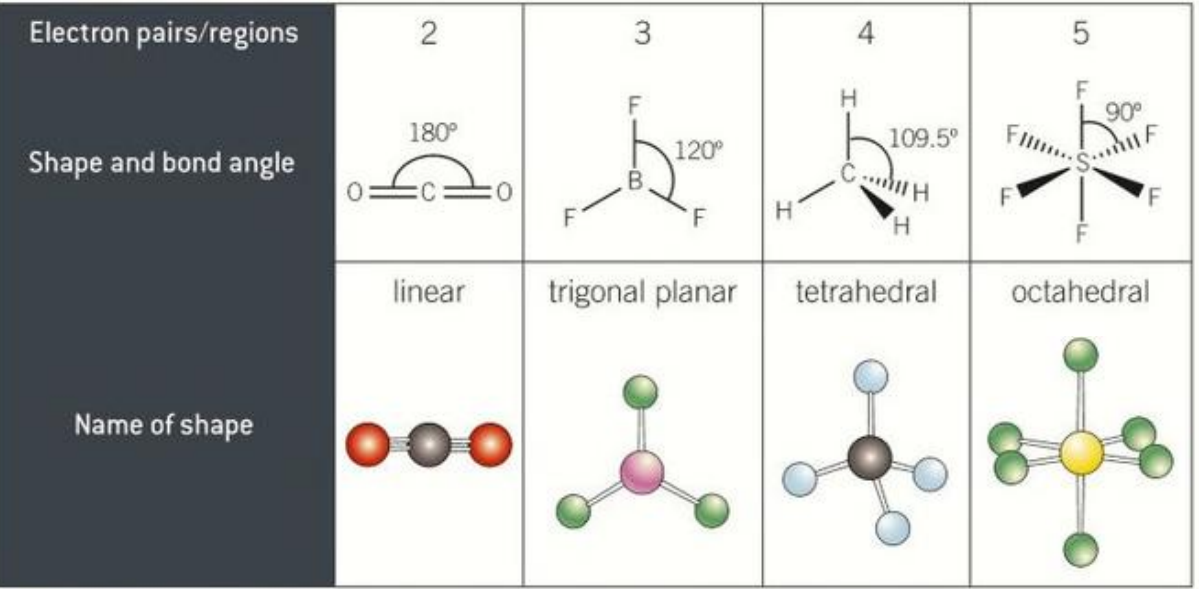
The electron-pair repulsion theory can predict shapes for any number of electron pairs around a central atom. Here are the key shapes:
Two electron pairs - linear shape
When there are only two electron pairs (or two bonding regions) around the central atom:
- They repel to opposite sides of the central atom
- This creates a linear shape
- Bond angle: 180°
- Example: (carbon dioxide), (beryllium iodide)
Three electron pairs - trigonal planar shape
When there are three electron pairs around the central atom:
- They arrange themselves in a flat triangular pattern
- This creates a trigonal planar shape
- Bond angle: 120° between any two bonds
- Example: (boron trifluoride)
Note
In trigonal planar shapes, all atoms lie in the same flat plane, creating a perfectly symmetrical triangular arrangement.
Four electron pairs - tetrahedral shape
As discussed earlier:
- Tetrahedral shape when all four are bonded pairs
- Bond angle: 109.5°
- Example: (methane), (silane)
Six electron pairs - octahedral shape
When there are six electron pairs around the central atom:
- They arrange themselves toward the six corners of an octahedron
- This creates an octahedral shape
- Bond angle: 90° between adjacent bonds
- Example: (sulfur hexafluoride)
Note
The term "octahedral" refers to the shape having eight faces (like two square pyramids joined base-to-base). The six fluorine atoms in are positioned at the six corners of this three-dimensional shape, with the sulfur atom at the center.
Shapes of ions
Electron-pair repulsion theory applies equally well to ions as it does to neutral molecules. We can predict and explain the shapes of polyatomic ions using the same principles.
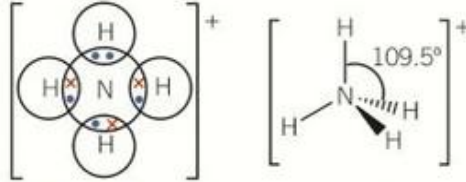
Ammonium ion ()
The ammonium ion has a positive charge but the same arrangement of electron pairs as methane.
Example
Worked Example: Ammonium Ion Structure
- There are four bonded pairs of electrons around the central nitrogen atom
- No lone pairs are present
- The shape is tetrahedral
- The bond angles are 109.5°
- Despite the positive charge, the ion has the same shape as methane because it has the same number and type of electron pairs
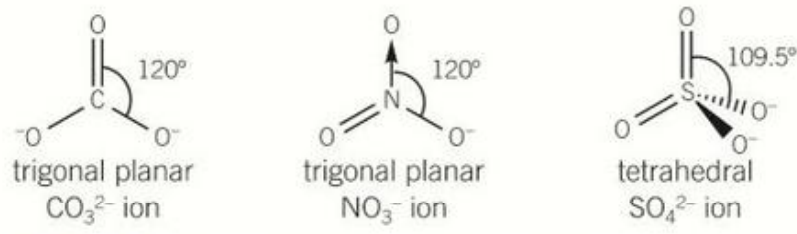
Carbonate ion () and nitrate ion ()
Both carbonate and nitrate ions have three regions of electron density around their central atoms.
- The carbonate ion has three bonding regions around the carbon atom (each bond counts as one region)
- The nitrate ion has three bonding regions around the nitrogen atom
- Both ions have a trigonal planar shape
- Bond angles are 120° between any two bonds
- All atoms lie in the same flat plane
Sulfate ion ()
The sulfate ion has four regions of electron density around the central sulfur atom.
- There are four bonding regions (four sulfur-oxygen bonds)
- The shape is tetrahedral
- Bond angles are 109.5°
- This is the same shape as methane and the ammonium ion
Predicting molecular shapes and bond angles
You should now be able to predict the shapes and bond angles of unfamiliar molecules and ions by following these steps:
1. Identify the central atom - this is usually the atom written first or in the middle of the formula
2. Count the electron pairs around the central atom:
- Count each single bond as one bonded pair
- Count each double or triple bond as one bonding region
- Count any lone pairs of electrons
3. Determine the electron pair arrangement - electron pairs arrange to be as far apart as possible:
- 2 pairs → linear arrangement (180°)
- 3 pairs → trigonal planar arrangement (120°)
- 4 pairs → tetrahedral arrangement (109.5°)
- 6 pairs → octahedral arrangement (90°)
4. Apply the effect of lone pairs:
- Remember: lone pairs repel more strongly than bonded pairs
- Each lone pair reduces bond angles by approximately 2.5°
- The molecular shape name depends on the positions of atoms only, not lone pairs
5. Name the shape based on the positions of atoms:
- 2 bonding regions (no lone pairs) → linear
- 3 bonding regions (no lone pairs) → trigonal planar
- 4 bonding regions (no lone pairs) → tetrahedral
- 3 bonding regions + 1 lone pair → pyramidal
- 2 bonding regions + 2 lone pairs → non-linear (bent)
- 6 bonding regions (no lone pairs) → octahedral
Important
Important tip: Dot-and-cross diagrams can be very helpful for working out the arrangement of electron pairs and predicting molecular shapes. Draw these diagrams first if you're unsure about the number of bonded pairs and lone pairs.
Remember!
Summary
Key Points to Remember:
- Electron-pair repulsion theory states that electron pairs around a central atom arrange themselves to minimize repulsion and be as far apart as possible
- Lone pairs occupy more space than bonded pairs and repel other electron pairs more strongly, reducing bond angles by approximately 2.5° per lone pair
- Multiple bonds count as one bonding region when determining molecular shape (e.g., a double bond = one region)
- Common shapes to memorize:
- 2 electron pairs → linear (180°)
- 3 electron pairs → trigonal planar (120°)
- 4 electron pairs (all bonded) → tetrahedral (109.5°)
- 4 electron pairs (3 bonded, 1 lone) → pyramidal (≈107°)
- 4 electron pairs (2 bonded, 2 lone) → non-linear/bent (≈104.5°)
- 6 electron pairs → octahedral (90°)
- The same principles apply to both molecules and ions - focus on the electron pairs around the central atom