Amines, Amino Acids and Proteins (OCR A-Level Chemistry A): Revision Notes
📚Revision Notes
Amines
What are amines?
Amines are organic compounds based on the ammonia structure (), where one or more hydrogen atoms have been substituted with carbon chains or rings. They contain nitrogen as a key functional group and are important compounds both in synthetic chemistry and biological systems.
There are two main types of amines based on what is bonded to the nitrogen atom:
Note
Aliphatic amines contain a nitrogen atom bonded to at least one straight or branched carbon chain (known as an alkyl group, R). The simplest example is methylamine, , which has just one methyl group connected to the nitrogen atom.
Aromatic amines contain a nitrogen atom bonded to an aromatic ring (known as an aryl group, Ar). The simplest aromatic amine is phenylamine, , where the nitrogen is directly attached to a benzene ring with the formula .
Important
When drawing amine structures, it is essential to show the lone pair of electrons on the nitrogen atom, as this lone pair is crucial for understanding the chemical behaviour of amines.
Classification of amines
Amines are categorized into three types based on how many alkyl or aryl groups are bonded to the nitrogen atom. This classification system divides amines into primary, secondary, and tertiary amines.
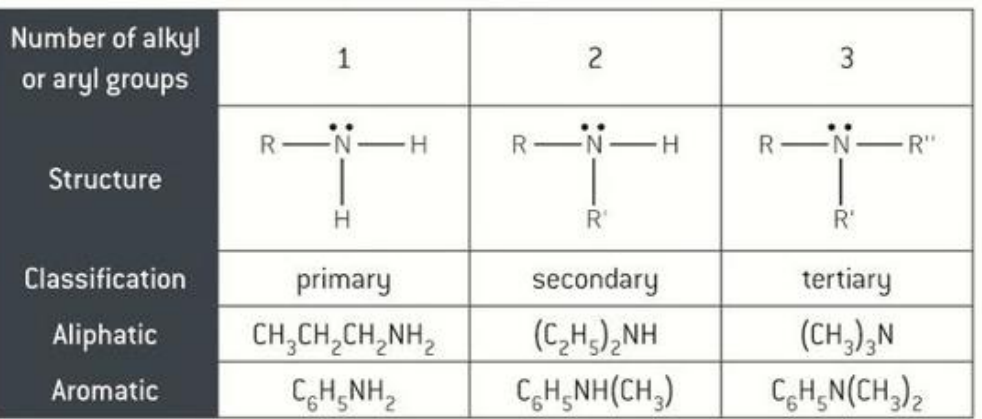
Primary amines have one alkyl or aryl group attached to the nitrogen, with the remaining two bonds connected to hydrogen atoms. The general structure can be written as . Examples include:
- Aliphatic: methylamine ()
- Aromatic: phenylamine ()
Secondary amines have two alkyl or aryl groups bonded to the nitrogen, with one remaining hydrogen. The general structure is or . Examples include:
- Aliphatic: diethylamine ()
- Aromatic: N-methylaniline ()
Tertiary amines have three alkyl or aryl groups attached to the nitrogen, with no hydrogen atoms bonded to it. The general structure is . Examples include:
- Aliphatic: trimethylamine ()
- Aromatic: N,N-dimethylaniline ()
Amines in nature
Amines are widespread in biological systems and many have significant effects on human physiology.
Note
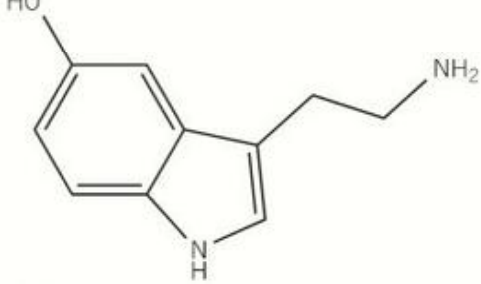
Serotonin is an important neurotransmitter that regulates several bodily functions. It controls:
- Appetite
- Sleep patterns
- Memory and learning processes
- Body temperature
- Muscle contractions
- Mood
Low serotonin levels are associated with depression.
Note
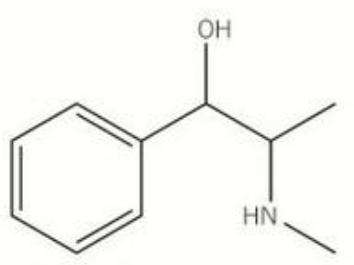
Pseudoephedrine is found in decongestant medications such as nasal drops and cold remedies. It works by causing nasal membranes to shrink and reducing secretions in the nasal passages.
Naming amines
The nomenclature system for amines depends on whether they are primary, secondary, or tertiary, and also on the structure of the carbon chain or ring.
Primary amines
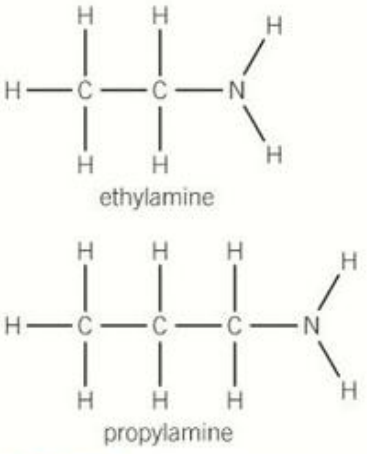
For a primary amine where the group is at the end of the carbon chain, add the suffix -amine to the name of the alkyl chain.
Example
Examples of simple primary amines:
- is called ethylamine
- is called propylamine
When the amine group is positioned on a carbon other than carbon-1, use the prefix amino- along with a number to indicate the position of the group on the carbon chain.
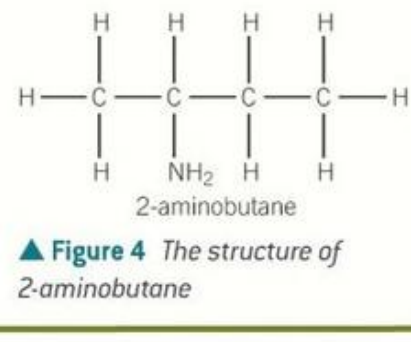
Example
Example of a branched primary amine:
- is called 2-aminobutane
Note: The number indicates that the amino group is attached to the second carbon in the butane chain.
Secondary and tertiary amines
When secondary or tertiary amines contain the same alkyl groups repeated, the prefixes di- or tri- are used to indicate the number of identical groups attached to the nitrogen.
Example
Example of a secondary amine with identical groups:
- is called dimethylamine
When two or more different groups are bonded to the nitrogen atom, the compound is named as an N-substituted derivative of the larger group.
Example
Examples of N-substituted amines:
- is called N-methylpropylamine
- The propyl group is the larger chain, and the methyl is named as an N-substituent
- is called N-ethyl-N-methylpropylamine
- Both ethyl and methyl groups are N-substituents on the propyl chain
Reactions of amines
Amines as bases
Amines behave as bases in chemical reactions because the lone pair of electrons on the nitrogen atom can accept a proton (). This is similar to how ammonia acts as a base.
When an amine accepts a proton, a dative covalent bond (also called a coordinate bond) forms between the lone pair on nitrogen and the proton. This creates a positively charged ion called an ammonium ion.
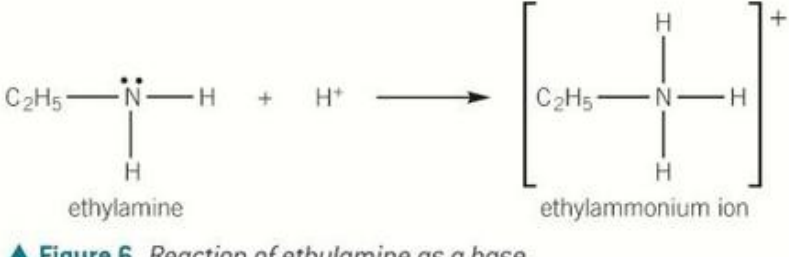
The general reaction can be written as:
Example
Example: Ethylamine accepting a proton
Ethylamine accepts a proton to form the ethylammonium ion:
This base behaviour is very similar to ammonia's reaction with protons:
Salt formation
Since amines are bases, they neutralize acids to form salts. This reaction is analogous to the neutralization of acids by ammonia.
Example
Reaction with hydrochloric acid:
Propylamine reacts with hydrochloric acid to produce the salt propylammonium chloride:
Example
Reaction with sulfuric acid:
Ethylamine reacts with sulfuric acid to form ethylammonium sulfate. Since sulfuric acid is dibasic (can donate two protons), two molecules of ethylamine are required:
Note
These salt formation reactions are directly comparable to ammonia's reactions:
Preparation of amines
Preparation of aliphatic amines
Formation of primary amines
Ammonia has a lone pair of electrons on the nitrogen atom, which allows it to function as a nucleophile in substitution reactions with haloalkanes. The nucleophilic substitution produces an ammonium salt. When aqueous alkali (sodium hydroxide) is added to this salt, it releases the free amine.
The formation of propylamine from 1-chloropropane and ammonia follows this two-step process:
Example
Formation of propylamine from 1-chloropropane:
Salt formation stage:
The product is propylammonium chloride (an ammonium salt).
Amine formation stage:
The final product is propylamine. This is classified as a primary amine because only one carbon atom is bonded to the nitrogen in the amine group.
Important
Essential reaction conditions:
Two conditions are crucial for this reaction to proceed effectively:
-
Ethanol must be used as the solvent. This prevents the haloalkane from undergoing substitution with water molecules, which would form alcohols instead of amines.
-
Excess ammonia must be used. This reduces further substitution reactions where the newly-formed amine group reacts with more haloalkane to form secondary and tertiary amines.
Formation of secondary and tertiary amines
The reaction described above cannot produce a pure primary amine. The product still contains a lone pair of electrons on the nitrogen atom, which means it can react further with more haloalkane molecules to form secondary and then tertiary amines. Each reaction produces another ammonium salt.
Example
Formation of a secondary amine:
The primary amine (propylamine) reacts with another molecule of the haloalkane:
This produces dipropylammonium chloride (a salt). Treatment with sodium hydroxide releases the secondary amine:
The product is dipropylamine, a secondary amine.
Note
Formation of tertiary amines:
Tertiary amines can form through further reaction of the secondary amine with another haloalkane molecule. In this example, continued substitution would eventually form tripropylamine, .
Preparation of aromatic amines
Aromatic amines, such as phenylamine (), are prepared through the reduction of nitrobenzene ().
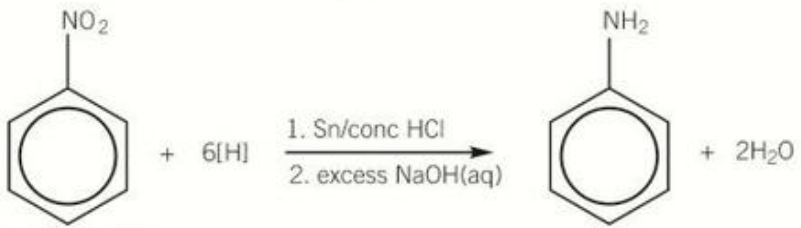
The reduction process involves heating nitrobenzene under reflux with tin metal and concentrated hydrochloric acid. This converts the nitro group () into an ammonium salt (phenylammonium chloride). Excess sodium hydroxide is then added to release the free aromatic amine, phenylamine. Tin and hydrochloric acid together act as the reducing agent.
The overall equation can be written as:
Where represents the reducing agent providing hydrogen atoms.
Example
The step-by-step process:
Stage 1: Nitrobenzene is heated under reflux with tin and concentrated hydrochloric acid to form phenylammonium chloride
Stage 2: Excess sodium hydroxide is added to the salt to liberate phenylamine and form water and sodium chloride as byproducts
Summary
Key Takeaways
Fundamental concepts:
- Amines are derived from ammonia () with hydrogen atoms replaced by alkyl (aliphatic) or aryl (aromatic) groups
- Amines are classified as primary (1 group), secondary (2 groups), or tertiary (3 groups) based on the number of alkyl/aryl groups bonded to nitrogen
- Amines act as bases because the lone pair on nitrogen can accept protons, forming dative covalent bonds and creating ammonium ions
- Amines neutralize acids to form salts (similar to ammonia)
Preparation methods:
- Aliphatic primary amines are prepared by nucleophilic substitution of haloalkanes with excess ammonia in ethanol solvent, followed by treatment with sodium hydroxide
- Aromatic amines are prepared by reducing nitrobenzene with tin and concentrated HCl, followed by treatment with excess sodium hydroxide
Exam focus checklist:
✓ Be able to identify and classify amines as primary, secondary, or tertiary from structural formulas
✓ Know how to name simple aliphatic and aromatic amines
✓ Understand why amines act as bases (lone pair accepts protons via dative covalent bonding)
✓ Write equations for salt formation between amines and acids
✓ Know the two-stage preparation of aliphatic amines: nucleophilic substitution then alkali treatment
✓ State essential conditions: ethanol solvent and excess ammonia
✓ Explain why secondary and tertiary amines form as byproducts
✓ Know the preparation of aromatic amines by reduction of nitrobenzene
✓ State conditions: tin/concentrated HCl (reflux), then excess NaOH
✓ Always show the lone pair when drawing amine structures