Introducing Benzene (OCR A-Level Chemistry A): Revision Notes
📚Revision Notes
Introducing benzene
What is benzene?
Benzene is the simplest member of a class of compounds called aromatic hydrocarbons or arenes. The molecular formula of benzene is , which tells us it contains six carbon atoms and six hydrogen atoms. This compound was first discovered in 1825 by the English scientist Michael Faraday, who isolated and identified it from an oily residue left behind from gas used for street lighting.
Note
Faraday's discovery of benzene in 1825 came from studying the byproducts of gas lighting - a reminder that important scientific discoveries can come from investigating everyday materials and processes.
Physical properties of benzene
Benzene has several distinctive physical properties that make it easily recognisable:
- It is a colourless liquid at room temperature
- It has a characteristic sweet smell
- It is highly flammable and poses a fire hazard
- It occurs naturally in crude oil and is a component of petrol
- It is also found in cigarette smoke
Health considerations
Important
Benzene is classified as a carcinogen, meaning it has the ability to cause cancer. This classification makes proper handling and safety precautions essential when working with benzene or benzene-containing compounds. Always work with benzene in a well-ventilated area or fume hood, and follow appropriate laboratory safety procedures.
The structure of benzene
The benzene molecule consists of a hexagonal ring containing six carbon atoms. Each carbon atom is joined to two other carbon atoms and to one hydrogen atom. Benzene is classified as an aromatic hydrocarbon or arene due to its ring structure and unique bonding arrangement.
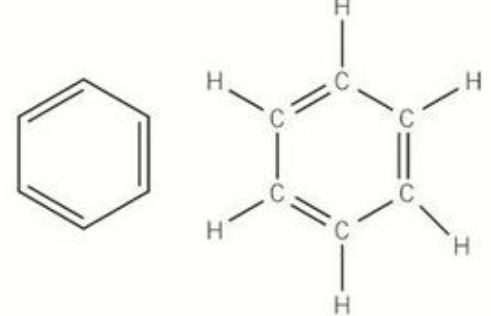
Note
The structure shown in Figure 1 can be represented in two ways - both representations are acceptable in examinations. The simplified version shows just the hexagonal ring, while the detailed version explicitly shows all carbon and hydrogen atoms.
Derivatives of benzene
Historically, the term "aromatic" was used to classify derivatives of benzene because many pleasant-smelling compounds were found to contain a benzene ring. Although many odourless compounds also contain benzene rings, the term aromatic continues to be used to classify these compounds.
Natural examples of aromatic compounds include thymol (found in the aromatic herb thyme) and benzaldehyde (which gives almonds their characteristic flavour).
The Kekulé model of benzene
For many years, scientists worked to establish a structure for benzene that would explain both its molecular formula and the experimental evidence available at the time. The molecular formula suggested a structure containing multiple bonds, since compounds with many double bonds or even double and triple bonds were known to exist. However, compounds containing multiple bonds were typically very reactive, yet benzene appeared to be unreactive.
Kekulé's proposal
In 1865, the German chemist Friedrich August Kekulé proposed a structure for benzene based on a six-membered ring of carbon atoms joined by alternating single and double bonds. According to legend, he claimed to have thought of this ring shape whilst day-dreaming about a snake seizing its own tail. This model showed three carbon-carbon double bonds () alternating with three carbon-carbon single bonds around the hexagonal ring.
Evidence that disproved Kekulé's model
Although Kekulé's model was an important step forward, not all chemists accepted it because the structure could not explain all of the chemical and physical properties of benzene. Three key pieces of evidence emerged that contradicted Kekulé's model:
1. The lack of reactivity of benzene
If benzene truly contained carbon-carbon double bonds as shown in Kekulé's structure, it should undergo the same reactions as alkenes. Specifically, benzene should decolourise bromine in an electrophilic addition reaction. However, experimental observations showed that:
- Benzene does not undergo electrophilic addition reactions
- Benzene does not decolourise bromine under normal conditions
Important
This lack of reactivity led scientists to conclude that benzene cannot contain any double bonds in its structure. This was a crucial observation that challenged the fundamental assumptions of the Kekulé model.
2. The lengths of the carbon-carbon bonds in benzene
Scientists can measure bond lengths in molecules using a technique called X-ray diffraction. When the crystallographer Kathleen Lonsdale examined benzene using this technique in 1929, she discovered that all the carbon-carbon bonds in benzene were identical in length, measuring 0.139 nm.
This bond length is significant because it falls between the length of a single carbon-carbon bond (0.153 nm) and a double carbon-carbon bond (0.134 nm). If Kekulé's model were correct, we would expect to see two different bond lengths in benzene - some bonds measuring 0.153 nm and others measuring 0.134 nm. The fact that all bonds are the same intermediate length contradicts the Kekulé structure.
Note
Bond Length Comparison:
- Single C-C bond: 0.153 nm
- Benzene C-C bond: 0.139 nm (intermediate)
- Double C=C bond: 0.134 nm
The intermediate length of benzene's bonds suggests a structure different from simple alternating single and double bonds.
3. Hydrogenation enthalpies
Hydrogenation is the name given to the addition of hydrogen to an unsaturated compound. This provides powerful evidence about the stability of benzene compared to the predicted Kekulé structure.
When cyclohexene (which contains one carbon-carbon double bond) undergoes hydrogenation, one double bond reacts with hydrogen. The enthalpy change of hydrogenation is .
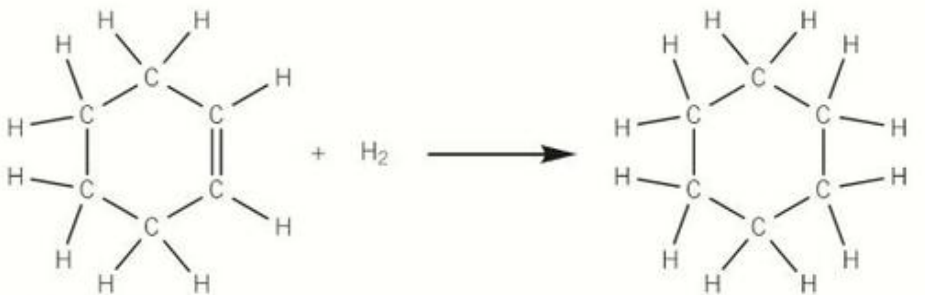
The Kekulé structure of benzene contains alternating single and double bonds, which could be named cyclohexa-1,3,5-triene to indicate the positioning of the three double bonds. If benzene truly had the Kekulé structure with three double bonds, then it would be expected to have an enthalpy change of hydrogenation that is three times that of cyclohexene:
Expected
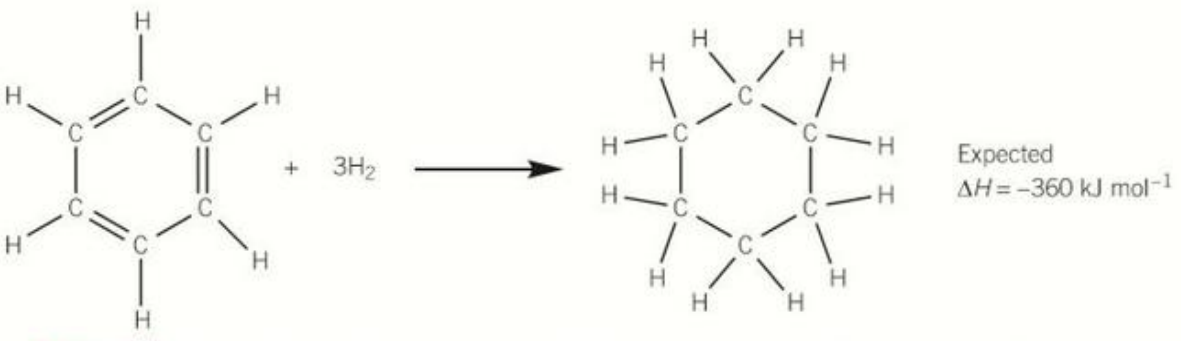
Example
Worked Example: Calculating the Stability Difference
Given information:
- Cyclohexene hydrogenation:
- Expected for Kekulé benzene (3 double bonds):
- Actual benzene hydrogenation:
Calculation: Difference in energy = Expected - Actual Difference =
Conclusion: Benzene releases 152 kJ mol⁻¹ less energy than predicted, meaning it is 152 kJ mol⁻¹ more stable than the Kekulé structure would suggest.
This substantial difference in energy - benzene being 152 kJ mol⁻¹ more stable than expected - led scientists to propose the delocalised model of benzene.
The delocalised model of benzene
Scientists developed the delocalised model of benzene after determining that the experimental evidence was sufficient to disprove the Kekulé structure. This model successfully explains the observed stability and properties of benzene.
Features of the delocalised model
The delocalised model has several key features that distinguish it from the Kekulé model:
1. Planar, cyclic structure
Benzene is a planar (flat), cyclic, hexagonal hydrocarbon containing six carbon atoms and six hydrogen atoms.
2. Electron arrangement in carbon atoms
Each carbon atom uses three of its available four electrons in bonding to two other carbon atoms and to one hydrogen atom. This leaves one electron per carbon atom available for further bonding.
3. P-orbitals and π-bonding
Each carbon atom has one electron in a p-orbital positioned at right angles to the plane of the bonded carbon and hydrogen atoms. These p-orbitals are perpendicular to the ring structure.
4. Sideways overlap of p-orbitals
Adjacent p-orbital electrons overlap sideways, in both directions, above and below the plane of the carbon atoms. This creates a ring of electron density that extends above and below the plane of the benzene ring.
5. Formation of π-bonds (pi-bonds)
This overlapping of the p-orbitals creates a system of π-bonds (pi-bonds) which spread over all six of the carbon atoms in the ring structure. Rather than being localised between two specific carbon atoms, these bonds are delocalised.
6. Delocalisation
The six electrons occupying this system of π-bonds are said to be delocalised - they are not confined between two specific carbon atoms but are spread evenly across the entire ring system.
Note
Key Concept: Delocalisation
This delocalisation of electrons is what gives benzene its enhanced stability compared to the theoretical Kekulé structure. The spreading of electron density over all six carbon atoms creates a lower energy, more stable arrangement than having three separate localised double bonds.
Naming aromatic compounds
In their systematic names, some functional groups are shown as prefixes attached to benzene. These include short alkyl chains, halogens, and nitro groups.
Compounds with one substituent group
Aromatic compounds with one substituent group are called monosubstituted compounds. In these compounds, the benzene ring is often considered to be the parent chain. When naming monosubstituted aromatic compounds:
- Alkyl groups (, , etc.) are shown as prefixes
- Halogens (F, Cl, Br, I) are shown as prefixes
- Nitro groups () are shown as prefixes
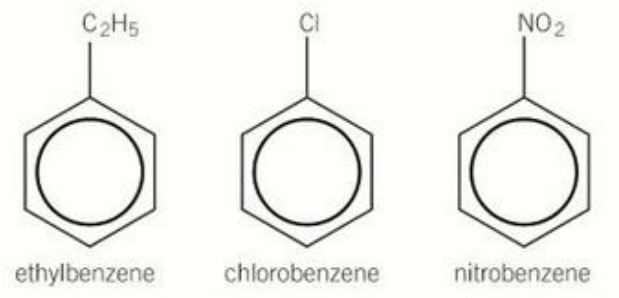
Example
Examples of Monosubstituted Aromatics:
- Ethylbenzene - benzene with an ethyl group
- Chlorobenzene - benzene with a chlorine atom
- Nitrobenzene - benzene with a nitro group
When benzene becomes a substituent
When a benzene ring is attached to an alkyl chain with a functional group, or to an alkyl chain with seven or more carbon atoms, benzene is considered to be a substituent rather than the parent chain. In these cases, the prefix phenyl is used in the name instead of benzene.
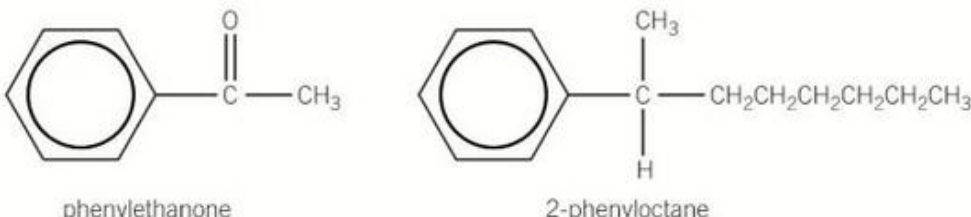
For example, phenylethanone contains a benzene ring attached to a ketone group, and 2-phenyloctane has a benzene ring as a substituent on an octane chain at the second carbon position.
Common exceptions
Important
Common Exceptions to Learn
As with many naming systems, there are some noticeable exceptions that must be learnt and remembered. Three common compounds you will encounter when studying aromatic chemistry have traditional names that are still widely used:
- Benzoic acid (benzenecarboxylic acid) - benzene with a carboxylic acid group
- Phenylamine - benzene with an amino group
- Benzaldehyde (benzenecarbaldehyde) - benzene with an aldehyde group
These traditional names are widely accepted and commonly used in chemistry, so it's essential to memorize them.
Compounds with more than one substituent group
Some molecules contain more than one substituent on the benzene ring. For example, disubstituted compounds have two substituent groups. When naming these compounds:
1. Number the ring
The ring is numbered starting with one of the substituent groups, just like numbering a carbon chain. The carbon bearing the first substituent is designated as carbon-1.
2. Use the lowest possible numbers
The substituent groups are listed in alphabetical order using the smallest numbers possible. Start numbering from the substituent that gives the lowest combination of numbers.
3. Alphabetical ordering
List the substituents in alphabetical order in the name, regardless of their position numbers.
Example
Worked Example: Naming 2-bromomethylbenzene
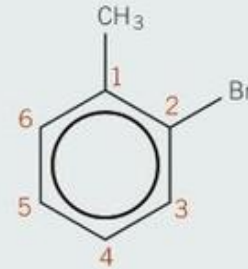
Step 1: Identify the substituents
- Methyl group ()
- Bromine atom (Br)
Step 2: Number the ring for lowest numbers
- The methyl group is on carbon-1
- The bromine is on carbon-2
- This gives the lowest possible numbering system
Step 3: List in alphabetical order
- Bromine comes before methyl alphabetically
- Name: 2-bromomethylbenzene
Another example is 3-chloromethylbenzene (also called 3-chlorotoluene when using methylbenzene/toluene as the base name):
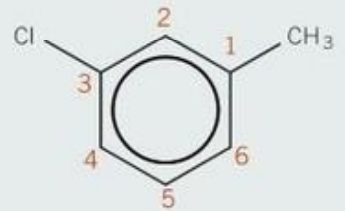
- The methyl group is on carbon-1
- The chlorine is on carbon-3
- This gives the name 3-chloromethylbenzene
Summary
Key Points to Remember:
-
Benzene () is an aromatic hydrocarbon with a hexagonal ring structure containing six carbon and six hydrogen atoms. It is a colourless, sweet-smelling, highly flammable liquid that is classified as a carcinogen.
-
The Kekulé model proposed alternating single and double bonds in the benzene ring, but this was disproved by three key pieces of evidence: benzene's lack of reactivity with bromine, all carbon-carbon bonds having equal length (0.139 nm), and the enthalpy of hydrogenation being 152 kJ mol⁻¹ less than predicted.
-
The delocalised model explains benzene's structure as a planar ring where six electrons in p-orbitals overlap sideways to form a system of π-bonds spread over all six carbon atoms. This delocalisation gives benzene extra stability compared to the Kekulé structure.
-
Naming monosubstituted aromatics: When benzene is the parent chain, substituents (alkyl groups, halogens, nitro groups) are shown as prefixes to "benzene". When benzene is a substituent on a longer chain or functional group, use the prefix phenyl.
-
Naming disubstituted aromatics: Number the ring starting from one substituent to give the lowest possible numbers, then list substituents in alphabetical order with their position numbers.