Carbon–Carbon Bond Formation (OCR A-Level Chemistry A): Revision Notes
📚Revision Notes
Carbon–Carbon Bond Formation
Introduction to carbon–carbon bond formation in synthesis
Building new carbon–carbon bonds is essential in organic synthesis because it allows chemists to create larger, more complex molecules from simpler starting materials. By forming C–C bonds, you can extend carbon chains, add functional groups to aromatic rings, and synthesise compounds with desired properties. This topic covers several key methods for creating these vital bonds, including reactions involving nitriles, Friedel–Crafts reactions on benzene rings, and the use of organometallic compounds.
Note
Understanding carbon–carbon bond formation is fundamental to organic synthesis. Without these reactions, chemists would be unable to construct the complex molecular frameworks found in pharmaceuticals, polymers, and natural products. Each method discussed here offers unique advantages for building specific types of carbon frameworks.
Formation of nitriles
What are nitriles?
The nitrile functional group consists of a carbon atom triple-bonded to a nitrogen atom, represented as . Nitriles are valuable intermediates in synthesis because they can be converted into other functional groups such as amines and carboxylic acids, and their formation creates new carbon–carbon bonds.
Nitriles from haloalkanes
Haloalkanes can be converted to nitriles by reacting them with sodium cyanide () or potassium cyanide () dissolved in ethanol. This reaction is particularly useful because it increases the length of the carbon chain by one carbon atom.
Example
Worked Example: Converting 1-chloropropane to butanenitrile
In this example, 1-chloropropane (3 carbon atoms) is converted to butanenitrile (4 carbon atoms).
Reaction mechanism:
The mechanism follows a nucleophilic substitution pathway (specifically ). The cyanide ion () acts as a nucleophile, attacking the carbon atom bonded to the halogen. The halogen acts as a leaving group, departing as a halide ion.
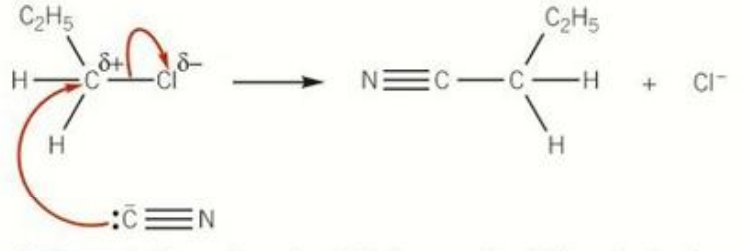
In this mechanism:
- The cyanide ion donates its lone pair to the electrophilic carbon atom (which carries a partial positive charge due to the electronegative chlorine)
- The carbon–halogen bond breaks simultaneously
- A new carbon–carbon bond forms between the cyanide and the alkyl group
- The chloride ion leaves as the leaving group
Nitriles from aldehydes and ketones
Aldehydes and ketones react with hydrogen cyanide () through a nucleophilic addition mechanism. This reaction also forms a carbon–carbon bond and increases the number of carbon atoms in the molecule.
Example
Worked Example: Reaction of propanone with hydrogen cyanide
The product formed is called a hydroxynitrile or cyanohydrin, as it contains both a hydroxyl group () and a nitrile group ().
Important
Safety considerations:
Hydrogen cyanide is extremely toxic, so direct use is dangerous. In practice, chemists use a mixture of sodium cyanide and dilute sulfuric acid to generate cyanide ions () in situ. This approach is safer and also increases the reaction rate.
Reaction mechanism:
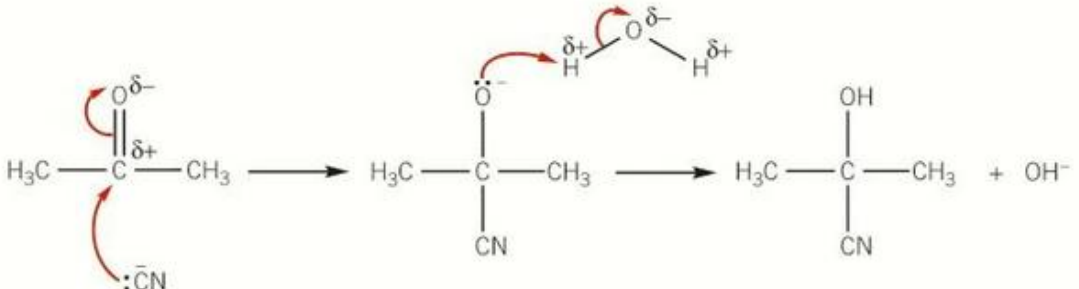
The mechanism proceeds in two main steps:
- The cyanide ion (acting as a nucleophile) attacks the partially positive carbon atom of the carbonyl group
- The oxygen atom of the carbonyl gains a negative charge temporarily
- A proton () from water or acid then transfers to the negatively charged oxygen
- The final product is a hydroxynitrile with both and groups attached to the same carbon
Reactions of nitriles
Once formed, nitriles serve as useful intermediates that can be converted into other functional groups.
Reduction of nitriles to amines
Nitriles can be reduced to primary amines by reaction with hydrogen gas in the presence of a nickel catalyst.
Example
Worked Example: Reduction of propanenitrile to propylamine
In this example, propanenitrile is reduced to propylamine. This reaction is valuable because it allows you to introduce an amine functional group whilst maintaining the extended carbon chain.
Hydrolysis of nitriles to carboxylic acids
Nitriles undergo hydrolysis when heated with dilute aqueous acid (such as ) to form carboxylic acids.
Example
Worked Example: Hydrolysis of butanenitrile to butanoic acid
Here, butanenitrile is converted to butanoic acid. This reaction demonstrates how nitriles can be used as intermediates to prepare carboxylic acids with longer carbon chains than the starting material.
Forming carbon–carbon bonds to benzene rings
Friedel–Crafts alkylation
Alkylation is a reaction that attaches an alkyl group to a benzene ring, creating a new carbon–carbon bond. The reaction requires a haloalkane reagent and a Friedel–Crafts catalyst such as aluminium chloride ().
Example
Worked Example: Alkylation of benzene with chloroethane
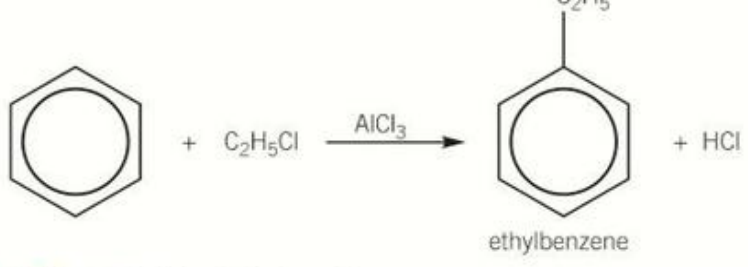
In this reaction, benzene reacts with chloroethane to form ethylbenzene, with hydrogen chloride produced as a by-product.
How it works:
The aluminium chloride catalyst helps to generate an electrophile (a positively charged or partially positive species) from the haloalkane. This electrophile then attacks the electron-rich benzene ring, forming a new carbon–carbon bond between the ring and the alkyl group.
Friedel–Crafts acylation
Acylation introduces an acyl group (containing a carbonyl) onto the benzene ring, forming a ketone. This reaction also requires an aluminium chloride catalyst and uses an acyl chloride as the reagent.
Example
Worked Example: Acylation of benzene with propanoyl chloride

In this example, benzene reacts with propanoyl chloride to form phenylpropanone (a ketone).
Note
Why acylation is useful:
Acylation is particularly valuable in synthesis because the ketone product can undergo typical carbonyl reactions. This allows further modification of the molecule, making acylation a versatile method for building complex structures.
Organometallic compounds in carbon–carbon bond formation
What are organometallic compounds?
Organometallic compounds contain a carbon–metal bond. These compounds play a crucial role in forming carbon–carbon bonds because they can act as a source of nucleophilic carbon atoms (called carbanions).
Key points about organometallic compounds:
- They contain carbon atoms bonded directly to metal atoms
- The carbon–metal bond is polar, with the carbon atom carrying a partial or full negative charge
- Common metals used include magnesium and lithium
- They are highly reactive towards electrophilic carbon centres
Grignard reagents
Grignard reagents are a specific type of organometallic compound with the general formula , where R is an alkyl or aryl group and X is a halogen.
Preparation of Grignard reagents:
Grignard reagents are prepared by reacting magnesium metal with an alkyl halide or aryl halide dissolved in dry ether solvent.
Example
Worked Example: Preparation of ethylmagnesium bromide
In this example, bromoethane reacts with magnesium to form ethylmagnesium bromide, a Grignard reagent.
Important
Critical condition: The solvent must be completely dry (anhydrous). Water will destroy Grignard reagents by protonating the carbanion, preventing the desired carbon–carbon bond formation.
How Grignard reagents work:
The Grignard reagent contains a carbanion (), which acts as a strong nucleophile. This carbanion can attack positively charged or partially positive carbon atoms (such as those in carbonyl groups), forming new carbon–carbon bonds.
Reactions of Grignard reagents with aldehydes and ketones
Grignard reagents react with aldehydes and ketones to form alcohols with extended carbon chains. This reaction is highly valuable because it allows you to create more complex structures from simpler starting materials.
Example
Worked Example: Grignard reaction with an aldehyde
When an aldehyde reacts with a Grignard reagent followed by dilute acid, a secondary alcohol is formed:
Step 1:
Step 2:
For instance, when butanal reacts with ethylmagnesium bromide followed by dilute acid treatment, a secondary alcohol with a longer carbon chain is produced.
Reaction mechanism:
The mechanism is similar to other nucleophilic additions to carbonyl compounds:
- The carbanion from the Grignard reagent () attacks the electrophilic carbon atom of the carbonyl group
- The carbon–oxygen double bond breaks, with electrons moving to the oxygen
- An intermediate forms with a negatively charged oxygen
- The oxygen is then protonated by water or dilute acid in a separate step
- The final product is an alcohol with a new carbon–carbon bond
Note
Important features:
- The carbon–carbon bond forms when the carbanion attacks the carbonyl carbon
- The carbonyl oxygen becomes an alcohol group after protonation
- The overall carbon chain length increases
Reaction with carbon dioxide:
Grignard reagents also react with carbon dioxide to form carboxylic acids after acidification. This provides another route to extend carbon chains whilst introducing a carboxylic acid functional group.
Summary
Key Points to Remember:
-
Carbon–carbon bond formation is central to organic synthesis, allowing chemists to build larger molecules from smaller starting materials
-
Nitriles provide versatile intermediates: they can be formed from haloalkanes (via nucleophilic substitution) or from carbonyl compounds (via nucleophilic addition), and can be converted to amines or carboxylic acids
-
Friedel–Crafts reactions add carbon chains to benzene rings: alkylation adds alkyl groups whilst acylation adds acyl groups, both requiring catalyst
-
Grignard reagents are powerful carbon nucleophiles: prepared from haloalkanes and magnesium, they form carbon–carbon bonds by attacking electrophilic carbons in carbonyl compounds
-
Safety matters: hydrogen cyanide is highly toxic, so cyanide ion sources like with acid are used instead to generate in situ
Exam focus checklist:
- Know the reagents and conditions for each C–C bond forming reaction
- Be able to draw mechanisms for nucleophilic substitution (nitriles from haloalkanes) and nucleophilic addition (nitriles from carbonyl compounds)
- Understand that nitriles increase carbon chain length and can be converted to amines or carboxylic acids
- Remember that Friedel–Crafts reactions require catalyst
- Recognise Grignard reagents and understand their role as carbanion sources
- Be able to predict products when Grignard reagents react with aldehydes, ketones, or